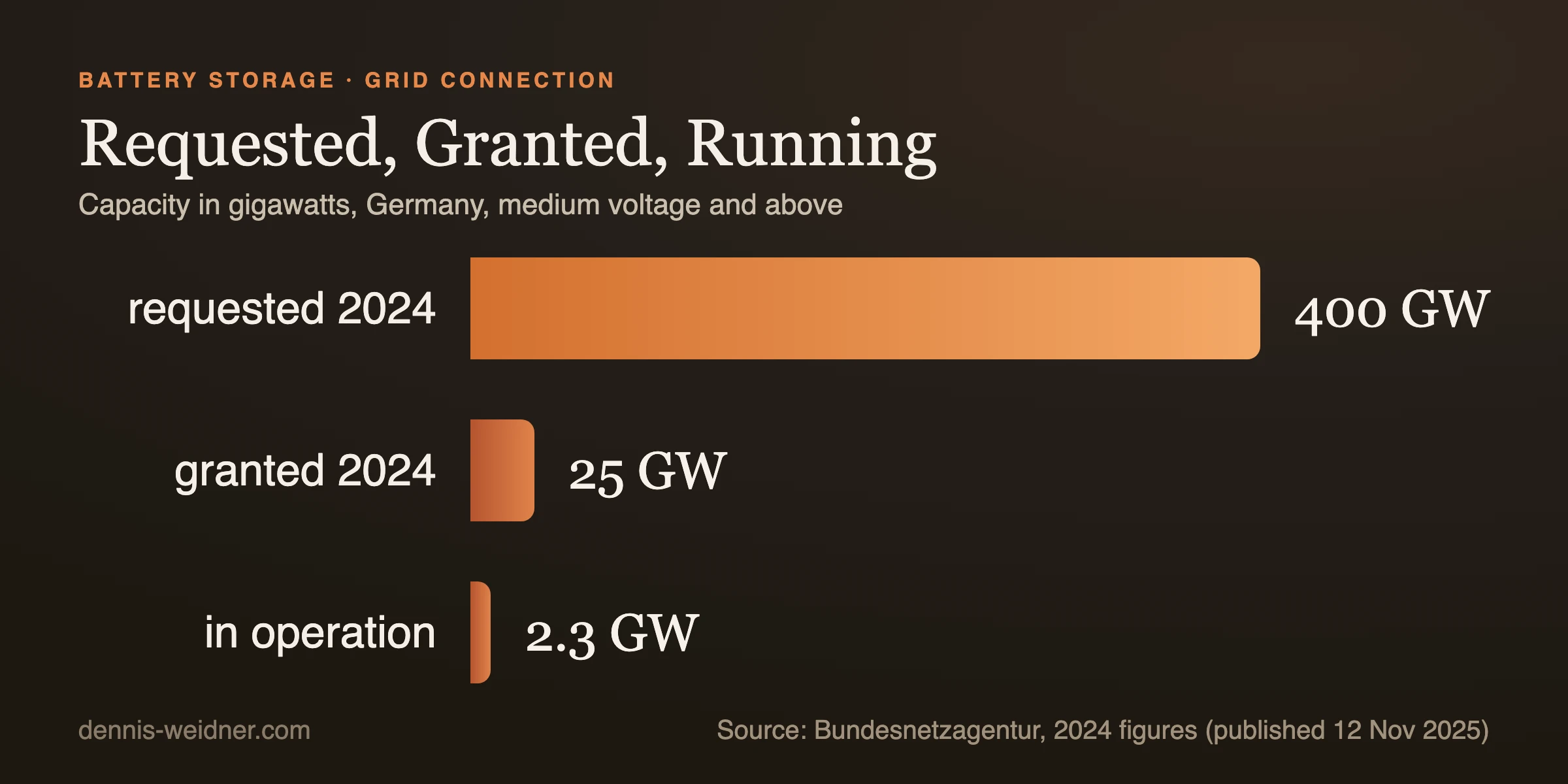
There is one number shaping every conversation in the German energy business right now, and almost nobody outside the industry has heard it. In 2024, German grid operators received 9,710 connection requests for battery storage, adding up to roughly 400 gigawatts. For context: Germany's entire annual peak load is about 80 gigawatts. Five times more storage capacity wants to plug in than the country consumes in its busiest hour. If you want to understand why storage projects are failing in 2026 even though the money is there, you have to understand this queue.
What is actually sitting in that queue
Germany's regulator, the Bundesnetzagentur, published these figures systematically for the first time in November 2025, and they are far blunter than any industry estimate had been. The data covers battery storage at medium voltage and above, so private home batteries are not included.
More on this topic: Battery Storage & Energy – background, practice and every article in one place.
Requested in 2024: 9,710 connection requests, roughly 400 gigawatts of capacity, roughly 661 gigawatt hours of storage.
Granted in 2024: roughly 3,800 connection commitments, roughly 25 gigawatts, roughly 46 gigawatt hours.
Actually in operation: 921 systems, roughly 2.3 gigawatts, roughly 3.2 gigawatt hours.
Those three lines tell the whole story. One sixteenth of the requested capacity survives to a commitment. One hundred and seventy-fourth of it survives into operation. And the regulator adds the decisive caveat itself: a connection commitment binds only the grid operator. It is no guarantee that anything ever gets built.
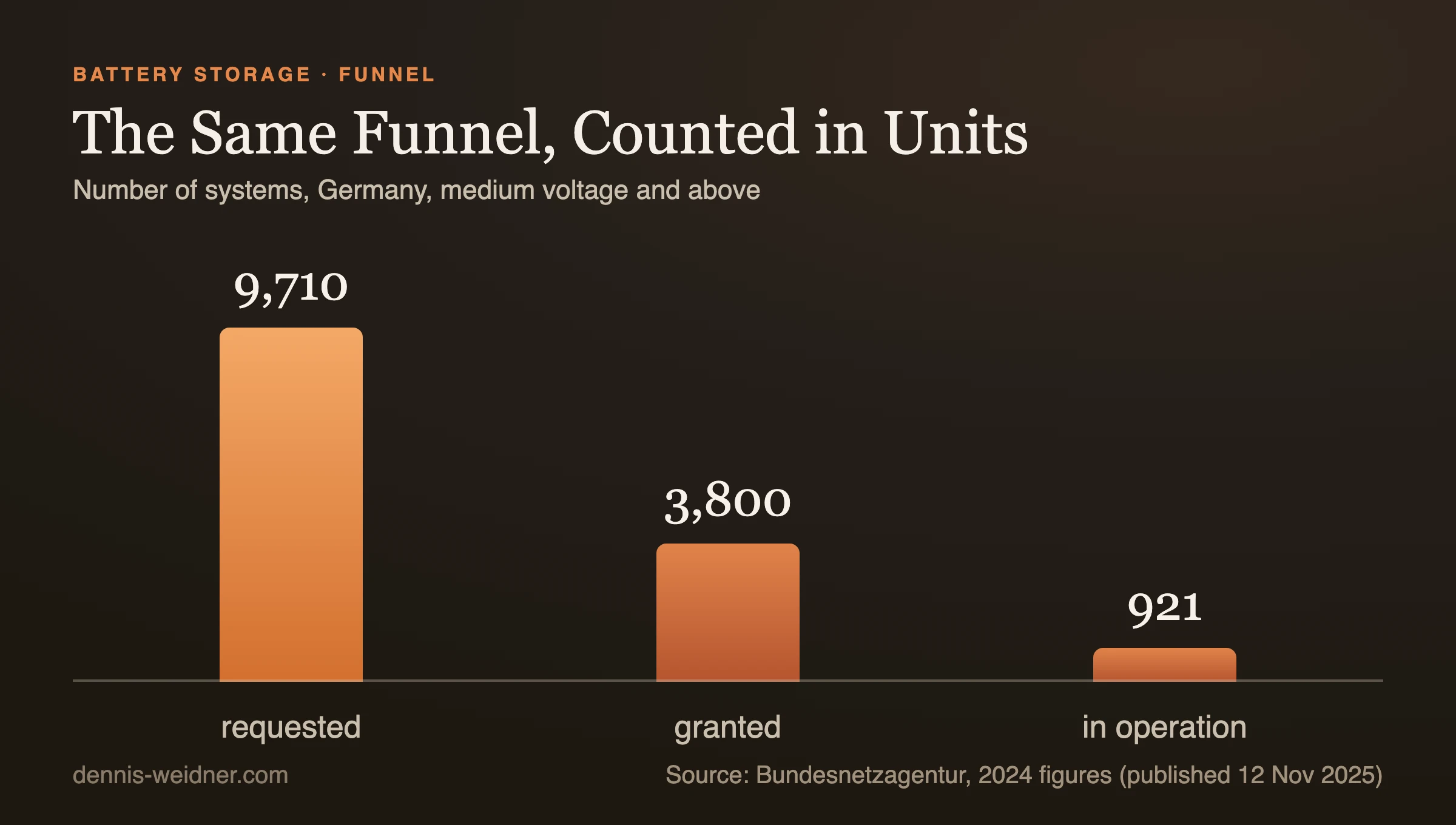
Counted in units it looks gentler at first: 39 percent of requests do get a commitment. But the gap between 39 percent of the requests and 6 percent of the capacity says exactly what every developer knows from practice. Small projects get their yes. The big ones, the applications carrying three-digit megawatt numbers, are the ones left waiting.
Power and energy are not the same thing
A short detour, because this is where most misunderstandings start. Gigawatts measure power, meaning how fast a battery can charge and discharge. Gigawatt hours measure energy, meaning how long it can keep going. You only have a project when you have both.
Run the regulator's numbers against each other: 661 gigawatt hours divided by 400 gigawatts gives about 1.65 hours. For the systems actually running, 3.2 divided by 2.3 gives about 1.4 hours. Germany is overwhelmingly building short, fast batteries. Those assets earn their money in balancing markets and in intraday trading, not by carrying summer sunshine into winter. If battery storage makes you think of seasonal storage, you are thinking of a different technology.
This is also why 400 gigawatts sounds enormous without meaning that Germany would be five times oversupplied. A battery with 1.65 hours of duration does not replace a power plant. It shaves peaks. Which is precisely why the question of which projects get built at which grid node matters more than the headline total.
Why 400 gigawatts is not a serious number
Now the uncomfortable part, and I say it as someone with projects in this pipeline. A large share of those requests was never a project. They were placeholders.
The reason is a design flaw in the old process. Grid connections were awarded first come, first served. Filing a request cost almost nothing, and withdrawing one cost nothing either. So the market did what any rational participant does in that situation: it took tickets, at as many substations as possible, for projects that did not yet exist. Whoever held a site and a grid connection point could sell the package on later without ever ordering an excavator.
Germany's utility association BDEW derived an even larger figure from a survey of transmission and distribution operators: around 720 gigawatts of requested connection capacity for large-scale storage in total. At the four transmission system operators alone, the end of the third quarter of 2025 saw 717 applications covering 270 gigawatts, of which 545 applications covering 211 gigawatts were for grid-scale batteries.
You can read those numbers as proof of a gigantic boom. What they actually show is that the application process had stopped filtering anything. And a process without a filter does not produce an order of priority, it produces noise. Grid operators end up assessing hundreds of requests that will never be built, tying up exactly the capacity the real projects need.
First come, first served died in April 2026
That is what this year's most important change addresses, and plenty of people missed it. On 1 April 2026, Germany's four transmission system operators launched what they call the maturity procedure, starting with an information and application phase. It applies to large grid customers: battery storage, but also data centres and electrolysers.
The shift is fundamental. Applications are no longer processed one by one in order of arrival. They are collected in fixed cycles and assessed together. When demand exceeds available capacity, the connection no longer goes to whoever was fastest, but to whichever project is most mature. Four criteria decide it:
First, site control and permitting status. No signed lease or purchase contract and no credible standing in the planning process means you drop to the back.
Second, the technical plant and connection concept. Not a letter of intent, actual engineering.
Third, the applicant's financial capability. Who is paying for this, and what evidence backs that up.
Fourth, the grid and system benefit of the project. What does this battery at this node do for the network.
In practice this inverts the order in which most projects used to be developed. The old logic was: secure the grid connection first, then sort out the site and the financing at leisure, because the connection was the bottleneck. Now the opposite holds. The site is the entry ticket, not the outcome. Anyone walking into an autumn 2026 cycle with a letter of intent and a map will watch projects overtake them that hold a signed 25-year lease and a building permit in the folder.
The case that genuinely rattled the industry
How serious this has become is clear from a decision dated 30 March 2026. Ruling chamber 6 of the Bundesnetzagentur rejected an application by BESS Germany 1 GmbH against the distribution grid operator E.ON Edis Netz. The operator had refused a connection for a large grey-power battery, and refused it even at reduced capacity, citing the risk of supply bottlenecks in its own network area. The regulator accepted that reasoning.
One detail is particularly uncomfortable for developers. The operator had not offered a flexible connection agreement, meaning a contract under which the battery can be curtailed when the grid is tight and gets connected in return. The regulator saw no fault in that, because such contracts may be offered but do not have to be. Lawyers have called it a free pass to reject connection requests with general assertions ever since.
The consequence for your business case is unambiguous. A grid connection is not a right you can enforce when things get tight. It is an outcome you earn, with a project that makes the operator's decision easy.
What this means for a real project
When I talk to someone about a storage project today, I sort the questions differently than I did two years ago. No longer: where do we source cells and what does the revenue case look like. Instead:
Is the site genuinely secured? A preliminary agreement is not site control. The maturity procedure counts a signed contract, registered against the land, with a term that matches the asset life. What is market standard here, and where these contracts fall apart, is covered in my piece on securing land for battery storage.
Does the size fit the connection point? The reflex to register as much capacity as possible was rational under first come, first served. Under the maturity procedure it backfires, because the grid benefit criterion rewards a well-fitted project and penalises an oversized one.
Is the revenue model properly evidenced? Financial capability gets assessed. If you have not worked through the revenue stack of balancing power, intraday and day-ahead, you cannot evidence it. How that stack actually breaks down is laid out in my piece on the revenue stack of a grid battery.
Is it settled whether you charge green, grey or mixed? That very question was part of the E.ON Edis case. It also carries heavy consequences for grid fees and taxes, and it is where the economics of a battery are decided today.
Where I land on this
I think the maturity procedure is right, even though it hurts in the short term. A market stacking up 400 gigawatts of requests while 2.3 gigawatts actually run does not have a demand problem, it has a seriousness problem. And a grid operator forced to assess hundreds of placeholders never gets around to connecting the real projects.
What does occupy me is something else. The new order rewards professionalism, which in practice means it rewards capital and administrative muscle. A small developer with a good site and a lean team finds it harder to secure land, drive permitting, build an engineering concept and evidence creditworthiness all at once than a corporate with a department for it. That is exactly where room for partnerships is opening up, and exactly what I am working on in my own projects. Why storage is the backbone of the energy transition in the first place is something I set out in my overview of battery storage and energy storage. The metering rules that apply alongside it are covered in my piece on Germany's new rules for battery storage and charging points.
The queue is not a queue any more. It has become an examination. Anyone who understood that early is developing differently from now on.
Frequently Asked Questions
How many battery storage projects are waiting for a grid connection in Germany?
For 2024 the Bundesnetzagentur counted 9,710 connection requests for battery storage at medium voltage and above, covering roughly 400 gigawatts of capacity and 661 gigawatt hours of energy. Around 3,800 requests received a commitment, together about 25 gigawatts. Only 921 systems with 2.3 gigawatts were actually in operation.
What is the maturity procedure?
Since 1 April 2026 it replaces first come, first served for awarding grid connections to large customers such as battery storage, data centres and electrolysers. Applications are collected in fixed cycles and assessed together. The deciding criteria are site control and permitting status, the technical concept, financial capability, and the grid and system benefit. Where capacity is short, the most mature projects win.
Can a grid operator simply refuse to connect a battery?
It can invoke the risk of supply bottlenecks. On 30 March 2026 the Bundesnetzagentur held a refusal by E.ON Edis Netz to be lawful even though the operator had not offered a flexible connection agreement. Such contracts may be offered but are not mandatory.
Why is the requested capacity so far above actual demand?
Because filing a request cost almost nothing under the old first come, first served regime. Developers took tickets at several grid connection points at once, often for projects that existed only on paper. The 400 gigawatts requested is roughly five times Germany's annual peak load of about 80 gigawatts.
Best,
Dennis Weidner
Note: AI tools supported me in writing this article, and some images were edited with AI. I stand behind its content and every statement with my name.