Since the start of 2025, every electricity supplier in Germany has been required to offer a dynamic tariff. It sounds like a small legal footnote, but it is a real turning point. For the first time, an ordinary household can plug straight into the wholesale price of power, hourly and transparent. The interesting question is not whether you are allowed to, but whether it actually pays off for you. That comes down to whether you can shift your consumption.
What the mandatory offer really means
The legal basis sits in Section 41a of the German Energy Act (EnWG). Until the end of 2024, only large suppliers with at least 100,000 customers had to keep a dynamic tariff on the shelf. Since 1 January 2025, the obligation applies to every supplier. You now have a right to such a tariff everywhere, no matter how small your local utility is.
More on this topic: Battery Storage & Energy, with background, practice and every article in one place.
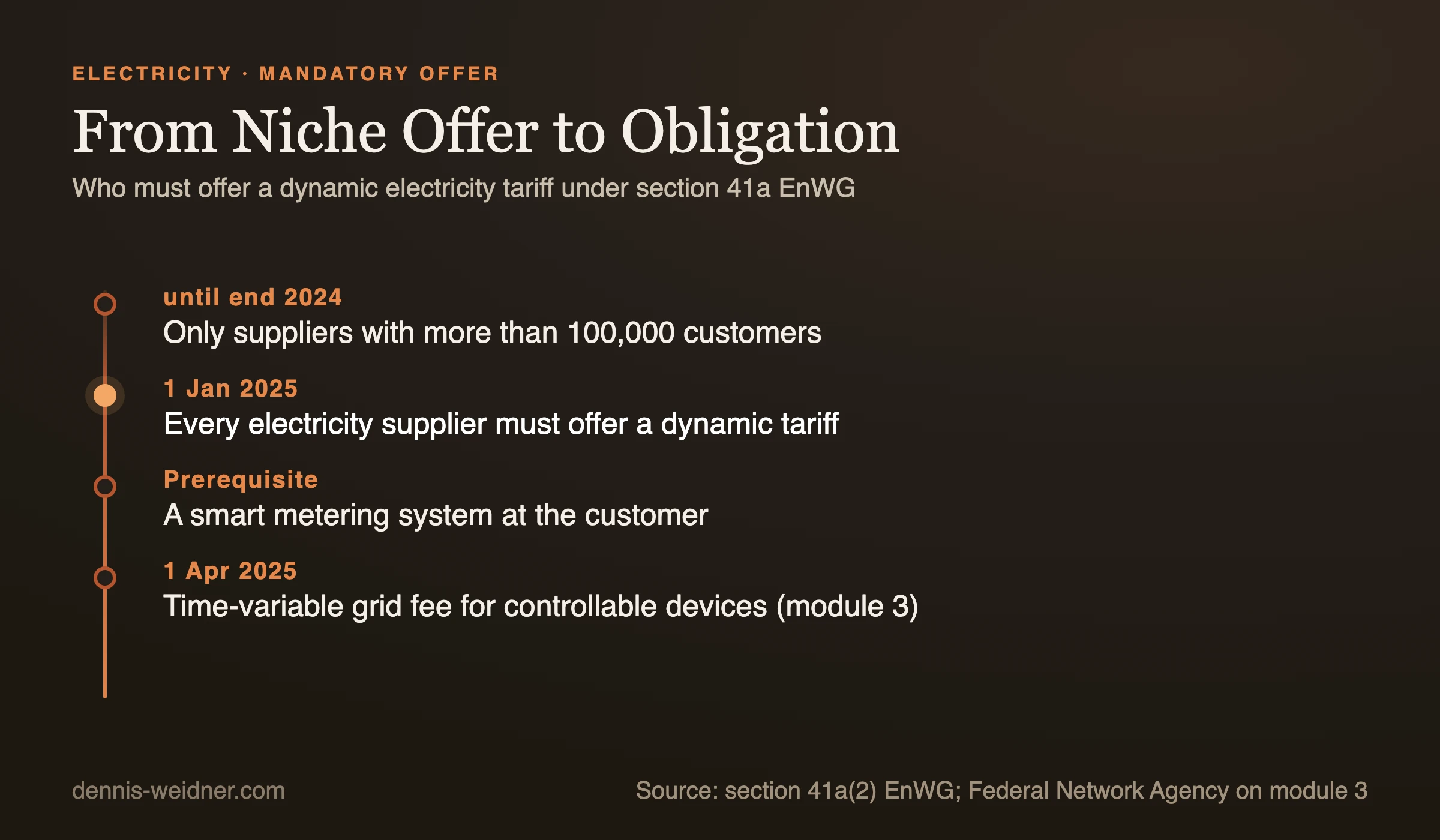
There is one condition, though. You need a smart meter that records your consumption hour by hour. Without that measurement a dynamic tariff cannot work, because the price changes several times a day. Germany's Federal Network Agency explains the principle plainly: the energy price follows the wholesale market and moves with supply and demand. In rare cases it can even turn negative.
Why the price moves at all
Electricity is a good that has to be consumed more or less the moment it is produced. When the sun is out and the wind is blowing at midday, the grid is full of cheap power and the price drops. On a dark winter evening, when everyone cooks, heats and charges at once, it gets expensive. A dynamic tariff passes this rise and fall straight through to you, instead of hiding it under one fixed price per kilowatt-hour.
This is exactly the logic I work with when I look at energy storage. A battery earns its money by charging in cheap hours and discharging in expensive ones. Anyone on a dynamic tariff becomes the same kind of market participant on a small scale. I wrote more about why storage is the key to the energy transition in my piece on BESS and energy storage.
Who genuinely benefits
The value of a dynamic tariff hangs on a single question: can you shift your consumption into the cheap hours? Those who can, win. Those who cannot are taking on risk without a real reward.
The textbook case is a family with a heat pump and an electric car. An EV quickly pulls several thousand kilowatt-hours a year, and it makes no difference whether it charges at two in the morning or seven in the evening. That large, time-flexible load is worth gold. You set the wallbox to the cheapest hours, let the heat pump pre-heat during the day, and suddenly a meaningful share of your annual consumption lands in the low-price windows. The Federal Network Agency confirms that since April 2025, dynamic tariffs have on average even been cheaper than classic fixed-price ones.
The opposite pole is the single person in a two-room flat using 1,400 kilowatt-hours a year. Fridge, laptop, a bit of light. There is almost nothing to shift, and consumption happens when life happens, usually in the expensive evening peak. For a household like that the savings potential is small, yet the price risk is carried all the same.
When a dynamic tariff costs you more
This is exactly where the marketing tends to fudge things. Promises of huge savings really only hold for the flexible family, not for the average home. The German consumer association does the math soberly: anyone who cannot shift their load not only saves little but may end up paying more. In unfavorable scenarios, additional costs of up to 20 percent are possible.
And there is a hidden cost driver. On top of the raw wholesale price, providers often add a fixed surcharge per kilowatt-hour and a monthly base fee. That surcharge is the real difference between two dynamic tariffs. Anyone who only looks at the pretty market curve and ignores the surcharge is comparing apples to oranges.
What I would advise
First check whether you have a smart meter, or can get one. Then be honest with yourself: do you really have large, shiftable loads such as an EV, a heat pump or a home battery? If yes, a dynamic tariff is one of the few ways in which a private household actually earns money rather than merely saving it. If no, stay relaxed on a good fixed-price tariff and wait until you truly have the flexibility.
What fascinates me about this shift is the view ahead. Millions of small, flexible consumers reacting to price signals are, in the end, nothing other than one enormous distributed storage system. This is precisely where power trading meets artificial intelligence, because no human re-tunes the wallbox every hour, but an algorithm can. I described why that is the real revolution in energy trading meets AI.
Frequently Asked Questions
Is a dynamic electricity tariff mandatory?
Not for you as a consumer. Since 1 January 2025, the only obligation is that every supplier must offer such a tariff (Section 41a EnWG). Whether you choose it remains your decision.
What do I need for a dynamic tariff?
A smart meter that records your consumption hour by hour. Without that measurement the hourly wholesale price cannot be billed.
Who does a dynamic tariff not suit?
Households with low consumption and no shiftable loads, such as a single person without an EV or heat pump. The savings potential is small, but the price risk is carried all the same.
Can a dynamic tariff be more expensive than a fixed price?
Yes. Anyone who does not shift consumption into cheap hours can, according to the consumer association, pay up to 20 percent more in unfavorable cases. The fixed surcharge per kilowatt-hour is the most important point of comparison.
Warm regards,
Dennis Weidner
Note: AI tools supported me in writing this article, and some images were edited with AI. I stand behind its content and every statement with my name.