When someone pitches me a storage project, the revenue slide always shows up eventually. Balancing power, arbitrage, a nice bar for each year. What is almost always missing is the one decision that shapes the outcome far more than any trading strategy: what actually goes into the battery? Grey power off the grid, green power from a directly coupled generator, or a mix of both? Grid fees, electricity tax and, in the worst case, the subsidy status of the plant next door all hang on that question. Germany answered it twice over at the turn of 2025 to 2026, and one of those answers comes with an expiry date.
The three operating modes in one paragraph
A grey-power battery sits on the public grid and buys whatever is cheap. It does not care where the electricity came from, only what it costs. A green-power battery is coupled directly to a generator, usually solar or wind, and primarily absorbs that plant's output. A mixed battery does both, and that has become the normal case, because no operator voluntarily gives up cheap grid hours just because the sun is not shining.
More on this topic: Battery Storage & Energy – background, practice and every article in one place.
For tax and regulatory purposes these were three separate worlds for a long time, with rules that occasionally contradicted each other. Mixed operation was the most awkward of the three, because it fitted none of the boxes and authorities tended to pick the reading that cost the operator most.
What changed on 1 January 2026
Germany's Third Act amending the Energy Tax and Electricity Tax Acts took effect at the turn of the year, and for storage projects it is the most meaningful relief in years. Three points that belong together:
Batteries now count as part of the supply grid on a technology-neutral basis, provided they are registered in the market master data register. Previously the classification hung on wording written at a time when a storage plant meant a pumped hydro station.
Double taxation across the charge and discharge cycle is gone. Electricity drawn for storage and later fed back in is no longer taxed twice. That sounds obvious. It was not, for years, and it made real projects unviable.
For pure storage operation, the supplier permit from the customs office is no longer required. One piece of bureaucracy less, and a noticeable one in the economics of smaller projects.
The sentence that matters for mixed operation sits in section 5 (4) of the Electricity Tax Act: tax exemption survives intermediate storage on a pro rata basis, in the ratio of tax-exempt electricity charged to total electricity charged over the assessment year. For the first time the mixed battery is properly calculated rather than merely tolerated. Charge 60 percent tax-exempt green power, and 60 percent of the exemption travels through the battery with it. You still have to do the arithmetic, across the full year rather than per cycle. And without robust metering there is no share you can evidence. The metering rules that apply here are covered in my piece on Germany's new rules for battery storage and charging points.
The register entry everything hangs on
One detail of this reform deserves more attention than it gets. Technology-neutral classification as part of the supply grid does not apply automatically to every battery, only to plants listed in the market master data register. The register entry is no longer a formality to be caught up on later, it is the condition the tax treatment rests on.
That sounds banal, and in practice it is not. Register entries tend to be made late, often shortly before or after commissioning, and they carry details about plant type, capacity and operating mode that are hard to correct afterwards. Put something wrong or imprecise in there and you end up arguing with the customs office about a statement you made yourself. I would treat the entry like a contract document and have it reviewed before commissioning by whoever will be responsible for the tax return, not after.
The same goes for the metering structure. Run a mixed battery and want to claim the tax-exempt share, and you need metering that separates the sources of supply. You build that structure at connection, not retrospectively.
The grid fee exemption and its cliff
The second big relief is the grid fee exemption under section 118 (6) of the Energy Industry Act. The logic is sound: a battery is not an end consumer, it hands the electricity back. So it should not pay grid fees on the power it draws to charge, provided the recovered energy is fed back into the same grid with a time delay.
The exemption runs for 20 years from commissioning. And here is the part many business cases underestimate: it applies only to storage commissioned between 4 August 2011 and 3 August 2029.
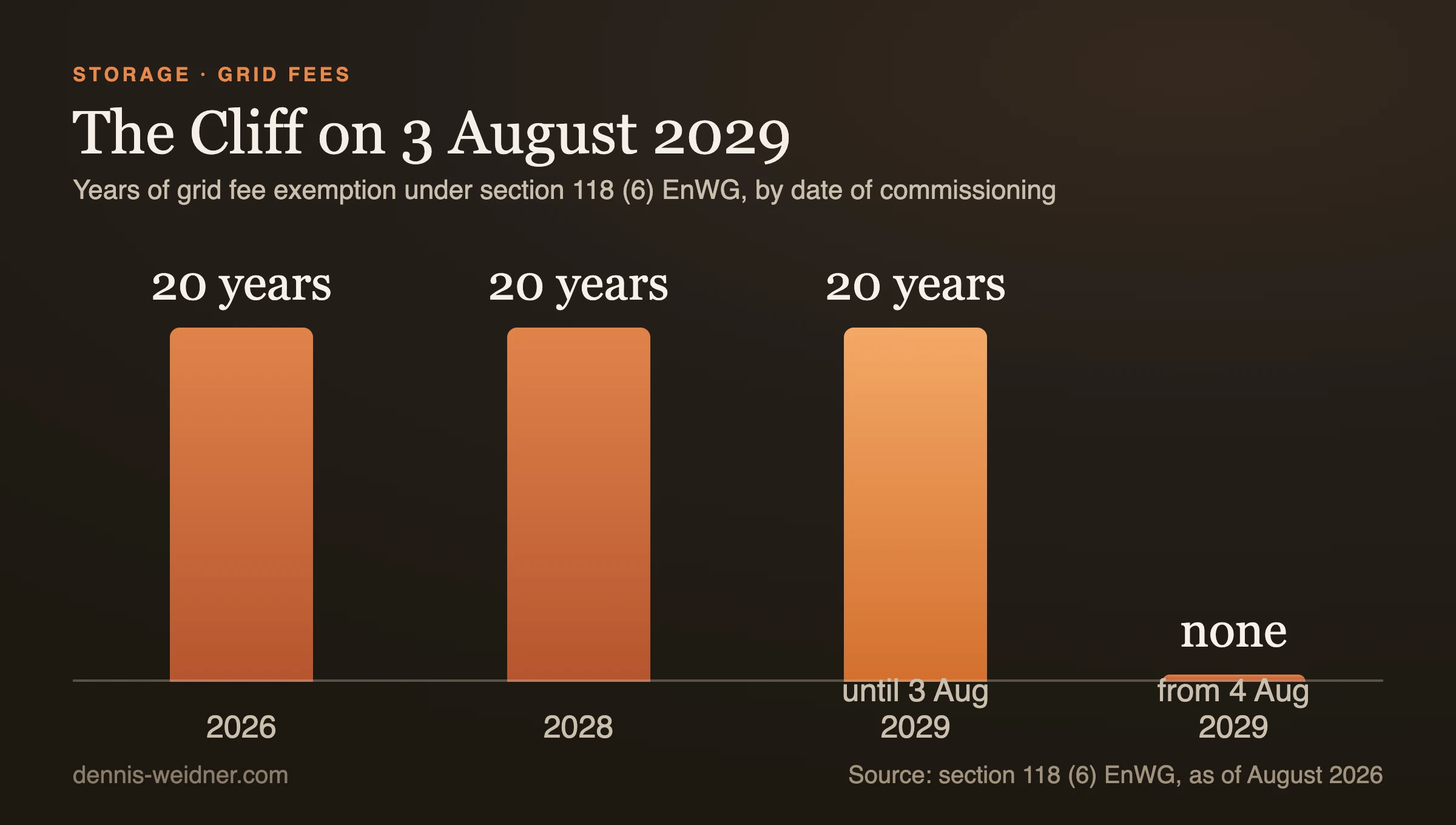
This is not a ramp that tapers off, it is an edge. Commission on 3 August 2029 and you get the full 20 years. Finish a day later and, as the law stands, you get nothing. For a project that comfortably takes three to four years from site control to commissioning, that means anyone not starting in 2026 is already planning against this deadline.
The exemption is legally contested. Specialist lawyers consider it vulnerable under European law, and the legislator expressly reserved the right, in that same provision, to reorganise its temporal scope. Anyone resting a business case on those 20 years alone is building on an assumption, not a commitment. As additional yield it is excellent. As a load-bearing pillar it is risky.
Since the amendment to the Energy Industry Act of 18 December 2025, in force since 23 December, section 21 of the Energy Financing Act also applies to this exemption. That finally brings multi-use operation and bidirectional charging via charging points into clear rules for grid fees instead of leaving them in a grey zone.
Why green is not automatically the better choice
Now the point where I see most projects stumble. Coupling the battery straight to your own solar plant sounds obvious. Green electricity, short distances, good story. But then a principle kicks in that many people only meet once it hurts: the double marketing prohibition in section 80 of the Renewable Energy Act.
The core of it is simple. Renewable electricity may not be sold more than once. If you receive an EEG payment for your power, you may not pass on guarantees of origin for that same kilowatt hour. You take the subsidy, or you market the green attribute. Not both.
For a coupled battery this means the question of whether the generating plant stays inside EEG support or moves to open direct marketing partly determines what the battery is even allowed to earn. An operator who wants to use the battery as a green selling point can inadvertently touch the subsidy status of the plant it is attached to. That is the kind of thing a project fails an audit on later.
The pure grey-power battery, conversely, has a revenue profile that surprises people. Grid fee exemption, input tax deduction and electricity tax exemption combined add up, according to practitioners, to more than 20 cents per kilowatt hour in relief. That is why so many pure grid batteries are being planned in Germany rather than predominantly coupled green projects. The financial incentive currently points towards grey power, which is a side effect worth arguing about in energy policy terms.
What this means for a project decision
I now sort this into four questions, in this order:
First: is commissioning safely before 3 August 2029? If not, the case has to work without the grid fee exemption. If yes, build a buffer into the schedule, because nobody renegotiates this deadline.
Second: does the coupled generating plant stay in EEG support? If it does, the green attribute of that electricity is already spoken for, and the battery should not be marketed on it.
Third: is metering built so the tax-exempt share can be evidenced? Pro rata survival of the exemption is a calculation, not a claim. Without a clean meter structure the share defaults to zero.
Fourth: does the grid connection tolerate the intended operating mode at all? Since this year that is no longer a formality. In the case I described in my piece on Germany's battery storage queue, a grid operator refused a connection to precisely one large grey-power battery, and the regulator upheld it.
Where I land on this
The rules got markedly better in 2026, and I say that as someone who spent years watching storage projects die on tax questions nobody could have anticipated. Double taxation is gone, mixed operation is calculated rather than tolerated, the customs paperwork has shrunk. Those are real gains.
What bothers me is the imbalance that came with them. The strongest financial incentive currently sits with the grey-power battery, meaning the operating mode with the least to do with building out renewables. A directly coupled green battery that shifts a solar plant out of unprofitable midday hours into valuable evening hours does more for the system, and gets no better treatment for it. If anything the double marketing prohibition narrows its options. It is fair to ask whether that was the intention.
For your own planning that still means: model both variants, and run the grey case once without the 2029 bonus. If it still stands, you have a project. If it does not, you have a bet on a deadline. Why storage is the backbone of the energy transition in the first place is something I set out in my overview of battery storage and energy storage.
Frequently Asked Questions
What is the difference between a grey-power and a green-power battery?
A grey-power battery draws from the public grid and optimises on price regardless of origin. A green-power battery is coupled directly to a generator such as solar or wind and primarily absorbs that plant's output. A mixed battery combines both and has become the normal case.
How long does the grid fee exemption for batteries last?
Under section 118 (6) EnWG, batteries commissioned between 4 August 2011 and 3 August 2029 are exempt, and the exemption then runs for 20 years from commissioning. Anything commissioned later falls out entirely as the law currently stands.
What changed for electricity tax on storage in 2026?
Since 1 January 2026 batteries count as part of the supply grid on a technology-neutral basis, provided they are listed in the market master data register. Double taxation across the charge and discharge cycle is excluded by statute, tax exemption survives intermediate storage pro rata, and the supplier permit from the customs office is no longer needed for pure storage operation.
What is the double marketing prohibition?
Section 80 of the Renewable Energy Act prohibits selling renewable electricity more than once. Anyone receiving an EEG payment for their power may not pass on guarantees of origin for the same volume. For coupled batteries that means either the plant stays in support, or the green attribute gets marketed, not both.
Best,
Dennis Weidner
Note: AI tools supported me in writing this article, and some images were edited with AI. I stand behind its content and every statement with my name.