Both happened within eight days in July: on 21 July Germany rewrote its heating subsidy, and on 29 July the Building Modernisation Act came into force and abolished the 65 percent renewable heating mandate. Anyone concluding that the heat pump market is about to collapse has not seen the sales figures for the same half year. They are 40 percent above last year.
Two pieces of news in one week
The first concerns regulation. The Building Energy Act has been replaced: parliament and the upper house passed the Building Modernisation Act in mid-July, it was published in the Federal Law Gazette on 28 July and has been in force since 29 July 2026. The requirement that every new heating system run on at least 65 percent renewable energy is gone. In its place comes a staircase for new gas and oil systems: from 2029 ten percent biogenic fuel, 2030 fifteen, 2035 thirty, 2040 sixty percent. The documents are on the official government portal.
More on this topic: Battery Storage & Energy – background, practice and every article in one place.
The second concerns the money. On 21 July 2026 the federal government restructured its building efficiency programme. The grant was not cut, it was redistributed: upwards for low income households, downwards for everyone else, and given an expiry date.
Together this creates an unusual situation. The state no longer says what has to be installed, but keeps paying for one particular choice. That is the moment subsidy policy takes over from regulation, and for anyone working in this market it is better news than a mandate. Mandates create resistance. Money creates demand.
What has actually applied since 21 July
The rates in detail, all from the KfW product page for heating subsidy 458:
Base grant 30 percent for every eligible heat generator, unchanged.
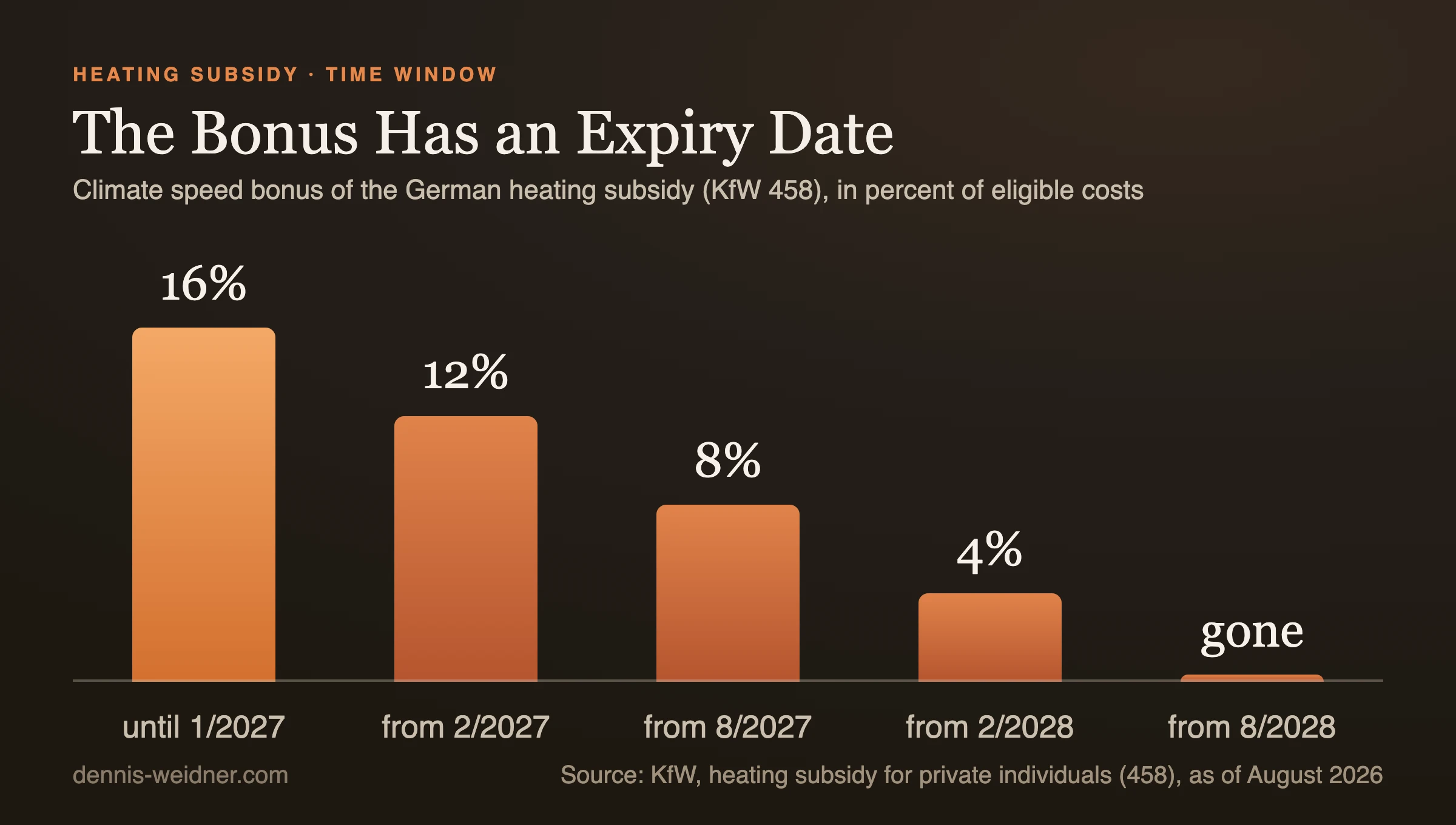
Climate speed bonus 16 percent instead of the previous 20, for replacing an old heating system. It applies until 31 January 2027 and then falls by four percentage points every six months until it disappears on 1 August 2028.
Income bonus newly tiered: 40 percent up to 30,000 euros of taxable household income, 30 percent up to 40,000, 10 percent up to 50,000, nothing above. New is a family allowance that deducts 10,000 euros from countable income where minor children live in the household, lifting families into the next bracket.
Efficiency bonus 5 percent for natural refrigerants.
Maximum rate 80 percent, reachable only with the income bonus. Without it the ceiling stays at 70 percent.
Eligible costs capped at 28,000 euros for the first residential unit instead of 30,000, 15,000 each for units two to six and 8,000 from the seventh. This amount also falls by 750 euros every six months from 1 February 2027.
For a single family home that works out at a maximum grant of 22,400 euros. More than before if the income is low, and less than before if it is not.
The market did not wait for the mandate
You can rarely read the effect of German subsidy policy as cleanly as in this curve.
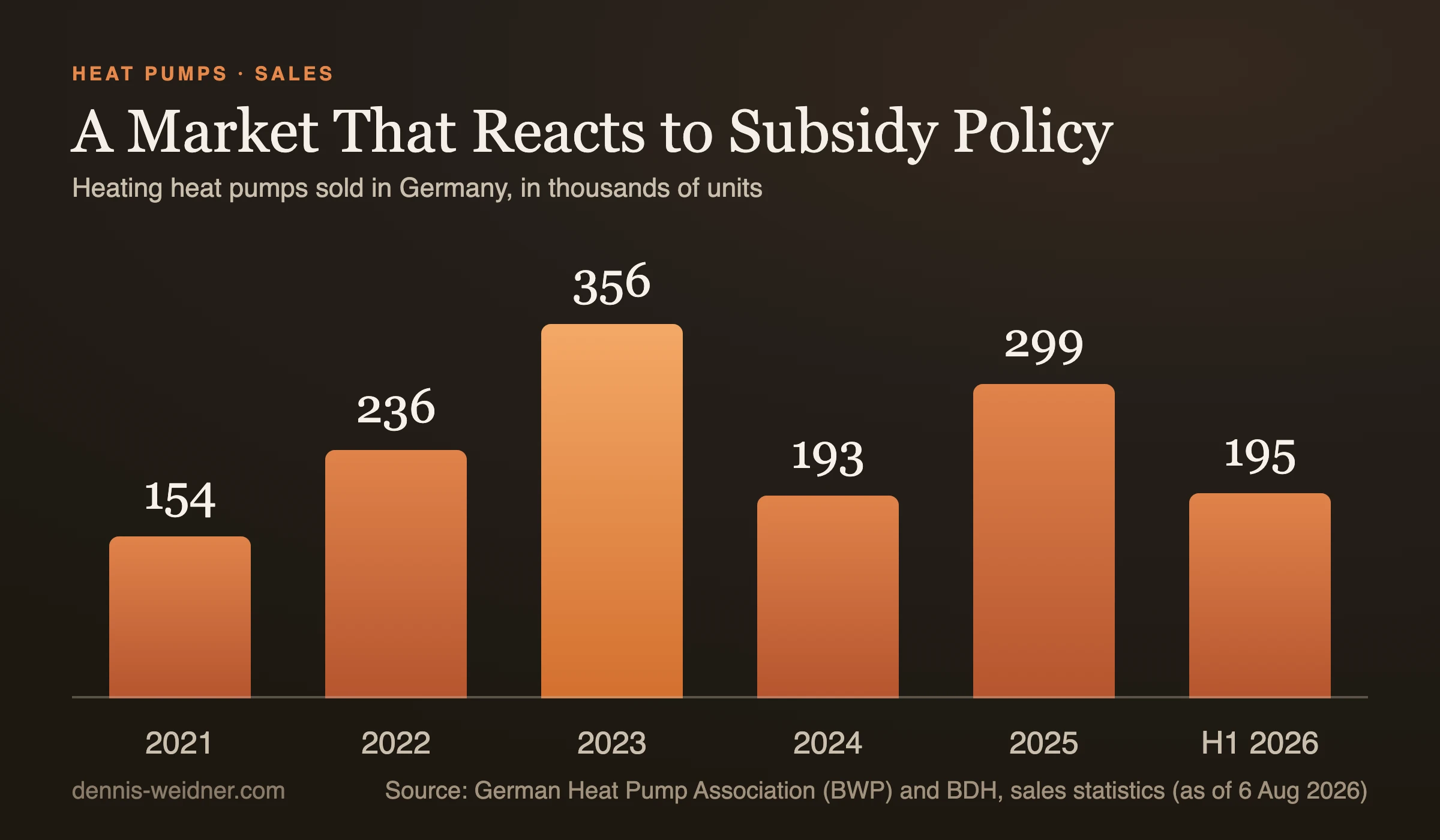
In 2023, 356,000 heating heat pumps were sold, a record. In 2024 the figure was 193,000, down 46 percent. Between the two lay no technical development, only a public argument about a law. In 2025 the market recovered to 299,000 units.
And 2026 delivers the actual finding: in the first half year, according to the joint statistics of the German Heat Pump Association and the heating industry association BDH, 195,000 units were sold, 40 percent more than a year earlier. It is the second strongest half year ever, with only the first half of 2023 slightly ahead at 196,500. According to the BDH half-year release, heat pumps made up exactly 194,500 of 352,000 heat generators sold, more than half the market and far ahead of gas-based units at 134,000. What is new is the size of the lead, not the top spot: heat pumps already outsold gas boilers in 2025, by 139,500 to 132,500 in the first half and by 299,000 to 276,500 over the full year.
That is the number that matters. The lead widens in the very half year in which the mandate falls. Not because of the mandate, but because subsidy and running costs now speak for themselves.
Who earns from this subsidy
Installers, as a bottleneck. Someone has to fit 195,000 units in six months. The constraint in the German heating market has for years not been equipment availability but the number of people who can get a heat pump properly into an existing building. Anyone with that capacity does not need to advertise it.
Energy consultants. The grant requires a confirmation of application issued by a registered expert. That is legally manufactured demand for a profession whose numbers cannot be scaled at will.
Manufacturers using natural refrigerants. The five percent efficiency bonus is the smaller part of the story. The bigger part sits in the technical requirements of the funding scheme: from 1 January 2028 only heat pumps with natural refrigerants will be eligible. A manufacturer without a propane unit by then loses not margin but market access.
Financiers and contracting models. A 30 percent grant leaves 70 percent open. Heat as a service, meaning installation and operation against a monthly fee, becomes interesting exactly when the grant falls and the investment does not.
Everything that runs the system intelligently. A heat pump is the largest controllable load in a house. Together with solar power and a dynamic electricity tariff, the controller decides a substantial share of the running cost. What is left of solar support and how it fits in is in Solar Subsidies: What Is Left in 2026.
I am building a comparison platform for the entire energy world, from heat pumps through solar and storage to split systems and the circular economy. Every figure there carries its source and every subsidy claim its reference in the actual guideline, and the research behind this article is part of it.
How to get in
The obvious route, selling heat pumps yourself, is the most crowded. The interesting places are where the process breaks.
The first is sequence. The grant requires the supply or service contract to be in place before the application is filed, and the expert confirmation to exist. Reverse the order and the claim is lost. It is the most common reason for rejection, and it is a pure process problem, not a technical one.
The second is the calculation itself. Hardly any quote shows what is actually payable after grant, income bonus and family allowance, or how that changes over the next eighteen months as the bonus steps down. That calculation is the real sales document.
The third is the existing building. Between a heat pump in new construction and one in a house from 1978 lie a heat load calculation, a hydraulic balance and often a new radiator in the bathroom. Master that part and you do not compete on price.
Heat pumps in 2027: why 31 January matters
A mandate creates resistance, a deadline creates appointments. The 65 percent rule produced three years of headlines and defiance, but the market only grew once the numbers worked. Now that the mandate is gone and the subsidy carries a visible countdown, demand will become steadier, not weaker.
Anyone planning to replace a heating system in 2027 should remember 31 January. After that the same unit costs four percentage points more, and six months later eight.
Frequently Asked Questions
How high is the German heat pump subsidy in 2026?
Since 21 July 2026: 30 percent base grant, 16 percent climate speed bonus, up to 40 percent income bonus and 5 percent efficiency bonus. The ceiling is 80 percent, reachable only with the income bonus, otherwise 70 percent. Eligible costs run to 28,000 euros for the first residential unit, so a maximum grant of 22,400 euros.
When does the heating subsidy fall?
The climate speed bonus stands at 16 percent until 31 January 2027 and then falls by four percentage points every six months until it disappears on 1 August 2028. Eligible maximum costs fall by 750 euros every six months from 1 February 2027.
Does the 65 percent renewable rule still apply?
No. The Building Modernisation Act has been in force since 29 July 2026 and removed the requirement. In exchange, new gas and oil heating systems must use a rising share of biogenic fuels from 2029, starting at ten percent.
Will only certain heat pumps be funded from 2028?
Yes. Under the technical minimum requirements of the German building efficiency scheme, only heat pumps with natural refrigerants, such as propane, will be eligible from 1 January 2028.
What is the most common reason for rejection?
The wrong sequence. The supply or service contract and the confirmation of application from a registered energy efficiency expert must exist before the application is submitted to KfW. Commissioning the work first and applying afterwards forfeits the claim.
Warm regards,
Dennis Weidner
Note: AI tools supported me in writing this article, and some images were edited with AI. I stand behind its content and every statement with my name.