Since 1 June 2026, households, associations and small businesses in Germany may share solar power with their neighbours over the public grid, under Section 42c of the Energy Industry Act (EnWG). Grid fees, levies and the concession fee still apply in full to every shared kilowatt hour. My worked example with a club's 30 kWp system and ten households yields a saving of about 3.8 euro cents per shared kilowatt hour, or just over 32 euros a year per household. The winner is the system operator, not the neighbour.
As of 25 September 2026. Not legal or tax advice, see the note at the end.
More on this topic: Battery Storage & Energy, with background, practice and every article in one place.
What Is Energy Sharing Under Section 42c EnWG?
Energy sharing is the joint use of electricity from a renewable plant by several final consumers, with the power flowing through the public distribution grid. A sports club with solar panels on its clubhouse can supply households in the neighbourhood, and the neighbours pay the club an agreed price per kilowatt hour.
The legal basis is Section 42c of the German Energy Industry Act, introduced by the consumer protection amendment of 18 December 2025 (Federal Law Gazette 2025 I No. 347). Two contracts are mandatory: a supply contract and a sharing contract. Under subsection 3, the sharing contract must set out the scope of use, an allocation key and the price in cents per kilowatt hour. The price may also be zero.
When Did Energy Sharing Start, and How Did the Regulator Implement It?
Energy sharing comes in two stages. Under Section 42c(4) EnWG, distribution system operators must enable sharing within their own balancing area from 1 June 2026, and from 1 June 2028 also with a directly adjacent balancing area in the same control zone.
How this works technically was settled on 7 July 2026 in Communication No. 73 of the Federal Network Agency's Ruling Chamber 6. Processing runs through the so-called service provider model: a supplier or direct marketer handles balancing, the sharing deliveries and, if the customer wants, the residual supply. Because this route exists, the agency sees no further implementation duties for grid operators. Suppliers, however, are not obliged to offer the service. Anyone who wants to start energy sharing first needs a partner willing to take part.
Who Can Take Part in Energy Sharing?
The operator may be a natural person, a partnership or a private-law entity such as a registered association (eingetragener Verein) or a cooperative. All members must themselves be final consumers or public bodies, and the plant must not be run mainly for commercial purposes. Companies only qualify as participants if they are micro, small or medium-sized enterprises under EU Recommendation 2003/361/EC (Section 42c(2)). Energy sharing is therefore a model for citizens, clubs, municipalities and mid-sized firms, not for corporations.
The operator does not have to guarantee full supply (subsection 6). The operator must, however, warn customers beforehand in text form that the residual power may cost more. The standard supplier duties, meaning registration with the Federal Network Agency under Section 5 and the contract and billing rules of Sections 40 to 42, only fall away under subsection 7 if a household customer runs a plant of up to 30 kilowatts, or residents of a multi-unit building run one of up to 100 kilowatts. Whether an association counts as a household customer is not clear-cut. As a club, I would plan with the full duties and hand them to the service provider, which subsection 5 expressly allows.
What Metering Does Energy Sharing Require?
Energy sharing only works with quarter-hourly metering at the plant and at every household supplied. Section 42c(1) nos. 6 and 7 require either a metered load profile or registering power measurement. The Federal Network Agency's consumer page on energy sharing is blunt about it: in practice, this usually means a smart metering system.
For a household using 3,500 kilowatt hours a year, such a meter is an optional installation. Under Section 30(3) of the Metering Point Operation Act (MsbG), the default metering operator may charge the customer no more than 30 euros a year. Anyone who has it installed early on request pays, under Section 35, up to 100 euros once plus up to 30 euros a year on top, so up to 60 euros a year in total. For a plant between 25 and 100 kilowatts, the cap for the operator is 140 euros a year. How to get one installed is covered in my piece on Germany's smart meter rollout.
Grid Fees, Levies, Power Tax: What Energy Sharing Leaves in Place
Energy sharing brings no discount on grid fees or levies. The Federal Network Agency puts it plainly: the usual grid fees and levies apply to the entire power drawn from the grid, the shared share as well as the residual one. The law also contains no special rule for the concession fee. The only item replaced is procurement and sales, the energy price a utility would otherwise charge.
How small that lever is can be seen in the electricity price analysis of the German Association of Energy and Water Industries (BDEW) from August 2026. Of an average 37.0 cents per kilowatt hour, 15.17 cents go to procurement and sales. The rest is grid fees, taxes, levies and charges.
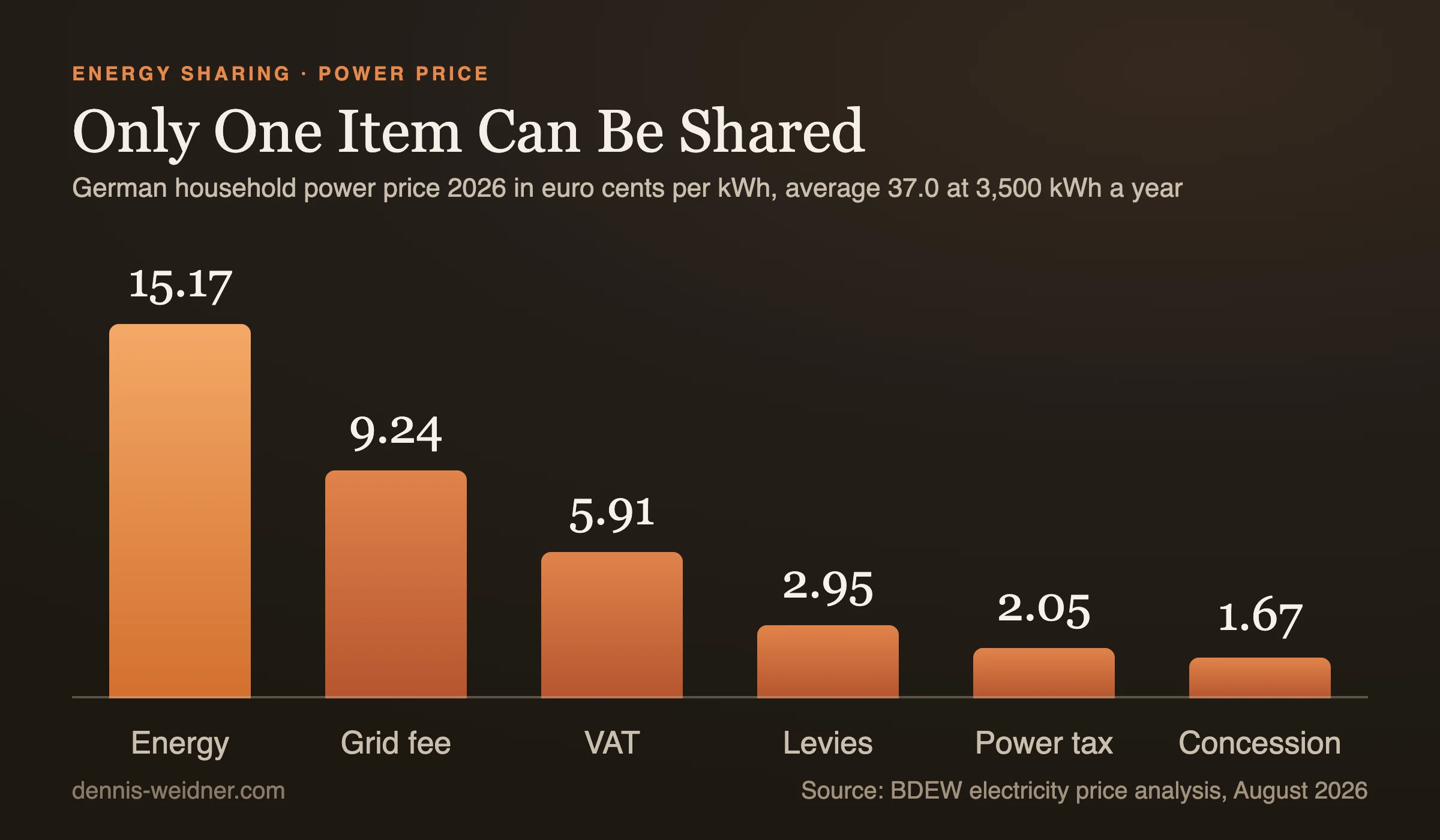
One exception is possible: the power tax (Stromsteuer) of 2.05 cents. Under Section 9(1) no. 3(b) of the Electricity Tax Act, solar power from plants of up to 2 megawatts is exempt if the operator supplies it to final consumers nearby, which Section 12b of the implementing ordinance defines as a radius of up to 4.5 kilometres. The operator needs a permit from the local main customs office. And Section 12b(2) only grants the exemption if no further parties are involved in the supply. That is exactly what is doubtful in the service provider model with an intermediary supplier.
For the operator, the subsidy changes too. The Federal Network Agency's FAQ on solar systems rule out the fixed feed-in tariff under the Renewable Energy Sources Act (EEG) for sharing plants. The plant must move into direct marketing, while the market premium still applies to all power fed into the grid, the shared part included.
Worked Example of Energy Sharing: A Club Shares 30 kWp With Ten Households
A club runs a 30 kWp system on the roof of its clubhouse, commissioned in autumn 2026, and shares the power with ten households using 3,500 kilowatt hours each. Assumptions: the club charges 12 cents net per kilowatt hour, the system produces 950 kilowatt hours per kilowatt a year (the reference value in Fraunhofer ISE's "Recent Facts about Photovoltaics in Germany"), and 30 percent of that meets household demand in the same quarter hour. All other price components come from the BDEW analysis.
| Euro cents per kilowatt hour | Grid power | Shared, with power tax | Shared, tax exempt |
|---|---|---|---|
| Energy (utility or club) | 15.17 | 12.00 | 12.00 |
| Grid fee | 9.24 | 9.24 | 9.24 |
| Concession fee | 1.67 | 1.67 | 1.67 |
| Levies (offshore grid, Section 19 StromNEV, CHP) | 2.95 | 2.95 | 2.95 |
| Power tax | 2.05 | 2.05 | 0.00 |
| VAT 19% | 5.91 | 5.30 | 4.91 |
| Price paid by the household | 36.99 | 33.21 | 30.77 |
| Saving per shared kilowatt hour | n/a | 3.78 | 6.22 |
| Saving per household and year (855 kWh shared) | n/a | €32.32 | €53.18 |
The system produces 28,500 kilowatt hours, of which 8,550 are shared, or 855 per household. Even with the power tax exemption, just over 53 euros a year remain, and up to 30 euros of that go to the smart meter if the household does not have one yet and the metering operator installs it on its own initiative. If the household has it installed early on request, it is up to 60 euros a year plus up to 100 euros once, and nothing of the benefit is left. The Federal Network Agency also warns that residual supply contracts may cost more.
For the club, the picture is different. A system with 10 kilowatts in the first and 20 kilowatts in the second capacity band would receive, if commissioned from August 2026, an averaged feed-in tariff of 7.01 cents under the Federal Network Agency's published EEG rates. With energy sharing, it gets 12 cents from the household plus the market premium. With an averaged reference value of 7.41 cents and a 2025 annual solar market value of 6.17 cents, that premium is roughly 1.24 cents. Per shared kilowatt hour, the club therefore earns 13.24 instead of 7.01 cents. Over a year, that adds up to about 610 euros more, before the direct marketer and the sharing service provider are paid. For a system of this size, precisely these fees decide whether anything is left. Why the fixed tariff barely carries a system anyway is explained in Feed-in Tariffs in Decline.
Energy Sharing, Tenant Electricity and Shared Building Supply Compared
Energy sharing is the only one of Germany's three models in which the power flows through the public grid, and therefore the only one with full grid fees.
- Tenant electricity (Mieterstrom) under Section 42a EnWG: supply within a building or neighbourhood without using the grid, the provider must also deliver the residual power, and the total price is capped at 90 percent of the local default supply tariff. In return, there is a tenant electricity bonus.
- Shared building supply (gemeinschaftliche Gebäudeversorgung) under Section 42b EnWG: also without the grid and within the same building, but without a full supply duty. Every resident keeps their own residual supplier, and power is split by an allocation key.
- Energy sharing under Section 42c EnWG: across property lines within the same grid area, no full supply duty, but with all grid-related costs.
With the plant and all customers under one roof, Section 42b is almost always the better choice, because grid fees and levies do not apply to the shared power there.
Who Benefits From Energy Sharing and Who Does Not
Energy sharing pays off mainly for plant operators whose alternative earns little. That includes plants whose 20-year EEG support has ended and which only receive the market value minus marketing costs, and new plants that may get no fixed tariff at all from 2027: the Federal Network Agency points to a successor to the EEG 2023 that is currently before parliament. It also includes clubs, cooperatives and municipalities that want to pass power on cheaply or for free to their members. At a price of zero, a household saves about 18 cents per shared kilowatt hour.
For an average household that uses little power during the day and has no smart meter yet, taking part hardly pays. It becomes more interesting with high daytime demand, for instance from a heat pump or an electric car charging at noon. In my view, energy sharing in its current form is a sales channel for solar power, not a savings scheme for power customers. More on storage and energy markets is collected under BESS and Energy Storage.
Frequently Asked Questions
Can I sell my solar power to my neighbour in Germany?
Yes, since 1 June 2026 through energy sharing under Section 42c EnWG, provided both are in the area of the same distribution system operator and both are metered every quarter hour.
Do I pay grid fees on shared electricity?
Yes. Grid fees, levies and the concession fee apply in full to every shared kilowatt hour. Only the power tax can fall away under the conditions of Section 9(1) no. 3(b) of the Electricity Tax Act.
Do I need a smart meter for energy sharing?
In practice, yes. The law requires quarter-hourly metering at the plant and at every customer, which usually means a smart metering system. For households using less than 6,000 kilowatt hours a year, it costs at most 30 euros a year if the metering operator installs it on its own initiative. Having it installed early on request costs up to 60 euros a year plus up to 100 euros once.
Do I still get the feed-in tariff with energy sharing?
No. The Federal Network Agency rules out the fixed feed-in tariff for sharing plants. The plant must move into direct marketing, while the market premium still applies to all power fed into the grid.
How far apart can the plant and the households be?
Until May 2028 within the balancing area of the same distribution system operator, and from 1 June 2028 also in the directly adjacent area of the same control zone. A distance limit exists only for the power tax exemption: 4.5 kilometres.
Note: This article is not legal or tax advice. It describes the legal situation in Germany as of 25 September 2026 and deliberately simplifies: the worked example uses averages, the market premium is a rough estimate based on the 2025 annual market value, and fees for service providers and direct marketing as well as a possible small business VAT exemption for the club are not included. Whether the power tax exemption applies is decided case by case by the main customs office. Next review of this article: once the successor to the EEG 2023 has been passed, by January 2027 at the latest.
Best,
Dennis Weidner
Note: AI tools supported me in writing this article, and some images were edited with AI. I stand behind its content and every statement with my name.