ESG is a strange subject in battery storage. A battery is by definition a tool of the energy transition: it integrates renewable power and displaces gas plants at peak. And yet almost every project carries a question that comes up sooner or later in financing conversations, and that very few document sets can answer: where do the cells come from, and what do you actually know about the road they travelled? Fail to answer it and you do not lose your permit. You lose part of the capital market.
The supply chain has three layers, not one
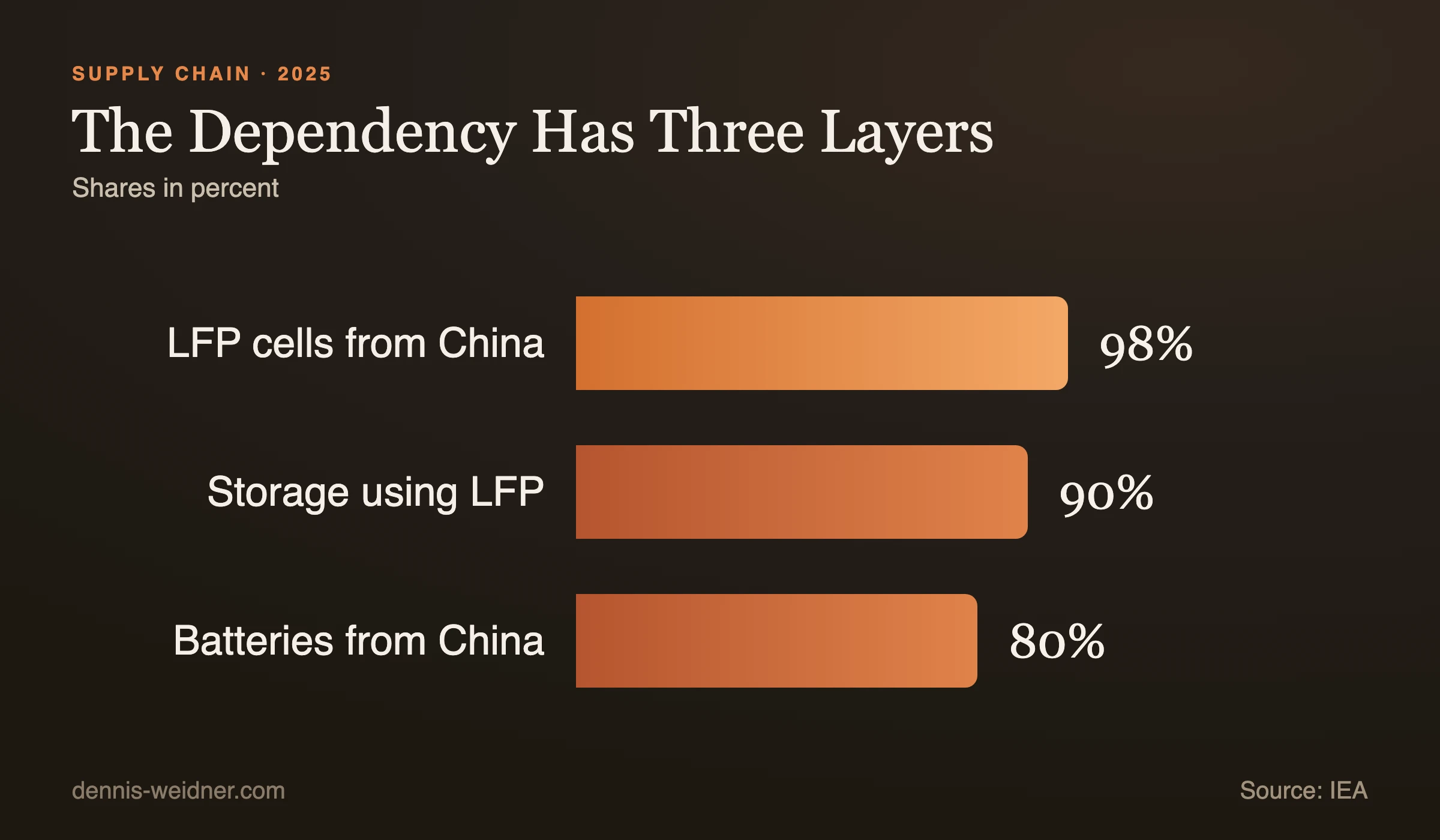
The International Energy Agency reports that more than 80 percent of all batteries worldwide were manufactured in China in 2025. That is the familiar number. The other two matter more. Over 90 percent of storage applications use lithium iron phosphate, because for stationary storage LFP is simply the better chemistry: cheaper, longer-lived, thermally more forgiving. And over 98 percent of LFP cathode material and LFP cells come from China.
More on this topic: Battery Storage & Energy – background, practice and every article in one place.
Those three numbers multiply. Build a grid-scale battery and you will almost inevitably choose LFP; choose LFP and you will almost inevitably buy from China. European cell manufacturing is growing faster than Chinese, with nameplate capacity in the EU and the US up around 50 percent in 2025 against just over 25 percent in China. It is simply starting from a base that is tiny by comparison. Global nameplate capacity passed four terawatt-hours by the end of 2025.
So anyone writing in a sustainability report that they are working on diversifying the supply chain should know that every informed reader reads that for what it is: a statement of intent. More honest, and considerably more robust in a conversation, is to name the dependency and explain what you do control instead. Which is evidence.
What stops being negotiable in 2027
The EU Battery Regulation, formally Regulation (EU) 2023/1542, is why this question is moving out of voluntary self-presentation and into market access. Three dates matter for storage projects.
18 February 2027: the battery passport. From that day, every industrial battery of two kilowatt-hours or more needs a digital product passport documenting origin, carbon footprint, technical characteristics and recyclability across its life cycle. For a container battery that means the passport is part of the delivery, not a document you obtain later.
18 August 2027: supply chain due diligence. This deadline is recent. The obligations covering lithium, cobalt, nickel and graphite were originally to apply from 18 August 2025. Regulation (EU) 2025/1561, part of the Omnibus IV package, pushed them back by two years and narrowed the scope at the same time: the exemption for small companies was extended to mid-caps, raising the threshold from 40 to 150 million euros of annual turnover. The Commission's guidelines are due by 26 July 2026.
The carbon footprint. The regulation provides for a carbon footprint declaration for rechargeable industrial batteries. Caution is warranted here, and I will say so plainly: actual applicability depends on delegated acts from the Commission, several of which arrived later than planned. If you put a firm date in an investor document, check it against the current state at the time of writing rather than lifting it from a 2024 slide deck.
Recycling is not an end point, it is a procurement quota
The part of the regulation that will change procurement most sits in Article 8 and is rarely read for what it is.
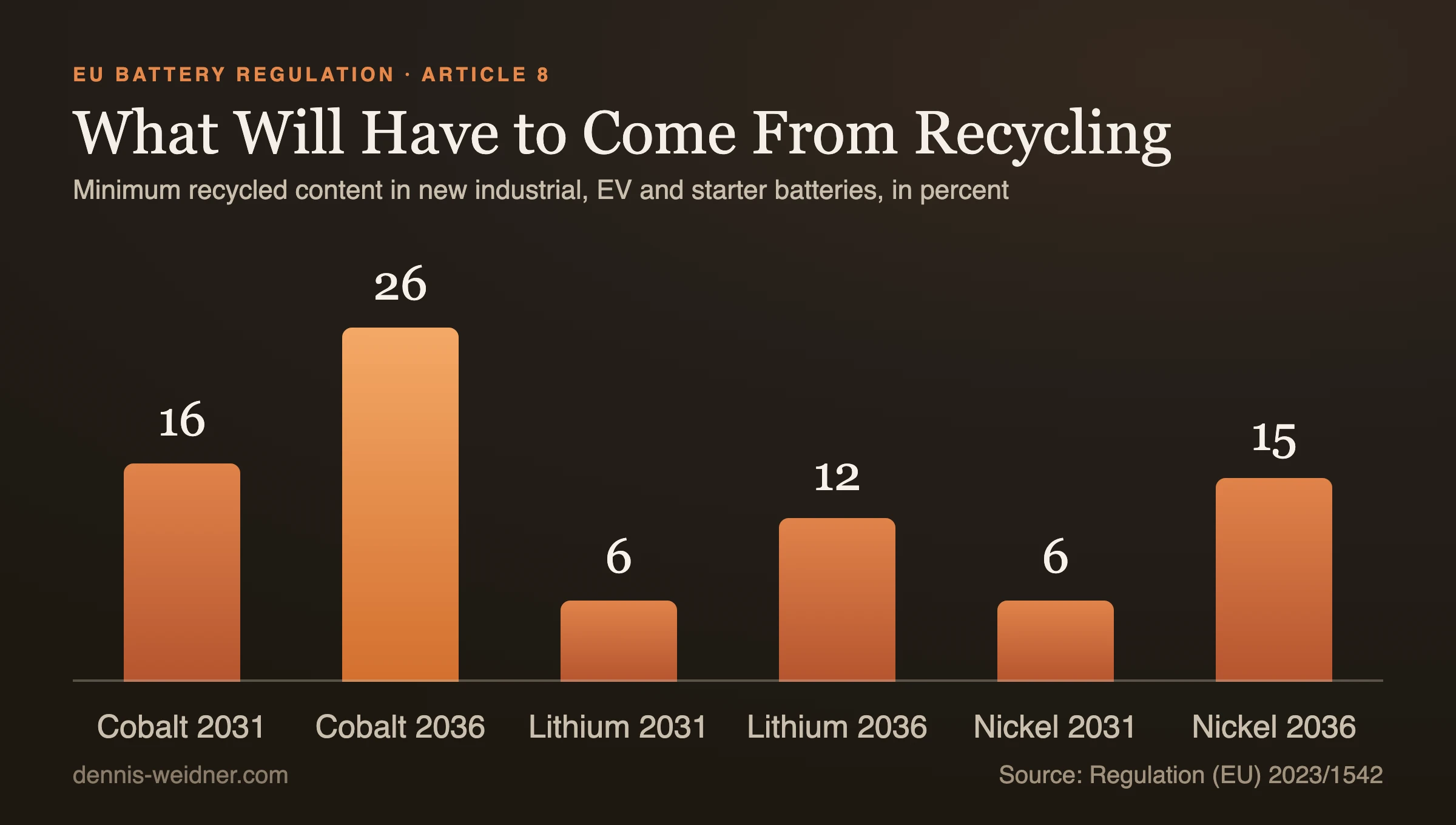
From 2031, new industrial, EV and starter batteries must contain at least 16 percent cobalt, 6 percent lithium and 6 percent nickel from recycled material. From 2036 those figures rise to 26, 12 and 15 percent. This is not a waste rule. It is a procurement requirement, and it bites where a battery is manufactured and placed on the market.
Recovery rates for recycling processes rise alongside it: 50 percent for lithium by the end of 2027 and 80 percent by the end of 2031. Anyone planning a battery with a 25-year life is planning into that regime whether they intend to or not. Decommissioning at the end stops being a cost line and becomes a material stream with value, and the question of who owns that value belongs in the construction contract and in the land lease.
How ESG gets lost, and why
In practice, ESG on storage projects rarely fails on a matter of principle. It fails on documentation, usually at four points.
Evidence is requested after the order. Origin documentation, the battery passport, carbon footprint data and declarations of conformity are things you negotiate at purchase or not at all. After signing, the supplier is in a different position, and a cell you have already paid for does not become traceable retroactively.
The chain breaks at the integrator. Many containers come through integrators who are not cell manufacturers themselves. An integrator can issue a declaration of conformity, but can only pass on what they received. If you do not contractually require that evidence is passed through to the cell manufacturer, you have a chain with a hole in the middle.
The S gets forgotten. ESG is not only the carbon footprint. Forced labour risk in the raw material chain, working conditions on site, the relationship with the host community. The last point is underrated: a storage project without an accepted fire safety concept and without a conversation with the fire service and the neighbours earns no social capital, and in a municipality that has seen a battery fire in the news, that can cost the project.
Governance is undocumented. Who audits suppliers, how often, against what standard, and what happens on a finding. Without a written procedure there is nothing to audit, and an auditor with nothing to audit does not write a good report.
Why this attaches to the financing
Here sits the real economic lever, and it is often underestimated because it does not arrive as a statute. Large lenders and institutional investors are themselves subject to reporting duties or market funds with sustainability characteristics. Their requirements therefore migrate into loan agreements regardless of whether the project sponsor has any reporting duty at all. A project without robust supply chain documentation is not prohibited; it is simply not investable for part of the capital market.
That bites twice. First on the interest rate, because a smaller pool of lenders means worse terms. Second at exit: a storage portfolio destined for an institutional buyer will be diligenced on exactly these documents, and what was not collected during construction cannot be manufactured five years later.
Put briefly: ESG costs a few percent of effort in procurement and nothing in financing. Missing ESG costs nothing in procurement and possibly the project in financing.
How I read it
What bothers me about the current debate is that it conflates two questions. One is a bureaucracy question: how many reports must a mid-sized company write. The answer there is now happily fewer, and pushing battery due diligence to 2027 while extending the exemption to mid-caps is part of that.
The other is a procurement question, and it does not disappear with a postponed deadline. A European storage market that depends over 90 percent on one chemistry which comes over 98 percent from one country is exposed, whatever the reporting forms say. Anyone who wants to build something durable out of that position documents their chain well enough to know what happens when one link changes. That is not a sustainability topic. It is risk management that happens to need the same data.
In practice, for my own projects: evidence is required in the supply contract, not requested afterwards. The battery passport is named as a deliverable, with a deadline and liquidated damages like any other item. And decommissioning and recycling get settled at signature, not in 25 years.
How this evidence fits into the construction contract is written up in what a BESS EPC contractor actually does. How a battery earns its money is covered in the revenue stack of a grid battery, and why land has become the entry ticket in securing land for battery storage. The overview of the whole field sits at BESS and energy storage.
ESG on a battery is, in the end, not a chapter in a report. It is the question of whether you know what you bought.
Frequently Asked Questions
Where do the cells for grid-scale batteries come from?
Overwhelmingly from China. The International Energy Agency reports that more than 80 percent of all batteries worldwide were manufactured there in 2025. For stationary storage the concentration is higher still: over 90 percent of storage applications use lithium iron phosphate, and over 98 percent of LFP cathode material and LFP cells come from China. European capacity is growing faster but from a very small base.
When does the battery passport apply?
From 18 February 2027. From that date every industrial battery of two kilowatt-hours or more, as well as EV and light means of transport batteries, needs a digital product passport covering origin, carbon footprint, technical characteristics and recyclability across the life cycle. The legal basis is Regulation (EU) 2023/1542.
Have the battery supply chain due diligence obligations been postponed?
Yes. They were to apply from 18 August 2025 and were pushed to 18 August 2027 by Regulation (EU) 2025/1561, part of the Omnibus IV package. At the same time the exemption for small companies was extended to mid-caps, with a turnover threshold of 150 million euros instead of 40 million. The Commission's guidelines are due by 26 July 2026.
How much recycled material must a battery contain?
Under Article 8 of the EU Battery Regulation, from 2031 at least 16 percent cobalt, 6 percent lithium and 6 percent nickel, rising in 2036 to 26, 12 and 15 percent. The requirements apply to new industrial, EV and starter batteries. Recovery rates for recycling processes rise in parallel: for lithium to 50 percent by the end of 2027 and 80 percent by the end of 2031.
Best,
Dennis Weidner
Note: AI tools supported me in writing this article, and some images were edited with AI. I stand behind its content and every statement with my name.