Everyone talks about dynamic electricity tariffs now. Almost nobody talks about the second largest item on your bill. Yet since April 2025 the German regulator has quietly introduced a way to save there that hardly anyone uses: time variable grid fees. If you run a heat pump, a wallbox or a home battery, you can now influence what it costs to move electricity to your house.
The line item nobody looks at
You are not only paying for the kilowatt hour itself. You are paying for the grid that delivers it: lines, substations, meters, maintenance. In Germany that share is called the Netzentgelt, the grid fee. Order of magnitude: roughly a quarter to just under a third of a household electricity price, so around ten cents per kilowatt hour, with meaningful regional variation.
More on this topic: Battery Storage & Energy – background, practice and every article in one place.
Until now this was a fixed cost. You could switch electricity supplier, but never your grid operator. The fee simply landed on top, regardless of when you consumed. That logic is breaking open. The Bundesnetzagentur has been reshaping grid cost allocation for years, and one piece of that reform hands you real influence over your own grid fee for the first time.
What section 14a of the Energy Act actually does
The legal basis is section 14a EnWG, and the underlying deal is simple and, I think, genuinely fair. You have a large controllable device in the house. The grid operator may briefly throttle its power draw during rare congestion events. In return, you pay a lower grid fee.
This applies to devices with at least 4.2 kilowatts of connected load on the low voltage grid: private EV charging points, heat pumps including their backup heating elements, and electricity storage systems. Anything commissioned since 1 January 2024 falls under the rule automatically. The Bundesnetzagentur then offers three modules.
Module 1 is a flat annual discount, the default if you choose nothing else. Each grid operator calculates it with a Federal Network Agency formula from 80 euros plus its energy rate. In the 2026 price sheets of large operators it comes to roughly 109 to 156 euros including VAT, from EWE Netz to enercity Netz. The often quoted range of 110 to 190 euros dates from 2023. Module 2 cuts the grid fee energy rate to 40 percent, but requires a separate meter for the controllable device alone, with its standing charge waived. For heat pumps with high annual consumption that is often the stronger option. Module 3 is the genuinely new one. It sits on top of Module 1 and makes the grid fee time dependent.
Module 3 in detail
Since 1 April 2025, distribution grid operators must offer a grid fee with three tariff levels: high load, standard and low load. The standard level roughly matches what you pay today, low load sits below it, high load above.
Here is the crucial difference from a dynamic electricity tariff: these windows are static. Your grid operator fixes them once for the whole year, they repeat daily, and they are published in advance in the price sheet. So in January you already know that five to eight in the evening is expensive and the night is cheap. Less elegant than an exchange price, but with one practical advantage: you program your wallbox once and never think about it again.
The prerequisite is a smart meter that records consumption hour by hour. Without that, there is nothing to bill against a time window. I have written about how that rollout is actually going in the smart meter rollout in 2026.
What time-variable grid fees save
Now the interesting part, and it cuts both ways. The spread between the high and low tariff level is not set nationally. Each grid operator defines it, and the differences are enormous. An analysis by the German trade publication zfk found spreads ranging from under half a cent to more than 22 cents per kilowatt hour depending on the grid area. For a heat pump using 3,000 kilowatt hours a year, that is a difference of several hundred euros annually between one grid area and another.
Do the math yourself, it fits on a napkin. Take your flexible annual consumption: EV plus heat pump plus battery charging. Say 5,000 kilowatt hours. Estimate what share you can realistically shift into the low load window. For a car that sits in the driveway overnight, 80 percent is not unrealistic. Multiply those kilowatt hours by the gap between the standard and low load level in your operator's price sheet. A three cent gap gets you 120 euros a year. A half cent gap gets you twenty, and the effort is not worth it.
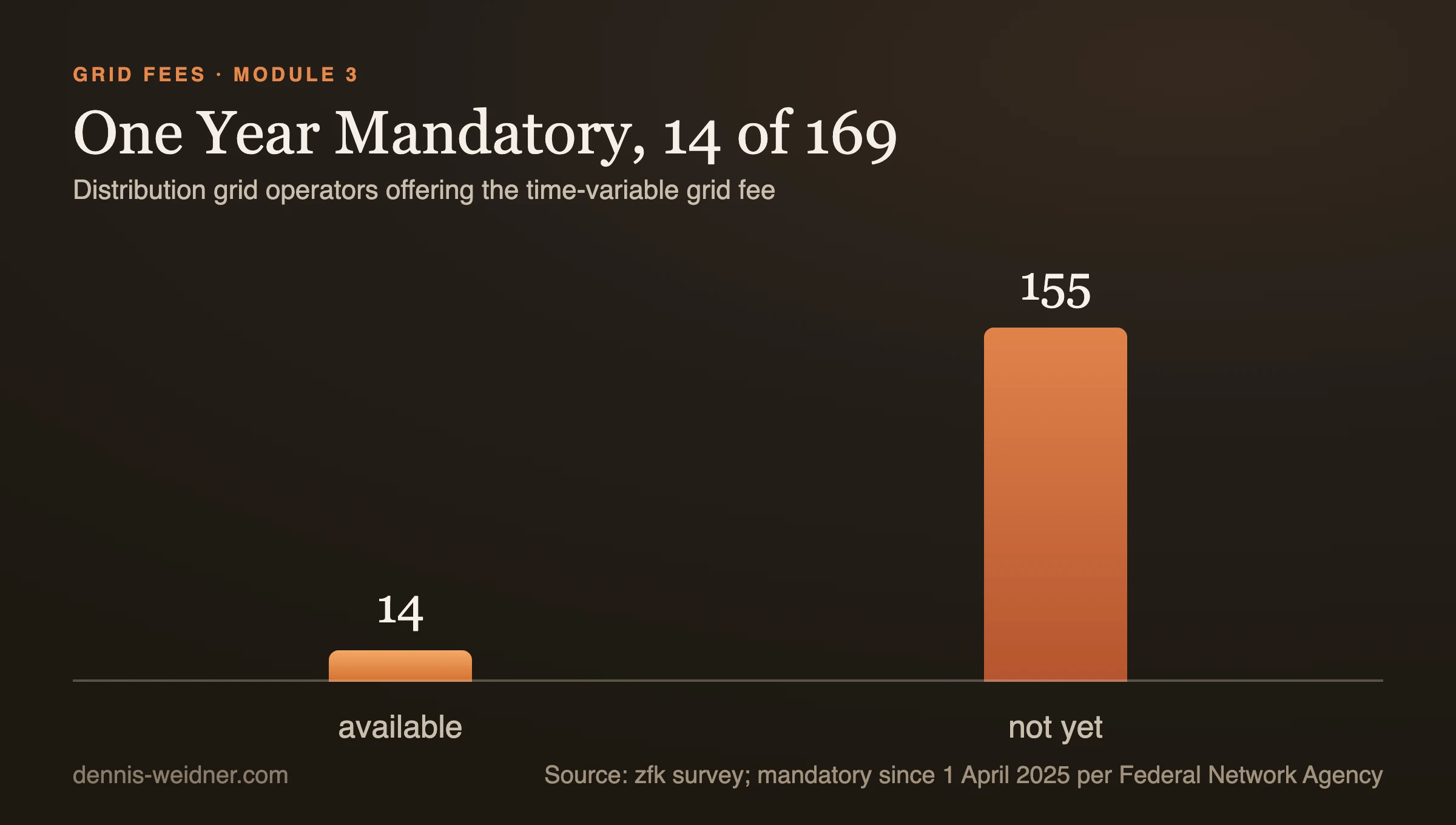
On top of that, in many places the offer does not exist yet. More than a year after the legal deadline, zfk reporting found only 14 of 169 distribution grid operators surveyed had actually made Module 3 bookable. In May 2026 the regulator responded by threatening penalty payments, giving the first operators until 30 September 2026 to fix it. That is the real reason this gets so little attention. It is an early mover topic because the infrastructure is lagging.
Why the combination is what matters
This is the point I consider most important. A time variable grid fee on its own does little. A dynamic electricity tariff on its own only goes so far. Together they give you a clean price signal across the full bill, energy and grid.
And there is a catch almost nobody mentions. The grid operator's time windows and the power exchange prices do not move in sync. The zfk analysis found a median correlation of just 0.22 between the two, which is close to no relationship at all. So you can easily hit a moment where the exchange is cheap because the sun is out, while your grid fee sits in the high load band. Optimize for only one curve and you are optimizing against your own wallet.
Which is why I keep pushing on this. The problem is no longer solvable by hand. Nobody weighs two hourly price curves against each other every day. An energy management system, or a decent home battery, does it in the background. I have written about why storage is the real key in BESS and energy storage, and about the market side in my piece on the dynamic electricity tariff in 2026.
Who this pays off for, and who it does not
Straight answer. It pays off if you have at least one large controllable device, if your grid operator actually offers Module 3, if the spread in the price sheet is more than one or two cents, and if you have automation that runs it for you. Tick all four and this is one of the rare measures that keeps working without any change in behavior.
It does not pay off if you live in an apartment with no heat pump, no EV and no battery, because section 14a does not apply to you at all. It also does not pay off if you would have to switch every device by hand. Nobody keeps up calendar reminded night charging for three months.
My advice: pull up your grid operator's 2026 price sheet, check whether three tariff levels are listed, and multiply the gap by your flexible consumption. Five minutes of work. After that you know whether to act this year or wait. Both are legitimate, but the answer should rest on a number rather than a gut feeling.
Frequently asked questions
What are dynamic grid fees?
The term usually refers to the time variable grid fee under section 14a of the German Energy Act, known as Module 3. Instead of one flat grid fee there are three tariff levels for high, standard and low grid load. Your distribution grid operator fixes the time windows once a year, so they are predictable rather than changing hour by hour.
Who can use a time variable grid fee?
Households with a controllable device of at least 4.2 kilowatts, meaning a wallbox, heat pump or battery storage system, plus a smart meter. Module 3 is only available in addition to the flat discount from Module 1, never as a replacement for it.
How much can you save with dynamic grid fees?
Almost entirely down to your grid area, because each operator sets its own spread. Reported gaps between the high and low load levels range from under half a cent to more than 22 cents per kilowatt hour. Multiply your shiftable kilowatt hours by the gap in your own price sheet, that is the only number you can rely on.
Do I also need a dynamic electricity tariff?
For the full effect, yes. The grid fee and the exchange price are two separate parts of the bill and they often do not line up in time. Optimizing only one of them leaves value on the table, or can even push your consumption into the wrong hour.
Warmly,
Dennis Weidner
Note: AI tools supported me in writing this article, and some images were edited with AI. I stand behind its content and every statement with my name.