Split air conditioning left the niche in 2026. Sales figures are closing in on the all-time high and manufacturer enquiries have multiplied. What almost always gets lost is the refrigerant: on 1 January 2029, R32 drops out of new sales of small split air conditioners, and that decides whether your system is still state of the art by then.
Why everyone suddenly wants air conditioning
The numbers are unambiguous. According to the survey by Germany's building climate association FGK, more than 300,000 room air conditioners with heat pump function were sold in Germany in 2025, up from over 250,000 the year before. The previous record stands at more than 330,000 units in 2020, so this market is in the process of catching up with its own peak.
Then the summer of 2026 added another layer. Daikin Germany reports enquiries from private households up by more than 300 percent in June compared with the same month last year, as reported by haustec. For portable units the effect is even sharper: market researcher NIQ counts roughly 387,100 units sold in the first half of the year, an increase of about 130 percent.
This is no longer a passing trend. Cooling is becoming standard equipment in Germany the way heating has been for decades. And that has consequences for the power system, more on that below.
Split or portable, and why that is not a detail
A portable air conditioner is bought quickly and works immediately. But it has a design flaw no manufacturer can engineer away: the exhaust hose has to go out of the window, and warm outside air flows back in through the gap. The unit spends a good share of its effort fighting the problem it creates itself. Consumption is correspondingly high for modest cooling output.
A split system separates the two halves: the indoor unit cools, the outdoor unit releases the heat outside. No open window, no counter-effect. In return it is a permanent installation with a wall penetration, refrigerant lines and an electrical connection, and it belongs in the hands of a certified installer.
What it costs
For a single-split system, meaning one indoor unit for one room, typical market prices including installation run from roughly 1,500 to 3,500 euros. A multi-split system serving two to four rooms from a shared outdoor unit sits closer to 3,500 to 8,000 euros. Installation is a significant share of that, depending on the effort for the wall penetration, pipe routing and electrics.
On running costs the picture turns in favour of the split system. An efficient unit typically consumes electricity worth a low two-digit to low three-digit euro sum across a German summer, a portable unit with comparable use considerably more. Over a few years that offsets the higher purchase price. The exact figures depend on room size, insulation, hours of use and electricity price. Anyone promising a precise number without knowing those four things is guessing.
The refrigerant question most people miss
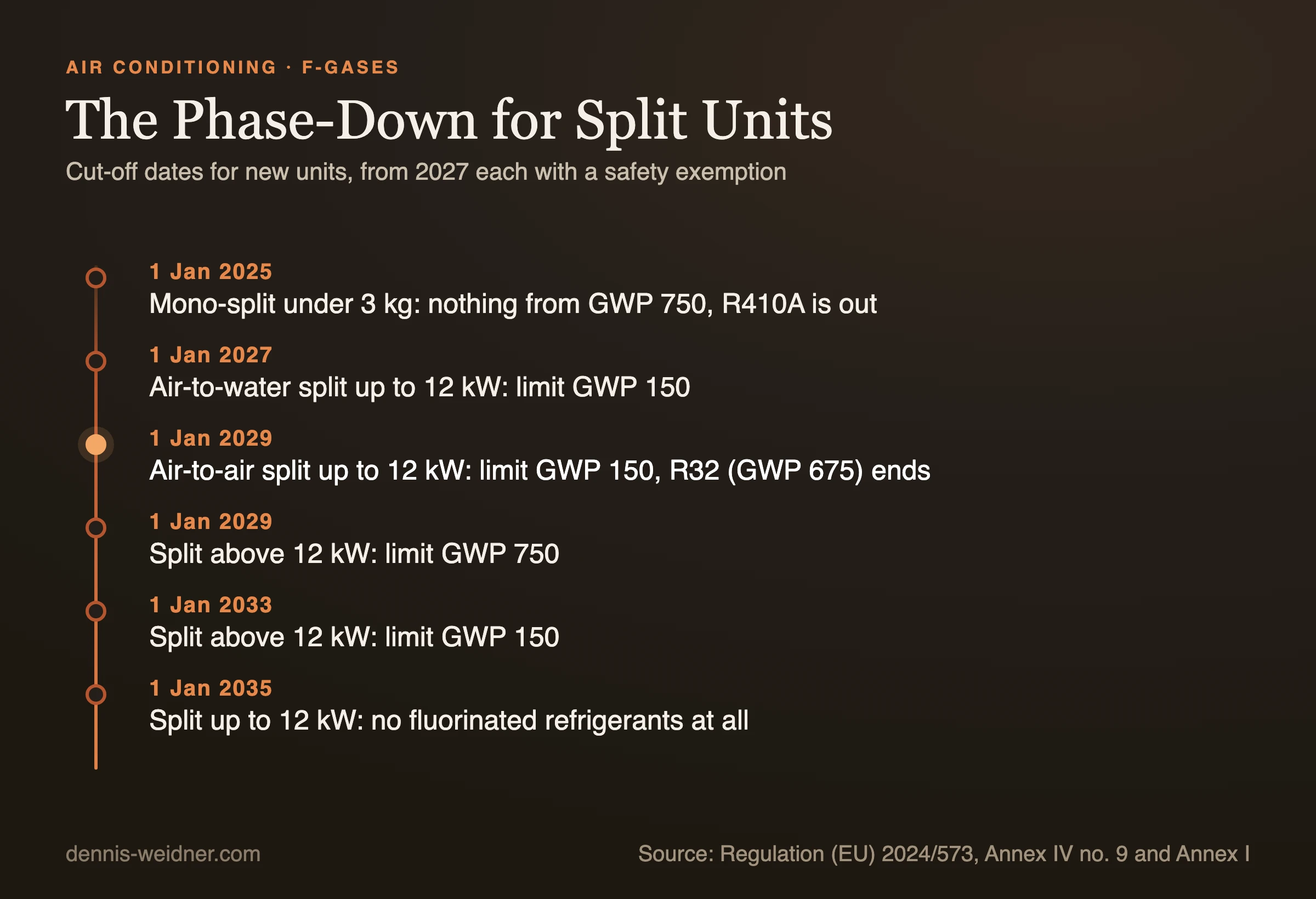
This is where most guides online get it wrong. The EU regulation on fluorinated greenhouse gases, Regulation (EU) 2024/573, does not suddenly ban everything. It lowers permitted global warming potentials in stages. For split air conditioners and split heat pumps, the stages are set out in point 9 of Annex IV:
Since 1 January 2025, single split units holding less than 3 kg of refrigerant may no longer be placed on the market if that refrigerant has a GWP of 750 or above. That removes R410A (GWP around 2,088) from new sales. On 1 January 2029 the limit for air-to-air split units up to 12 kW rated capacity drops to GWP 150. That class covers the usual air conditioners for flats and family homes, and new units running on R32, listed in Annex I with a GWP of 675, may then no longer be placed on the market. The wave this deadline sets off well before 2029 is covered in my piece on the pull-forward effect ahead of deadlines.
The other stages in the same point: for split heat pumps that heat water for the heating system (air-to-water), the GWP 150 limit applies from 1 January 2027. Above 12 kW the limit is 750 from 2029 and 150 from 2033. From 1 January 2035, fluorinated refrigerants are excluded altogether in split units up to 12 kW. Every stage from 2027 onwards carries one exception: where safety requirements at the site of operation make a fluorinated refrigerant necessary. Monoblock room air conditioners follow their own timetable in point 8: up to 12 kW, GWP 150 from 2027 and no fluorinated refrigerants at all from 2032.
In practice: an R32 unit bought today is entirely legal and may be operated, serviced and recharged. But you are buying a technology at the end of its market cycle. Units running on R290 (propane) are on the safe side: propane is not a fluorinated greenhouse gas, Annex VI of the regulation lists it with a GWP of 0.02, and none of the stages applies. If your quote offers both, the refrigerant is worth asking about, precisely because the system is meant to run for 15 years or more.
A second point is not negotiable: only certified companies may handle refrigerants. The installer's certificate of competence is a legal requirement. Having a system fitted without one becomes an insurance problem the moment something goes wrong.
Rented flats, owner associations, neighbours
The outdoor unit changes the facade, which makes it something you do not decide alone. In a rented flat you need the landlord's consent. In a German owner association the facade is generally common property, so a resolution is required. Add noise protection towards the neighbours, which genuinely matters when positioning the outdoor unit.
My pragmatic advice: settle these questions before the quote, not after. An installer can design a perfect system that then fails on a missing association resolution.
The point almost nobody makes
A split air conditioner is technically an air-to-air heat pump. It does not just cool, it heats as well, and efficiently. In the shoulder seasons it replaces a gas boiler entirely on many days. That is exactly why the FGK counts these units as heat pumps. Thinking only about cooling means giving away half the system.
Then there is the system side. Cooling draws power precisely when the sun shines, meaning when solar electricity is abundant and cheap. It is one of the few loads that matches generation almost perfectly. Combined with a solar array, a battery and a dynamic electricity tariff, a power hog turns into a system that largely carries itself.
How flexible that battery is even allowed to be is a regulatory question. That is what MiSpeL governs, the determination that finally integrates storage and charging points properly into the market. Cooling, storage and the grid are more tightly connected than any single quote suggests.
Frequently Asked Questions
What does a split air conditioner cost including installation?
Typical market prices for a single-split system with one indoor unit run from roughly 1,500 to 3,500 euros including installation. A multi-split system for two to four rooms sits closer to 3,500 to 8,000 euros. The installation share depends heavily on the effort for the wall penetration, pipe routing and electrical connection.
Is R32 banned from 2029?
Only for new equipment. From 1 January 2029, point 9 of Annex IV to Regulation (EU) 2024/573 bars air-to-air split units up to 12 kW rated capacity from being placed on the market if their refrigerant has a GWP of 150 or more, unless safety requirements at the site of operation make it necessary. R32 sits at 675. Existing systems may still be operated, serviced and recharged. Anyone buying now with a long horizon should look at units running on R290 (propane).
Can a split air conditioner also heat?
Yes. A split air conditioner is technically an air-to-air heat pump and works in both directions. In the shoulder seasons it replaces conventional heating on many days. That is precisely why the German building climate association FGK counts these units as heat pumps.
Can I install a split system in a rented flat?
Not on your own initiative. The outdoor unit alters the facade, so the landlord's consent is required. In an owner association the facade is generally common property, which means a resolution is needed as well. Settle these questions before requesting quotes.
Is a portable unit a reasonable alternative?
Only as a stopgap. The exhaust hose forces a window to stay ajar, letting warm outside air flow back in. The unit therefore partly fights the problem it creates. Power consumption is considerably higher than a split system for less cooling output.
Warm regards,
Dennis Weidner
Note: AI tools supported me in writing this article, and some images were edited with AI. I stand behind its content and every statement with my name.