On 1 January 2029, R32 drops out of new sales, in a market already growing towards some 335,600 units a year. That is three summers of runway. How this tends to play out does not have to be guessed: Germany's solar December of 2011 and the heat pump slump of 2024 have both been there, and they left two very different lessons behind.
The pattern nobody plans for
When a legislator names a date after which something is no longer allowed, the same thing happens with striking regularity. Demand surges before the date and collapses after it. This is an effect of the rule itself, and in Germany it is documented several times over.
The obvious suspect for the swing is the tightening itself. The figures say otherwise. A clear rule with a clear date produces a wave you can plan around, because everyone knows when it arrives. What really damages a market is the state in between: announced, but not decided. At that point nobody buys, because nobody knows what they are committing to.
Three markets show the same pattern. Two cases are closed, the third is running right now.
Solar 2011: the textbook case
From 1 January 2012 the German feed-in tariff for solar power was set to fall by 15 percent. The date was fixed, the size of the cut was fixed, and the market responded exactly as you would expect. In December 2011 alone, roughly 3,000 megawatts were newly installed. The whole of 2011 came to around 7,500 megawatts. A single month therefore accounted for about 40 percent of the year.
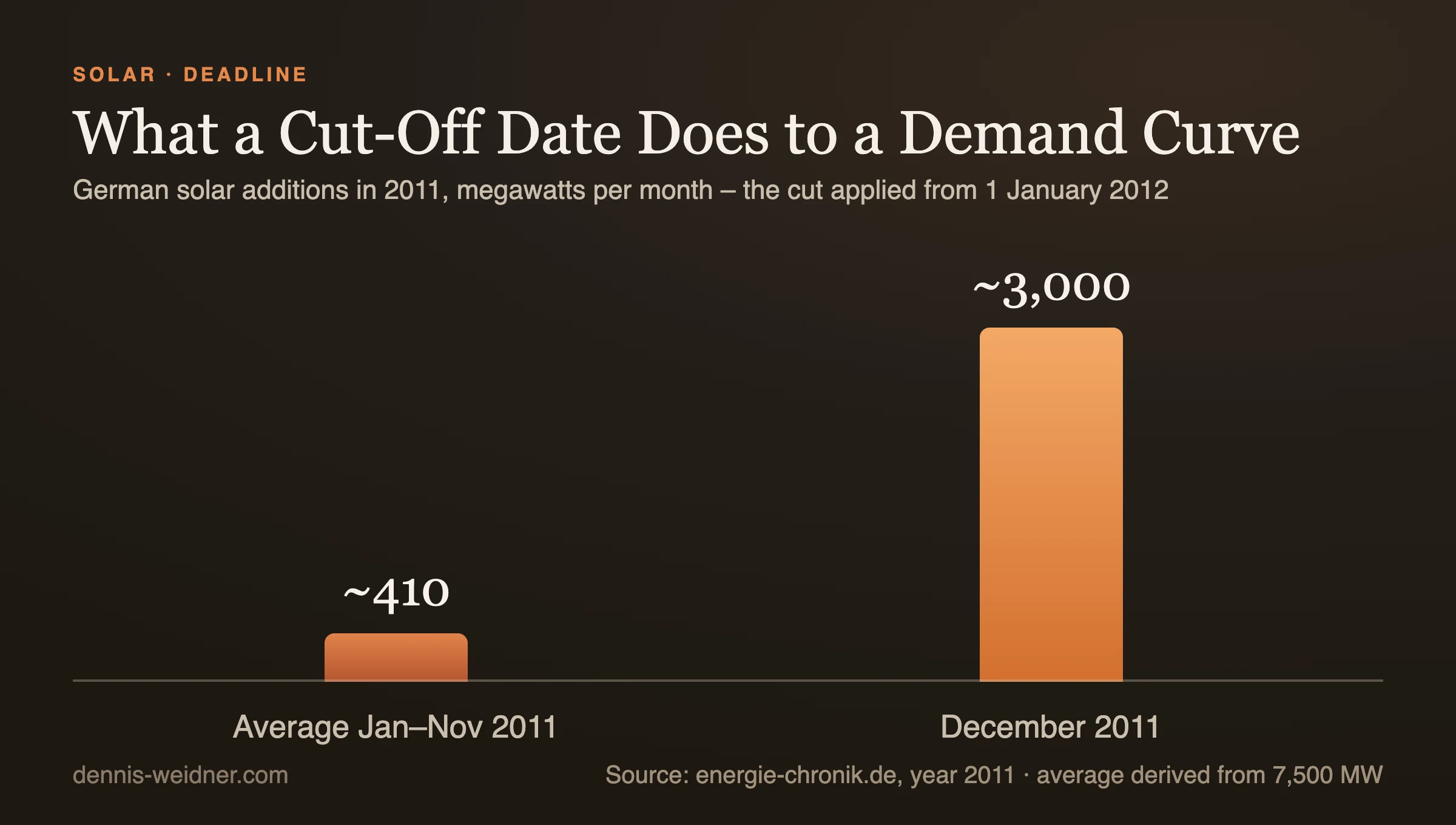
A month that delivers seven times the capacity of an average month before it is the future pulled forward: systems that would have been built in 2012 moved into December instead. Installers worked flat out, modules ran short, and by January the order book was empty.
What the legislator did with that is the remarkable part. From May 2012 the degression was switched to 1 percent per month, explicitly to smooth out precisely these pull-forward effects. That is a rare, clean feedback loop: the cut-off date created the wave, the sliding path ended it. Anyone asking whether a regulatory instrument works will find the evidence here. Documented at energie-chronik and in this analysis of the 2012 renewables act.
Heat pumps 2024: the flip side
356,000 heat pumps were sold in Germany in 2023, a record. In 2024 the figure was 193,000, down 46 percent. Read without context, the record looks like the cause: demand pulled forward, then the dip. That is half the truth.
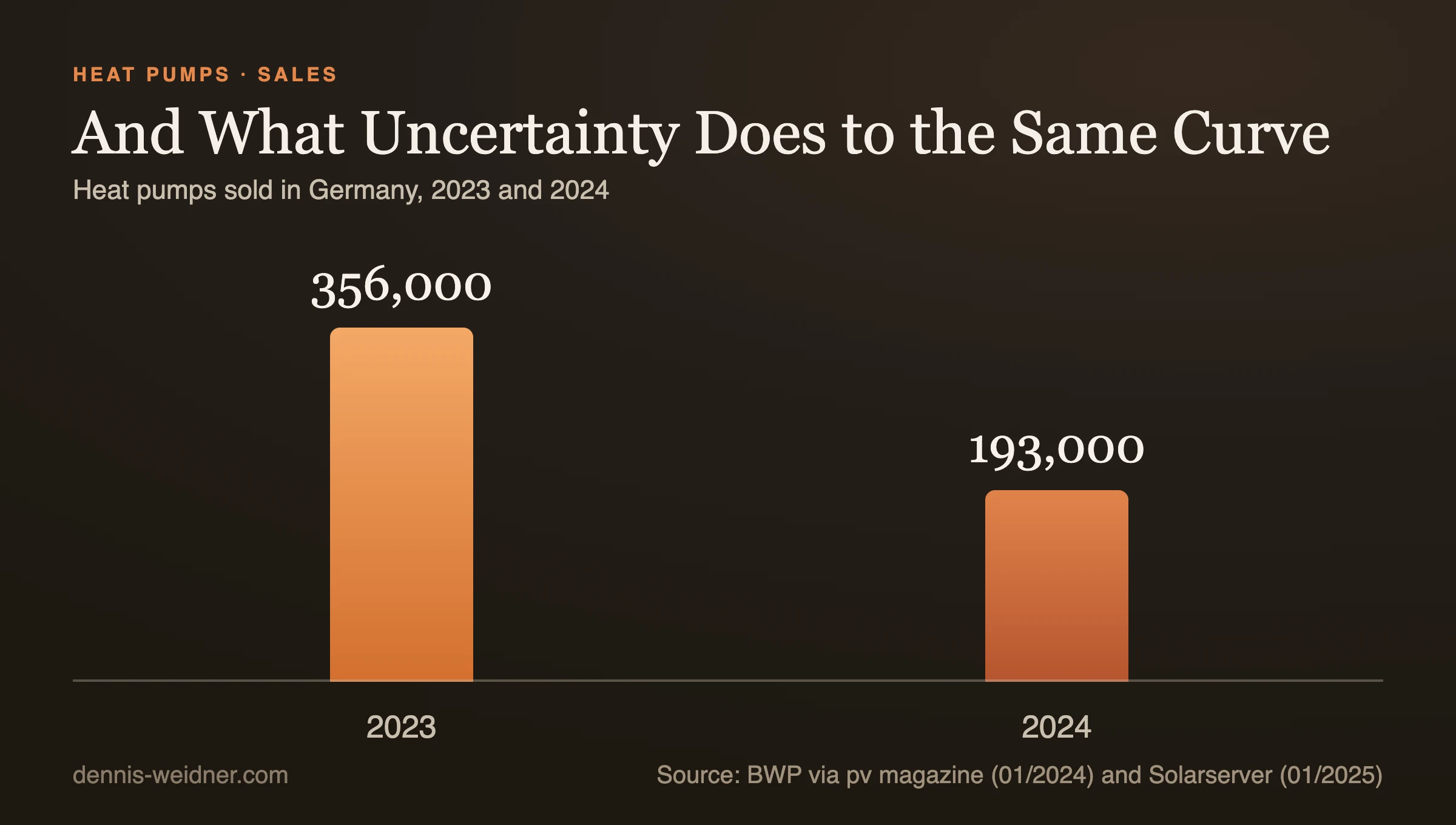
The other half sits in the association's own explanation. The slump does not trace back to a rule but to uncertainty about one. How local heat planning would turn out, and how much subsidy would remain, was simply unanswerable for many households at the moment of purchase. If you cannot tell whether a decision will still look right in two years, you do not decide at all.
What damaged the market, then, was the debate about the tightening. A rule that is settled can be priced in, even an unwelcome one. A rule still being negotiated cannot be priced in, and markets in that position always do the same thing: they wait. Details at pv magazine and Solarserver.
Air conditioning: the market with the next deadline ahead of it
The third case is live. Sales of room air conditioners with heat pump function rose from around 260,000 units in 2023 to roughly 320,000 in 2025. For 2030, around 335,600 units per year are expected, on about 7.2 percent annual revenue growth.
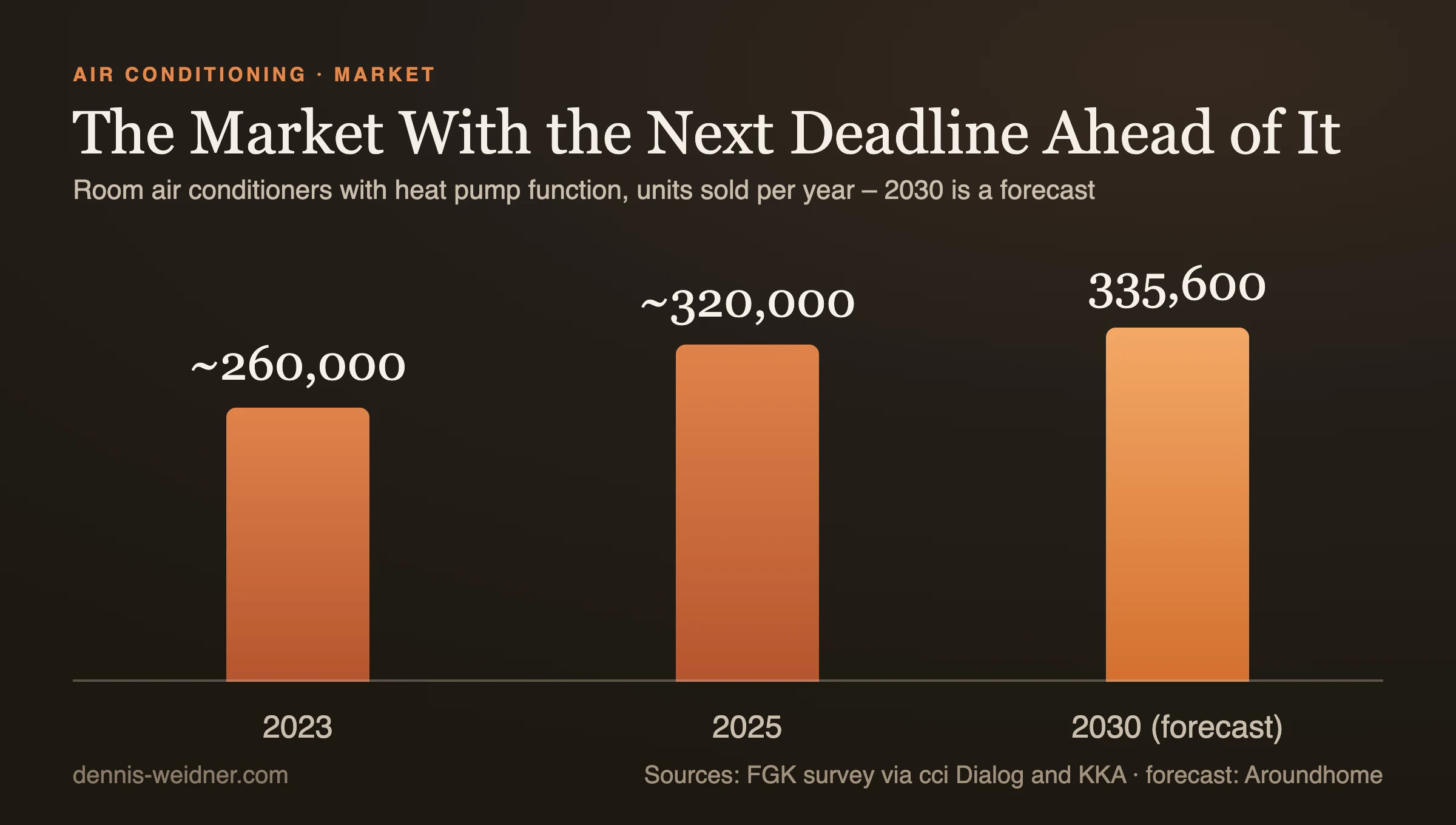
This curve is not seasonal, even if every hot summer gives it an extra push. The number of heat days has tripled since the 1980s and 2024 was the warmest year on record. Around 6 percent of German households cool today, and by 2030 it will be close to 8 percent. In a country where heating has been standard equipment for decades, cooling is becoming the same thing. Details in the FGK survey, the market development 2025 and the forecast to 2030.
Into that growing market falls a deadline on 1 January 2029. For new air-to-air split units up to 12 kilowatts, the permitted global warming potential drops to 150. That takes R32, today's most widely installed refrigerant in this class, out of new sales. What that means technically is in the box below this text, and in detail in my piece on split air conditioning.
Economically it means three summers of runway. Following the pattern of the first two cases, 2027 and 2028 will be above-average years for retailers and installers, and 2029 will be a hard one.
What this means for three groups
For buyers: there is no reason to rush and one good reason to ask a question. Anyone buying a system in 2027 or 2028 should know which refrigerant is inside it, because that co-determines resale value and the spare parts and service situation ten years out. That is a question for the installer, not a panic decision.
For installers: the solar case shows what a cut-off wave does to a business. It is a revenue record first and a utilisation hole afterwards, and both land in the same set of books. Anyone sizing staff and stock around a pulled-forward year has a problem in the year that follows. The more reliable planning figure is the trend, not the peak.
For manufacturers and retail: the question is less how much R32 stock still moves in 2028 than when the range change gets communicated. Saying early and clearly what applies from when is exactly what prevents the state of affairs that cost the heat pump market its 2024.
There is no decommissioning date for existing units
A pull-forward effect turns into scaremongering with very little effort, and that is happening in plenty of places online right now. The rule is simple: existing units may keep running, be serviced and be repaired without restriction. There is no decommissioning date.
The deadline applies solely to placing new equipment on the market. Anyone who owns an R32 system today has to do nothing, and anyone buying one in 2028 is buying entirely legally. Guides that leave this out usually have something to sell.
Why I look at this through a storage lens
Because the same thing is visible here that I see in the storage market every day. What gets built is rarely decided by the technology. It is decided by whether a rule is clear enough to be written into a financing model. With MiSpeL, the German regulator's determination on storage and charging points, one open question held the market back for years: how a kilowatt hour with two possible origins gets treated.
And there is a substantive link between the two topics. Cooling draws power exactly when the sun is out and solar electricity is abundant. It is one of the few loads that matches generation. A growing air conditioning market is therefore also a building block in load management, provided the rules for it are settled in time.
My recommendation is therefore aimed less at buyers than at everyone who sets deadlines. A date is not a problem. A date that is still being negotiated is.
Frequently Asked Questions
What is a pull-forward effect?
A pull-forward effect occurs when an announced tightening shifts demand out of the future and into the period before the cut-off date. The textbook German example is December 2011: ahead of the feed-in tariff cut on 1 January 2012, roughly 3,000 megawatts of solar were installed in that single month, against around 7,500 megawatts for the entire year.
Why did the German heat pump market collapse in 2024?
356,000 units were sold in 2023 and only 193,000 in 2024, a drop of 46 percent. The German heat pump association BWP points to uncertainty about local heat planning and about subsidies as the main reasons. It was not the rule itself that slowed the market, it was the open debate around it.
When can R32 no longer be sold?
For new air-to-air split units up to 12 kilowatts, the permitted GWP limit falls to 150 on 1 January 2029. R32 sits at around 675 and may not be placed on the market in new equipment of that class from then on, unless safety requirements at the site of operation make it necessary. For split air-to-water heat pumps up to 12 kilowatts the same limit already applies from 1 January 2027. These two deadlines are frequently confused.
Do I have to replace my existing air conditioner in 2029?
No. The deadline applies solely to placing new equipment on the market. Existing installations may continue to be operated, serviced and repaired without restriction. There is no decommissioning date.
How large is the German air conditioning market?
According to the building climate association FGK, sales of room air conditioners with heat pump function were around 260,000 units in 2023 and roughly 320,000 in 2025. Around 335,600 units per year are expected for 2030. About 6 percent of German households currently cool, rising to close to 8 percent by 2030.
Warm regards,
Dennis Weidner
Note: AI tools supported me in writing this article, and some images were edited with AI. I stand behind its content and every statement with my name.