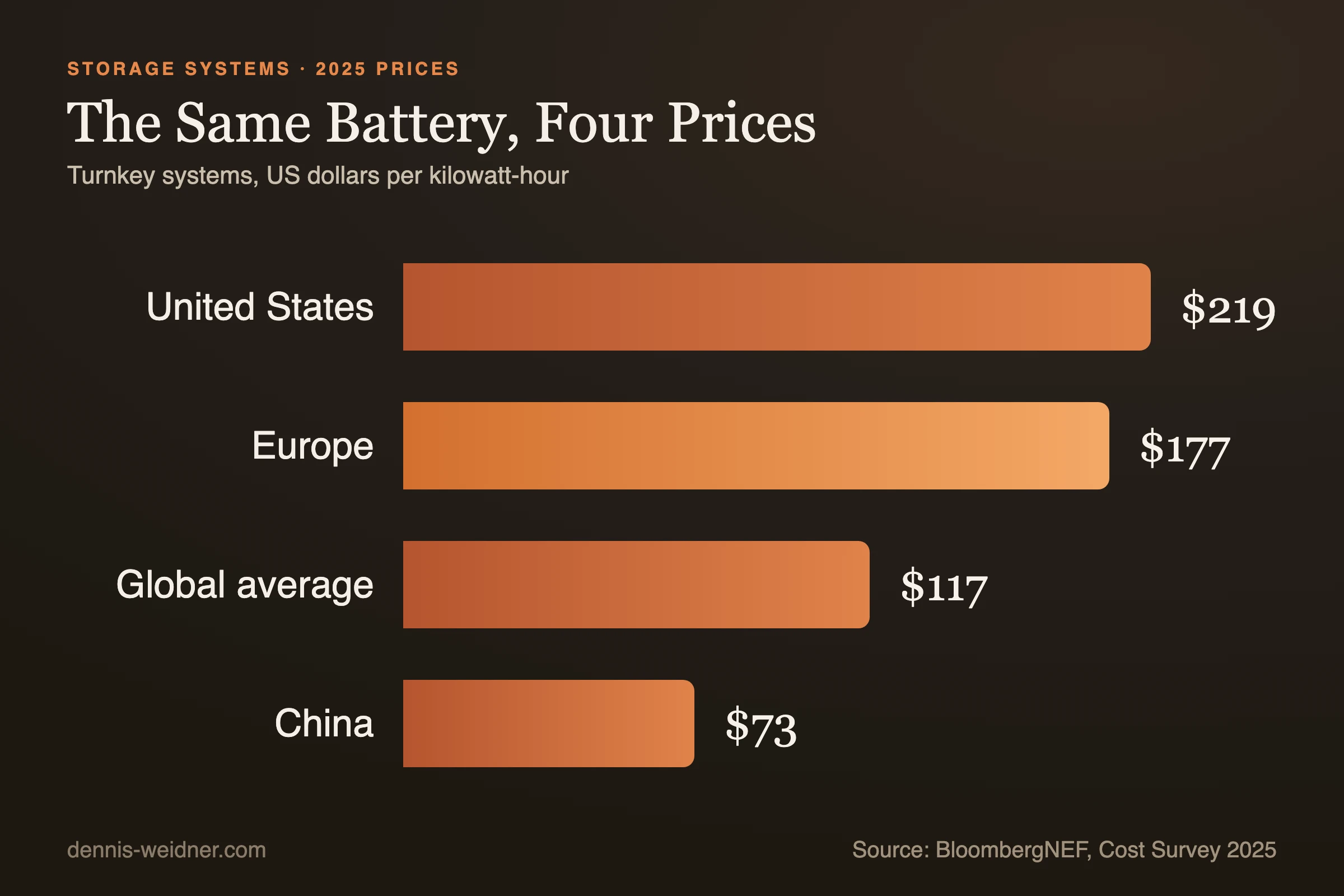
A turnkey battery storage system cost 117 US dollars per kilowatt-hour on global average in 2025. In China it was 73 dollars. In Europe, 177. Same container, same cells, often the same manufacturer, and still two and a half times the price. That gap is the shortest possible answer to the question of what an EPC contractor actually does. Because what is more expensive in Europe is almost never the cells.
What the three letters stand for
EPC means engineering, procurement, construction. An EPC contractor designs the plant, buys the components and builds it, against a fixed price and a completion date. That sounds like a construction service, but it is mainly a transfer of risk. The owner is not buying labour hours. The owner is buying a single address for everything that can go wrong.
More on this topic: Battery Storage & Energy – background, practice and every article in one place.
The alternative is multi-contracting: the owner buys containers from the cell manufacturer, the transformer from a second supplier, the medium-voltage switchgear from a third, the energy management system from a fourth, and hires a civil contractor for the rest. On paper that is five to fifteen percent cheaper. Whether that saving arrives is decided at the interfaces.
The calculation that rarely gets made
When hardware prices fall and the final project price does not follow at the same pace, it is worth looking at what sits in between.
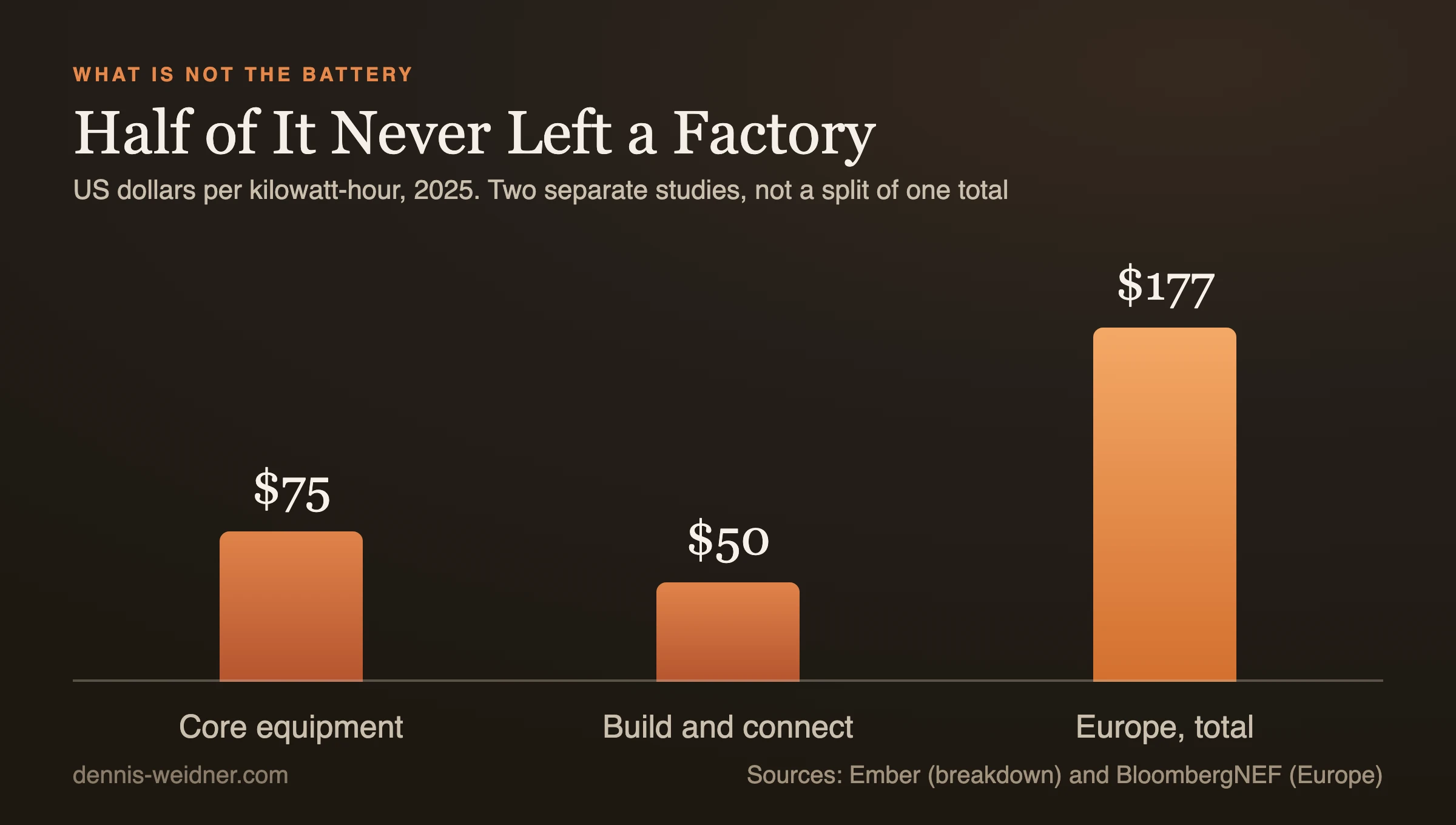
Ember puts core equipment ex works, meaning the enclosure, the power conversion system and the energy management system, at around 75 dollars per kilowatt-hour, and installation plus grid connection at around 50 dollars. So roughly 40 percent of what a battery costs has never seen a factory. It is earthworks, cable, transformer, protection equipment, certification, commissioning and paperwork.
That is precisely the part that is not falling in price. Cell prices have dropped by double digits twice since 2023, most recently a 31 percent fall in the global average against 2024. An excavator in Brandenburg does not get cheaper because of that, and neither does a test engineer. Anyone updating a 2024 project model with 2026 cell prices while leaving the construction cost untouched is talking themselves rich.
What actually eats the time in Germany
The European premium is not a premium for worse work. It is the price of a system that will not connect a plant until it has proven it behaves itself on the grid. Three blocks drive it.
The certification package. Before a battery can connect at medium or high voltage, it needs a plant certificate under the technical connection rules VDE-AR-N 4110 and 4120 respectively. That rests on valid unit certificates for the installed components, and only certification bodies accredited to ISO 17065 by the German accreditation body may issue it. This is not a form but an evidence procedure with a simulation model, a test report and a declaration of conformity. It depends on third-party capacity, and it is where German projects routinely lose months.
The grid connection itself. Cable route, transfer station, protection concept, coordination with the network operator. How tight that bottleneck has become is written up in the piece on the German battery storage connection queue.
Fire safety and permitting. Separation distances, firefighting concept, access roads, coordination with the fire service. In China the container stands on a concrete slab. Here it stands in an expert report.
Interface risk, in one example
Why the five to fifteen percent saving from multi-contracting often fails to arrive can be shown with a single sentence that reads differently in almost every pair of contracts: where is it measured?
A battery guarantees two things the business case depends on: usable capacity and round-trip efficiency. Both are only guarantees if three things are fixed: the measurement point, the test protocol, and the boundary conditions, meaning C-rate and temperature and whether HVAC and the other auxiliary loads are counted in.
The classic mistake: the supply contract for the containers guarantees efficiency at the DC terminals of the battery. The operations agreement and the revenue model measure at the medium-voltage point of interconnection. In between sit the inverter, the transformer, cabling and air conditioning. If the plant meets its promise at the terminals but falls short of the business plan at the interconnection point, nobody has breached a contract and the owner carries the loss. Under an EPC contract with one guaranteed figure at one point, that cannot happen.
The same pattern repeats at every seam: the transformer does not match the protection settings, the energy management system speaks a different protocol than the network control centre, the certifier demands a simulation model the inverter manufacturer does not supply in the required version. Every seam costs weeks. Under multi-contracting, the seams are the owner's problem.
How to recognise a good EPC contract
Not by the price. At six points.
One guaranteed figure, one measurement point. Capacity, efficiency and availability all belong at the same point, under the same test protocol the later operations agreement uses.
A real performance test before acceptance. With defined cycles, defined temperature and a right of repetition. Acceptance is the moment risk transfers; it must not rest on a datasheet.
Liquidated damages that track the shortfall. For delay, for missing capacity, for missing efficiency, for missing availability, each proportional. A flat penalty helps nobody, because it is too harsh for small deviations and too soft for large ones.
A liability cap that fits the plant. Caps in the region of the contract value are common. More important than the level is what is carved out, and whether the defects liability period for construction and the product warranty on the cells are aligned. Otherwise they run for different lengths, and the gap always belongs to the operator.
Degradation and augmentation. A cell loses capacity. Whether modules get added after five years, who pays and at what price belongs in the contract, not in a later negotiation with a supplier who by then faces no competition.
The certification path as a named deliverable. Who obtains the unit certificates, who engages the certification body, who carries the delay if a simulation model is missing. If it is not written down, it sits with the owner.
Two years or five, and who decides that
One point that offers almost never explain and that nonetheless governs years of liability: under section 634a of the German Civil Code, defect claims on a building are time-barred five years after acceptance. If the German construction contract terms known as VOB/B are agreed instead, which is standard for construction work, section 13 (4) reduces that to four years.
Then comes the sentence that hits a battery particularly hard. For parts of mechanical and electrotechnical installations where maintenance affects safety and functionality, the period shortens to two years if the client chooses not to award the maintenance contract to the contractor. A battery storage plant consists almost entirely of such parts. Award maintenance to a third party to save money, and you have halved the warranty on the plant, usually without anyone noting it in the negotiation minutes.
This is not an argument for automatically handing maintenance to the builder. It is an argument for making the decision deliberately and pricing both versions: two years of warranty plus cheaper maintenance against four years plus more expensive maintenance. Find out after acceptance and there is no choice left to make.
How I read it
I work on these projects as an advisor rather than a contractor, which means I read contracts from one particular direction: what happens when it goes wrong, and who pays then. From that angle, the choice between EPC and multi-contracting is not a price question but a question about your own organisation.
Whoever has a team that can judge interfaces technically, and who builds several projects in a row, is better off multi-contracting, because the saving is real and the learning curve stays in-house. Whoever is building their first or second project is not buying convenience with the EPC premium but bankability: lenders assess a project with one address and one guaranteed figure very differently from one with seven contracts and a spreadsheet managing the seams.
What I see most often in offers and like least is the halfway state: a contract that calls itself EPC but excludes the grid connection, the certification and commissioning. Then you have paid the premium and kept the seams. The first question to any offer is therefore not what it costs, but what it excludes.
How this battery earns its money later is covered in the revenue stack of a grid battery. Why the land underneath it has become the entry ticket is written up in securing land for battery storage. The overview of the field sits at BESS and energy storage, and the metering rules that apply in operation are covered in the piece on the new German rules for battery storage and charge points.
The best EPC contract is the one you never have to open again after acceptance. The only time you can tell is beforehand.
Frequently Asked Questions
What does an EPC contractor do on a battery storage project?
They take on engineering, procurement and construction of the whole plant against a fixed price and a completion date. The commercial core is not the construction work but the bundling of risk into one address, together with guaranteed capacity, guaranteed round-trip efficiency and liquidated damages for shortfalls. The alternative is multi-contracting, where the owner awards each package separately and owns the interfaces.
Why does a battery storage system cost more in Europe than in China?
Because the difference is not in the cells. According to BloombergNEF, a turnkey system cost 117 US dollars per kilowatt-hour on global average in 2025, 73 in China and 177 in Europe. Ember puts core equipment ex works at around 75 dollars and installation plus grid connection at around 50 dollars per kilowatt-hour. The rest is local cost: earthworks, grid connection, certification, permitting and fire safety. Those items do not fall in price; cells do.
What is interface risk on a storage project?
The risk that two suppliers each perform under their own contract while the overall system still misses its promises. The classic case: efficiency is guaranteed at the battery's DC terminals, but measurement and settlement happen at the medium-voltage interconnection point, behind the inverter, the transformer and the cooling. Nobody breached a contract, and the loss sits with the owner. An EPC contract with one figure at one measurement point closes that gap.
What is a plant certificate and who issues it?
It is the proof that an installation complies with the technical connection rules, VDE-AR-N 4110 for medium voltage and VDE-AR-N 4120 for high voltage. It rests on valid unit certificates for the installed components. Only certification bodies accredited to ISO 17065 by the German accreditation body may issue it. Without that package there is no commissioning, and because it depends on third-party testing capacity it is one of the most common causes of delay.
Best,
Dennis Weidner
Note: AI tools supported me in writing this article, and some images were edited with AI. I stand behind its content and every statement with my name.