MiSpeL is the word everyone in the German storage industry is using and almost nobody explains. On 1 October 2026 the Federal Network Agency adopted the ruling, and it has applied since 21 October. It sets out when a battery or an electric car may charge grid power and feed it back without losing the subsidy for solar power. Whether you benefit comes down to one question above all: fixed feed-in tariff or direct marketing.
What MiSpeL actually is
MiSpeL stands for Marktintegration von Speichern und Ladepunkten, the market integration of storage systems and charging points. It is not a law but a determination by the Federal Network Agency, meaning a binding regulatory decision. The proceeding under file number 618-25-02 was opened on 31 July 2025, and the agency adopted the determination on 1 October 2026. Anyone planning, building or financing a battery in Germany, or wanting to use an electric car as storage, has to deal with these rules.
The term is everywhere because it settles a question that held back German storage projects for years: what happens when a battery takes in not only subsidised solar power from its own roof, but also electricity from the grid? The agency puts the problem plainly in its background paper on the ruling: electricity carries no name tag. Once grid power and solar power flow into the same battery, they can no longer be told apart.
The all-or-nothing problem before MiSpeL
Until the ruling the rule was essentially this: a storage system that charged grid power alongside subsidised solar power risked the renewable subsidy for the entire installation. So operators simply avoided grid charging, even where it made technical and economic sense. A battery that could have absorbed cheap midday power sat idle instead. Bidirectional charging points, through which an electric car feeds power back into the house or the grid, could not be used at all under this rule.
That is absurd. A battery is a tool for shifting energy through time. Dictating the origin of every single kilowatt hour strips it of exactly the flexibility it was built for. Why the interplay of generation, storage and trading creates so much value is something I covered in more depth in BESS explained.
MiSpeL options: delimitation or lump sum
MiSpeL solves this by making mixed operation billable. Operators choose between two routes.
The delimitation option meters storage and charging points through a separate meter. Every 15 minutes it records how much power came from your own solar system, how much from the grid and where it went. The volumes relevant for subsidies and levies are calculated monthly and added up to annual figures for the final settlement. This route is open to installations of every type and size: the home battery, the battery next to a solar or wind farm, the combination with a heat pump and the purely grid-connected battery. In some special cases, such as batteries without any solar system, a single meter is enough here too.
The lump-sum option is the simplification for solar systems up to 30 kWp with a battery or a bidirectional wallbox, in households and small businesses. A quarter-hour meter at the grid connection is enough, and the meter cabinet does not need rebuilding. Instead of metering every kilowatt hour, the ruling works with flat limits: up to 500 kWh of grid feed-in per kWp of solar capacity a year counts as subsidised solar power.
In both cases the renewable subsidy stays in place, including for solar power that is stored first and fed in later. For grid power that is stored and fed back into the grid, levies are waived in that amount, and through statutory cross-references the same applies to grid fees. Anyone feeding in at negative prices loses the levy benefit for that volume and, where the EEG provides for it, the subsidy.
Both routes need a meter that records in quarter-hour intervals. How far Germany has come with installing such systems is covered in Germany's smart meter rollout.
The Federal Network Agency's worked example for the lump-sum option
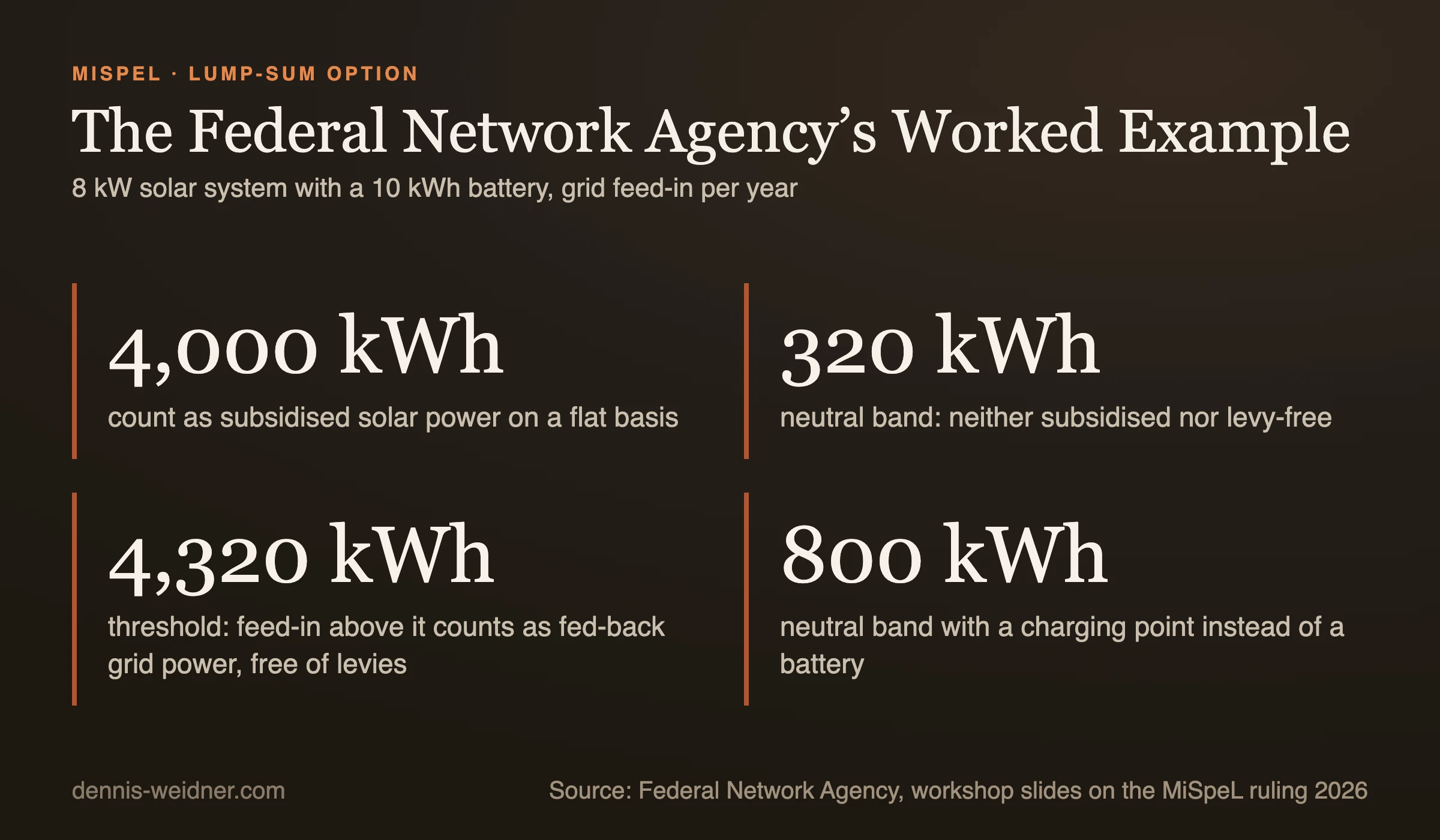
In its workshop slides on the final ruling the agency works through an 8 kW solar system. The flat subsidy limit is then 4,000 kWh a year, 8 kWp times 500 kWh. Above that sits a neutral band in which feed-in counts neither as subsidised solar power nor as fed-back grid power. Only what is fed in beyond that at prices that are not negative counts as fed-back grid power and reduces levies, at most up to your own grid purchases for the year.
| Case with 8 kWp of solar | Subsidised solar power up to | Neutral band | Levy-free feed-back above |
|---|---|---|---|
| with a 10 kWh battery | 4,000 kWh a year | 320 kWh | 4,320 kWh |
| with a bidirectional charging point, no battery | 4,000 kWh a year | 800 kWh | 4,800 kWh |
The larger the battery relative to the solar capacity, the narrower the neutral band. For charging points the agency cut the factor from 0.5 in the working draft to 0.2, which narrows the band considerably. That was a central demand from the market.
Who can use MiSpeL: direct marketing only
This is the point to understand before planning anything. Both options require at least one renewable installation, together with the batteries and bidirectional charging points behind the grid connection, to be assigned to direct marketing with a market premium, as item 5 of the operative part of the ruling sets out. The agency says so explicitly in its background paper: the new rules apply to direct marketing, not to the fixed feed-in tariff. Solar systems in unsubsidised other direct marketing are covered as well.
For the typical homeowner with solar panels that means: if you stay on the fixed feed-in tariff, MiSpeL changes nothing for you. Your battery should keep charging solar power only if the subsidy is to stay safe. If you want to store grid power or let your car feed back into the grid, you need a direct marketer and switch the form of sale under the rules of sections 21b and 21c of the Renewable Energy Sources Act (EEG).
MiSpeL status: adopted, in force, with a transition period
The Federal Network Agency was legally required to conclude the determination by 30 June 2026. That deadline was missed; the agency pointed to evidence of perverse incentives from the consultation, as reported by pv magazine. A working draft followed on 5 August 2026 and the decision on 1 October 2026, 254 pages long according to the law firm BBH. It was published in the agency's official gazette on 7 October and has been in force since 21 October 2026. All documents are on the Federal Network Agency's MiSpeL page, the summary is in the press release of 1 October.
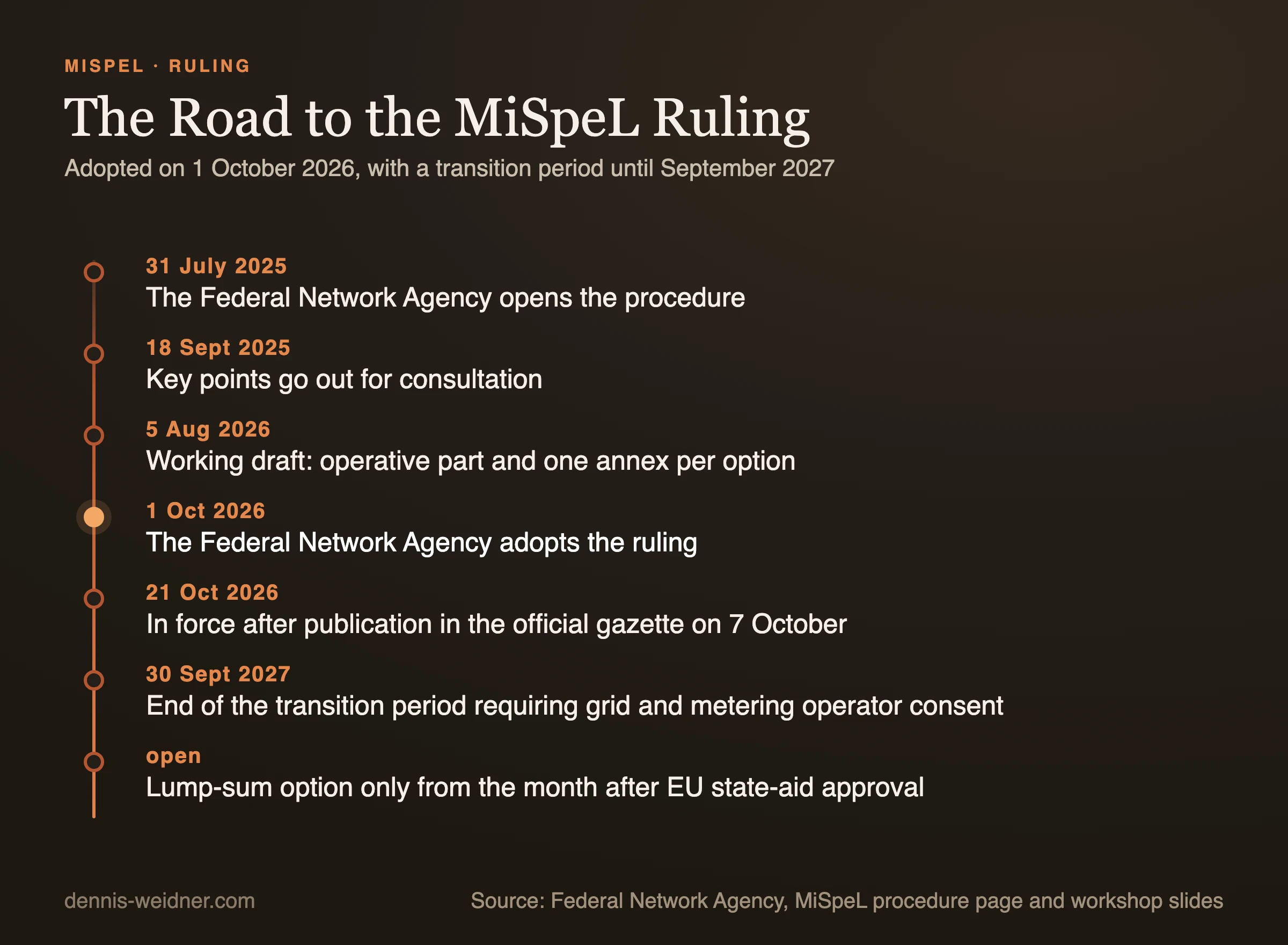
Two limits remain. During a transition period until 30 September 2027 both options can only be used with the consent of the grid operator and the metering operator, who use this time to set up their IT and billing processes for the mass market. And the lump-sum option applies only from the calendar month following state aid approval of the statutory basis by the European Commission. There is no date for that yet; as of 23 October 2026 the approval had not been granted. The delimitation option carries no such condition.
Compared with the 2025 consultation draft, the agency tightened the rules: installations without a market premium are now covered, the delimitation option settles monthly, and the lump-sum option gained the neutral band against perverse incentives. Until the end of September 2027, however, grid and metering operators effectively hold a veto, as BBH puts it. The rules are in place; whether you can use them yet is up to your grid operator.
What MiSpeL means for you in practice
If you have a home battery with solar on the fixed feed-in tariff: nothing changes for now. Whether switching to direct marketing pays off depends on your direct marketer, on a dynamic tariff, see Dynamic electricity tariffs 2026, and on whether your grid operator plays along during the transition. It only gets truly simple with the lump-sum option, because a single meter is then enough, and that option is still waiting for EU approval.
If you have or plan an electric car with a bidirectional wallbox: this is where MiSpeL brings the most. Vehicle-to-home and vehicle-to-grid become possible, with the lump-sum option even without a second meter. The rules look at the charging point, not the individual car, so any bidirectional car can be integrated at any bidirectional wallbox. You keep paying levies and grid fees on driving power drawn from the grid, and power the car charged elsewhere, at work for example, gets no renewable subsidy when it is fed back.
If you operate storage commercially: the delimitation option comes with its own formula sets, for example for integrating a heat pump and for batteries in energy-intensive industry. Settle the metering concept with your grid and metering operators early, because you need their consent during the transition. Reversing that decision later costs money.
If you develop grid-scale storage: batteries next to a ground-mounted solar farm or a wind turbine get their own formula sets, and the solar share keeps its subsidy even when the battery also trades grid power. Every financing model needs to account for the consent of grid and metering operators until the end of September 2027, and for the rule that feed-in at negative prices earns no levy benefit and, where the EEG provides for it, no subsidy. The overall picture on storage projects is on my topic page on BESS and energy storage.
Why I follow MiSpeL so closely
Because it makes visible what actually slows the energy transition down. It is rarely the batteries and rarely the technology. It is the question of how a kilowatt hour is treated in regulation when it could have two origins. Rules like this decide whether a storage project gets built or stays in the drawer.
And because there is a wide gap between this regulation and what people and companies eventually buy. Anyone trying to find out today whether a battery pays off mostly finds vendor promises and very few defensible numbers.
Frequently Asked Questions
What does MiSpeL mean?
MiSpeL stands for Marktintegration von Speichern und Ladepunkten, the market integration of storage systems and charging points. It is a determination by Germany's Federal Network Agency (file number 618-25-02), not standalone legislation, adopted on 1 October 2026. It governs how electricity volumes are treated when a battery or charging point takes in both subsidised solar power and grid power.
Since when does MiSpeL apply?
The Federal Network Agency adopted the ruling on 1 October 2026 and published it in its official gazette on 7 October; it has been in force since 21 October 2026. Until 30 September 2027 the options can only be used with the consent of the grid and metering operators.
Can I use MiSpeL on the fixed feed-in tariff?
No. Both options require the solar system, the battery and any bidirectional charging points to be assigned to direct marketing with a market premium. If you keep the fixed feed-in tariff, your battery should keep charging solar power only if the subsidy is to stay safe.
What is the difference between the delimitation and the lump-sum option?
The delimitation option meters storage and charging points through a separate meter in quarter-hour intervals and is open to installations of any size. The lump-sum option applies to solar systems up to 30 kWp, needs only a quarter-hour meter at the grid connection and works with flat limits: up to 500 kWh of feed-in per kWp a year counts as subsidised solar power.
When does the lump-sum option apply?
Only from the calendar month following state aid approval of the statutory basis by the European Commission. As of 23 October 2026 that approval had not been granted, and no date has been set. The delimitation option is not affected.
What does MiSpeL change for bidirectional charging?
MiSpeL makes vehicle-to-home and vehicle-to-grid possible, with the lump-sum option even without a second meter. The renewable subsidy for solar power stays in place even if the car battery has charged grid power. Levies and grid fees remain payable on driving power drawn from the grid.
What does MiSpeL have to do with BESS?
BESS stands for Battery Energy Storage System. MiSpeL is the regulatory framework that determines how flexibly such a system may be operated in Germany without putting subsidy entitlements at risk. Without these rules a lot of storage capacity stays unused.
Warm regards,
Dennis Weidner
Note: AI tools supported me in writing this article, and some images were edited with AI. I stand behind its content and every statement with my name.