Search for solar subsidies in Germany today and you mostly find the feed-in tariff. It is the smallest and the fastest shrinking part of the picture. The three instruments that actually move money in 2026 appear in no subsidy database, because two of them are tax law and the third is a loan. Together they are worth more on a typical system than the feed-in tariff of its first ten years.
Subsidy is not the same as feed-in tariff
The confusion starts with the language. When people say subsidy, most think of a payment per kilowatt hour. In reality the German state supports a solar system along four routes at once: through the purchase price, through the tax on the yield, through the financing, and through the tariff for feeding in. Only the fourth sits in the Renewable Energy Sources Act, and only the fourth is currently disappearing. Why, I described in Feed-in Tariffs in Decline.
More on this topic: Battery Storage & Energy – background, practice and every article in one place.
Knowing the other three changes how you read a quote. Not knowing them means comparing offers by a number that loses its meaning in 2027 anyway.
The three instruments that stay
Zero VAT on purchase and installation. Since 2023 the supply and installation of photovoltaic systems on or near residential buildings carries a value added tax rate of zero percent, set out in section 12 (3) of the German VAT Act. The rule has no expiry date and covers modules, inverters, mounting systems and battery storage. On a 10 kWp system with storage, roughly 18,000 to 25,000 euros gross, that is around 3,400 to 4,800 euros compared with the previous 19 percent. It is not a grant you apply for. It is one you receive at purchase without noticing.
Income tax exemption. Section 3 no. 72 of the Income Tax Act exempts revenue from small systems from income tax. That removes not only the tax burden but above all the paperwork: no profit calculation, no separate tax schedule. Anyone who has ever prepared a tax return for 400 euros of annual yield knows the simplification can be worth more than the amount.
The KfW 270 loan. It finances up to 100 percent of the investment, covering solar, storage, wall boxes and solar thermal, with fixed interest over 5 to 20 years. The effective rate starts at roughly 3.9 percent depending on creditworthiness, with the house bank typically adding 0.2 to 0.5 percentage points. It is not free money, but it is the difference between a system paid out of savings and one that carries itself.
On top come state and municipal programmes, which vary widely and often target storage, green roofs or tenant power models. They are the one part where searching genuinely pays, because they are regional and rarely easy to find.
Add the three instruments up on a typical system and you get an order of magnitude that makes the focus on the tariff look distorted. On a 10 kWp system with storage the VAT benefit alone is around 3,400 to 4,800 euros. The feed-in tariff of that same system, at 7.70 cents and roughly 6,300 exported kilowatt hours, brings about 485 euros a year. The tax benefit therefore corresponds roughly to the first seven to ten years of exports, and it arrives on the day of purchase rather than spread over two decades.
Then there is plug-in solar, even though it is not a subsidy in the narrow sense. In 2025 the Federal Network Agency recorded around 430,000 balcony systems totalling 0.5 gigawatts, 3.2 percent of all new capacity. For grid planning that is a footnote. For the question of how many households now generate their own power, it is the most important figure in the data set.
Where capacity is actually growing
It is worth holding the subsidy debate against the installation figures. You then see that the business has already shifted before politics caught up.
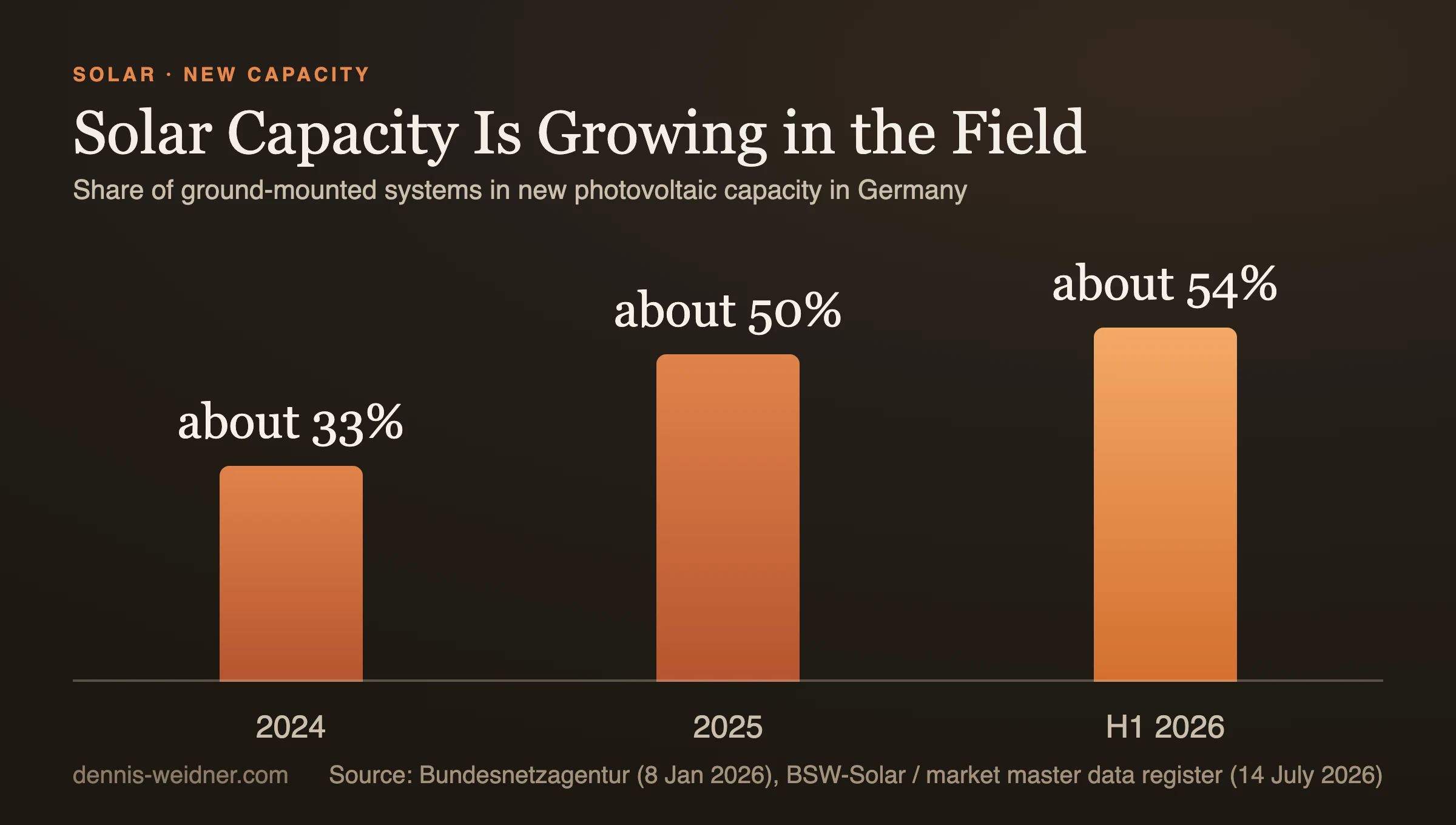
In 2025 Germany added 16.4 gigawatts of solar capacity, reaching 117 gigawatts installed by year end. The first half of 2026 added 7.4 gigawatts, about nine percent more than the same period a year earlier. The German Solar Association attributes that increase mainly to one-off effects and warns of a slowdown from 2027.
The real news sits in the split. In 2024 the rooftop to ground ratio was two to one, in 2025 one to one, and in the first half of 2026 ground-mounted systems took the majority. Rooftops are losing share even though they are the politically more popular option. And that is exactly where the legislator is now pointing: the cabinet draft explicitly speaks of strengthening the more cost-effective ground-mounted plants.
What the draft does to the rooftop
From 2027 rooftop systems below 25 kilowatts would lose their fixed tariff, replaced by direct marketing plus a bonus of 1.5 cents per kWh for at most 48 months. On top comes the cap limiting feed-in to 50 percent of system capacity.
That cap is the quietest and most effective subsidy decision in the whole package, only with the sign reversed. It subsidises nothing, it forces something: if you may not feed in the second half of your midday output, you have three options. Let it go, use it yourself, or store it. For most households that means a battery stops being a comfort decision.
The support effect therefore moves from the export meter to the self-consumption rate. And that depends on three things which have nothing to do with modules: a battery sized to the actual load, a controller that starts the heat pump and the car at the right moment, and a dynamic electricity tariff that makes cheap hours visible in the first place.
Where this becomes a business
Subsidy advice as a product, not a giveaway. The four routes are not hard to understand, but they sit in four different places. Nobody shows a customer what zero VAT, tax exemption, a KfW loan and a regional programme add up to. Do that cleanly on one page and the sale gets easier.
Retrofitting storage into existing systems. More than a million German rooftop systems run without storage, many of them on a tariff far above today's rate. Legally nothing changes for them. Economically everything does, as soon as bought electricity costs more than their own tariff.
The land itself. If the majority of new capacity moves to open ground, the scarce resource is not the module but the site with a grid connection. That is a real estate business wearing an energy badge, and it is remarkably poorly organised.
Metering and control. No direct marketing without a smart metering system. The rollout is the bottleneck of the entire model, see Germany's Smart Meter Rollout 2026.
I am building a comparison platform for the entire energy world, from solar and storage through heat pumps and split systems to the circular economy. Every figure there carries its source, every subsidy claim its reference in the actual guideline, and the research behind this article is part of it.
What I would tell someone building now
First: do not optimise for the tariff. It is the smallest component and the only one that falls on a schedule.
Second: take the connection date seriously. Under the current draft, the distance between commissioning in December 2026 and February 2027 is twenty years of known rules versus a market product. That is not scaremongering. It is a date.
Third: size the battery to your own load profile, not to the catalogue. The 50 percent cap turns a rough rule of thumb into a calculation worth doing.
And fourth: compare quotes by who handles the grid connection and the registration. That is where German projects stall, not at the mounting rail.
Frequently Asked Questions
What solar subsidies still exist in Germany in 2026?
Four routes in parallel: a zero percent VAT rate on purchase and installation under section 12 (3) of the VAT Act, the income tax exemption under section 3 no. 72 of the Income Tax Act, the KfW 270 loan for financing, and the feed-in tariff under the Renewable Energy Sources Act. Regional and municipal programmes come on top.
How much does the zero VAT rate actually save?
On a 10 kWp system with storage and gross costs of 18,000 to 25,000 euros, dropping the 19 percent VAT is worth roughly 3,400 to 4,800 euros. The benefit arises directly at purchase, no application required.
Is the KfW 270 loan worth it?
It finances up to 100 percent of the investment including storage and wall box, with fixed interest for 5 to 20 years and an effective rate from around 3.9 percent depending on creditworthiness. It is not a grant, but it often decides whether a system can be carried by the savings it generates.
Why is new capacity moving to open land?
Because ground-mounted plants are cheaper per kilowatt hour. In 2024 the rooftop to ground ratio was two to one, in 2025 one to one, and in the first half of 2026 about 54 percent of new capacity was ground-mounted.
Will I need a battery from 2027?
It is not mandatory. But the cabinet draft caps feed-in from small rooftop systems at 50 percent of capacity. Without storage or well-timed self-consumption the rest is lost, which noticeably changes the economics.
Warm regards,
Dennis Weidner
Note: AI tools supported me in writing this article, and some images were edited with AI. I stand behind its content and every statement with my name.