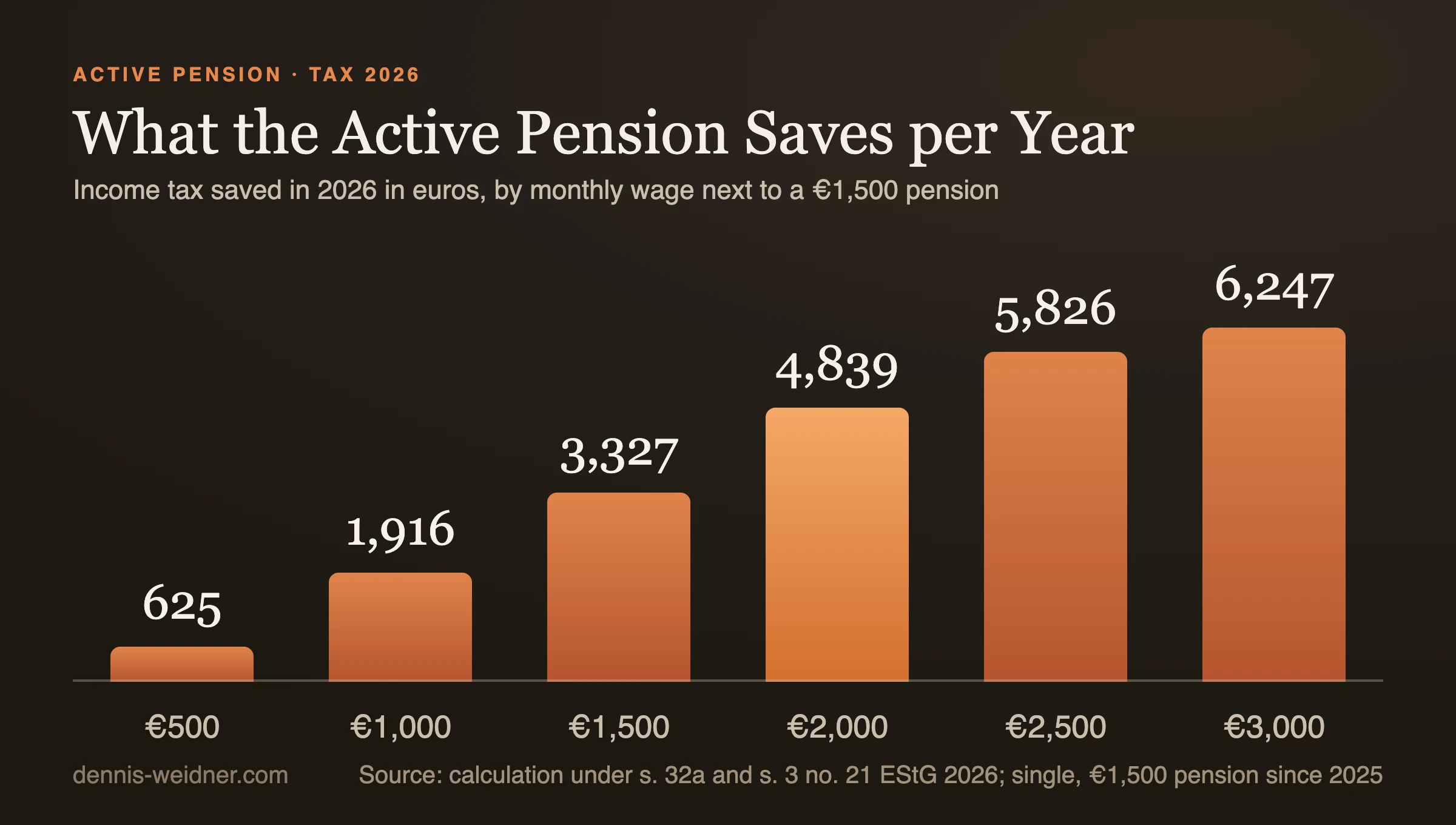
Since 1 January 2026, Germany has exempted up to 2,000 euros a month of wages from income tax for people who have reached the statutory retirement age and keep working as employees subject to social insurance. The rule is called the Aktivrente, or active pension, and sits in Section 3 No. 21 of the Income Tax Act (EStG). Next to a 1,500 euro pension, it saves someone earning 2,000 euros a month a little over 4,800 euros of income tax a year. The self-employed, freelancers, civil servants and mini-jobbers do not get it. On 14 October 2026, the Bundestag's petitions committee saw no reason to change that.
As of 25 October 2026. Not tax advice, see the note at the end.
More on this topic: Finance & Crypto Assets, with background, practice and every article in one place.
What Is Germany's Active Pension? The Rule in Section 3 No. 21 EStG
Despite its name, the active pension is not a pension at all. It is a tax exemption on wages. It is one of the pension measures of Germany's coalition government, alongside the early-start pension for children and the new retirement account that starts in 2027. The text of Section 3 No. 21 EStG sets 24,000 euros a year and reduces that by one twelfth for every month in which the conditions are not met. In practice that means a maximum of 2,000 euros per month, and whatever is unused in one month is lost. Someone earning 1,500 euros part-time cannot shift the remaining 500 euros onto a Christmas bonus.
The exemption applies from the month after the statutory retirement age is reached. Drawing a pension is not required. That retirement age is not yet 67 in 2026: under Section 235 of Social Code Book VI, people born in 1959 reach it at 66 years and two months, those born in 1960 at 66 years and four months. Only from the 1964 cohort does 67 apply. Anyone who retired early has to wait until that date.
Who Gets the Active Pension and Who Does Not
The exemption goes to anyone earning wages from employment for which the employer must pay statutory pension insurance contributions. The Federal Finance Ministry's FAQ on the active pension, dated 25 June 2026, explicitly excludes:
- the self-employed, trade businesses and freelancers with their profits,
- civil servants (Beamte) who stay in office beyond the age limit,
- members of parliament,
- mini-jobbers, Germany's marginal jobs with flat-rate contributions.
Only the current job counts. A former freelancer who takes up employment at 67 qualifies. So does a retired civil servant working as an employee. Jobs in the so-called transition zone up to 2,000 euros a month are covered on the full wage.
For founders, one line in the FAQ matters: for a shareholder-managing director of a GmbH, Germany's limited liability company, it depends on whether pension contributions must be paid. A managing director who controls the company is generally not treated as an employee for social insurance purposes, so no mandatory contributions flow. That salary then stays fully taxable.
Active Pension and Social Security: What Is Still Paid
Social insurance obligations do not change. Tax-free does not mean contribution-free. After the retirement age, the employee's side looks like this:
- Health and long-term care insurance: still payable. Anyone drawing a full old-age pension has no right to sick pay and therefore pays the reduced rate of 14.0 percent, half of it as the employee share.
- Pension insurance: exempt when drawing a full pension (Section 5 (4) SGB VI). The employee can waive that exemption in writing, pay his share and increase his future pension.
- Unemployment insurance: exempt from the month after the retirement age (Section 28 SGB III).
The employer still pays its half of pension and unemployment insurance (Section 172 (1) SGB VI, Section 346 (3) SGB III). That very obligation is what unlocks the active pension.
There is no progression clause (Progressionsvorbehalt), the German mechanism that lets tax-free income raise the rate on other income. Section 32b EStG lists the benefits it applies to exhaustively, and Section 3 No. 21 is not among them. The tax-free 2,000 euros therefore do not push up the rate on the pension. There is one offset, though: work expenses and health and care contributions attributable to the tax-free wage are not deductible.
The Active Pension Calculated: Net Effect at 1,000, 2,000 and 3,000 Euros
The table covers the year 2026 for a single person with one child, born in 1959, drawing a pension since 2025 of 1,500 euros gross a month, in the statutory health scheme, without church tax, employed all year. It includes the taxable share of the pension of 83.5 percent, standard allowances, the old-age relief amount and deductible health and care contributions. The tariff is the basic schedule under Section 32a EStG for 2026. The pension on its own costs 45 euros of tax a year in this case.
| Gross monthly wage | Annual tax without active pension | Annual tax with active pension | Saving per year | Net from the wage per month, without / with |
|---|---|---|---|---|
| €1,000 | €1,961 | €45 | €1,916 (€160 a month) | €738 / €898 |
| €2,000 | €4,884 | €45 | €4,839 (€403 a month) | €1,392 / €1,795 |
| €3,000 | €8,208 | €1,961 | €6,247 (€521 a month) | €2,012 / €2,533 |
"Net from the wage" is the gross wage minus the employee's own health and care contributions (10.25 percent) minus the extra tax the wage triggers on top of the pension. Up to 2,000 euros the wage becomes practically tax-free, above that the saving flattens. At 3,000 euros the part above 2,000 is taxed exactly like the first euro of someone earning 1,000 euros without the exemption: the 1,961 euros of tax are identical in both rows. Higher earners save more in absolute terms, but never more than the tax on 24,000 euros.
For scale: the explanatory memorandum to the bill, Bundestag document 21/2673, puts the revenue loss at 890 million euros a year and assumes 168,000 beneficiaries. That is just under 5,300 euros per person on average, more than the middle row. The legislator expects full-time staff rather than occasional helpers.
What the Active Pension Means for Employers
For employers, the active pension shifts the negotiation: same labour cost, clearly more net pay for the employee. In the example above, 2,000 euros gross with the exemption leaves 1,795 euros net, more than 2,500 euros gross without it (1,706 euros). Anyone who wants to keep an experienced worker beyond the retirement age can now make a better offer at a lower gross salary than before 2026.
Three duties and one relief come with it:
- Payroll: the employer must apply the exemption in wage tax withholding, it is not optional.
- Second jobs: in tax class VI, the class for a second employment, only with the employee's written confirmation that no other employer already uses the exemption. The confirmation goes into the payroll file.
- Reporting: for 2026, the amount is reported on the electronic wage tax certificate in a free line labelled "SteuerfreibetragAktivrente".
- Fixed-term contracts: under Section 41 (2) SGB VI, the German ban on repeat fixed-term contracts without cause does not apply to employees past the retirement age, up to eight years and twelve contracts in total. An agreed end date at the retirement age can also be postponed during the employment.
Why the Self-Employed Get Nothing From the Active Pension, With Numbers
The explanatory memorandum gives two reasons. The aim is to promote dependent employment, where the skills shortage is growing. And many self-employed people already keep working past the retirement age, so an extra incentive is not needed.
The numbers show what that means in a single case. A freelancer with the same pension and a profit of 2,000 euros a month gets no exemption; the column without the active pension applies to him. He pays roughly 4,500 to 5,200 euros of income tax a year, depending on how much health and care contribution falls on his profit, and he has no employee lump-sum allowance of 1,230 euros. His employed neighbour with a 2,000 euro wage pays 45 euros. For the same amount of work that is about 400 euros a month.
I find the reasoning weak. Self-employed people who work past the retirement age often do so out of economic necessity, as even the CDU argues in its party conference resolution. They also carry their health and care contributions alone. Those who want to build retirement savings now get a different route from 2027: Germany's new retirement account for the self-employed, which opens the state subsidy to them for the first time.
Active Pension for the Self-Employed: Where the Debate Stands in October 2026
As of 25 October 2026, there is no draft bill to extend it. The milestones:
- 27 November 2025: the chambers of commerce (IHK) call in their statement for the self-employed to be included, arguing that their labour supply also raises economic output.
- 21 February 2026: the CDU party conference resolves to seek an "incentive model based on the active pension" for the self-employed. A party resolution is not a law.
- 23 June 2026: the pension commission hands over its report. It recommends bringing all uninsured self-employed people who start out after a cut-off date into the statutory pension scheme, mandatorily and without opt-out.
- 14 October 2026: the Bundestag's petitions committee recommends by majority closing the petition to extend the active pension to the self-employed, because it cannot be granted. It points to the finance ministry's reasoning that a high share of the self-employed keep working past retirement age anyway, and to the planned review after two years, which is to examine an extension.
- By the end of 2029: according to document 21/2673, the government will review whether the active pension raised employment among older people and whether including the self-employed would add growth.
My assessment: nobody should plan on an extension before 2030. If mandatory pension insurance for the self-employed does come, however, it would create exactly the contribution obligation the law ties the active pension to. That would be the obvious lever. More on savings and money is collected under Crypto and Finance.
Frequently Asked Questions
Do I have to apply for the active pension?
No. The employer applies the exemption in payroll. If it was missed, the employer can correct it, otherwise it can be claimed in the income tax return.
Does the active pension apply if I do not draw a pension yet?
Yes. All that is required is having reached the statutory retirement age and a job for which the employer pays pension contributions. Anyone deferring the pension while working in insured employment also earns a 0.5 percent supplement per month on the later pension, according to the German pension insurance.
Do mini-jobbers get the active pension in Germany?
No. Mini-jobs are expressly excluded because flat-rate contributions and a flat 2 percent tax apply there. Jobs in the transition zone above 603 euros a month are covered.
Does the active pension increase the tax on my pension?
No. It is not subject to the progression clause. The pension is taxed as if the tax-free wage did not exist.
Can I use the active pension with two employers?
In payroll only with one. If part of the monthly amount remains unused there, the rest can be claimed for the second job through the tax return.
Note: This article is not tax advice. It describes the legal situation in Germany as of 25 October 2026. The calculation simplifies: it assumes the average additional health insurance contribution of 2.9 percent, no church tax, no other income and no joint assessment. For married couples, the privately insured or a different pension start the result will differ. Whether a shareholder-managing director is employed for social insurance purposes can only be settled bindingly through a status determination by the German pension insurance.
Best,
Dennis Weidner
Note: AI tools supported me in writing this article, and some images were edited with AI. I stand behind its content and every statement with my name.