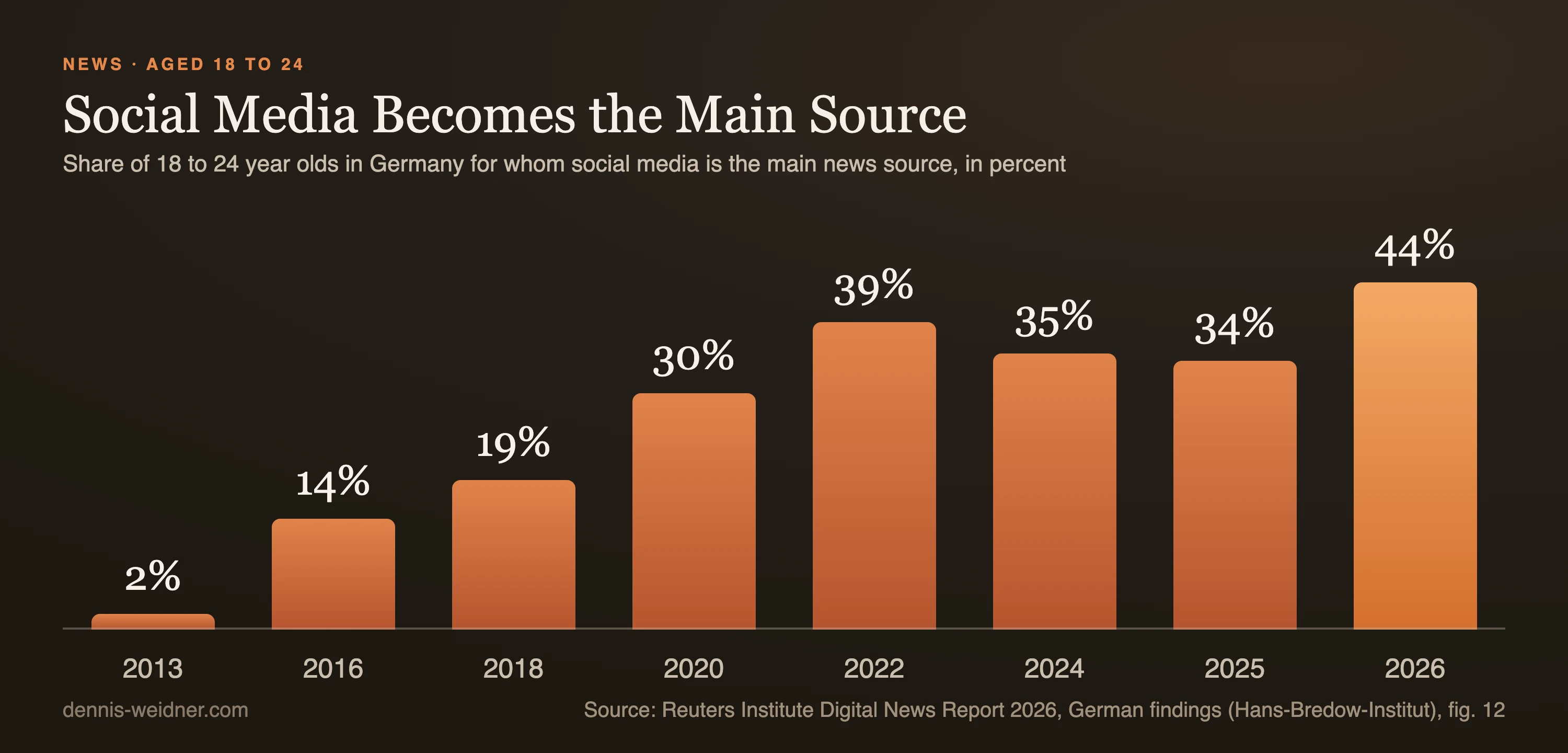
In 2026, 44 percent of 18 to 24 year olds in Germany name social media as their main source of news; in 2013 it was 2 percent. Research paints a more precise picture than the phrase "the algorithm radicalises": large experiments found no evidence that feeds amplify fringe parties more than moderate ones, but they do show that feeds capture time and sort content by reaction. In my view the danger lies in that combination of time, belonging and constant confirmation.
As of 27 September 2026.
More on this topic: Politics & Society, with background, practice and every article in one place.
Social media as a news source: what the numbers show
The Reuters Institute Digital News Report 2026, analysed for Germany by the Hans-Bredow-Institut, shows the shift clearly. Thirty-six percent of adult internet users encounter news on social media in a normal week. For 18 percent it is their main news source, a new high. Among 18 to 24 year olds it is 44 percent, up from 35 percent in 2024 and 34 percent in 2025. For 17 percent of the youngest group, social media is the only way news reaches them at all.
That is not bad news in itself. There is serious journalism on Instagram, YouTube and TikTok too. But it means that it is no longer an editorial team that decides what a young person sees in the morning, but a ranking optimised for time spent.
A contradiction: using what you do not trust
One finding from the same report stands out. Only 13 percent of adult internet users mostly trust news on social media, compared with 24 percent for search engines and 46 percent for news in general. Yet use keeps growing. Among 18 to 24 year olds, 85 percent use Instagram and 52 percent also use it for news. People know they are not looking at the most reliable source, and they stay anyway. That points to habit and convenience rather than conviction, and it shows how strong the pull of the platform is. Anyone who wants to strengthen young people's news literacy has to start where they actually get informed, instead of recommending channels they no longer open.
What algorithms actually amplify: the research
Public debate often moves faster than research. Three large studies deserve a close look, because they are based not on surveys but on experiments with real users or bots.
| Study | Platform and method | Finding |
|---|---|---|
| Huszár et al., PNAS 2022 | Twitter, control group of almost 2 million daily active accounts with a chronological feed | In six of seven countries the algorithm amplified the mainstream right more than the mainstream left. No evidence that it amplified fringe parties more than moderate ones. |
| Guess et al., Science 2023 | Facebook and Instagram, 2020 US election, users switched to a chronological feed | Less time on the platform, more political and more untrustworthy content, but no measurable change in polarisation over three months. |
| Hosseinmardi et al., PNAS 2024 | YouTube, bots imitating real users versus bots that only follow recommendations | Relying only on recommendations leads on average to less partisan consumption, especially for heavy consumers of partisan content. |
The originals are public: the Twitter study by Huszár and colleagues, the Facebook experiment by Guess and colleagues and the YouTube study by Hosseinmardi and colleagues. Together they refute the simple claim that an algorithm automatically pushes everyone to the edges. But they also show that algorithms capture attention: without them, users spent considerably less time on the platforms.
The rabbit hole: why it still feels that way
My own experience nevertheless matches what many people describe. Social media eats time. Every click brings something similar, only a little more pointed, and after half an hour you are in a rabbit hole you never meant to enter. That applies to every topic, from nutrition and finance to crypto and parenting, and in politics to every direction, not only the right. The AfD, though, plays the platforms particularly well.
The studies and this impression contradict each other less than it seems. An algorithm does not need to radicalise anyone to build bubbles. It is enough that it shows what already interests you and that you follow channels that confirm you. For some people the end point is the feeling that their own opinion and that of their bubble is the only correct one. Add isolation and, for many younger people, low moods when the screen replaces conversation.
Belonging and agency: what new movements promise
People want to belong, and they want to make a difference. Social media delivers both instantly: a like, a group, a shared outrage. New movements use this with a simple promise: "We are the revolution." Anyone who does not feel heard in daily life finds a role there. Why so many people feel let down by the political centre is the subject of Political Discontent in Germany. Social media does not create this discontent, but it amplifies it and gives it a stage.
What policymakers and platforms can do
One lever already exists. Under Article 38 of the Digital Services Act, very large online platforms must offer at least one option for each recommender system that is not based on profiling. In everyday use this option is often hard to find. I would require it to be reachable with one tap and platforms to disclose how many users choose it. For adults I consider bans the wrong approach. Transparency and real choice are the right one.
For children and teenagers the debate is currently going a step further. In June 2026 the expert commission on protecting children and young people in the digital world handed Germany's education and family minister Karin Prien 56 recommendations. Prien considers a statutory minimum age of 13 for using social media independently the right way forward, combined with effective age verification and graduated protection up to 18, and wants providers to build in safety from the start, "safety by design". On 17 September 2026 the European Commission put forward its proposal for an EU KIDS Act: children under 13 would have no access to social media platforms, an account of one's own would be possible EU-wide only from 15, and platforms would have to show that their services are age-appropriate and safe by design. Both start at the same point as the studies above: not with the individual post but with how the platform is designed.
Why this matters for founders and businesses
For entrepreneurs this is not a side issue of politics. Anyone looking for staff, customers or investors today meets people whose picture of business, taxes and entrepreneurship comes largely from feeds. There, pointed stories about greedy companies or about the state as an enemy reach further than a sober explanation of how a small company pays its wages. I therefore think it is the job of entrepreneurs to explain their daily reality themselves, factually and with numbers. This blog is my attempt to do that. That includes showing openly where the state falls short, for example with faulty tax assessments that have to be corrected by objection, or with the question of who actually supervises a tax office. I answer that in How German Tax Offices Are Supervised. Factual criticism is the best antidote to the pointed kind. How to win trust in a feed full of doubt is something Tesla has just shown: with the kickflip of the new Roadster, the company delivered the proof against the AI suspicion along with the stunt.
What I take from this, personally and as an entrepreneur
I deliberately read news where an editorial team makes the selection, and I watch political programmes in which people with different positions sit at the same table. I recommended this in the opening piece of this series, Entrepreneurs and Politics. As an entrepreneur the same rule applies: a company that reaches its customers only through algorithmic feeds depends on their ranking. Owned channels such as a newsletter or a blog mean independence.
Frequently Asked Questions
Do social media algorithms radicalise people?
The large experiments find no simple evidence for this. Twitter did not amplify fringe parties more than moderate ones, and a chronological feed on Facebook did not measurably change polarisation. But algorithms capture time and sort by reactions, which favours bubbles.
How many young Germans get their news from social media?
According to the Digital News Report 2026, social media is the main news source for 44 percent of 18 to 24 year olds in Germany. For 17 percent it is the only one.
What is the EU planning on age limits for social media?
On 17 September 2026 the European Commission proposed an EU KIDS Act. Under it, children under 13 would have no access to social media platforms, and an account of one's own would only be possible from 15. In Germany, education and family minister Karin Prien considers a minimum age of 13 with effective age verification the right way forward.
What is a social media rabbit hole?
It describes the effect of recommendations showing more and more of the same, often a little more pointed, until you have spent a lot of time on a single topic or a single point of view.
Can I switch off the algorithm on Instagram or TikTok?
Under Article 38 of the EU Digital Services Act, very large platforms must offer at least one option not based on profiling, such as a chronological or non-personalised feed. Where it is located differs by app.
Is only right-wing politics amplified on social media?
No. Sorting content by reaction affects every topic and direction. The 2022 Twitter study did find, however, that the mainstream right was amplified more than the mainstream left in six of seven countries.
Best,
Dennis Weidner
Note: AI tools supported me in writing this article, and some images were edited with AI. I stand behind its content and every statement with my name.