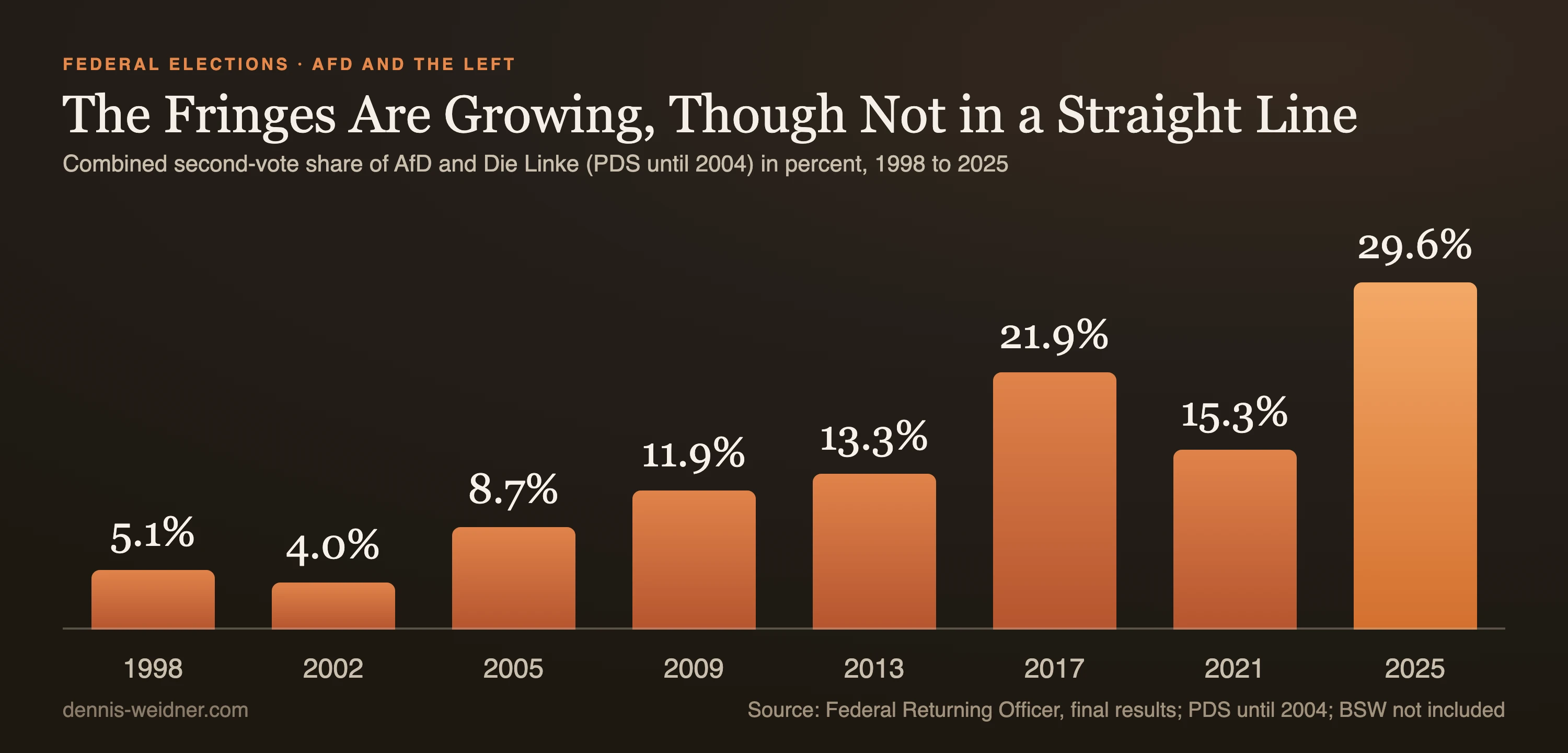
In the state election in Saxony-Anhalt on 6 September 2026, the AfD and Die Linke (The Left) together won 52.3 percent of the second votes, the party-list votes that decide the make-up of parliament; nationwide they won 29.6 percent in the 2025 federal election, and in 1998 just 5.1 percent. At the same time, according to the Deutschland-Monitor 2025, 98 percent of people support democracy as a form of government, but only 60 percent are satisfied with how it works. To me this is not a sign that people reject democracy. It is a sign that they feel let down by a system that solves too little.
As of 27 September 2026.
More on this topic: Politics & Society, with background, practice and every article in one place.
The centre and the fringes in numbers
The trend can be read from the results published by the Federal Returning Officer. The CDU/CSU and SPD, which together long held three quarters of the vote, reached 44.9 percent in 2025. The AfD and Die Linke, known as PDS until 2004, reached 29.6 percent together. On top of that, the new BSW party won 4.98 percent, just below the five-percent threshold.
| Federal election | CDU/CSU and SPD combined | Die Linke (PDS until 2004) | AfD | AfD and Die Linke combined |
|---|---|---|---|---|
| 1998 | 76.1% | 5.1% | did not stand | 5.1% |
| 2005 | 69.4% | 8.7% | did not stand | 8.7% |
| 2013 | 67.3% | 8.6% | 4.7% | 13.3% |
| 2017 | 53.4% | 9.2% | 12.6% | 21.9% |
| 2021 | 49.8% | 4.9% | 10.4% | 15.3% |
| 2025 | 44.9% | 8.8% | 20.8% | 29.6% |
The totals are calculated from absolute votes, so in some years they differ by a tenth of a point from the sum of the rounded individual figures. The trend is not a straight line. In 2021 the fringes shrank because Die Linke almost halved and the AfD also lost. That shows voters can be moved, in both directions.
The state elections of September 2026
In September 2026 this picture continued in three states, and more clearly than at federal level. In Saxony-Anhalt the AfD and Die Linke together won 52.3 percent on 6 September according to the final result published by the state returning officer, while the CDU and SPD won 26.5 percent. In Mecklenburg-Western Pomerania the provisional result of 20 September gave the AfD and Die Linke 44.8 percent, and the CDU fell below the five-percent threshold with 4.9 percent. In Berlin, on the same day, Die Linke became the strongest party with 25.7 percent; together with the AfD the two reached 41.9 percent according to the provisional result.
| State election 2026 | AfD | Die Linke | AfD and Die Linke combined | CDU and SPD combined | Turnout |
|---|---|---|---|---|---|
| Saxony-Anhalt, 6 September | 43.8% | 8.6% | 52.3% | 26.5% | 77.8% |
| Mecklenburg-Western Pomerania, 20 September | 38.2% | 6.5% | 44.8% | 40.4% | 78.1% |
| Berlin, 20 September | 16.3% | 25.7% | 41.9% | 30.9% | 74.2% |
Saxony-Anhalt shows the final result, Mecklenburg-Western Pomerania and Berlin the provisional results; the totals are calculated from absolute second votes. In all three states the two parties on the fringes together won more votes than the CDU and SPD, in Saxony-Anhalt more than half. State elections follow their own rules, the parties are rooted differently in the east than in the west, and Berlin is a big city. The direction is nevertheless the same as at federal level.
Why people feel let down by the system
The Deutschland-Monitor 2025, a government-funded annual survey by the Centre for Social Research Halle, the University of Jena and the GESIS institute, measures exactly this gap. Ninety-eight percent support democracy as a form of government. Only 60 percent are satisfied with how it actually works. In eastern Germany the figure recently rose from 43 to 51 percent. Looking back over ten years, 71 percent see a rather negative development of democracy; among people with populist attitudes it is 85 percent.
One finding from the same study strikes me as particularly important: the willingness to accept change and burdens rises when the state is seen as capable of acting and when decisions are understandable. So the problem is not that people do not want reform. The problem is that they do not believe the state will deliver it.
The structural problem: everyone has a say, nobody decides
For me, democracy means winning majorities for your proposals. In practice I see something else: everyone speaks up loudly, every opinion counts as equally valid, and everyone has to be heard before anything happens. That is well meant and still paralysing. More parties in parliament mean longer coalition talks and more fragile alliances. In the opening piece of this series, Entrepreneurs and Politics, I showed that in 2017 it took 171 days until a chancellor was elected. According to the Bundestag's data handbook, it was 31 days in 2009, 73 in 2021 and 72 in 2025. For a business, two and a half months without a government are two and a half months without a reliable line on taxes, energy and funding. For a citizen waiting for a decision, they feel like standstill, even if negotiations are going on in the background.
Citizens who feel that nothing moves despite all the debates look for parties that promise to do everything differently. I consider that a rational reaction to a political centre that administered too long and decided too little.
Discontent is not apathy
Anyone who talks about political apathy overlooks one number. In 2025, according to the Federal Returning Officer, 82.5 percent of eligible voters turned out, more than in any federal election since 1998, when the figure was 82.2 percent. In 2009 turnout was 70.8 percent, in 2021 76.4 percent. In the state elections in September, turnout was 77.8 percent in Saxony-Anhalt and 78.1 percent in Mecklenburg-Western Pomerania. People are not turning away from politics. They go and vote, and they vote differently.
That is good news for democracy and uncomfortable news for the parties of the centre. Anyone who votes and still does not choose the parties that have governed the country for decades is saying something very concrete: I want things to change, and I no longer trust you to do it. That message is more precise than any poll, and it cannot be answered with campaigns, only with results people notice in their daily lives.
What entrepreneurs experience of the state
As an entrepreneur I experience the state mainly as an authority. The tax office can query bank accounts, seize funds and enforce assessments before a court has looked at the case. For the tax offices alone, the Federal Central Tax Office ran 169,901 account data queries in 2023, according to the federal government's answer to parliament; across all authorities there were 1.4 million. Anyone who fights back applies for a suspension of enforcement, on which the same tax office decides first. Assessments arrive with the wrong progression rate or amounts counted twice, and as a matter of principle you have to object first. Several times I had the feeling of being treated as an awkward case after winning an objection, because the next query and the next audit followed. How a German tax office is organised and who supervises it is covered in How German Tax Offices Are Supervised.
I am not writing this to disparage civil servants. I am writing it because this experience extends far beyond entrepreneurs. Anyone who mainly knows the state through demands, deadlines and forms, and rarely through a quick solution, loses trust in the parties that have run this state for decades.
Understanding is not agreement
I can understand why so many people vote for the AfD or Die Linke. I do not share their programmes, and on this blog I do not take sides for any party. But I know the dissatisfaction these votes come from, and I think it is wrong to dismiss it as mere protest. Anyone who wants to win back voters from the fringes has to take their experiences seriously, not just fight their parties. Writing these voters off hands them to those who promise simple answers. And listening to them often reveals things about authorities, rents, energy prices and waiting times that never reach any party headquarters.
What the centre must deliver now
The best answer to growing fringes is a centre that visibly solves problems. For me that means: public authorities get binding deadlines, and those who miss them bear the consequences. Anyone who has to correct a wrong assessment gets their costs reimbursed. Funding programmes become simple enough to apply for without a lawyer. And administration becomes digital, not as an announcement but as the standard. These are not questions of left or right. They are questions of whether the state works for its citizens.
Frequently Asked Questions
What share did the AfD and Die Linke win together in 2025?
In the federal election on 23 February 2025 they won 29.6 percent of the second votes together: the AfD 20.8 percent and Die Linke 8.8 percent. In 1998 the PDS stood at 5.1 percent.
How did the AfD and Die Linke do in the September 2026 state elections?
In Saxony-Anhalt they won 52.3 percent of the second votes together on 6 September 2026, in Mecklenburg-Western Pomerania 44.8 percent on 20 September and in Berlin 41.9 percent on the same day. The figures for Mecklenburg-Western Pomerania and Berlin are provisional results.
How satisfied are Germans with democracy?
According to the Deutschland-Monitor 2025, 98 percent support democracy as a form of government, but only 60 percent are satisfied with how it works. In eastern Germany the figure is 51 percent.
Why do people in Germany vote for the AfD or Die Linke?
The reasons vary. A recurring finding is dissatisfaction with how the state and democracy work. According to the Deutschland-Monitor, 71 percent see a rather negative development of democracy over the past ten years.
Do the CDU/CSU and SPD still have a majority?
Not in votes. In 2025 they won 44.9 percent together, compared with 76.1 percent in 1998. In the Bundestag they still hold a majority with 328 of 630 seats, because parties below five percent receive no seats.
When are people most willing to accept reforms?
According to the Deutschland-Monitor 2025, when burdens are seen as socially and generationally fair, the state is seen as capable of acting, and decisions are understandable.
Best,
Dennis Weidner
Note: AI tools supported me in writing this article, and some images were edited with AI. I stand behind its content and every statement with my name.