In Germany, an objection to a tax assessment does not stop the payment: the tax office may still enforce, look up your bank accounts and garnish them. Protection comes only from a suspension of enforcement (Aussetzung der Vollziehung), requested first from the tax office under Section 361 of the Fiscal Code and, after a refusal, from the tax court under Section 69 of the Tax Court Code. Tax courts took just over four months on average in 2024 to decide on the merits, and whoever loses pays 0.5 percent interest per month.
As of 25 September 2026. Not tax advice, see the note at the end.
More on this topic: Finance & Crypto Assets, with background, practice and every article in one place.
Why an Objection Alone Does Not Suspend Enforcement of a German Tax Assessment
Lodging an objection (Einspruch) does not suspend enforcement of the assessment, says Section 361(1) of the Fiscal Code (AO). The tax stays due. Anyone who does not pay owes late-payment surcharges (Säumniszuschläge) of 1 percent for every month or part of a month, and the enforcement unit may act, because anything whose enforcement has not been suspended is enforceable (Section 251(1) AO).
This is the point I criticised in my piece on entrepreneurs and politics: friends who run companies have seen the tax office look up and garnish their accounts while the dispute over the assessment was still open. Collect first, examine later. To prevent that, you need a second application alongside the objection.
Applying to the Tax Office for Suspension of Enforcement: Serious Doubts or Undue Hardship
The tax office should suspend enforcement if there are serious doubts about the lawfulness of the assessment or if enforcement would cause undue hardship (Section 361(2) sentence 2 AO). It requires a pending objection; a mere request to amend is not enough.
The bar is lower than many expect. Under settled case law of the Federal Fiscal Court (BFH), serious doubts exist if a summary review reveals weighty reasons against the assessment. They do not have to prevail; success need not be more likely than failure. The same test is set out in the Federal Finance Ministry's administrative guidance on Section 361 AO, which binds every tax office. Doubts should generally be accepted if the office departs from favourable BFH case law or if tax courts disagree and the BFH has not ruled.
Undue hardship is the weaker pillar: it requires disadvantages beyond the payment itself, such as a threat to the company's existence, which the applicant must set out in detail.
Two points decide a lot of money. If you file and justify the application before the due date, the suspension will as a rule apply from the due date, and no surcharges arise. And while the application is pending, the guidance says enforcement measures should not be taken, unless it is hopeless or obviously meant only to delay.
Security Deposits: When the Tax Office May Demand a Bank Guarantee
The tax office may make the suspension conditional on security (Section 361(2) sentence 5 AO), such as a cash deposit or a guarantee from a suitable guarantor, usually a bank (Section 241 AO). Under the guidance, security is appropriate when the claim is at risk and unreasonable when the assessment is very likely to fall. Anyone who cannot provide security despite reasonable efforts must not be asked for it where serious doubts exist. A suspension granted only against security counts as a partial refusal and opens the way to court.
Suspension Refused: Applying to the German Tax Court Under Section 69 FGO
If the tax office refuses, the tax court (Finanzgericht) can only be reached through an application under Section 69(3) of the Tax Court Code (FGO); a lawsuit against the refusal is not available (Section 361(5) AO). The application can be filed before any lawsuit, while the objection is still pending.
The hurdle sits in Section 69(4) FGO: the application is admissible only after the tax office has refused suspension in whole or in part, unless the office has failed to decide within a reasonable time without good reason or enforcement is imminent. A payment demand is not enough; the BFH requires that enforcement has begun or is about to begin (order of 6 March 2013, X S 28/12). The condition must be met when the application reaches the court and cannot be cured later.
| Point | Application to the tax office | Application to the tax court |
|---|---|---|
| Legal basis | Section 361(2) AO | Section 69(3) FGO |
| Requirement | pending objection, serious doubts or undue hardship | the same, plus refusal by the tax office, inaction without good reason or imminent enforcement (Section 69(4) FGO) |
| Deadline | none of its own while the objection runs; the objection itself within one month (Section 355 AO) | none of its own; the access condition must be met on filing |
| Who decides | the same tax office that issued the assessment | a panel, the rapporteur or a single judge, usually without a hearing |
| Cost | no fee | 2.0 court fees on 10% of the disputed amount; for €38,460 that is €296, plus adviser fees |
| Effect | suspension, often from the due date, limited to one month after the objection decision, revocable | court order; appeal to the BFH only if the court allows it (Section 128(3) FGO) |
Official statistics show how often applicants fail here. In 2024 the tax courts issued 2,059 orders in interim relief proceedings. 214 granted the application, 260 granted it in part, 876 rejected it as unfounded and 709 as inadmissible. More than one in three orders ended without the court looking at the merits. Anyone going to court should be able to prove the tax office's refusal or the start of enforcement.
How Long Does Suspension of Enforcement Take at the Tax Court?
Usually a few months. According to the Federal Statistical Office's 2024 report on the tax courts, the 1,350 proceedings decided on the merits took 4.1 months on average. 53 percent were done within three months, 80 percent within six. Just over 5 percent took longer than a year. The states differ widely: 7.4 months on average in Rhineland-Palatinate, 2.7 in North Rhine-Westphalia.
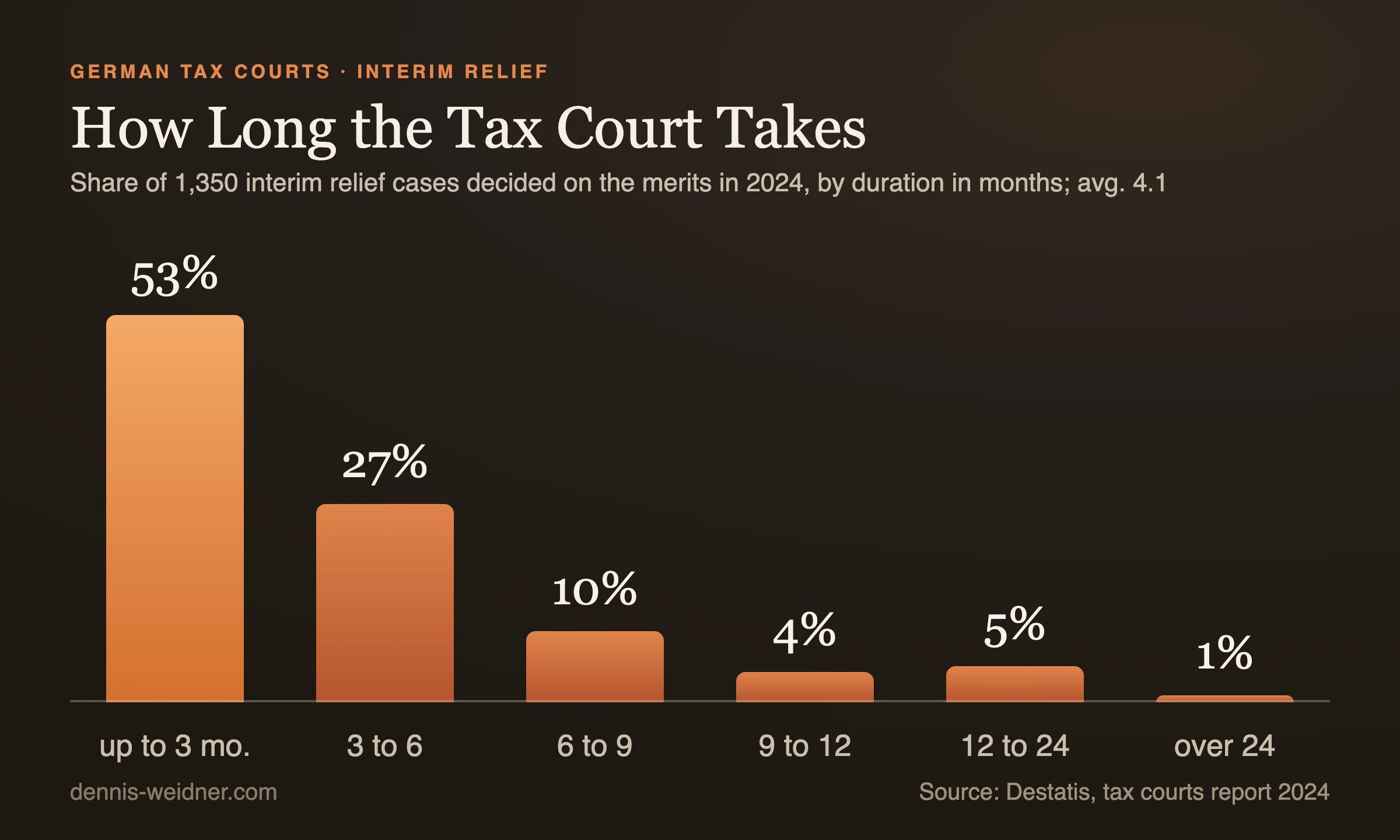
Four months is long for interim relief: a company with a garnished account pays neither wages nor suppliers. The number of applications has been falling for years: in 2007 the tax courts disposed of 8,144 applications under Section 69(3) FGO, in 2024 of 3,679.
What Happens While Enforcement Runs: Account Lookups, Garnishment, Deferral
Without a suspension, the tax office may ask the Federal Central Tax Office which banks a person holds accounts with, as far as this is needed to collect the tax (Section 93(7) no. 4 AO). It does not see balances, and the person is notified after the lookup (Section 93(9) AO).
Then comes the garnishment order, effective on service to the bank and covering the following days' balances too (Section 309 AO with Section 833a of the Code of Civil Procedure). How routine this is shows in the government bill for the 2026 Annual Tax Act: according to it, tax offices garnish around 1.5 million accounts a year. The bill of 14 August 2026 also introduces electronic account garnishment (new Section 309a AO).
Two levers remain without a suspension. If enforcement is unfair in the individual case, the enforcement unit may temporarily halt or limit it under Section 258 AO. And under Section 222 AO the tax office may grant a deferral (Stundung) in cases of considerable hardship, usually against security and with 0.5 percent interest per month.
A liability notice against a managing director can be suspended as well (Section 237(6) AO). When directors are liable in the first place is covered in my article on managing director liability in a German GmbH.
Suspension Interest Under Section 237 AO: What It Costs If You Lose
If the objection or the lawsuit finally fails, the suspended amount carries interest (Section 237(1) AO) at 0.5 percent for every full month (Section 238(1) AO). The lower 0.15 percent applies only to interest on back taxes under Section 233a AO; the 2026 bill raises that to 0.3 percent from 2027 and leaves suspension interest unchanged. The amount is rounded down to the nearest 50 euros.
The example: €38,460 of income tax is disputed (solidarity surcharge left aside). Assessment on 2 March 2026, due on 2 April, objection with a justified suspension request on 16 March. The tax office suspends from the due date, the objection decision arrives on 14 December, and the suspension ends one month later on 14 January 2027. That makes nine full interest months.
| Outcome | Calculation | Cost |
|---|---|---|
| Objection fully succeeds | no interest, Section 237 applies only on failure | €0 |
| Objection fails for half | €19,230 rounded down to €19,200 × 0.5% × 9 | €864 |
| Objection fails completely | €38,450 × 0.5% × 9 = €1,730.25 | €1,730 |
| Lawsuit fails too, suspension 30 full months in total | €38,450 × 0.5% × 30 = €5,767.50 | €5,767 |
| For comparison: no suspension, unpaid until 14 January 2027 | surcharge €38,450 × 1% × 10 started months | €3,845, plus enforcement |
The BFH considers the rate unconstitutional for periods from 2019 and has referred the question to the Federal Constitutional Court (referral order VIII R 9/23 of 8 May 2024). Until Karlsruhe decides, the BFH grants suspension of the interest on request in the amount of the gap to back-tax interest, 0.35 percent per month (order of 24 October 2024, VI B 35/24 (AdV)). In the example that is about €1,211, leaving about €519 to pay at once. I would therefore object to an interest notice and ask for its suspension.
My view: suspension of enforcement is the most important tool in a tax dispute. If you challenge an assessment, file the request together with the objection, before the due date and with reasons. Even so, I do not find it acceptable that the first decision lies with the same office that issued the assessment. If it refuses because it simply sees the case differently, only the tax court remains, and by the time it decides, a company may long since have lost the ability to act. If it wins later, the account was still empty, and partners may be gone. The separation of powers comes too late here. Who oversees that office is the subject of the first part of this series, how German tax offices are supervised. More on tax and capital for founders is in Crypto and Finance.
Frequently Asked Questions
Do I have to pay a German tax bill even after filing an objection?
Yes, unless suspension of enforcement has been granted. An objection does not suspend enforcement (Section 361(1) AO). Without suspension, surcharges of 1 percent per started month accrue and the tax office may enforce.
How do I apply for suspension of enforcement in Germany?
The law prescribes no form; the request is best placed in the same letter as the objection. It names the assessment, the amount to be suspended and the reasons why the assessment is seriously doubtful. Filed and justified before the due date, suspension usually applies from the due date.
Can the tax office garnish my account while my suspension request is pending?
It should not. Under the administrative guidance on the Fiscal Code, enforcement measures are not taken while the request is open, unless it is hopeless, obviously meant to delay or there is danger in delay. After a refusal, enforcement usually follows.
What does an urgent application to a German tax court cost?
The court charges 2.0 fees under no. 6210 of the schedule to the Court Fees Act. Following BFH case law, the amount in dispute is 10 percent of the sum to be suspended. For €38,460 that is €296, or €111 if withdrawn, plus adviser fees.
How high is suspension interest in Germany in 2026?
0.5 percent per full month, or 6 percent a year, payable only if the appeal finally fails. The BFH considers the rate unconstitutional; the Federal Constitutional Court has to decide.
Note: This article is not tax or legal advice. It describes the legal situation in Germany as of 25 September 2026 and simplifies: the interest example leaves out solidarity surcharge, church tax and prepayments, and suspension of a tax assessment is generally limited to the final payment (Section 361(2) sentence 4 AO). Do not let the one-month objection deadline pass on the strength of an article; ask a tax advisor or a lawyer specialising in tax law in good time.
Best,
Dennis Weidner
Note: AI tools supported me in writing this article, and some images were edited with AI. I stand behind its content and every statement with my name.