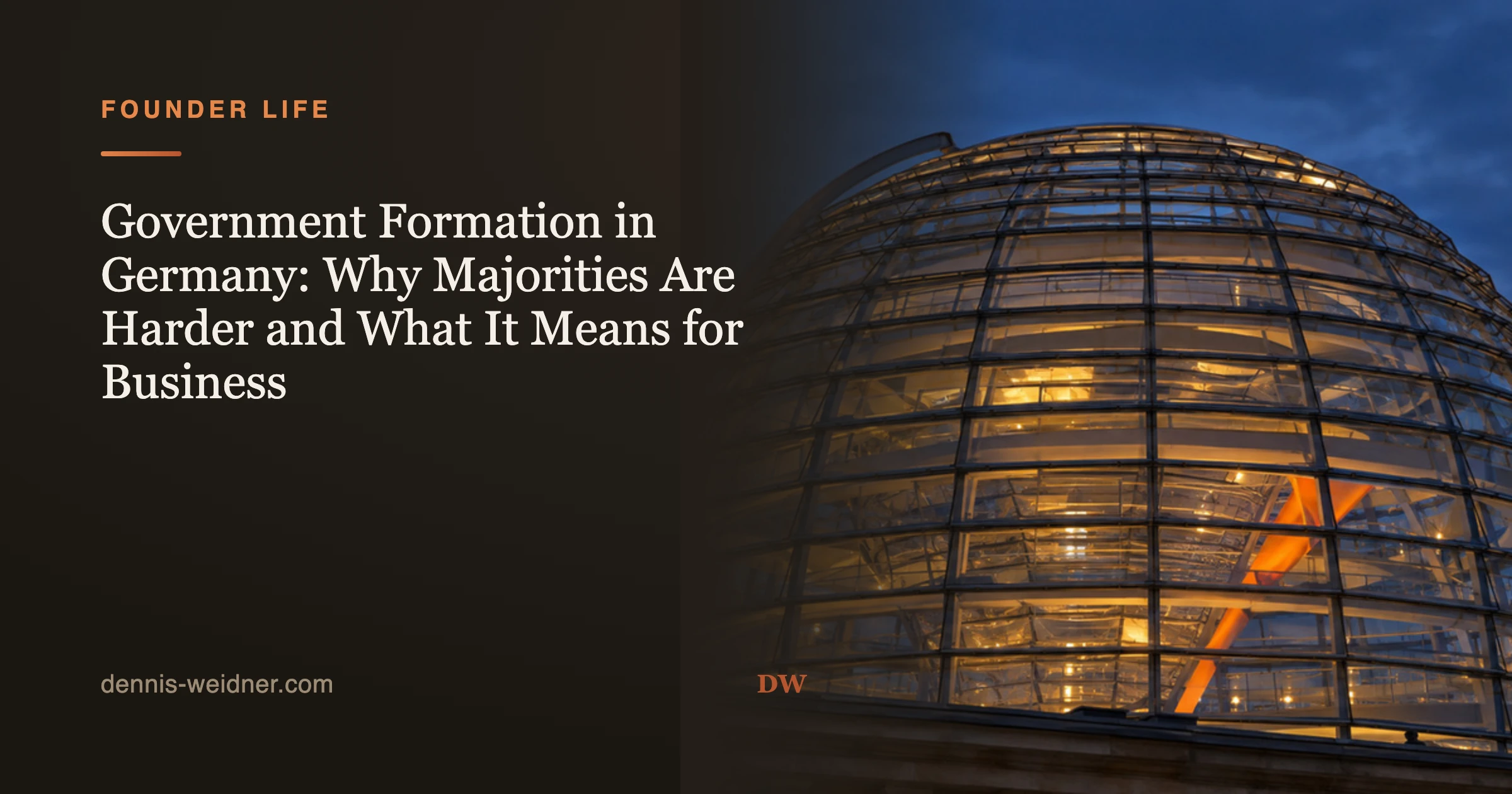
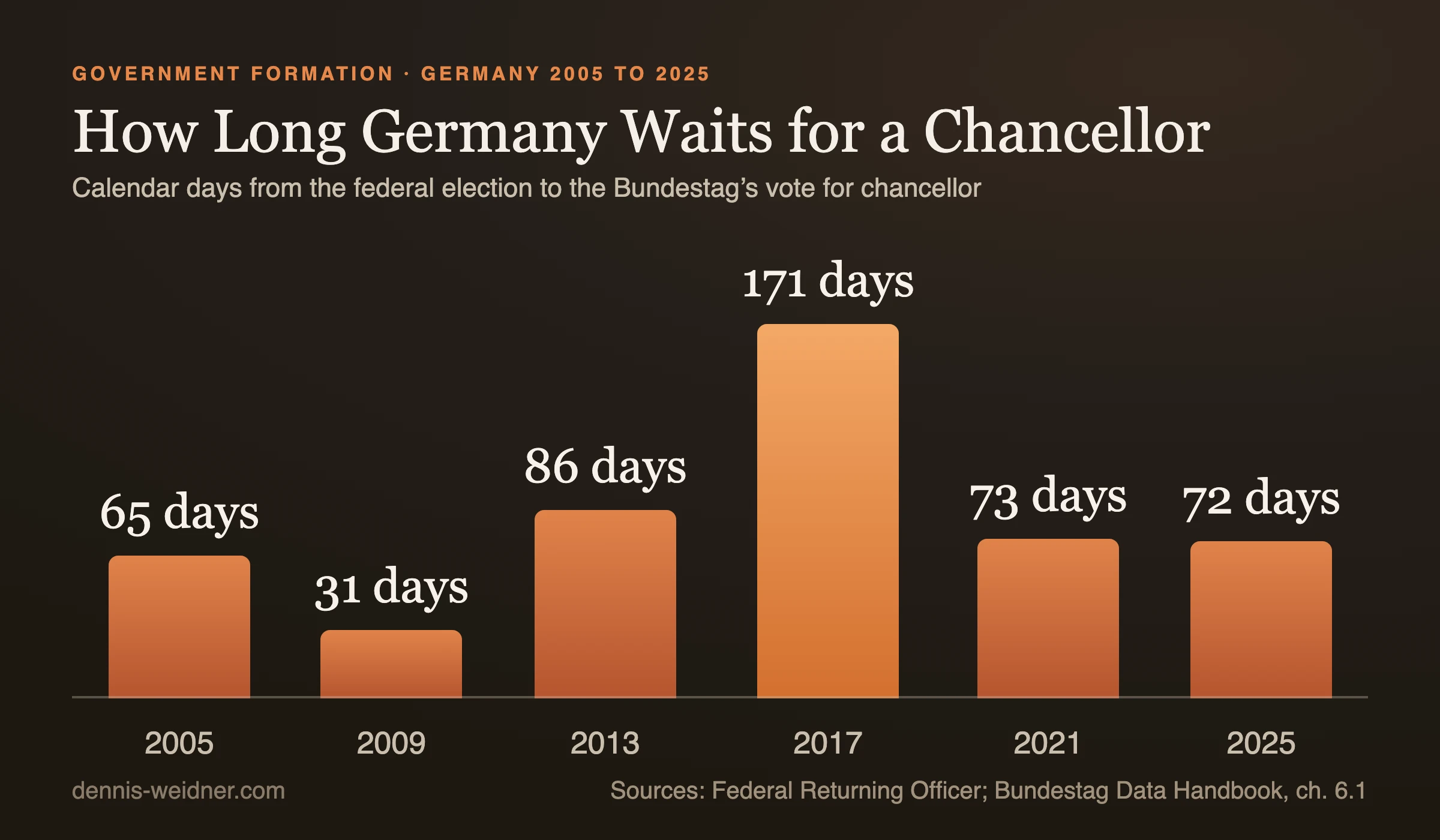
Government formation in Germany now takes more than twice as long as it did in the late 1990s: after the 1998 and 2002 elections a chancellor was in office within 30 days, since 2013 it has never taken less than 72 days, and in 2017 it took 171. The arithmetic behind it is simple. The two traditional big parties, the conservative CDU/CSU and the Social Democrats (SPD), won 76.1 percent of the party-list vote together in 1998 and 44.9 percent in 2025. For business owners, a long stalemate mainly means one thing: new federal funding programmes and spending decisions wait until a budget is in place.
As of 1 October 2026.
More on this topic: AI in the Founder's Working Day – background, practice and every article in one place.
Why government formation in Germany takes longer
To me, democracy means winning majorities for your proposals. That has become harder. Where two large parties once governed with one small partner, Germany now needs three partners or a coalition that sits only just above the majority line. Everyone speaks up loudly, every opinion counts as equally valid, and everyone has to be heard before anything is decided. The intention is good. But every negotiation takes longer when more parties with their own campaign promises sit at the table.
I touched on this in the opening piece of this series, Entrepreneurs and Politics. This article looks at the mechanics: how long government formation actually takes, what the German constitution, the Basic Law (Grundgesetz), provides for when no majority emerges, and what a business owner notices in the meantime.
Government formation in numbers: vote share, parliamentary groups, waiting time
The table sets three series side by side: the combined share of the second vote (Zweitstimme, the party-list vote that decides the number of seats) for CDU/CSU and SPD according to the results published by the Federal Returning Officer, the number of parliamentary groups (Fraktionen) at the start of each term, and the calendar days from election day to the election of the chancellor according to the Bundestag's Data Handbook.
| Federal election | CDU/CSU and SPD combined | Parliamentary groups at start | Days to chancellor vote |
|---|---|---|---|
| 1998 | 76.1% | 5 | 30 |
| 2002 | 77.0% | 4 | 30 |
| 2005 | 69.4% | 5 | 65 |
| 2009 | 56.8% | 5 | 31 |
| 2013 | 67.3% | 4 | 86 |
| 2017 | 53.4% | 6 | 171 |
| 2021 | 49.8% | 6 | 73 |
| 2025 | 44.9% | 5 | 72 |
The number of groups alone does not explain the delay: in 2013 there were only four and it still took 86 days. What matters is whether a coalition with a comfortable majority can be found. The Data Handbook shows this in a figure it lists next to every result, the coalition's number of votes. In 2013 the grand coalition held 503 votes against 316 required, a cushion of 187. In 2021 the cushion was 47, in 2025 only 12 (328 votes against 316 required). The thinner the cushion, the longer the talks, and the more the outcome depends on a handful of members.
How government formation works under Article 63 of the Basic Law
Government formation ends with the election of the chancellor, which Article 63 of the Basic Law regulates in three stages. In the first round the Federal President proposes a candidate, who is elected with the votes of a majority of all members of the Bundestag. If that fails, the Bundestag can elect a chancellor of its own choosing with the same majority within 14 days. If nobody succeeds, a final round follows without delay in which the most votes are enough. If the winner falls short of an absolute majority, the Federal President has seven days to decide: appoint a minority government or dissolve the Bundestag, in which case a new election follows within 60 days under Article 39.
Until then the outgoing government stays in office on a caretaker basis. The stages are not just theory, as 6 May 2025 showed: Friedrich Merz received 310 votes in the first round, six short of the 316 required, although his coalition held 328 seats. According to the Bundestag, none of the 20 previous chancellor elections had failed in the first round. He was elected in a second round the same day with 325 votes.
Government formation in the German states: Thuringia, Saxony and Saxony-Anhalt
In the states (Länder), whose parliaments elect a minister-president as head of government, building majorities has been harder than at federal level for years. In Thuringia in February 2020, a minister-president was elected in the third round by 45 votes to 44, partly with votes from the Alternative for Germany (AfD), and resigned within days. A newly elected government was only in place on 4 March 2020. After the election of 1 September 2024, the CDU, the Sahra Wagenknecht Alliance (BSW) and the SPD held 44 of Thuringia's 88 seats, exactly half. Mario Voigt was nevertheless elected in the first round on 12 December 2024 with 51 votes, 102 days after the election.
Saxony has been governed since December 2024 by a minority coalition of CDU and SPD with 51 of 120 seats. On 18 December 2024, Michael Kretschmer won 55 votes in the first round, short of the 61 required, and was elected in the second round with 69, where a majority of the votes cast is enough. Saxony's constitution sets a hard limit: if no minister-president is elected within four months of the new parliament's first sitting, it is dissolved.
The situation is most difficult right now in Saxony-Anhalt. After the election of 6 September 2026, the AfD holds 39 of 83 seats. CDU, SPD, Greens and the Left together also hold 39, the BSW 5, and a majority needs 42. According to a report by public broadcaster ZDF on 30 September, AfD lead candidate Ulrich Siegmund wants to stand for election in December, the BSW has announced it will abstain, and in the third round a majority of the votes cast is enough. On paper that means 39 votes against 39, and a single vote decides. In parallel, SPD, Greens, Left and BSW have held a first round of talks, while the CDU sees itself in opposition. The new parliament meets for the first time on 6 October. Until a vote, Sven Schulze remains in office as caretaker. In Mecklenburg-Western Pomerania and Berlin, which voted on 20 September, exploratory talks are under way for alliances of SPD, Left and Greens. How those results break down and why so many voters are leaving the centre is the subject of Political Discontent in Germany.
What a long government formation means for businesses
The most tangible effect of a long government formation is money. As long as no budget act has been passed, Germany runs on provisional budget management under Article 111 of the Basic Law. The federal government may then only pay what is needed to maintain existing institutions, carry out measures already adopted by law and meet legal obligations. Approved projects continue, new ones struggle.
2025 was the textbook case. After the three-party coalition collapsed, provisional budget management took effect on 1 January 2025 and only ended when the budget act was promulgated on 2 October 2025, after 274 days. In its explanation of provisional budget management, the federal government said plainly that new spending is only allowed if it is unavoidable in substance and timing, and that starting new projects is harder. For businesses this means an announced funding programme is an intention in such a phase, not a commitment. Whoever waits for new funding waits along with the government. An overview of the programmes that run regardless is in Funding Programs for Founders.
What a capable political centre needs for government formation
I do not see the diversity in parliament as the problem. The problem arises when centrist parties treat government formation as a negotiation over maximum demands rather than a search for a majority. In my view a centre that can act needs three things.
- A few priorities instead of completeness. A coalition agreement that regulates everything takes months. One that sets five projects with a timetable takes weeks.
- A budget before detailed policy. Money is what municipalities, development banks and companies are waiting for. Agreeing the financial frame first shortens the wait for everyone.
- Majorities beyond one's own camp. Saxony shows that a minority coalition can govern if it actively seeks votes for each project. It is demanding, but it is democracy in the literal sense.
Part of this is a public debate that weighs arguments again rather than volume. How platforms steer time and attention is covered in Social Media Algorithms and Radicalisation.
How business owners can plan for a long government formation
A long government formation cannot be prevented, but it can be planned for. In election years I would apply three rules. First: file applications for existing programmes before election day and get them approved, because approved funding keeps flowing. Second: do not tie an investment to a programme that a new government is still supposed to launch, and do not build a business plan on a tax cut that only exists in a coalition agreement. Third: at federal level, expect at least ten weeks until a government is in place and further months until a budget, and more in a state with a difficult majority.
Frequently Asked Questions
How long does it take to form a government in Germany?
Across the six federal elections from 2005 to 2025, it took between 31 and 171 days to elect a chancellor, 83 days on average. In 1998 and 2002 it took 30 days each.
What happens if the Bundestag cannot elect a chancellor with a majority?
After 14 days without an absolute majority, a final round follows in which the most votes are enough. If the winner lacks an absolute majority, the Federal President appoints them within seven days or dissolves the Bundestag (Article 63 (4) Basic Law).
Who governs Germany while no new government has been elected?
The outgoing government stays on, at the Federal President's request, until its successors are appointed (Article 69 (3) Basic Law). In Saxony-Anhalt, Sven Schulze is currently continuing in office on this basis.
What does provisional budget management mean for grants and subsidies?
Funding that has already been approved continues to be paid. New spending is only allowed if it is unavoidable in substance and timing, so new programmes usually start only once a budget is adopted (Article 111 Basic Law).
Can Germany have a minority government at federal level?
Yes, the Basic Law provides for it: if someone is elected in the final round without an absolute majority, the Federal President can appoint them. Since 1998, every coalition formed after a federal election has had its own majority. Minority governments currently exist at state level, for example in Saxony.
Best,
Dennis Weidner
Note: AI tools supported me in writing this article, and some images were edited with AI. I stand behind its content and every statement with my name.