
If you receive an incorrect tax assessment in Germany, you have one month to file an objection (Einspruch). The clock starts on the day of notification, and since 2025 a posted assessment is deemed notified only on the fourth day after mailing. Miss the deadline and you need a specific correction rule such as Section 129 or Section 173 of the Fiscal Code. Checking pays off: in 2025, German tax offices granted 2.81 million objections, 63 percent of all cases closed, according to the Federal Ministry of Finance.
As of 27 September 2026. Not tax advice, see the note at the end.
More on this topic: Finance & Crypto Assets, with background, practice and every article in one place.
How Does an Incorrect Tax Assessment Come About in Germany?
Many German tax assessments are issued today without a human ever looking at them, and that is the first source of error. Under Section 155 (4) of the Fiscal Code (Abgabenordnung, AO), tax offices may assess, amend and revoke taxes on a fully automated basis, "where there is no reason for the individual case to be handled by an official". Whether a person does look is decided by a risk management system under Section 88 (5) AO. It flags conspicuous cases and draws random samples. How it filters stays secret: the law says details may not be published where that could endanger equal taxation.
For me, this is the heart of the problem: software replaces review by people, and the review ends up with the taxpayer. My wife and I have several times received assessments with a wrongly calculated progression rate or with amounts counted twice. This is not an isolated case, it is everyday life: you basically have to object first and have the assessment checked, and every check costs a tax adviser or a specialist lawyer. Why I am calling for a reform of the tax administration is explained in Entrepreneurs and Politics. Why experiences like these damage trust in the state as a whole is the subject of Political Discontent in Germany. One tool is in your own hands: the free-text field for additional information under Section 150 (7) AO in the electronic return. Anything entered there is, by law, a reason for an official to handle the case.
Amounts Counted Twice: When Electronic Data and Late Adjustments Collide
Many figures reach the tax office before the taxpayer files a return. Employers, the pension insurance, health insurers and parental allowance offices report them electronically under the rules of Section 93c AO, by the end of February of the following year. Under Section 150 (7) sentence 2 AO, these data count as the taxpayer's own statements unless the taxpayer enters something different. If the same amount is entered again, or a corrected figure is added next to the old one instead of replacing it, it appears twice in the assessment.
In our case it was a late adjustment by our tax adviser that was added instead of replacing the original entry. Outside the objection period there are two ways to fix this. If electronically reported data were "not taken into account or not taken into account correctly", the assessment must be amended under Section 175b (1) AO. How far this reaches is shown by a ruling of the Federal Fiscal Court of 27 November 2024 (X R 25/22): the amendment is allowed even if the data only arrived after the assessment. If the tax office simply keyed in the wrong figure, Section 129 AO applies.
Progression Clause Miscalculated: A Worked Example With the 2026 Tariff
Errors in the progression clause (Progressionsvorbehalt) are treacherous because they hardly show. Parental allowance, sickness benefit or unemployment benefit are tax-free in Germany, but under Section 32b of the Income Tax Act (EStG) they raise the tax rate applied to the rest of your income. If such a benefit is counted twice, the rate on your entire taxable income goes up, although not a single additional euro is taxable.
The table calculates a married couple filing jointly with taxable income of 100,000 euros and 14,000 euros of parental allowance (Elterngeld), tax year 2026. Assumptions: both partners have employment income, so the employee lump-sum allowance is already used up there; no solidarity surcharge, no church tax. Tariff under Section 32a (1) and (5) EStG as applicable from 2026, basic allowance 12,348 euros.
| Item | Without parental allowance | Correct: €14,000 allowance | Wrong: counted twice |
|---|---|---|---|
| Taxable income | €100,000 | €100,000 | €100,000 |
| Income used to find the rate | €100,000 | €114,000 | €128,000 |
| Tariff tax on it (income splitting) | €21,096 | €26,182 | €31,608 |
| Special tax rate | 21.10% | 22.97% | 24.69% |
| Income tax on €100,000 | €21,096 | €22,966 | €24,693 |
The parental allowance counted twice costs this couple 1,727 euros, although the allowance itself remains tax-free. Such an error is hard to spot in the assessment, because the tax rises while taxable income stays the same. My advice: for every assessment involving wage replacement benefits, compare the total with the certificates from the parental allowance office or the health insurer.
Estimated Tax Assessment Under Section 162 AO: When the Return Is Missing
If the tax office cannot determine the basis of taxation, it "must estimate" it, says Section 162 (1) AO. A typical trigger is a tax return that was never filed. An estimate is not a penalty. But it only reflects what the tax office knows: business expenses, work-related costs or losses it is unaware of are missing.
The fastest remedy against an estimated assessment is to file the return together with the objection within the one-month period. If the assessment was issued subject to review (Vorbehalt der Nachprüfung) under Section 164 AO, which is stated at the top of the notice, it can still be amended after the month has passed, as long as the reservation applies. Without that reservation, the main route left is Section 173 (1) no. 2 AO, which only helps if you are not grossly at fault. Someone who never filed a return will hardly be able to rely on it. Keep your records until the assessment is truly final; the applicable periods are covered in Record Retention Periods in Germany.
Objection Deadline in Germany: One Month From Notification, and When Notification Is Deemed
An objection must be filed "within one month of notification of the administrative act", Section 355 (1) AO. A posted assessment is deemed notified under Section 122 (2) no. 1 AO on the fourth day after mailing. For notices mailed up to the end of 2024 it was three days (Article 97 Section 1 (15) of the Introductory Act to the Fiscal Code). For assessments made available for download in ELSTER, the tax authorities' online portal, Section 122a (4) AO also uses the fourth day after they are made available.
An example: if an assessment is mailed on Friday, 4 December 2026, it is deemed notified on Tuesday, 8 December. The objection period ends on Friday, 8 January 2027. If the deadline falls on a weekend or public holiday, it moves to the next working day under Section 108 (3) AO. Important for 2027: if you file your own return through ELSTER, Section 122a (1) AO says the assessment should, as a rule, only be made available for download, not mailed. If you want letters, you have to request postal delivery under Section 122a (2) AO.
Under Section 357 (1) AO, the objection only has to be in writing or electronic; using the wrong label does no harm. The reasoning can follow later, because Section 357 (3) AO only says it should be given. What an objection does not do is stop payment. For that you need a suspension of enforcement, which I explained in the previous part of this series. If a deadline is running for you, do not let it lapse on the strength of an article; ask a tax adviser or a lawyer specialising in tax law.
Objection, Simple Amendment, Section 129 or Section 173: Which Route Fixes an Incorrect Tax Assessment
Which rule fits depends on the type of error. Once the objection period has passed, that alone decides whether anything can still be changed.
| Type of error | Correction rule | Deadline | Who has to act |
|---|---|---|---|
| Error of law, wrong assessment of facts, progression clause applied incorrectly | Objection, Section 347 AO | one month from notification (Section 355 AO) | Taxpayer |
| Clear single point the office should fix without a formal procedure | Simple amendment, Section 172 (1) no. 2 a AO | application before the objection period ends | Taxpayer |
| Typing, arithmetic or transfer error by the tax office, such as a double entry | Obvious error, Section 129 AO | until the assessment period expires (Section 169 (1) AO) | Tax office, mandatory if the taxpayer has a legitimate interest |
| Electronically reported data wrong or counted twice | Section 175b (1) AO | until the assessment period expires | Tax office on its own motion |
| Your own typing or arithmetic error in the return | Section 173a AO | until the assessment period expires | Taxpayer applies |
| New facts or evidence that lower the tax | Section 173 (1) no. 2 AO | until the assessment period expires, only without gross fault | Taxpayer |
The assessment period (Festsetzungsfrist) is four years for most taxes under Section 169 (2) AO. The Federal Fiscal Court applies a strict test to "obvious" in Section 129 AO. In a ruling of 22 October 2024 (VIII R 33/21) it names mechanical slips such as input or transfer errors. Mistakes in interpreting the law or evaluating the facts rule out Section 129 AO, and even a serious possibility of such a mistake is enough. In that case the court still set aside the judgment against the claimant company: the fact that further enquiries were needed to find the correct figure does not rule out an obvious error. I would still never rely on Section 129 while the objection period is running.
The objection has a catch: the tax office must re-examine the case "in full" under Section 367 (2) AO and may even change the assessment to your disadvantage. This is called reformatio in peius (Verböserung), and the office must warn you first. If you receive such a warning, you can withdraw the objection until the decision under Section 362 AO. I have several times experienced a won objection being followed by the next query, the next audit and the next assessment, and I was left with the feeling of being treated as a troublemaker from then on. Legally that is allowed as long as the assessment period runs and a correction rule applies. It should never become a contest, though.
How Often an Objection Against a German Tax Assessment Succeeds
According to the Federal Ministry of Finance's monthly report of September 2026, German tax offices closed 4,457,138 objections in 2025. Of these, 2,813,661 ended with the office granting relief (Abhilfe), 63.1 percent. Only 45,778 cases went to court, 1.0 percent. The share of relief was lower than a year earlier (68.0 percent), while the share of formal objection decisions rose from 12.7 to 16.9 percent.
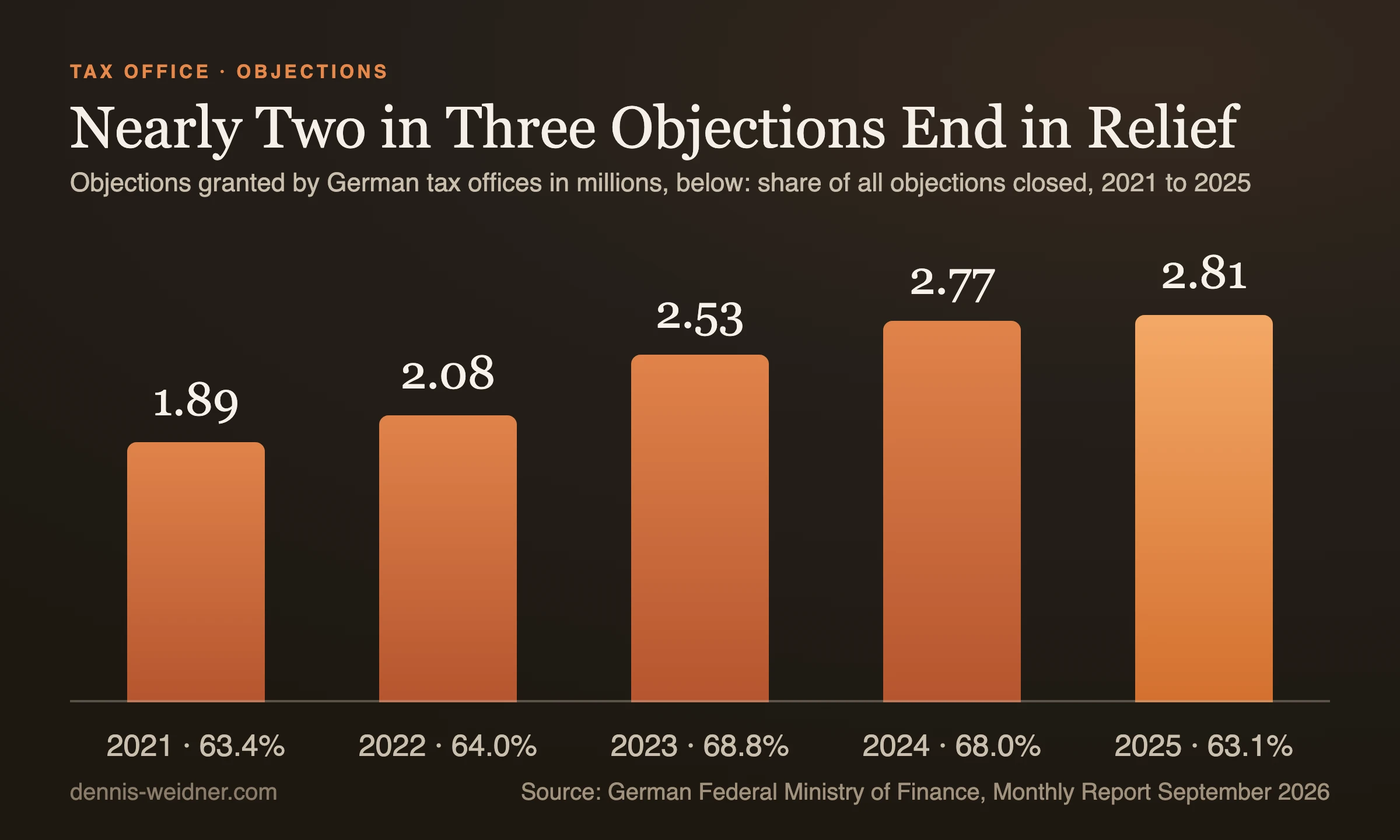
The ministry itself warns against concluding from relief that an assessment was wrong, because many cases are resolved by returns filed only during the objection. Fair enough. But the reverse holds too: nearly two in three closed objections end with relief, year after year. Anyone who does not check an assessment may be leaving money on the table. And here lies the imbalance: file late and you pay surcharges; get a wrong assessment corrected and you are proven right, but receive nothing for your time and adviser costs. I find that unacceptable. How to have a tax office's work reviewed is covered in the first part of this series, How German Tax Offices Are Supervised. More tax and finance topics are collected under Crypto and Finance.
Frequently Asked Questions
How long do I have to object to a German tax assessment?
One month from notification (Section 355 (1) AO). Since 2025, a posted assessment is deemed notified on the fourth day after mailing, and an assessment made available in ELSTER on the fourth day after it is made available. If the deadline falls on a weekend or public holiday, it ends on the next working day.
Can a German tax assessment be changed after the objection deadline?
Only under a specific rule: Section 129 AO for obvious errors by the tax office, Section 173a AO for your own typing or arithmetic errors, Section 173 AO for new facts, Section 175b AO for electronically reported data taken into account incorrectly. If the assessment is subject to review, an application under Section 164 (2) AO is enough.
Can the tax office demand more tax during an objection?
Yes. Under Section 367 (2) AO it re-examines the whole case and may change it to your disadvantage, but it must warn you first. You can then withdraw the objection until the decision (Section 362 AO).
What can I do about an estimated tax assessment?
File an objection within one month and enclose the missing return. If the assessment is subject to review, the return can still lead to a change later.
Does an objection stop me having to pay the tax?
No. The assessed tax remains due. If you do not want to pay until the decision, you must also apply for suspension of enforcement under Section 361 AO.
Note: This article is not tax advice. It describes German law as of 27 September 2026 and simplifies: the worked example ignores the solidarity surcharge and church tax, and the table of correction rules is not exhaustive. If a deadline is running for you, do not let it lapse on the strength of an article; ask a tax adviser or a lawyer specialising in tax law.
Best,
Dennis Weidner
Note: AI tools supported me in writing this article, and some images were edited with AI. I stand behind its content and every statement with my name.