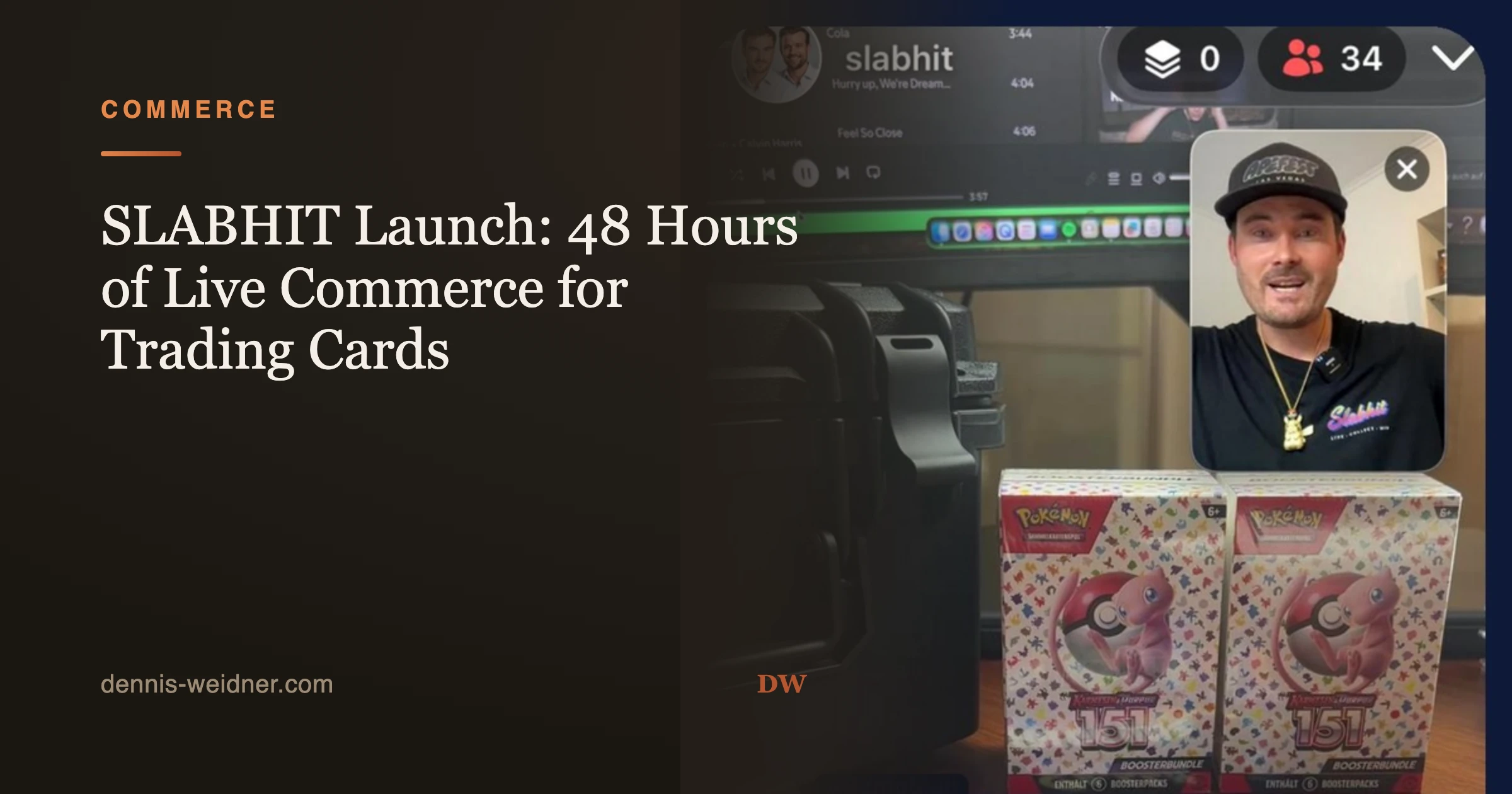
On 15 and 16 September 2026 SLABHIT went live as a soft launch among family and friends, with more than 100 live auctions for trading cards in two days and up to 40 viewers at the same time. Three days later, on 18 September, the app arrived in the App Store. Here I describe how those 48 hours went, how the auction formats work and what we take from it as founders.
What Happened on 15 and 16 September: Opening Show and Surprise Show
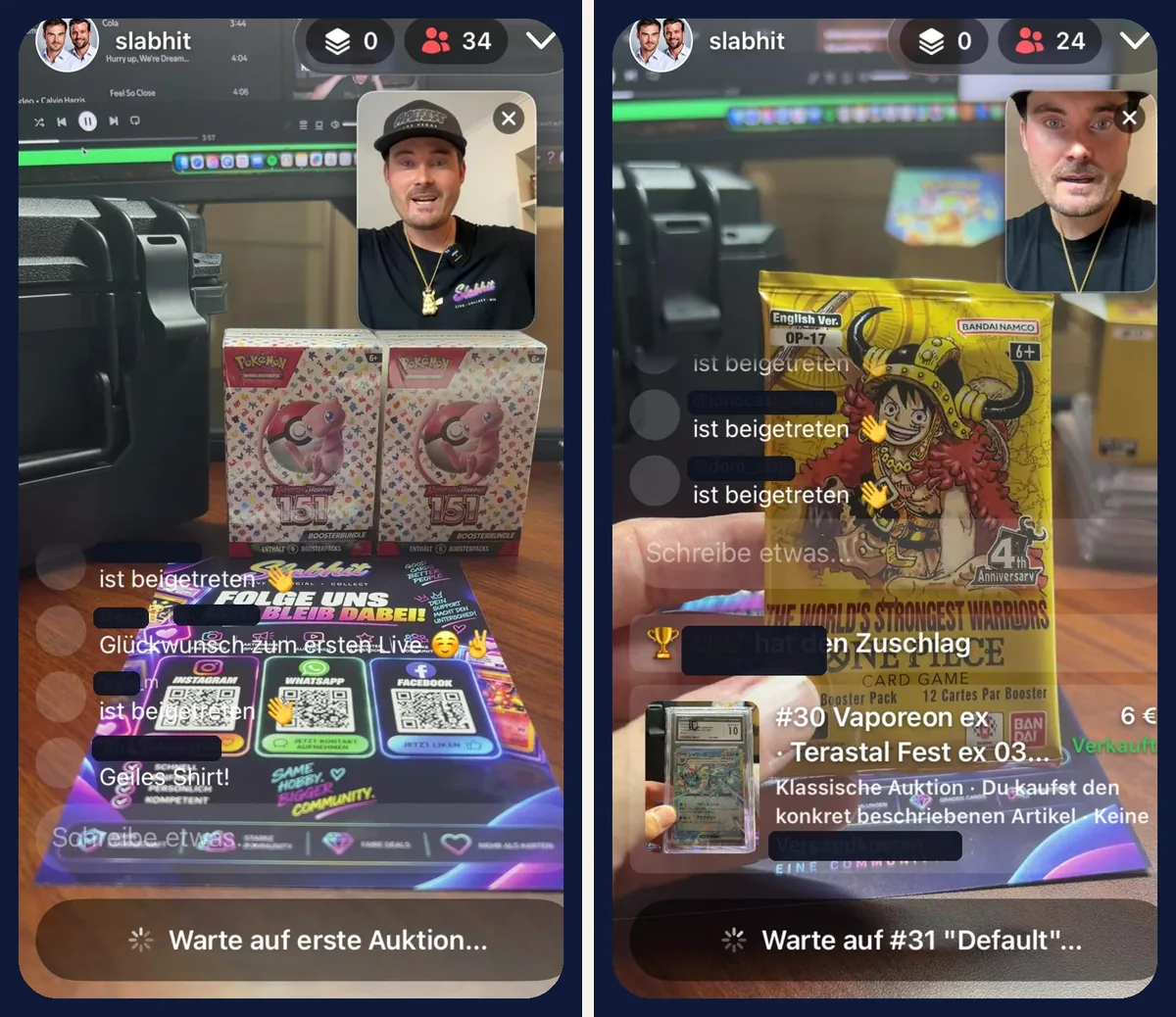
SLABHIT went live on Tuesday, 15 September 2026, at 6 pm with a six-hour Opening Show from Bad Saarow in Brandenburg, Germany. It was a soft launch among family and friends, with no official starting signal yet, because at that point the app was still in Apple's review. Everyone first had to install Apple's app for pre-release versions, then our app, create an account with a username, verify their phone number and add a credit card and shipping address. That is a real hurdle, and still almost 40 people were watching live when the first hammer fell. Across the full six hours an average of 25 to 30 viewers stayed with us, a strong result for a first evening before the App Store launch. By midnight more than 70 lots had sold, which is what SLABHIT calls its single auctions. On Wednesday the Surprise Show followed from 8 to 10 pm. Two days brought more than 100 auctions.
On the table were a Charizard and a Blastoise with the 25th anniversary stamp, illustration rares from Scarlet and Violet 151, One Piece, boxes and boosters from 151 and several slabs, meaning graded cards in sealed holders. The slab prices ranged from 180 euros for a 2001 Surfing Pikachu in PSA 8 through 450 euros for an Umbreon V from Evolving Skies in PSA 9 to 790 euros for a Charizard ex from the Japanese 151 set in PSA 10. The first hammer of the evening went to a 151 booster for 18 euros, and auction number 30 brought a Vaporeon ex for 6 euros. Alongside Pokémon and One Piece, Magic and sports cards are to find their place on SLABHIT as well, so that there is something for every collector. What everyone is hunting right now is the Charizard with the 30th anniversary stamp from the newest collection. What a slab is and why the grade on the label sets the price is covered in What a Slab Is.
I described why we are building SLABHIT back in July in Slabhit: Why We're Rebuilding Live Shopping for Trading Cards. This piece is about the launch itself and what we learned in the first 48 hours.
The Way Into the App: From Soft Launch to the App Store
At launch the app was still in Apple's review. We kept the date anyway and brought the first viewers into the app via Apple's official route for pre-release versions. That way everyone with an iPhone could bid from the first evening, with their own account, shipping address and payment method. Our viewers all took that route because they absolutely wanted to be there.
Since 18 September 2026 the Slabhit app has been in the App Store, free for iPhone with iOS 17 or later. Everyone who joined on launch night kept their account, bids and settings. To bid, a shipping address and a credit card in the app are enough, and the seller takes care of shipping afterwards. A bid only goes through with a stored payment method, because every winning bid is a binding purchase.
Watching works without an iPhone too, on any device in the browser via the "Live zuschauen" button on slabhit.de. Nearly half of the people who visit slabhit.de on a phone use Android, which is why an Android app follows in 2027. Until then there is a waiting list for Android.
The Auction Formats: Clock, Dutch Drop and the Wildcard and Quality Pipelines
On SLABHIT every lot gets its own clock, and on top of that come the Dutch Drop and the pipelines sellers use to prepare their show.
The auction with a clock. The seller sets the clock for each lot in advance to anything from ten to sixty seconds, and many lots start at one euro. Every bid sets the clock back to ten seconds, even if only two seconds were left, and as long as bidding continues the lot keeps running. That gives every bidder enough time for a counter-bid, and in the end the card goes to whoever values it most. We chose the ten seconds deliberately, because in our tests they produced the best baskets. Sellers who want a faster pace switch on sudden death. Then bids no longer reset the clock, and when it runs out the lot is sold. In addition, every lot can carry a buy-now price at which it sits in the shop during the show.
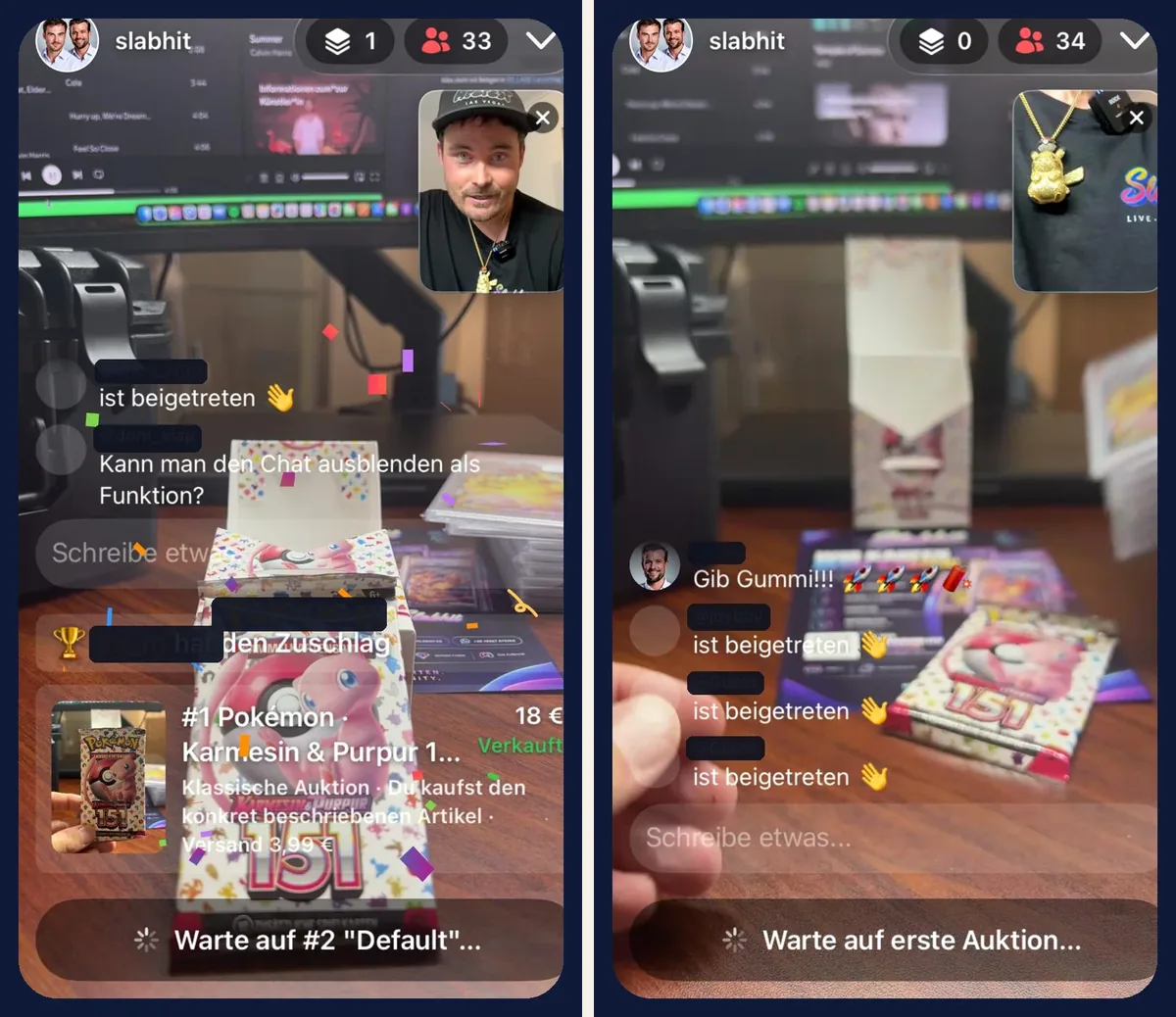
The pipelines. A show is prepared through pipelines. These are lists of lots with shared presets for starting price, clock and format, which every lot takes over. Wildcard is meant for many single cards, 50 slots, say, with a starting price from one euro. The photo is taken automatically during the show when the seller holds the card up to the camera and presses the button. Quality is for slabs and sealed product, with a shared starting price that the seller can adjust for individual lots. Everything else, including whatever is added spontaneously during the show, runs through Default.
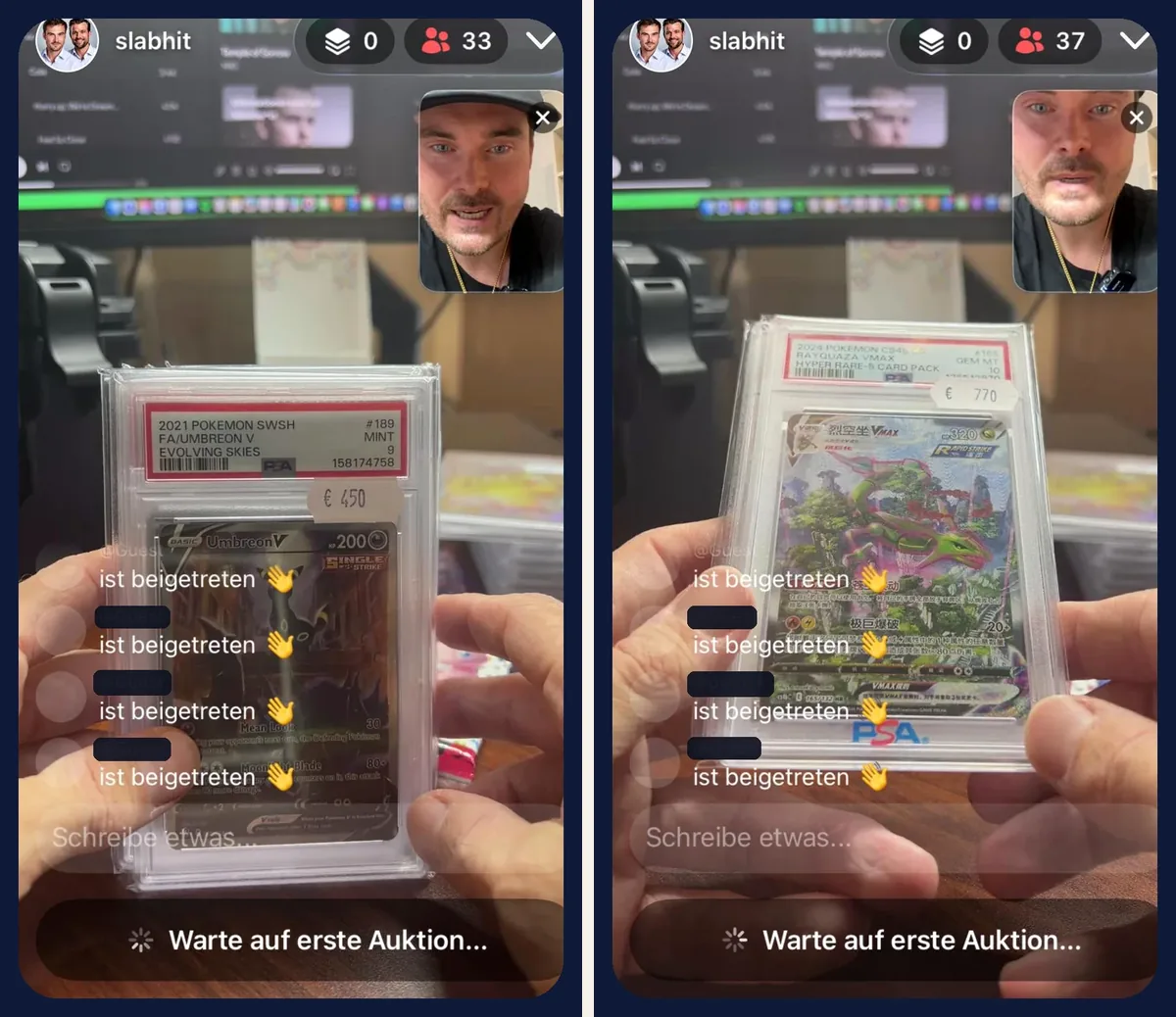
The Dutch Drop. This is a reverse auction for several identical items. The price starts high and falls visibly for everyone, and whoever taps buys immediately at the current price. Whoever buys early has their item for certain, whoever waits pays less, as long as items are left. The first Dutch Drop on SLABHIT ran in the Surprise Show on 16 September, and ten identical items sold in two minutes. Television has used the principle for decades; in live trading card commerce it did not exist until now.
After the show. All of a buyer's winning bids and instant buys from the same show are billed together and shipped in one parcel, so shipping is charged only once. The buyer has already paid it at purchase. The seller prints the shipping label directly from the seller area. For Germany, sellers can also opt for the margin scheme under section 25a of the German VAT Act (UStG). It applies to resellers who bought goods without VAT being charged, for instance from private collectors, and VAT is then due only on the margin. Whether that fits a particular case is something every seller settles with their tax adviser. SLABHIT itself earns a platform fee on the sale price.
Startup Launch: Lessons From 48 Hours of Live Operation
We learned the most in the days before the App Store launch. Because the app was still running as a pre-release version, we could fix faults during live operation and ship the new version to everyone immediately. For some users the screen stayed black when they briefly left the app and came back. We fixed that right away. An invitation code that one collector had copied from a screenshot and mistyped has since been replaced by a button with the link.
The show itself changed too. Whatever used to be asked in the chat is now handled by a button in the app. Push notifications can be switched on directly in the app, under settings right from the home screen, so nobody misses a show. Our AI scanner is getting the Rip or Ship choice. Whoever wins a sealed item decides with one tap between rip, where the seller opens the pack live on camera, and ship, where it travels sealed. Nobody has to ask in the chat anymore.
The small circle was an advantage. Because both evenings ran with real accounts and real money, we tested the auction formats and instant buy under real conditions and improved them the same evening, sometimes between two lots while the clock was running. That was possible because development and broadcast sat at the same table. Thanks to Bene, who built the app.
How much a single well-made video can move at a launch, Tesla showed on 16 October 2026: the clips of the new Roadster reached around 95 million views in twelve hours. What is behind it and what founders can take from it is in Tesla Roadster: Real or AI? What the Kickflip Teaches.
Co-Founder Benedikt Bingler on Building the App
At launch Benedikt calculated on LinkedIn how much value this platform holds. The article by The Agentics that he published alongside it is based on Barry Boehm's COCOMO model. On launch day the platform's code comprised about 192,750 lines, which in the model's conservative mode equals 602 person-months. At 8,500 euros per month that would be roughly 5.1 million euros, or ten engineers over five years. We built SLABHIT in six months, with one engineer responsible for specification and governance and, on average, three AI agents, for about 60,000 euros. On top of that come around 103,000 lines of specification that the agents work from. The full article is on LinkedIn under the title We shipped a 5.1M platform in 6 months with 3 AI engineers for 60K.
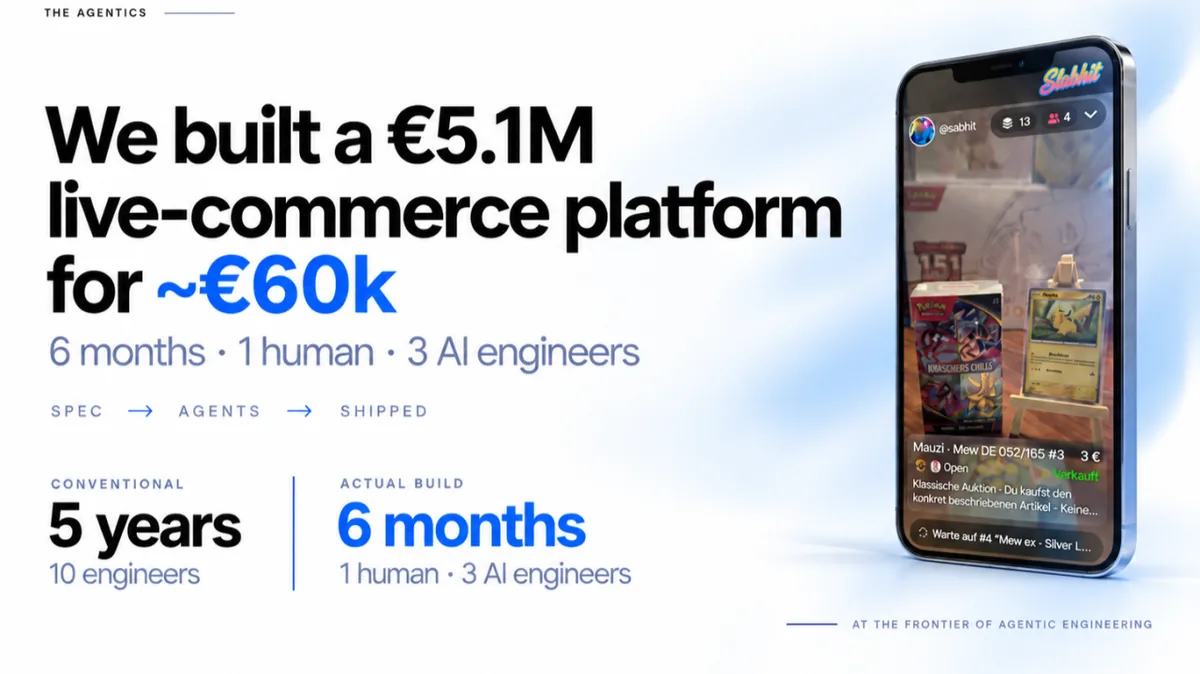
The whole platform came out of a small team working with AI agents. How we organise that is on the topic page E-Commerce and Live Commerce.
The Market: Whatnot, eBay Live, Voggt and Fanatics, and Where SLABHIT Stands
The largest provider of live auctions is Whatnot. The company closed a 545 million dollar round on 7 August 2026 at a valuation of 20 billion dollars, after 5 billion in January 2025 and 11.5 billion in October 2025. More than 8 billion dollars of goods were traded on the platform in the first half of 2026, revenue for 2026 is expected to exceed one billion dollars, and Whatnot claims about 60 percent of a live commerce market it sizes at roughly 22 billion dollars. eBay Live launched in Germany on 29 November 2025, with a card dealer as its first stream. Voggt, founded in France in 2021 and for a long time Europe's market leader in live selling of trading cards with more than half a million members, has belonged to Fanatics Live, the live commerce arm of the American sports collectibles group Fanatics, since 3 October 2024. Then there is Cardmarket, the marketplace where trading card prices in Europe are formed, with 417 million euros of goods traded in 2025. Fees, valuations and the situation in Germany are covered in Whatnot Fees and Valuation and in Live Shopping for Trading Cards: Whatnot, eBay Live, TikTok Shop and Voggt Compared.
SLABHIT is two founders, Benedikt Bingler and me, plus the AI agents in the engine room. In six months that has become a platform that sold more than 70 lots on its very first evening and can do things live trading of cards had not seen before. They include the clock per lot with the reset rule and sudden death, instant buy on the lot, the Dutch Drop, the pipelines, combined shipping per show with the label printed from the seller area, and the margin scheme as an option. We are proud of that. Next come more reach, the Android app and a growing team, and for that we will be seeking a financing round in the next six months. The valuations of the incumbents are rising while the barrier to entering this market has fallen, and that gap is where we are building.
Every marketplace starts with the same chicken-and-egg problem, because buyers need sellers and sellers need buyers. We are solving it from both sides. From 18 September the first sellers broadcast their own shows, and with the App Store and our first app ads we are bringing in the buyers. Trading cards are only the beginning. As a marketplace we will build many more categories over the coming months and years, with new growth markets and new revenue streams.
What Comes Next: A Sprint Show From Berlin, Then the Sellers Take Over
The first two evenings we broadcast ourselves. On Thursday, 17 September, I am broadcasting a short Sprint Show at 8:15 pm from Berlin, from a founders' event at Mindspace where startups pitch to a jury. For one hour there is a box break from 151 and Prismatic Evolutions and three slabs, broadcast with nothing but an iPhone.
From 18 September the first sellers broadcast their own shows, and with that the real operation begins, with several broadcasts a day, each with its own stock and its own audience. Since 18 September the app has been in the App Store, and in parallel we are building the Android app. The programme is at slabhit.de, bidding goes through the SLABHIT app.
Anyone selling on SLABHIT will find out in Selling Trading Cards and Taxes in Germany when selling trading cards starts to count for tax.
We are building SLABHIT because the cards have been with us since our youth and still bring joy, and because this market moves a lot, offers opportunities and rewards work. The first 48 hours confirmed that for us. It is a pleasure to build in these times, and we are growing. Anyone who wants to build with us finds our open positions on the careers page. Since the launch, people who want to invest have been getting in touch as well. We choose carefully who we take the next steps with, and the door is open. For business angels, a stake in our GmbH in Brandenburg, Germany, comes with an extra advantage, because the German federal INVEST programme refunds 15 per cent of the investment as a tax-free grant. Anyone who wants to come in can reach me directly via my contact page.
Frequently Asked Questions
What is SLABHIT?
SLABHIT is a live commerce auction platform for trading cards from Bad Saarow in Brandenburg, Germany. Sellers broadcast live, every lot gets its own clock, and all of a buyer's winning bids from one show are billed and shipped together. SLABHIT launched on 15 September 2026 with a six-hour Opening Show.
How do I get into the SLABHIT app?
The app has been in the App Store since 18 September 2026, free for iPhone with iOS 17 or later. How to get it is on the SLABHIT app page. Bidding requires a shipping address and a credit card. Watching works without the app in the browser via the Live zuschauen button on slabhit.de.
How does the auction with a clock work at SLABHIT?
Every lot gets its own clock; the seller sets between ten and sixty seconds. Every bid resets the clock to ten seconds, and as long as bidding continues the lot keeps running. The highest bid wins. Optionally sudden death applies, in which case bids do not reset the clock and the lot ends when it runs out.
What is a Dutch Drop?
The reverse auction as an instant buy for several identical items, such as boosters from the same set. The price starts high and falls visibly for everyone; whoever taps buys immediately at that moment's price. In the Surprise Show on 16 September 2026 ten identical items went that way in two minutes.
How many auctions ran on the first two days?
More than 100 auctions on 15 and 16 September 2026, spread across the six-hour Opening Show on Tuesday and the two-hour Surprise Show on Wednesday. By midnight of the first evening more than 70 lots had sold, and when the first hammer fell almost 40 viewers were watching live, even before the App Store launch.
Is SLABHIT available for Android?
The Android app is on its way and arrives in 2027. Until then watching works on any device in the browser via slabhit.de, and Android users can join the waiting list there. Bidding currently works with the iPhone app.
What does Rip or Ship mean on SLABHIT?
For sealed product such as boosters, the buyer decides with one tap in the app after winning. Rip means the seller opens the pack live on camera, ship means it is sent sealed. The choice comes to the app with the AI scanner, so nobody has to ask in the chat anymore.
Can you invest in SLABHIT?
Yes. SLABHIT is run by a GmbH based in Bad Saarow in Brandenburg, Germany. Through the German federal INVEST programme, business angels receive 15 per cent of their investment back as a grant that is tax-free in Germany, for stakes from 10,000 euros held for at least three years, convertible loans included. The application to BAFA has to come before signing, and under the current guideline applications are possible until the end of 2026. Anyone who wants to come in or help build the project gets in touch directly with Dennis Weidner via his contact page. Open positions are listed on the SLABHIT careers page.
Warm regards,
Dennis Weidner
Note: AI tools supported me in writing this article, and some images were edited with AI. I stand behind its content and every statement with my name.