Bandai Namco sold 95.1 billion yen worth of ONE PIECE toys and hobby products in Japan in the fiscal year to March 2026, almost ten times as much as in the last year before the One Piece Card Game launched in 2022. On Cardmarket, however, half of the 12,175 priced singles cost less than 50 cents, while 184 cards trade above 1,000 euros. The One Piece TCG is a smaller market next to Pokémon, denser at the top and with rules of its own.
One Piece TCG: From Licence to a Card Market of Its Own
The One Piece Card Game is Bandai's trading card game based on Eiichiro Oda's manga series. According to the official product page, the first set, Romance Dawn, went on sale in Japan on 22 July 2022 at 198 yen for a six-card pack. The English edition followed on 2 December 2022 at a suggested price of 4.19 US dollars per pack. There is no German edition: the official site lists Japanese, English, French, Simplified Chinese and Korean.
Since then the game has become one of Bandai Namco's key growth drivers. In its shareholder newsletter No. 80 from 2025, the group says the game has grown continuously since launch and that 1,800 different cards had been released by then. Bandai calls Europe and North America its strategic key region: a trading card market three times the size of Japan's, in which the One Piece Card Game ranks fifth by market share.
The ambition is clear: in the medium to long term Bandai wants its card game brand to rank second in global market share. To that end it opened an office in Dallas in 2024, says it supplies event material to more than 1,600 retailers in North America, and brought a second major card game based on the Gundam licence to market in July 2025. One Piece is the flagship.
One Piece Card Game Sales: What Bandai Namco Reports
Bandai Namco does not break out the card game on its own. With every set of annual results, however, it publishes sales by brand for its toys and hobby business in Japan, and there the effect is plain. In the fiscal year 2021/22, the last one before the card game, Bandai Namco sold 10.0 billion yen worth of ONE PIECE toys and hobby products in Japan. In the fiscal year to March 2026 the figure was 95.1 billion yen, according to the supplementary materials to the annual results.
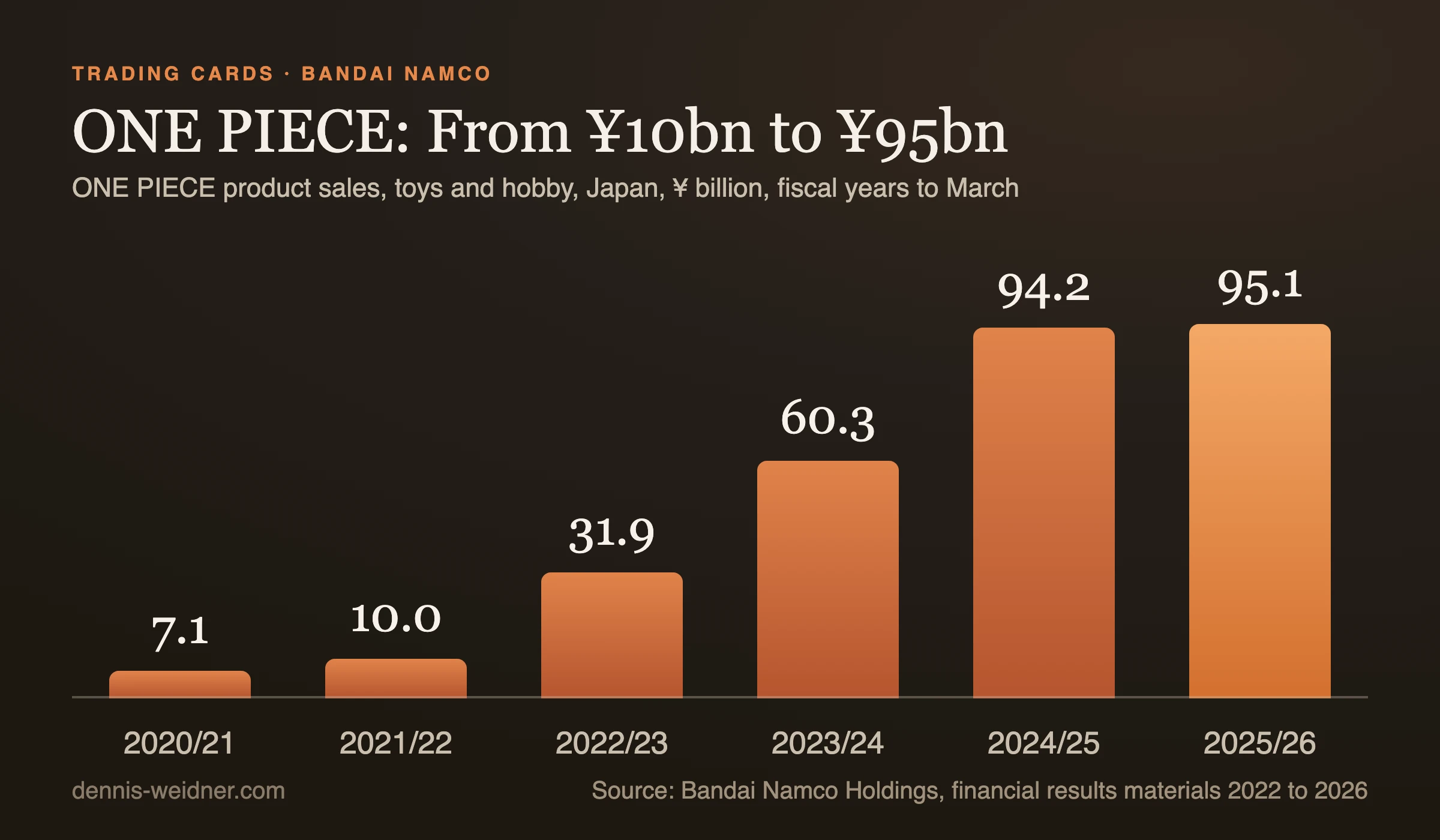
The jump starts in the very year the card game launched: 31.9 billion yen in fiscal 2022/23, 60.3 billion a year later, 94.2 billion in 2024/25. At the European Central Bank reference rate of late September 2026, 179.70 yen per euro, 95.1 billion yen equals around 530 million euros, in Japan alone and in toys and hobby alone. Group-wide, including video games, film and licensing, ONE PIECE brought in 139.3 billion yen in the same year.
Most recently the curve flattened: 2025/26 was just 1 percent above the prior year. The new fiscal year then started strongly. In the first quarter from April to June 2026, ONE PIECE sales in Japan's toys and hobby business rose from 22.1 to 27.5 billion yen, up 24 percent. With the quarterly figures, Bandai Namco raised its first-half forecast from 48.0 to 57.0 billion yen and kept its full-year plan to March 2027 at 96.0 billion yen.
One Piece TCG vs Pokémon: How Big the Gap Is
Pokémon remains the benchmark. According to The Pokémon Company, more than 85 billion Pokémon cards had been produced by the end of March 2026, in 16 languages and for more than 90 countries and regions. In Germany, Circana data presented by the German toy industry associations in November 2025 puts Pokémon at more than 84 percent of the trading card segment. The same release says Magic: The Gathering, One Piece and Marvel are also developing very positively, if at a much lower level, having grown by more than 4 million euros combined. Why such a dominant single licence is both an opportunity and a dependency for retailers is covered in The Pokémon Boom: 30 Years and Still Going Strong.
The size gap also shows on Cardmarket, the large European marketplace for trading cards. Its price guide lists a little over five times as many priced Pokémon singles as One Piece singles. The price structure, however, is different:
| Cardmarket, singles | One Piece | Pokémon |
|---|---|---|
| Cards with a price trend | 12,175 | 63,127 |
| Median price trend | €0.41 | €0.87 |
| Share under €0.50 | 52.0% | 41.6% |
| Share at €100 or more | 6.9% | 3.4% |
| Cards at €1,000 or more | 184 | 192 |
On Cardmarket, One Piece has a catalogue five times smaller and almost as many cards above 1,000 euros. The share of cards at 100 euros or more is twice that of Pokémon. The game is smaller but denser at the top, and that is exactly where a market becomes interesting for sellers. How Cardmarket handles prices, fees and shipping is explained in Cardmarket broken down.
One Piece Card Prices: Half of All Singles Cost Under 50 Cents
Cardmarket's price guide file is a snapshot, not a time series. For each card it gives a price trend, plus average prices over one, seven and 30 days. Across all 12,175 priced One Piece singles, as of September 2026, the picture is clear: 52.0 percent cost less than 50 cents, and almost a third less than 10 cents. The median is 0.41 euros.
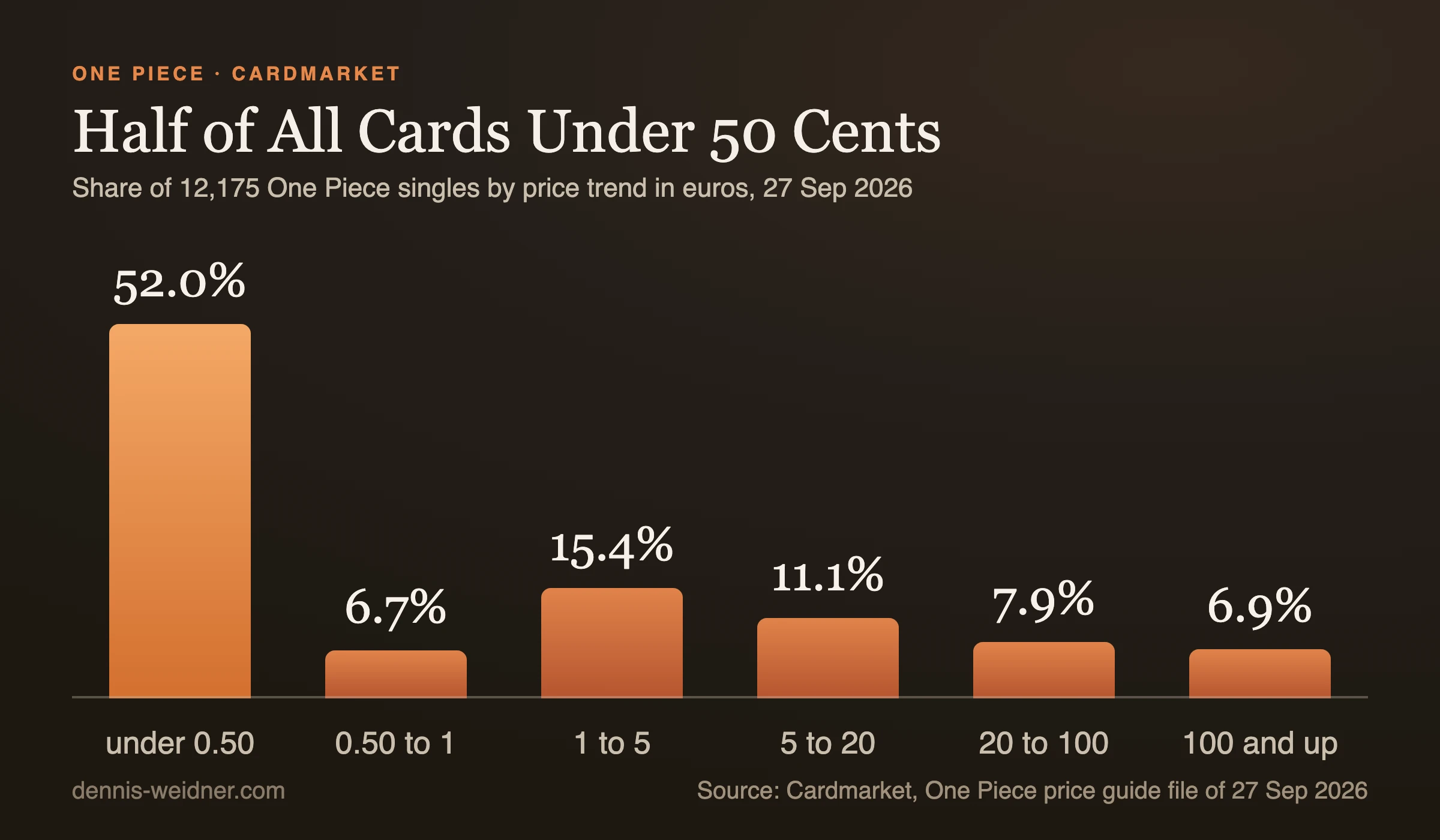
At the other end sit 835 cards with a price trend of 100 euros or more, 6.9 percent of the catalogue, 184 of them above 1,000 euros. Seven cards trade above 10,000 euros, four of them showing the main character Monkey D. Luffy. The spread comes from versions: many cards also appear as a parallel card with different artwork, and according to Bandai the first set alone contains 27 of them. On Cardmarket, 2,707 of the 2,814 priced card numbers exist in at least two versions, and at the median the most expensive version costs 35 times the cheapest. In between lies a broad middle: 15.4 percent of cards cost 1 to 5 euros, 11.1 percent 5 to 20 euros.
For collectors this means the value of a collection almost never lies in its size but in a handful of cards. Anyone valuing a box of One Piece cards sorts out the rare versions first and checks them individually. The rest is usually bulk sold as a lot; Cardmarket even has a separate category for lots.
Sealed vs Singles: What One Piece Booster Boxes Cost
Alongside single cards there is the market for sealed product: boxes full of booster packs that are collected or resold unopened. Here the price guide shows a marked difference between old and new sets. English booster boxes of the main sets by price trend, as of September 2026:
| English booster box | Price trend |
|---|---|
| OP01 Romance Dawn | €1,143 |
| OP05 Awakening of the New Era | €808 |
| OP09 Emperors in the New World | €440 |
| OP11 A Fist of Divine Speed | €406 |
| OP13 Carrying on his Will | €352 |
| OP14 The Azure Sea’s Seven | €192 |
| OP15 Adventure on Kami’s Island | €197 |
| OP16 The Time of Battle | €175 |
| OP17 The World’s Strongest Warriors | €258 |
| Median of main sets OP01 to OP17 | €281 |
The first set, Romance Dawn, now costs more than six times as much as The Time of Battle (OP16). The newer sets OP14 to OP17 sit close together between about 175 and 260 euros, while older sets with particularly sought-after cards, such as OP05, climb far above that. Sealed product is a market with its own logic: a box gains value once it becomes scarce in retail while the chase cards inside stay in demand.
For sellers this implies a clear split. New boxes are turnover stock with thin margins that has to move quickly. Older boxes are inventory that ties up capital and demands storage discipline. Anyone holding both should value them separately, including for tax purposes, as described in selling trading cards and taxes in Germany.
What the One Piece TCG Means for Live Commerce
With Slabhit we are building live shopping for trading cards, and from that angle the numbers read very practically. Three conclusions:
First: the opening is the product. When more than half of all cards sit below 50 cents and almost 7 percent above 100 euros, the excitement lies in opening a pack. Live formats make exactly this moment visible, which is why trading cards fit streaming so well. How the major platforms organise it is covered in live shopping platforms for trading cards.
Second: expensive cards need trust. A card worth several hundred euros is rarely bought sight unseen. The higher the value, the more a grading service pays off, as described in card grading with PSA and CGC, along with trading in the sealed case known as a slab. In a live stream the buyer also sees the card on screen before buying and can ask questions.
Third: a second strong licence lowers risk. A seller carrying only Pokémon depends on the decisions of a single publisher. One Piece brings its own collector community, its own release calendar and a price structure that is even denser at the top. For a platform, a second strong game means stability, not competition.
Checklist for One Piece TCG Sellers and Collectors
- Read the price trend, not just the cheapest listing: for One Piece cards worth a euro or more, the lowest listing sat at a median 73 percent of the price trend, so the cheapest listing is no measure of value.
- Check the version: a regular card and a parallel with the same number often differ many times over in price, by a factor of 35 at the median.
- Bundle the bulk: cards under one euro rarely justify individual shipping and sell better as a lot.
- Protect anything worth three figures: sleeve, top loader and, when selling, a check whether grading pays off.
- Keep sealed separate: record the purchase price and date for each box, because the value builds over years.
- Regular selling means checking for a business: when a hobby turns into a trade in Germany and how registration works is covered in registering a business in Germany.
Whether trading cards work as an asset at all is discussed in are trading cards an asset class?. For One Piece, the figures from Bandai Namco and Cardmarket point one way: in four years the game has grown from newcomer to an established market next to Pokémon, and its value is more concentrated in a few cards than with Pokémon.
Frequently Asked Questions
Who publishes the One Piece Card Game and when did it launch?
The One Piece Card Game is published by Bandai, a subsidiary of Bandai Namco Holdings. The first set, Romance Dawn, launched in Japan on 22 July 2022 and in English on 2 December 2022. According to Bandai Namco, the game is available in Japanese, English, Simplified Chinese, Korean and French.
How much does Bandai Namco make with ONE PIECE?
In its toys and hobby business in Japan, Bandai Namco sold 95.1 billion yen worth of ONE PIECE products in the fiscal year to March 2026, up from 10.0 billion in fiscal 2021/22. Group-wide the figure was 139.3 billion yen. The card game is not reported separately.
How much are One Piece cards worth?
Most are worth little: on Cardmarket half of all One Piece singles cost less than 50 cents, with a median of 0.41 euros as of September 2026. At the same time 835 cards trade at 100 euros or more, 184 above 1,000 euros and seven above 10,000 euros. The version matters most: parallel cards often cost many times the regular card with the same number.
Is One Piece bigger than Pokémon?
No. More than 85 billion Pokémon cards had been produced by March 2026, and according to Circana data Pokémon holds more than 84 percent of trading card sales in Germany. Cardmarket lists a little over five times as many priced Pokémon singles. One Piece, however, has almost as many cards above 1,000 euros.
Why do old One Piece booster boxes cost more than new ones?
Because older boxes become scarce in retail while the chase cards inside stay in demand. On Cardmarket the English booster box of the first set, Romance Dawn, has a price trend of around 1,143 euros, The Time of Battle (OP16) around 175 euros, as of September 2026.
Is there a German edition of the One Piece Card Game?
No. The game's official site lists editions in Japanese, English, French, Simplified Chinese and Korean, and there is no German edition as of September 2026. Players and collectors in Germany therefore trade the foreign-language editions.
Warm regards,
Dennis Weidner
Note: AI tools supported me in writing this article, and some images were edited with AI. I stand behind its content and every statement with my name.