Within three years four new platforms have entered the German trading card market, one of them bought by a US group. What sellers criticise about all of them is remarkably consistent and technically easy to fix. That is exactly where our own project came from.
Live Shopping Platforms for Trading Cards in Germany
Anyone wanting to sell trading cards in Germany in 2023 essentially had one address. Today they have a choice, and the list came together in a remarkably short time.
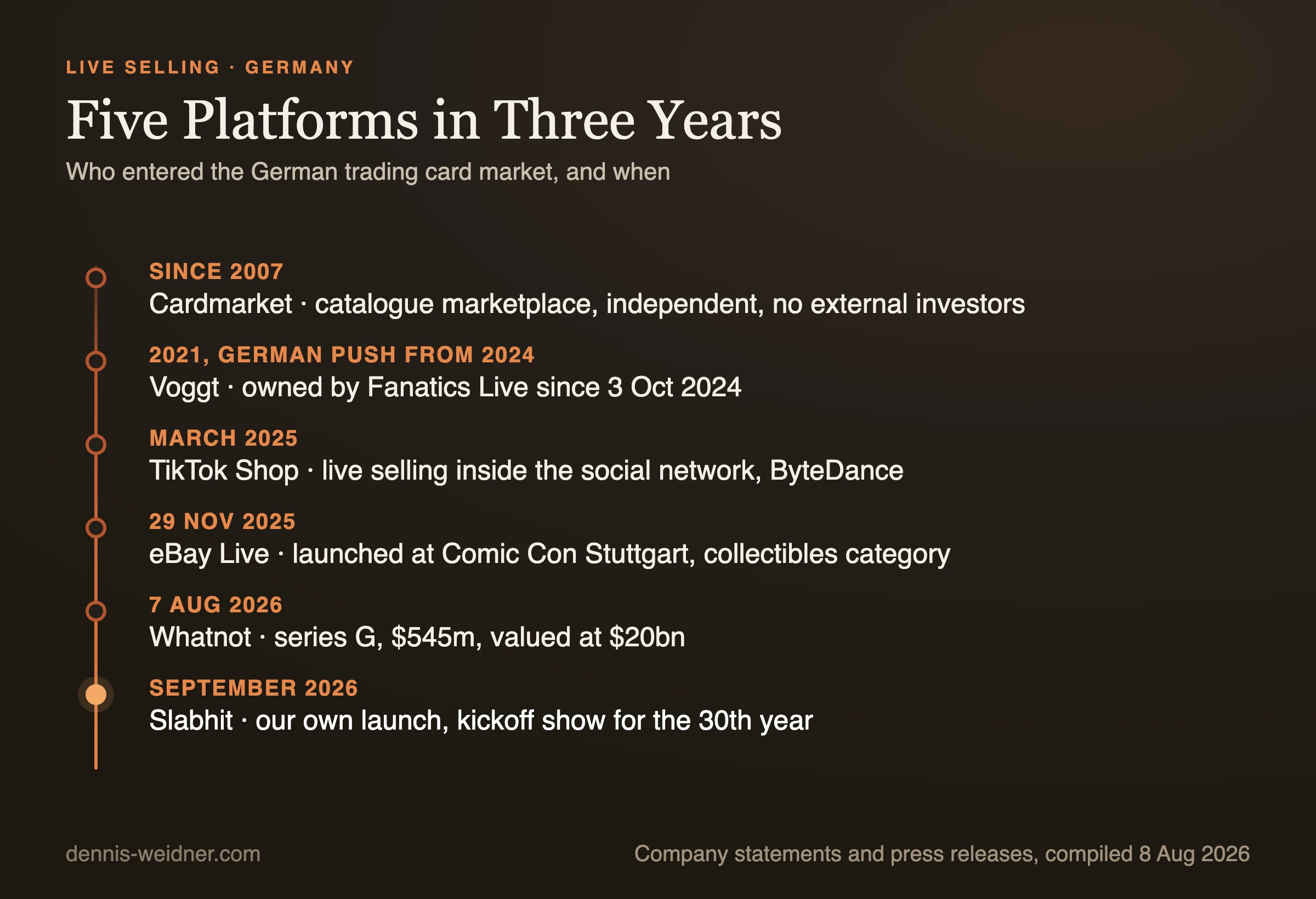
In order. Cardmarket has been there since 2007 and is not a live provider but the catalogue marketplace where the European card price is formed. Voggt was founded in France in 2021, was Europe's market leader in live selling of sports collectibles and trading cards, and has belonged to Fanatics Live since 3 October 2024. TikTok Shop launched in Germany in March 2025. eBay Live followed on 29 November 2025, opening at Comic Con in Stuttgart and, fittingly, with a card dealer as its first stream. And Whatnot closed a 545 million dollar round at a 20 billion valuation on 7 August 2026.
This is no longer a niche, it is a land grab. More interesting than who wins it is what nobody in this fight is currently doing.
Voggt and Fanatics Live: What the Acquisition Means
The Fanatics purchase is the event that got talked about least in Germany and says the most. Fanatics is an American group for sports merchandise and collectibles. With Voggt it did not buy its way into a market, it took over a finished European user base, more than half a million members according to statements at the time.
For sellers that always means the same thing: decisions about the platform they built their business on are now made somewhere else. Not worse, not better, but elsewhere. The priorities of a group focused on sports collectibles are not automatically those of a German Pokémon dealer.
And it sets the benchmark for everything that followed. If Europe's market leader in live selling of trading cards goes to a US group within three years, then the question for any new provider is no longer whether there is capital in this market. The question is what you build that does not depend on it.
Whatnot, eBay Live, TikTok Shop: The Pattern Behind the Growth Figures
All these platforms communicate their size in growth rates, almost never in absolute numbers.
Whatnot's own European report cites a 600 percent increase in seller numbers without stating the starting point. eBay Live advertises an eightfold increase, and even sympathetic observers note that actual scale cannot be derived from it. TikTok Shop publishes hardly any solid category figures for Germany at all.
I am not imputing intent to anybody. It is industry standard, and nobody is obliged to disclose country figures. But a seller deciding where to invest their time gets no answer from these reports to the only question that matters: how many viewers will see my stream if I go live on a Tuesday evening? That number is nowhere, which is why other dealers' experience ends up deciding.
What Sellers Criticise About Live Shopping Platforms
Those experiences can be read. I follow the relevant dealer forums and talk to people selling on these platforms. Five points come up again and again, across platforms.
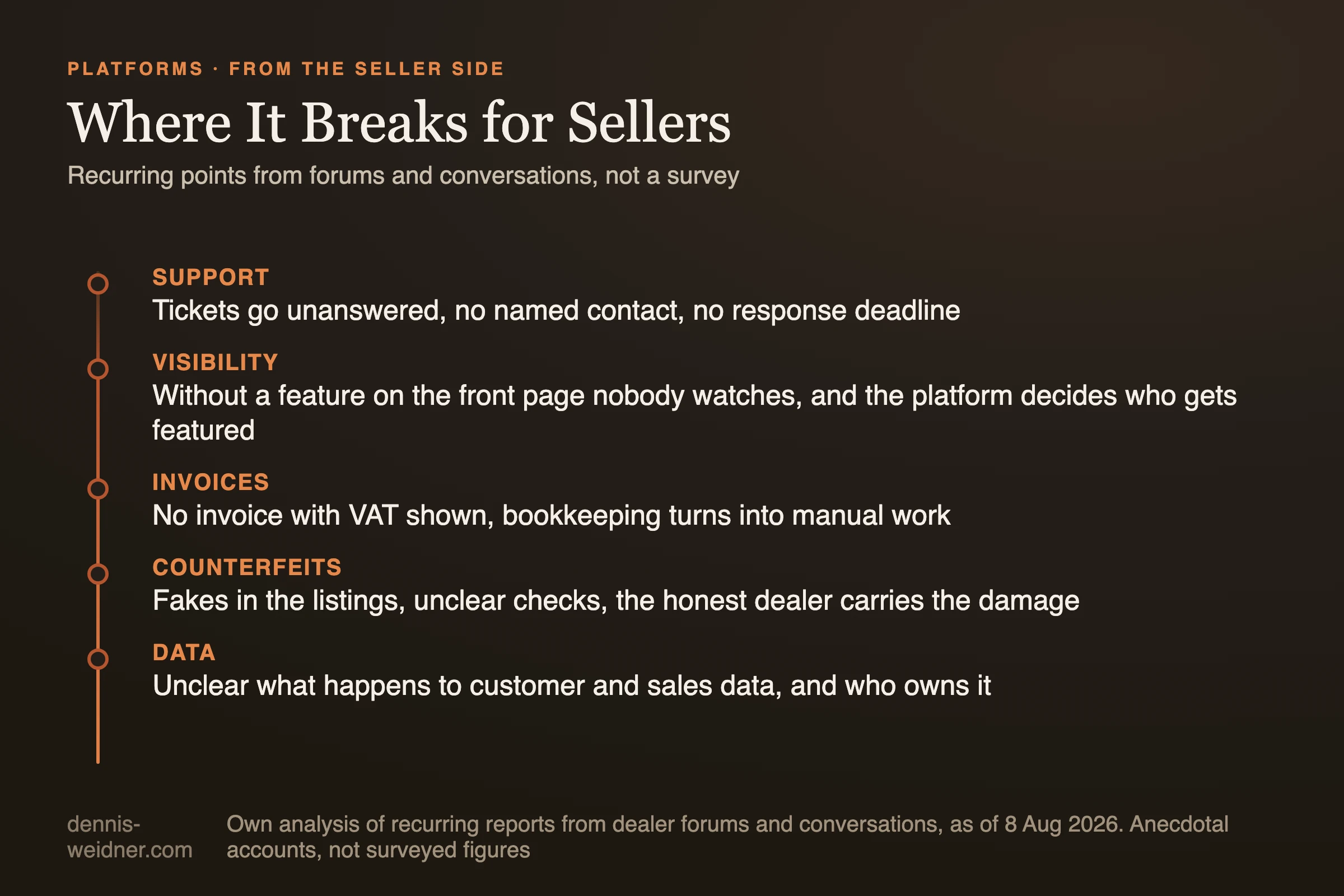
Support does not answer. By far the most common point, and it hits TikTok Shop particularly hard. A ticket disappears, there is no named contact and no promised deadline. For a dealer whose payout is stuck or whose account has been restricted, that is existential.
Without featuring, nothing happens. If you are not surfaced on the front page you have no viewers, and who gets surfaced is decided by an algorithm or a platform team. That is not malice, it is the nature of a marketplace with finite attention. But it means the dealer builds a business on visibility that does not belong to them.
Invoices are a permanent issue. No invoice with VAT shown, no clean statement to download, bookkeeping done by hand. Among German dealers on TikTok Shop there is even a documented case of imported orders arriving with zero percent VAT. Anyone selling commercially cannot wait for that to be fixed, they need it correct.
Counterfeits. Fakes in the listings, unclear checking, and in the end the honest dealer carries the damage because trust in the whole category suffers. In a market where a counterfeit card is barely distinguishable from a real one by eye, that is not a side issue.
Data. Who owns the customer data, what happens to the sales data, and what is left of it when a dealer leaves the platform? With a provider based outside Europe, the data protection question comes on top.
Complaints naturally come from the dissatisfied. These, however, are consistent, they span platforms, and they all describe the same thing: not a product problem, but a service problem.
Why This Gap Stays Open
The decisive thing about these five complaints is that none of them is technically hard to solve. An invoice with correctly stated VAT is standard software. A named contact is an organisational decision. Transparent rules for visibility are a question of openness, not technology. A data export is an afternoon's work.
So why does it not happen? Because for a platform growing in twelve countries at once it simply does not pay off. The effort of solving German invoicing requirements properly is the same whether three hundred or thirty thousand dealers sit behind it. At three hundred it is not worth it for the group, but it very much is for the specialised provider, because that is their entire market.
That is the gap. It is not in the feature race, it is in the service. And it is open precisely because it does not pay off for the big players.
How That Became Slabhit: A Hundred Days to a Running Platform
We started designing this at the beginning of this year. Not as a reaction to a funding round, but from the same observation: the market exists, the category is proven, and the diligence is missing.
What surprised me was the pace. From the first concept page to a running instance with our own code took roughly a hundred days. Three years ago the same thing would have needed a team of ten to fifteen developers and a seven-figure budget, and I have accompanied enough projects to judge that. It was built by agentic systems, steered by a few people who know what they want.
Those hundred days are the real news. The barrier to entering this market has just fallen dramatically while the valuations of the incumbents rise. That is an unusual combination, and it will not last forever. How I work with these tools is in Rebuilding My Website with AI Agents.
Winning Market Share: Why the Best Product Has a Chance
The usual objection: nice product, but distribution decides, and the big player has it. True in many markets. It is just not always true.
I am watching it right now somewhere unrelated to trading cards, in tools I use daily. Among AI tools the first provider was the obvious choice for years, and the competitor that arrived later is now ahead in exactly the area where I work. Not because of a bigger budget, but because the product got better where it counts. Starting later is no handicap if you look for the advantage in the right place.
Applied to this market: nobody switches platforms over a prettier button. But dealers do switch when somebody takes off their hands the three things that annoy them daily. Anyone selling on a large platform today who has been waiting weeks for an answer is not a loyal customer. They are a customer without an alternative yet.
Slabhit Launch in September 2026: Kickoff Show and Beta Testers
We launched Slabhit on 15 September 2026, and deliberately small: with a kickoff show marking the thirtieth year of the collection, together with sellers from Germany, Austria and Switzerland. Not a mass launch, but an evening with the people who carry this market.
That is a deliberate choice. A live platform without sellers is an empty stage, and sellers do not turn up because of an announcement, they turn up because somebody they trust is already standing there. So we build the circle first and the reach second, not the other way around.
And we are still looking for beta testers. If you collect or sell cards and fancy taking an early look, get in touch directly. We are not looking for applause but for the uncomfortable sentences: what is missing, what is annoying, what the other platforms solve better. They are where the difference this whole text is about comes from.
On the market as a whole and where retail is shifting, I write continuously on my topic page on e-commerce and live commerce.
Frequently Asked Questions
Which live shopping platforms sell trading cards in Germany?
Four, plus the incumbent market. Voggt has been active since 2021 and has belonged to Fanatics Live since 3 October 2024. TikTok Shop launched in Germany in March 2025, eBay Live on 29 November 2025 at Comic Con Stuttgart. Whatnot is the largest provider and was valued at 20 billion dollars on 7 August 2026. On top of that sits Cardmarket, which is not a live provider but has set the European card price since 2007.
Who owns Voggt?
Fanatics Live, the live commerce arm of the American sports collectibles group Fanatics. The acquisition of Voggt's assets was announced on 3 October 2024. Voggt was founded in France in 2021 and had more than half a million members according to statements at the time.
When did eBay Live launch in Germany?
On 29 November 2025, opening at Comic Con in Stuttgart. The first categories were collectibles and rarities as well as clothing and accessories, with more to follow in 2026. The first livestream came from a card dealer with a curated Pokémon selection.
What do sellers criticise about the large platforms?
Five points come up across platforms: support that does not answer; no visibility without a feature on the front page; no invoices with VAT shown; counterfeits in the listings; and uncertainty over who owns the customer and sales data. The points come from dealer forums and conversations with sellers.
Why do the large platforms not fix these problems?
Because the effort does not pay off for them. Implementing German invoicing requirements properly costs the same whether three hundred or thirty thousand dealers sit behind it. For a group growing in many countries at once that is one task among many. For a specialised provider it is the entire market.
When did Slabhit launch?
On 15 September 2026, deliberately small with a kickoff show marking the thirtieth year of the collection, together with sellers from Germany, Austria and Switzerland. The beta has been running since then, and we are still looking for beta testers to take a look and say what is missing.
Can a small provider compete with a 20 billion platform?
Not on price and not on reach, but on service. None of the recurring complaints is technically hard to fix: a correct invoice is standard software, a named contact is an organisational decision, a data export is an afternoon's work. On top of that the barrier to entry has fallen: our running instance was standing after roughly a hundred days, built by agentic systems rather than the team it would once have required.
Warm regards,
Dennis Weidner
Note: AI tools supported me in writing this article, and some images were edited with AI. I stand behind its content and every statement with my name.