Since 2023, eBay, Cardmarket and classifieds platforms have been reporting their sellers to the German tax authorities, and collector forums have been trading more fear than facts ever since. In reality there are exactly three thresholds to know: one for the report, one for income tax, one for VAT. I lay them out side by side, with the legal reference, the date and the source.
Selling Trading Cards and Taxes: Why the Fear Is Bigger Than the Rule
There is a question that surfaces in every German collector forum on a regular basis, usually in a slightly panicked tone: I sold my Pokémon collection on eBay, do I have to pay tax on that now? The replies underneath are almost always a mixture of half-knowledge, rumour and the advice to simply say nothing. That is a poor basis for decisions that can involve four-figure sums.
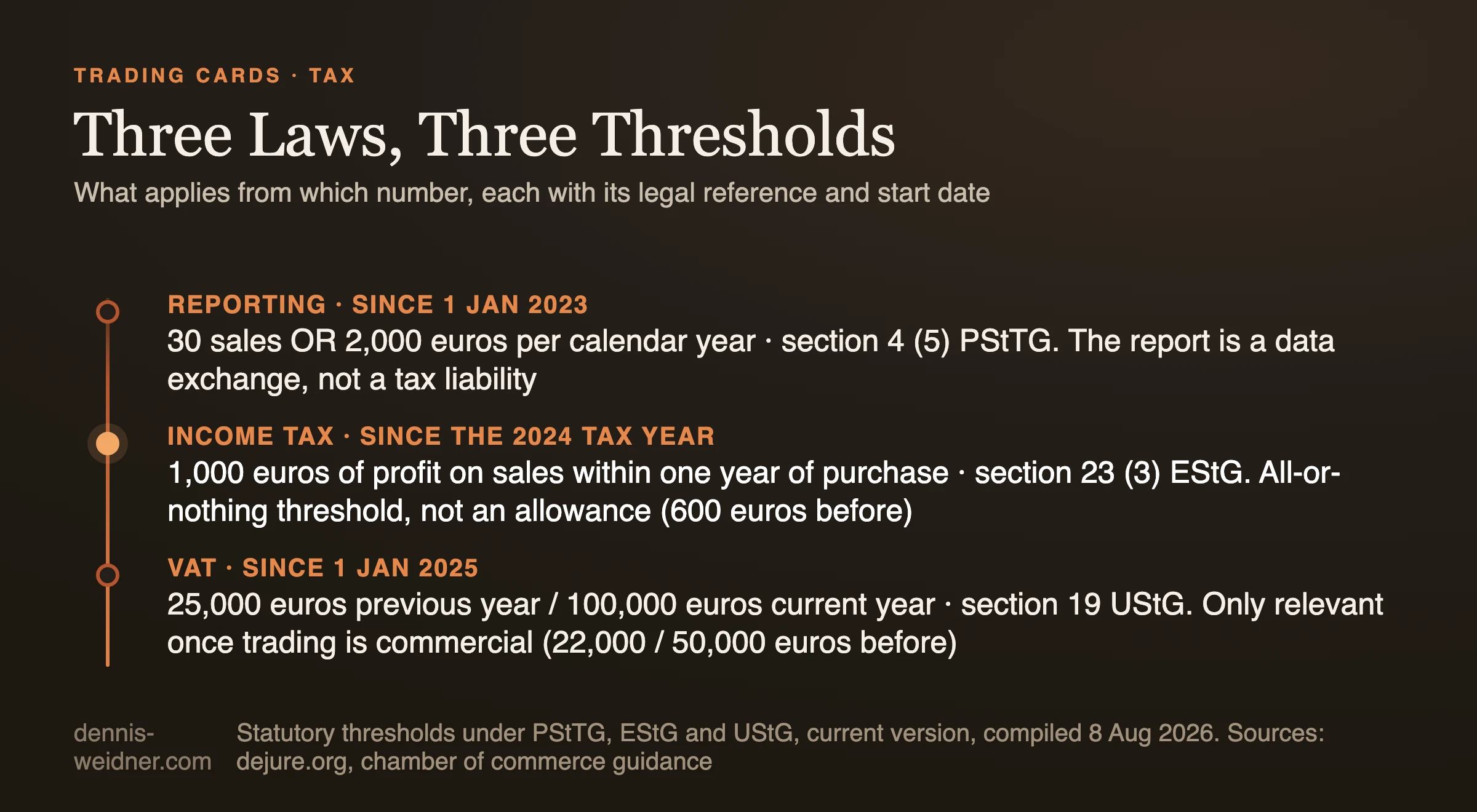
The legal situation is actually more orderly than those threads suggest. There are exactly three thresholds a private card seller in Germany needs to know: the reporting threshold for platforms (30 sales or 2,000 euros), the income tax threshold (1,000 euros of profit on sales within one year of purchase) and the VAT small business limit (25,000 euros), which only becomes relevant once the collector has turned into a dealer. These three thresholds belong to three different laws, they have nothing to do with each other, and confusing them is what generates most of the fear.
I am an entrepreneur currently building Slabhit, a live shopping platform for trading cards, not a tax adviser. This is not tax advice for an individual case. Anyone liquidating a five-figure collection or trading regularly should walk through the actual numbers with a professional.
DAC7 and the Platform Tax Transparency Act: When eBay and Cardmarket Report You
The reason this topic has been boiling for a few years is a law with an unwieldy name: the German Platform Tax Transparency Act (PStTG), in force since 1 January 2023. It implements the EU directive known as DAC7 and obliges digital platforms to report their sellers once a year to the Federal Central Tax Office, which passes the data on to the seller's local tax office.
The decisive part is the exemption for casual sellers, set out in section 4 (5) of the act: a seller is not reported if, in a calendar year, they completed fewer than 30 sales and received less than 2,000 euros. Put the other way round: 30 or more sales or 2,000 euros or more in proceeds, and the report is filed. eBay explains it exactly this way on its seller pages, and the same duty applies to Cardmarket, Kleinanzeigen, Etsy and Vinted.
What gets reported is substantial: name, address, date of birth, tax identification number, bank details, plus the payments received and the number of transactions, broken down by quarter. The platform is also obliged to collect this data from the seller and may block accounts if it is not provided.
Now the sentence missing from every forum thread: the report is not a tax liability. It is a data exchange. Someone who sells an inherited collection for 5,000 euros will be reported and may not owe a cent of tax. Someone with 29 sales for a total of 1,900 euros will not be reported and can still owe tax if they sold at a profit within the one-year window. Whether tax is due is decided by other laws, and those come next.
§ 23 EStG: The One-Year Rule and the 1,000 Euro Threshold for Card Sales
For private sellers the central rule is section 23 of the German Income Tax Act, which governs private disposal transactions. The mechanics fit into three sentences.
First, the one-year rule. A sale is only taxable if no more than one year lies between purchase and sale. Anyone who has owned their cards for longer than a year sells tax-free as a private individual, whether the profit is 50 euros or 50,000 euros. The childhood collection, the inherited binder, the display bought three years ago: all outside the window, all tax-free. That is the collector's normal case, and it is why most reported sellers have nothing to fear.
Second, an exemption that does not help here. The law excludes items of everyday use from taxation, think used clothing or household goods. Trading cards, under the prevailing reading, do not qualify, because they carry appreciation potential and are bought precisely for it. So whoever buys a display in spring, opens it and sells the best pulls at a profit in summer is trading within the one-year window and inside taxable territory.
Third, the threshold. Profits from all private disposal transactions in a year remain tax-free if together they stay below 1,000 euros. This limit has applied since the 2024 tax year, previously it was 600 euros, and it is an all-or-nothing threshold, not an allowance: make 999 euros of profit and you pay nothing. Make 1,001 euros and the full 1,001 euros are taxed at your personal rate. The same pot, by the way, includes crypto gains realised within their one-year window; the limit applies per person and year across all private disposal transactions.
Profit means: sale price minus acquisition cost minus selling costs, which includes the platform fees I took apart in my Cardmarket report. From this follows the most practical rule in this article: keep your purchase receipts. Anyone who cannot document acquisition costs risks an estimate by the tax office, and estimates rarely favour the seller. Losses from card sales within the one-year window can be offset against gains from other private disposal transactions; that too is in section 23.
When Selling Cards Becomes a Business: The Federal Fiscal Court Ruling on 3,000 eBay Auctions
The one-year rule and the threshold only apply while you sell privately. The more expensive question is therefore: when does that flip? When does the collector become a trader, for whom neither the one-year rule nor the threshold applies and who pays tax on every euro of profit?
There is no bright-line number, but there is a leading case that sets the direction. On 12 May 2022 (case V R 19/20), Germany's Federal Fiscal Court ruled on a woman who bought items at household clearances and resold them over five years in roughly 3,000 eBay auctions for about 380,000 euros. The court classified this as a sustained entrepreneurial activity. What mattered was not a single number but the pattern: systematic buying with intent to resell, over years, with considerable organisational effort.
Translated to trading cards: liquidating a collection that grew over years, even in many individual auctions, is private. Regularly buying displays, collections or singles in order to resell them is commercial, whether you call it that or not. The tax administration's criteria have been the same for years: duration and intensity, revenue level, systematically acting like a dealer, selling on behalf of others, professional presentation. Any ambitious flipper ticks three of those.
Being commercial is not a catastrophe, it is a different rulebook: profit taxation under section 15 of the Income Tax Act, business registration, trade tax above 24,500 euros of profit, plus the VAT question in the next section. What gets expensive is not the status itself but its retroactive discovery by the tax office, because then several years are unrolled at once, and the DAC7 reports deliver the evidence free of charge.
VAT on Trading Card Sales: The Small Business Exemption and the Margin Scheme
Commercial sellers meet the third threshold, VAT. Here too the numbers changed recently, and many people still remember the old ones: since 1 January 2025, the small business exemption of section 19 of the VAT Act applies with new limits. You stay VAT-exempt if your revenue was at most 25,000 euros in the previous year and does not exceed 100,000 euros in the current year. The old limits were 22,000 and 50,000 euros. Also new is the severity of the second limit: exceed 100,000 euros during the year and you drop out of the exemption immediately, not at the year end.
For card dealers above these limits there is a mechanism that effectively carries the whole trade and is still barely known: the margin scheme of section 25a of the VAT Act. A reseller who buys cards from private individuals, meaning without being charged VAT, pays VAT on resale not on the full sale price but only on the margin between purchase and sale. The Federal Fiscal Court explicitly confirmed this in the 2022 eBay ruling and even held that missing purchase records do not automatically exclude the margin scheme; the figures are then estimated. For anyone trading second-hand cards, this is the difference between a viable business model and a dead one.
Three Worked Examples for Card Sellers
Case 1: the collection sale. Someone sells their childhood Pokémon collection in 45 individual auctions for a total of 6,200 euros. The platform reports them to the Federal Central Tax Office, since both thresholds are crossed. Still, no tax is due: every card was owned for longer than a year, so all sales fall outside the one-year window of section 23. If the tax office ever asks, one sentence and a few dated photos of the collection settle it.
Case 2: the occasional flipper. Someone buys a display for 160 euros in March, pulls a sought-after card and sells it in June for 900 euros. Sale within the one-year window, profit around 740 euros after fees. If that remains the only flip of the calendar year and total private disposal profits stay under 1,000 euros, the gain is tax-free. Add a second sale in November with 400 euros of profit and the total is 1,140 euros, which makes the entire amount taxable, not just the 140 euros above the line.
Case 3: the permanent seller. Someone has been buying collections every week for two years and reselling them broken up, 1,200 sales, 40,000 euros of annual revenue. That is no longer a private disposal, that is a business: profit taxed under section 15, VAT above the small business limit, but the margin scheme on the spread and business expenses from sleeves to postage. Anyone on this path should walk it deliberately, with registration and an adviser, instead of waiting for two years of platform reports to catch up with them.
What This Means for Live Shopping and Slabhit
Why does this interest me beyond collecting? Because live shopping crosses the thresholds in this article faster than any other sales format. A single live show with individual sales easily produces 30 transactions, exactly the number at which the DAC7 report kicks in. On Whatnot and the other platforms whose landscape I have mapped here, private individuals sell at a pace that stopped being casual selling, in tax terms, long ago. The topic almost never comes up in seller forums, and I consider that gap between selling speed and tax knowledge one of the underrated risks of the format.
For Slabhit I draw a product lesson from this: a platform that takes its sellers seriously treats reporting obligations not as fine print but as part of seller care. Clean sales overviews, exportable statements with fees itemised, clear information about what gets reported and what does not: that costs little and spares sellers exactly the panic this article started with. How I think about retail in general is on my topic page on e-commerce and live commerce.
The Old 600 Euro Threshold and Special Cases: When You Need a Tax Adviser
The 1,000 euro threshold has applied since the 2024 tax year, 600 euros before that. Older guides still carry the old number, which is a handy freshness test for any text on this topic.
Special cases such as cross-border sales, gifts before a sale or mixed collections need individual tax advice. Anyone living in case 3, or planning a five-figure liquidation, belongs in a consultation, not in a forum.
Frequently Asked Questions
Do I have to pay tax when I sell my Pokémon collection in Germany?
In most cases no. If you owned the cards for more than one year, the sale is tax-free for a private individual, regardless of the amount. Tax only becomes an issue for sales within one year of purchase, once total profits from private disposals reach 1,000 euros in a calendar year, or if the activity is commercial.
When does eBay report my sales to the German tax authorities?
Since 1 January 2023, platforms report sellers who complete 30 or more sales or receive 2,000 euros or more in a calendar year, under the Platform Tax Transparency Act implementing DAC7. The report goes to the Federal Central Tax Office, which forwards it to the local tax office. The report itself does not create a tax liability.
How does the 1,000 euro threshold work?
Profits from private disposal transactions remain tax-free if they total less than 1,000 euros in the calendar year (section 23 (3) EStG, since the 2024 tax year). It is an all-or-nothing threshold: from 1,000 euros upwards the entire profit is taxable, not just the excess. The pot includes all private disposals, crypto gains within their one-year window included.
Do trading cards count as items of everyday use?
No. The exemption for everyday items covers things like used clothing or household goods that typically lose value. Trading cards are bought precisely for their appreciation potential and therefore fall outside the exemption, so sales within the one-year window are taxable in principle.
When does selling trading cards become a commercial activity?
When you systematically buy in order to resell. In 2022 the Federal Fiscal Court (V R 19/20) classified a seller with around 3,000 auctions and 380,000 euros of revenue over five years as an entrepreneur. There is no fixed unit count; what matters is resale intent, duration, revenue and dealer-like conduct. Liquidating your own collection built up over years remains private.
What is the margin scheme and why does it matter for card dealers?
Under section 25a of the VAT Act, a reseller who buys goods from private individuals pays VAT only on the difference between purchase and sale price, not on the full price. Since second-hand cards almost always come from private hands, the scheme is what makes the trade economically viable. The court confirmed in 2022 that missing purchase records do not automatically exclude it.
What are the German small business VAT limits since 2025?
Since 1 January 2025 you remain VAT-exempt with at most 25,000 euros of revenue in the previous year and no more than 100,000 euros in the current year, up from 22,000 and 50,000 euros. Exceeding the 100,000 euro line now takes effect immediately during the year, not at the year end.
Are screenshots enough to prove my acquisition costs?
Better than nothing, but the weakest form of evidence. Anyone selling within the one-year window or trading commercially should keep purchase receipts, invoices and payment records, because without proof the tax office estimates acquisition costs, and estimates rarely favour the seller. For old collections, dated photos and plausibility help, though those sales are usually tax-free anyway.
Warm regards,
Dennis Weidner
Note: AI tools supported me in writing this article, and some images were edited with AI. I stand behind its content and every statement with my name.