
Slab is one of those words that come up constantly around trading cards and are rarely explained. Behind it sits a small revolution: an industry where everybody described their own goods has given itself an independent inspection authority. Here is what actually happens, and where the limits are.
Where the Word Comes From
A slab is the sealed plastic holder that a graded trading card sits in: two moulded shells, the card in an inner sleeve between them, and a label at the top with card name, set, certification number and a grade. Open the holder and you destroy it, and that is by design.
The term comes from the American coin trade of the 1980s. The first sealed holders for graded coins appeared there, and collectors mockingly called the chunky things slabs. The nickname stuck, the principle caught on, and thirty years later it travelled from baseball cards to Pokémon and Magic.
I am not telling this out of etymological enthusiasm. We named our live shopping project Slabhit, and the question "what does slab actually mean" comes up in every second conversation. This text is the long answer. What the individual providers charge and which grade pays off when is deliberately not here, that is a topic of its own.
What Actually Happens on the Way to a Grade
The process is essentially the same at all the large providers, and it is considerably more industrial than most collectors assume.
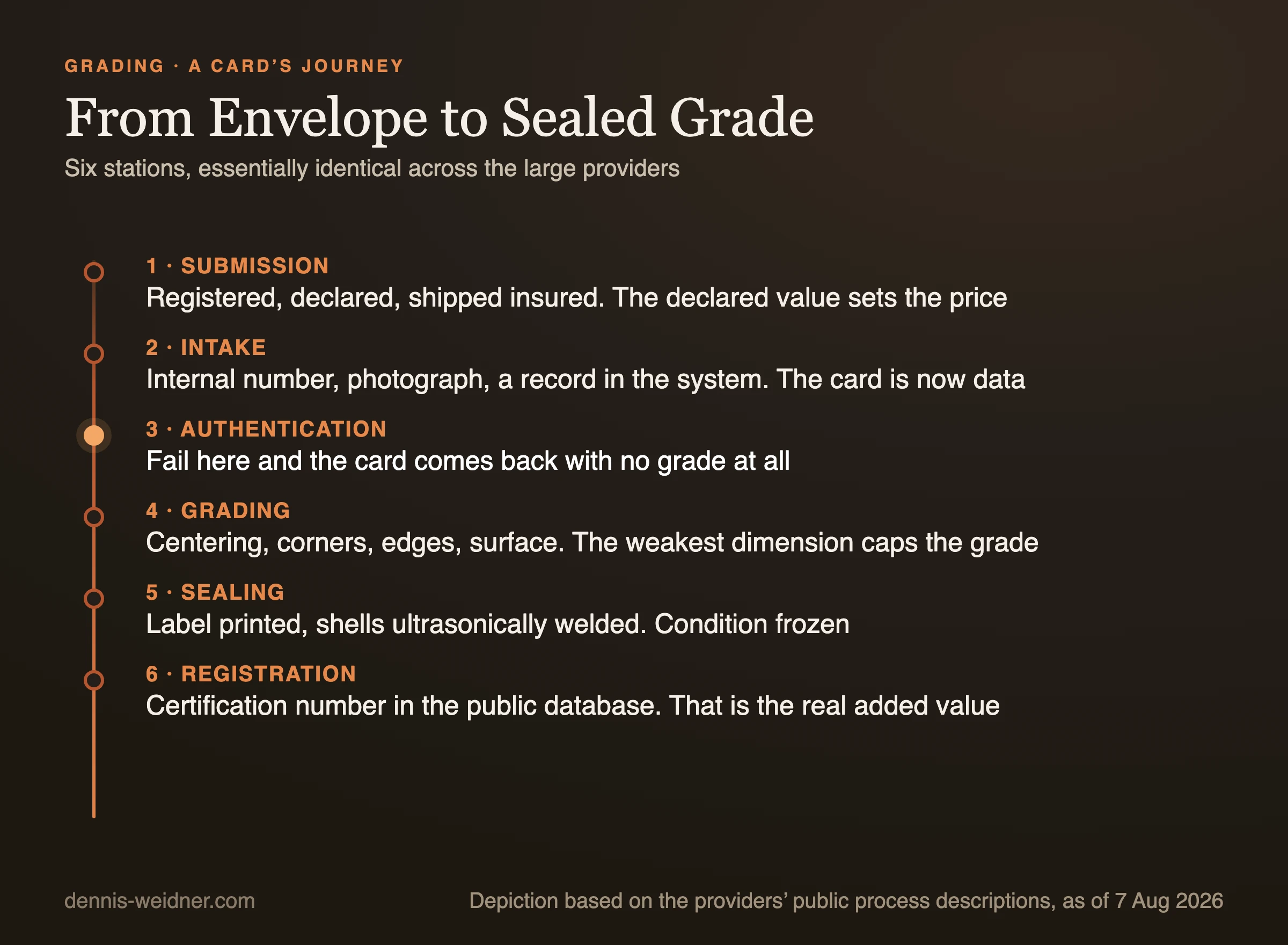
Submission. The card is registered, declared and shipped insured, in a soft sleeve and a rigid holder, but not taped shut. Money is already at stake here: the declared value determines the service tier and therefore the price.
Intake. The shipment is opened, every card receives an internal number, is photographed and from that moment on is a record in an inventory system. The emotional value of the card ends at that door.
Authentication. Before anything is graded, the card is checked for authenticity. If it fails here, it comes back without a grade. This is the most important station and the reason a slab creates trust at all.
Grading. Several graders assess four dimensions: centering, corners, edges and surface. The overall grade usually does not come from an average but from a rule under which the weakest dimension caps the result. That is why a card with three perfect values can fail on a slightly off centering.
Sealing. The card goes into the inner sleeve, the label is printed, and the two shells are ultrasonically welded. From then on the condition is frozen and documented.
Registration. The certification number goes into a public database. Anyone can enter it and see which card was registered under that number with which grade. That is the real benefit, and it is often overlooked.
The Difference You Can See on the Marketplace
How big the jump from a condition statement to a grade really is becomes clearest where millions of cards change hands every day without a slab. Cardmarket, Europe's largest marketplace, works with a seven-step scale from Mint through Near Mint, Excellent, Good, Light Played and Played down to Poor. And the platform writes a remarkably honest sentence about it in its own card condition help page: grading is not an exact science, and what one person still considers Near Mint is Excellent to the next.
That is not a criticism of Cardmarket, quite the opposite, that openness is exemplary. But it describes the problem precisely: a condition statement on a marketplace is the seller's own assessment. It is well meant, often accurate, and in a dispute it is a matter of negotiation. The help page suggests a ten percent refund of the card's value as a rule of thumb when the disagreement is about one grade. That rule of thumb would be unnecessary with a slab.
The grade in a slab, by contrast, is the judgement of a third party that neither buys nor sells, documented, verifiable and tied to a physically sealed object. The difference is not precision versus imprecision. The difference is that an opinion becomes a checkable statement. It is the same jump a used car with an inspection report makes over a used car with a description.
How to Recognise a Serious Grading Company
Grading companies are private businesses. Nobody licenses them, there is no supervisory authority and no standard to measure them against. Their entire value consists of reputation. Four questions separate the serious from the doubtful, and all of them can be answered in five minutes:
First: is there a public certification database? You have to be able to enter the number from the label and see the same card with the same grade. Without that verifiability, the slab is a piece of plastic with a claim printed on it. This is the first and hardest criterion.
Second: is there a population report? That is, a breakdown of how many copies of a card have already been graded at which grade. Publishing that figure makes a company accountable and proves it has graded consistently over years. A company that does not publish one either lacks volume or has something to hide.
Third: how is the card insured in transit? Serious providers state explicitly in their terms what they are liable for in case of loss or damage, and up to what amount. If that section is missing, the card is effectively uninsured for the entire process.
Fourth: how does the provider handle its own mistakes? Every large house has a procedure for disputing a grade or having a card reviewed. That it exists matters more than how often it succeeds.
What deliberately does not appear in these four questions: price and turnaround time. Both fluctuate heavily and both belong in a dedicated comparison. For the question of whether a provider works seriously at all, they are unsuitable.
What a Slab Explicitly Is Not
This is where most misunderstandings are born, so here are three clear boundaries.
A slab is not a valuation. The label carries a condition grade, not a price. What the card is worth is decided by the market, and that can halve within a year without anything changing about the grade. Anyone presenting a slab to an insurer as proof of value will have to explain that.
A slab is not a legally binding certificate of authenticity. It is the documented assessment of a private company that is liable to the extent its own terms provide for. That is worth a great deal in practice and is legally something different from an official attestation.
A slab is not counterfeit-proof. Fake holders exist, labels carrying somebody else's certification number exist, and so do opened and re-welded slabs with swapped contents. That is why criterion one above matters just as much when buying: look up the number and compare the card shown in the database with the card in your hand. If the image does not match what you are holding, the case is clear.
How much counterfeits shape everyday trading can be read in Cardmarket's counterfeit guide: a missing accent on the word Pokémon, wrong typefaces, off-centre symbols in the energy costs, cards claiming a "second edition" that never existed. A grading company checks exactly these features systematically, and that is why its judgement is worth money in the trade.
When It Is Worth It and When It Is Not
Without talking about fees, the question can be answered surprisingly well, because at its core it does not depend on price.
It is worth it when the grade moves the price sharply. That applies to cards sitting just below the top of the scale and traded in high volume. There, one grade step separates two entirely different price levels.
It is worth it when authenticity is the real question. With old, expensive and frequently counterfeited cards, you are not buying a grade with the slab, you are buying an answer to whether the thing is genuine at all.
It is not worth it if the card is going to be played. Sounds obvious, gets overlooked constantly. A card in a slab is out of the game, and anyone who takes it out has destroyed the holder and devalued the documentation.
It is not worth it for cards in the lower price range. Beyond a certain point the process costs more than the grade can ever bring in, regardless of provider.
What interests me about this development is less the card than the pattern. An industry in which everybody described their own goods for decades has created an independent inspection authority and accepted its judgement as the basis for pricing. I know that pattern from retail in general, and it is why I believe more is changing in how trading cards are sold than just the channel. More on my topic page on e-commerce and live commerce.
Frequently Asked Questions
What does slab mean for trading cards?
A slab is the sealed plastic holder containing a card that has been checked by a grading company. The label carries the card name, the set, a condition grade and a certification number. The term comes from the American coin trade of the 1980s and was originally a mocking nickname for the chunky holders.
What is the difference between grading and a marketplace condition rating?
A marketplace condition rating is the seller's own assessment. Cardmarket states in its own help pages that this classification is not an exact science and that the same card is placed differently depending on the person. A grading company's grade comes from an uninvolved third party, is documented, can be verified through a certification number and is tied to a sealed object.
How do I recognise a serious grading company?
By four things: a public certification database in which every number can be looked up, a published population report, clearly defined insurance for submitted cards, and a procedure for disputing a grade. Without the database, a slab is just a piece of plastic with a claim printed on it.
Is a slab a certificate of authenticity?
Not in a legal sense. It is the documented assessment of a private company, liable to the extent its own terms provide for. In practice it is worth a lot, because authentication happens before grading and a card that fails receives no grade at all. It is still not an official attestation.
Can slabs be faked?
Yes. There are counterfeit holders, labels carrying somebody else's certification number, and opened and re-welded slabs with swapped contents. That is why the rule when buying is always: look up the certification number in the provider's database and compare the card shown there with the card in the holder.
How is the overall grade determined?
Four dimensions are assessed: centering, corners, edges and surface. The overall grade usually does not come from an average but from a rule under which the weakest dimension caps the result. That is why cards with three perfect values regularly fail on slightly off centering.
Should I get my cards graded?
It is worth it when the grade moves the price sharply, so for frequently traded cards near the top grades, and when authenticity is the real question, so for old and often counterfeited cards. It is not worth it for cards meant to be played, and not in the lower price range. What the process costs at which provider is a topic of its own.
Warm regards,
Dennis Weidner
Note: AI tools supported me in writing this article, and some images were edited with AI. I stand behind its content and every statement with my name.