In February 2026, a single Pokémon card changed hands for 16.49 million dollars. At the same time, trading cards are showing up in portfolios, tracked by funds, indices, and databases like a stock market. Is this a serious asset class or a bubble with pretty pictures? I looked at the numbers from an entrepreneur's point of view, without hype and without sneering.
With Slabhit I am building in the world of collectors and rarities myself, so I know the business from the inside. Nobody building in this market wants a bubble, we want a hobby that is still alive in twenty years.
More on this topic: E-Commerce & Live Commerce, with background, practice and every article in one place.
A market too big for sneering
The scale alone surprises many people. According to Grand View Research, the global trading card market is projected to reach nearly 54 billion US dollars by 2033, growing at an expected 7.7 percent per year. This is no longer a niche hobby. It is an industry with its own infrastructure: auction houses, grading services, data providers, marketplaces, vault storage.
Grading, the professional assessment of a card's condition, tells the same story. In 2025, roughly 26.8 million cards were graded across the industry, up 32 percent year over year, an all-time record, as industry data shows. Volumes like that explain why institutional money is paying attention. But size alone does not make an asset class.
What speaks for trading cards as an investment
Trading cards have properties investors fundamentally value. They are scarce, some print runs exist only a few dozen or a few thousand times, and that scarcity cannot simply be reprinted away. They are emotionally charged, which keeps demand stable across generations. And they are only loosely tied to stocks or bonds, which in theory makes them useful for diversification.
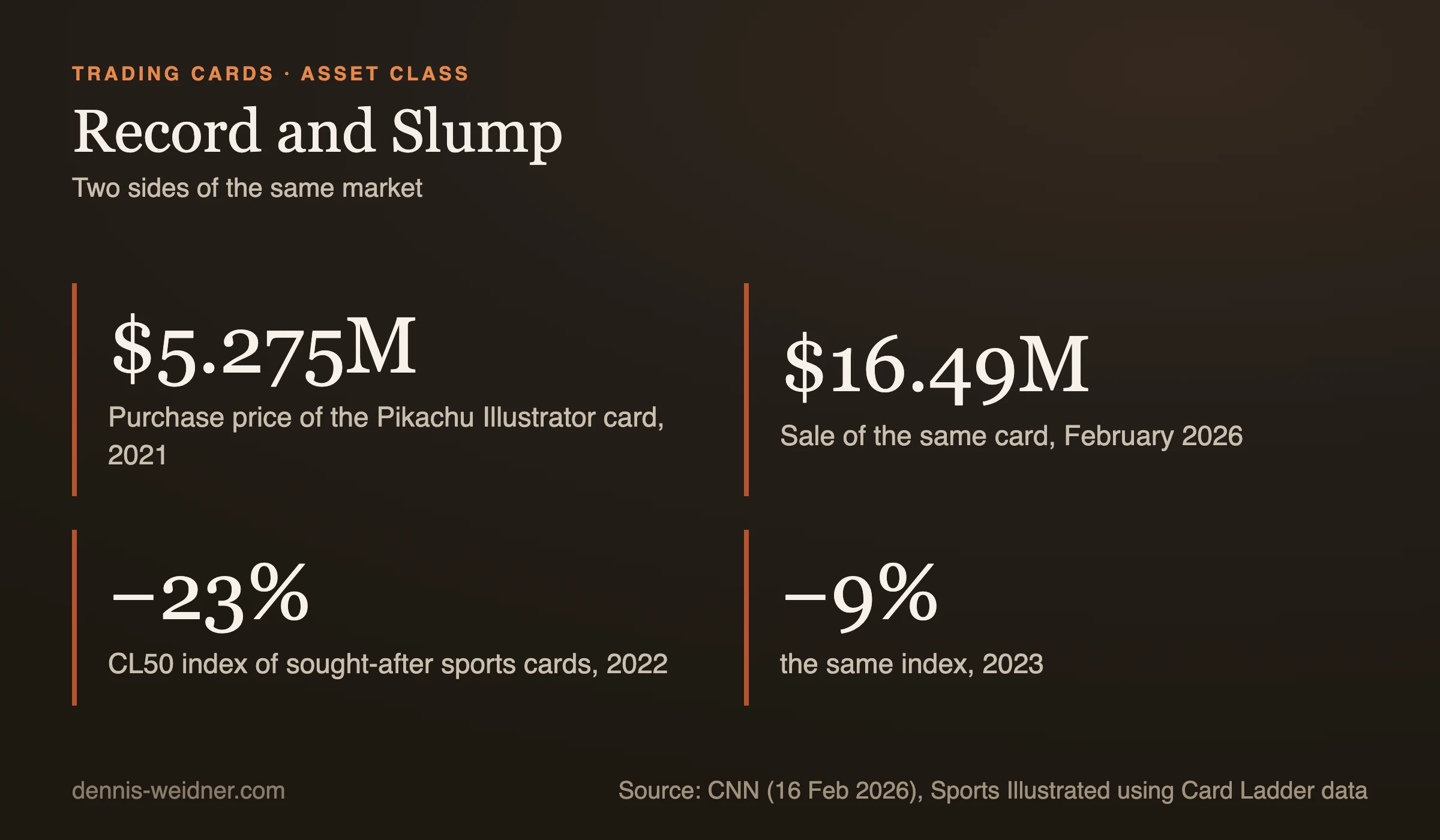
The top pieces have also delivered serious performance. The best example is the Pikachu Illustrator in PSA 10: Logan Paul acquired it privately in 2021 for 5.275 million dollars. In February 2026, that very card was auctioned at Goldin for 16.49 million dollars, a world record, as CNN reported. More than a threefold increase in barely five years. But a single trophy piece is not a market statistic. It is the summit, not the terrain.
The stress test: boom and bust from 2021 to 2023
The last cycle showed how the terrain behaves. The CL50, data provider Card Ladder's index of important cards, rose 337 percent between 2019 and March 2021. Then came the reckoning: down 23 percent in 2022, down another 9 percent in 2023, as Sports Illustrated traces based on Card Ladder data. Anyone who bought at the peak sat on heavy paper losses for years.
A stock index fluctuates too. But behind stocks stand earnings and dividends. Behind a card stands nothing but the expectation that someone will pay more later. When that expectation flips, there is no intrinsic value to cushion the fall. That is why the swings in this market were so brutal, in both directions.
The five criteria of a real asset class
An asset class is defined by the structure of its market, not by the price of its most expensive piece. Let me go through the criteria.
Liquidity. The biggest weakness. A sought-after card in top condition sells quickly, a mediocre one in a weak phase barely at all. In a crisis, the market for expensive pieces can dry up, and if you need money quickly, you sell at a steep discount or not at all.
Valuation. This has improved. Grading scores, sales databases, and indices make prices more transparent than ever. Still, every card remains a unique mix of print run, condition, and demand. There is no fair value like with a bond, only comparable sales.
Costs and storage. Cards pay no interest and no dividend. Instead they cost money constantly: grading fees, insurance, secure storage, plus spreads and auction fees on every sale. Any appreciation first has to earn all of that back.
Market cycles. The market is heavily driven by fashion and pop culture. An anniversary, a Netflix hit, or a celebrity collector can push prices up, and the fading of that same wave pushes them back down. The 2021 to 2023 cycle was not an accident, it is the nature of this market.
Counterfeit risk. Where there are high prices, there are forgers. Fake cards, tampered slabs, doctored surfaces all exist. Without reliable authentication, every high price is speculation on good faith.
Grading as value infrastructure
That last point is also where the market's most important development lies. Grading services like PSA or CGC certify authenticity and condition, turning a subjective collector's item into a standardized, tradable good. PSA alone graded roughly 19.26 million cards in 2025, about 72 percent of the entire grading market. Remarkably, gaming cards like Pokémon overtook sports cards in grading volume for the first time.
Grading is to cards what auditors and rating agencies are to securities: a layer of trust without which no liquid trading emerges. And it is exactly this layer that new sales formats build on, from marketplaces to live shopping, where cards are opened, shown, and sold on camera. Why I consider this combination of trust, entertainment, and commerce so powerful, I describe on my page about e-commerce and live commerce.
Trading cards as an investment: my assessment
So are trading cards an asset class? My answer: they are on their way there, but they are no substitute for the basics. For connoisseurs who have followed the market for years, can read print runs and conditions, and are in it out of passion, cards can be a small portfolio addition, with money whose total loss they could absorb. As the foundation of a retirement plan they do not work; liquidity, costs, and cycles are too unpredictable. And to be clear: this is not investment advice, it is my personal assessment as an entrepreneur and collector.
Anyone who buys a card because they love it is doing everything right anyway, because the real return of collecting is the joy and the community behind it. Why exactly that trust between people is the real value, I describe in Trust as a Business Model. Collectors always win. Speculators only sometimes.
Frequently asked questions
Are trading cards a safe investment?
No. Trading cards produce no ongoing income, and the market is narrow, cost-intensive, and driven by fashion. After the boom that peaked in March 2021, the Card Ladder CL50 index lost more than 30 percent combined in 2022 and 2023. For connoisseurs, cards can be a small portfolio addition, but not a basis for building wealth.
How big is the trading card market?
Grand View Research projects the global trading card market to reach nearly 54 billion US dollars by 2033, at around 7.7 percent annual growth. In 2025, roughly 26.8 million cards were professionally graded, an all-time record.
What is the most expensive trading card in the world?
The Pikachu Illustrator in PSA 10. Logan Paul acquired the card for 5.275 million dollars in 2021, and in February 2026 it was auctioned at Goldin for 16.49 million dollars, a world auction record for trading cards.
Why is grading so important for a card's value?
Grading services like PSA or CGC certify authenticity and condition, making cards comparable and tradable. They reduce counterfeit risk and create the trust without which high prices and liquid trading cannot work. PSA alone graded roughly 19.26 million cards in 2025.
Warmly,
Dennis Weidner
Note: AI tools supported me in writing this article, and some images were edited with AI. I stand behind its content and every statement with my name.