Cardmarket is where the price of a trading card is made in Europe. Yet the figures published about the company contradict each other by a factor of four. I opened the primary sources instead of collecting secondary quotes, and found a development nobody is writing about.
Why This Report Exists
If you buy or sell trading cards in Europe, you cannot avoid Cardmarket. For Magic, Pokémon, Yu-Gi-Oh! and a dozen other games, the marketplace is what eBay once was for second-hand goods: the place where the price is made. When a dealer in Hamburg wants to know what a card is worth, they do not open a catalogue. They open Cardmarket.
And yet it is remarkably hard to find out how big this company actually is. For this report I did not quote secondary sources. I opened the primary ones myself: the legal notice, the help pages, the documentation of the programming interface, the job listings, the commercial register entries and older versions of the company's own website in the Internet Archive. One finding is uncomfortable: the figures circulating about Cardmarket contradict each other by a factor of four.
This report puts the statements side by side, each with its date, and then the contradiction largely resolves itself.
The Company Behind the Marketplace
Cardmarket is a brand, not a legal entity. Behind it stands Sammelkartenmarkt GmbH & Co. KG, based in Berlin, registered with the local court of Berlin-Charlottenburg under HRA 39760 B, VAT ID DE256122758. Its general partner is Sammelkartenmarkt Verwaltungs GmbH, HRB 205929 B. These details appear unchanged in the legal notice, and they were already there in 2021.
What changed is more interesting. The snapshot of the legal notice from 27 January 2021 names three managing directors: Luis Torres, Dr Matthias Knelangen and Dr Marko Schädlich. The snapshot from 9 February 2023 adds a fourth name: Robert Giel. He is the CEO who represents the company's figures publicly today. The Pokémon boom sits between those two versions, and you can see the professionalisation in them.
The scale of the business can be approximated through the German federal gazette. The balance sheet total grew from 9.6 million euros in 2019 to 29.6 million euros in 2023, roughly tripling in four years. The most recent filing dates from 16 March 2026. A limited partnership of this size does not have to disclose a profit and loss statement, so revenue stays dark there. I get to revenue by a different route below.
One side note: the legal notice still lists Nordkapstrasse 4, 10439 Berlin. The job listings the company published through its careers page on 7 August 2026 give the work location as Berliner Strasse 80, 13189 Berlin. Both are in Pankow, so this is most likely a move the legal notice has not caught up with. It shows how quickly a primary source can go stale while remaining formally valid.
How Big Is Cardmarket? Four Answers to One Question
Now to the core. Two pairs of figures circulate about Cardmarket's size, and they do not fit together: roughly half a million users with about 100 million listings, or two million users with 500 million listings. That is not a rounding issue. That is a factor of four to five.
The resolution is not that one side is lying. It is that almost nobody writes down when and what exactly was counted. Here are the statements I can back with a date and a source:
15 March 2021. A detailed company profile at OMR reports around 500,000 users from 30 countries, roughly 100 million listings, of which about 50 million are single cards, 50 employees and 7.5 million visits per month. The Pokémon boom was only just picking up speed.
1 February 2023. In the version stored in the Internet Archive, the company's own homepage advertises "100 million+ card offers". What is notable here is less the figure than its constancy: two years after the OMR profile, the company advertises the same order of magnitude.
26 May 2026. In a Forbes interview, CEO Robert Giel gives the figures that actually matter for the first time: 735,000 active buyers and 210,000 active sellers, 110 million cards traded per year and a gross transaction volume of 417 million euros for 2025. Plus 115 employees.
Undated. The claim of "two million users" appears in forums, guides and encyclopedia-style entries, but no primary source attaches a date to it. A German Wikipedia article on Cardmarket that could serve as an anchor does not exist.
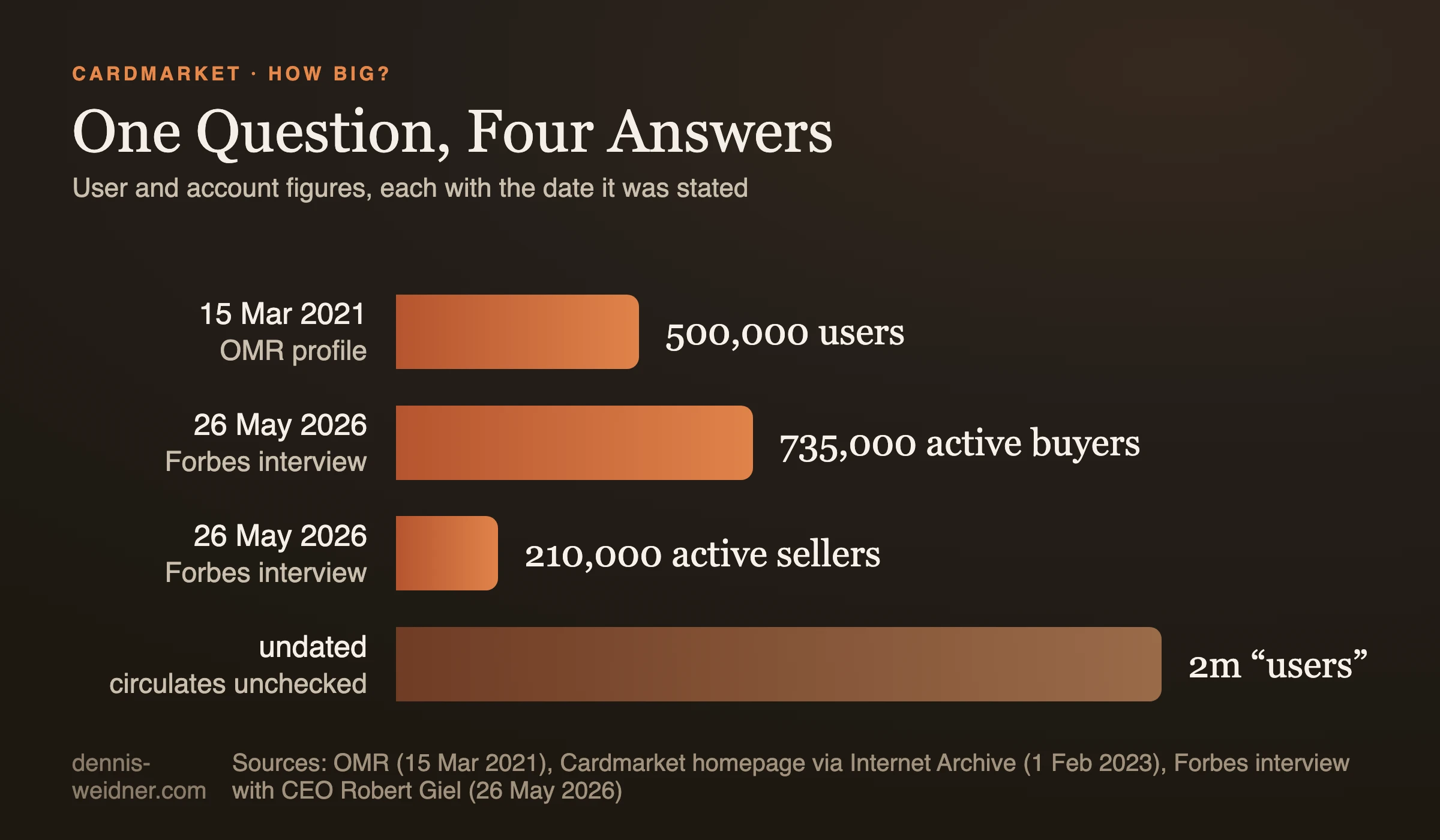
Laid out like this, the contradiction almost resolves itself. 735,000 plus 210,000 is 945,000 active accounts, and anyone who counts buyers and sellers twice, or means registered rather than active accounts, quickly arrives at "almost a million" or, with a few years of dormant accounts, at two million. The figures contradict each other less than they measure different things. Which is exactly why asking for the reference date is not pedantry.
A second contradiction concerns the headcount: the OMR profile reports 50 employees for 2021. The Forbes interview in 2026 describes the growth path as going from 30 to 115 employees, with the 30 also assigned to 2021. Two sources, same year, a difference of 20 people. Possible explanations are different reference dates, full-time equivalents versus headcount, or simply an imprecise recollection in an interview.
What Cardmarket Earns, and How
The business model is strikingly simple, and that is a strength. Cardmarket takes a five percent commission on the sale price, paid by the seller. There is no listing fee, no advertising inventory, no paid visibility in the rankings. This five percent figure already appears in the 2021 OMR profile and is confirmed unchanged in the 2026 Forbes interview. Five years of boom without a price increase is remarkable restraint in marketplace economics.
On top of that sits the trustee service, where Cardmarket holds the buyer's payment until arrival is confirmed. According to the Forbes interview it costs an additional 0.5 to 1 percent and applies to tracked shipments. Cardmarket describes the procedure quite openly on its own trustee service help page, including the instruction that the tracking status must read delivered, not merely arrived in the destination country.
That allows a rough estimate of the revenue side. 417 million euros in gross transaction volume times five percent gives roughly 20.9 million euros in commission income for 2025. The calculation errs on the low side: trustee fees, shipping margins and interest on held customer funds come on top. Put the balance sheet total of 29.6 million euros next to it and you see a company that funds its size out of ongoing operations.
This fits a statement that drops almost casually in the Forbes interview: Cardmarket is independent and has no external investors. In an industry where American competitors have long belonged to corporate groups, that is the real strategic news. For sellers it means there is no capital provider who would need to push through a take-rate increase.
The company itself confirmed the five percent figure in two independent interviews, years apart.
The Interface Is Closing, and Almost Nobody Is Talking About It
Now comes the part I found in no other text about Cardmarket, and the part that occupied me most.
Cardmarket has offered a public programming interface for years, letting dealers manage stock, pull prices and process orders. That interface underpins practically every professional card dealer software in Europe. Its documentation keeps a dated list of changes, and read in one sitting, that list reads like the chronicle of a gradual closing.
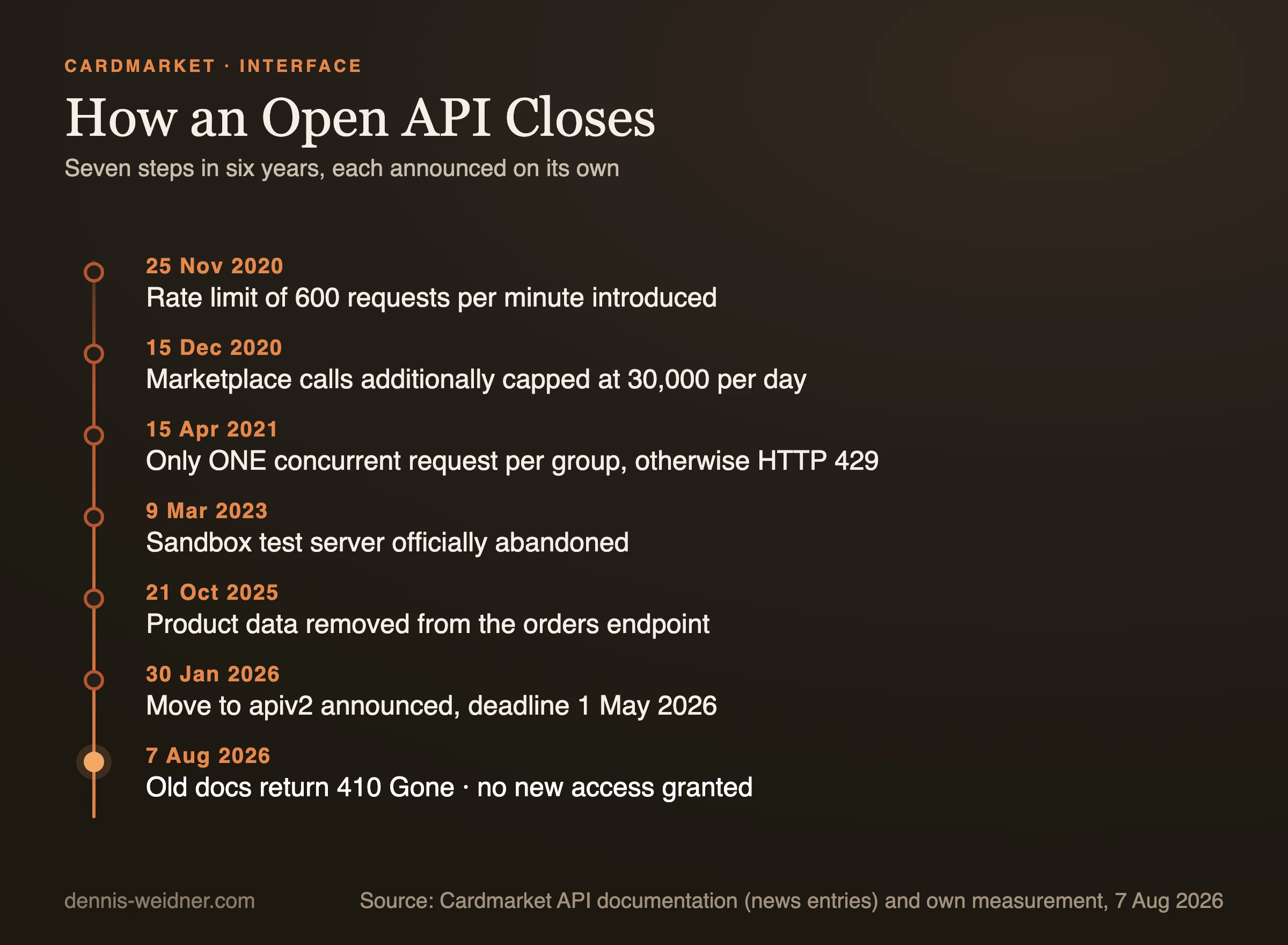
In order. On 25 November 2020 a limit of 600 requests per minute arrives. Three weeks later, on 15 December 2020, marketplace calls are additionally capped at 30,000 per day, even for commercial accounts with an overall quota of 100,000 requests. On 15 April 2021 the harshest restriction follows: only one single request per request group may run at a time, and every parallel one receives a 429 error. Anyone operating software has to build a queue from then on.
On 9 March 2023 the sandbox test server is officially abandoned, with the remarkably candid justification that it had not been updated for more than two years. Developers have been testing against production ever since. On 21 October 2025 product information disappears from the orders endpoint and can only be fetched with a second call, which costs real money under a capped quota.
On 30 January 2026 Cardmarket announces that the base address of the interface will move from api.cardmarket.com to apiv2.cardmarket.com, deadline 1 May 2026. On 7 August 2026 the old address returns HTTP 410 Gone with a request to switch to apiv2.cardmarket.com. So the deadline was not just set, it was enforced.
And then there is a sentence that is easy to miss. On the API help page, on the same day: "Currently, we are not accepting applications for access to the Cardmarket API." Anyone who wants to build a tool for card dealers today can no longer simply do so. Fittingly, the partner page lists exactly two official partner applications, an inventory manager and a card search engine.
I do not read this as malice. Each of the seven measures has a sound technical rationale on its own, and a marketplace processing 110 million cards a year has to protect its database. But the sum says something different from any single step: the marketplace where the European card price is formed has turned programmatic access to those prices from open to closed within six years. If you need a price signal from this market today, you are either a legacy customer or you are outside.
The Open Counter-World, and Where It Ends
You could say at this point: fine, there are alternatives. And that is even true. A whole data world has grown up around Pokémon that does the exact opposite of Cardmarket. Pokedata, operated by Browse LLC, tracks sets, cards, sealed products and price statistics, and hands them out without registration. On 8 August 2026 the sets endpoint returned 692 records in a single call, the product list 3.5 megabytes, one set 113 cards. No key, no application, no quota.
Those data reveal something that explains the 110 million traded cards in the first place: the supply side. Count set releases across all three language editions and you see the boom not in the price but in the production.
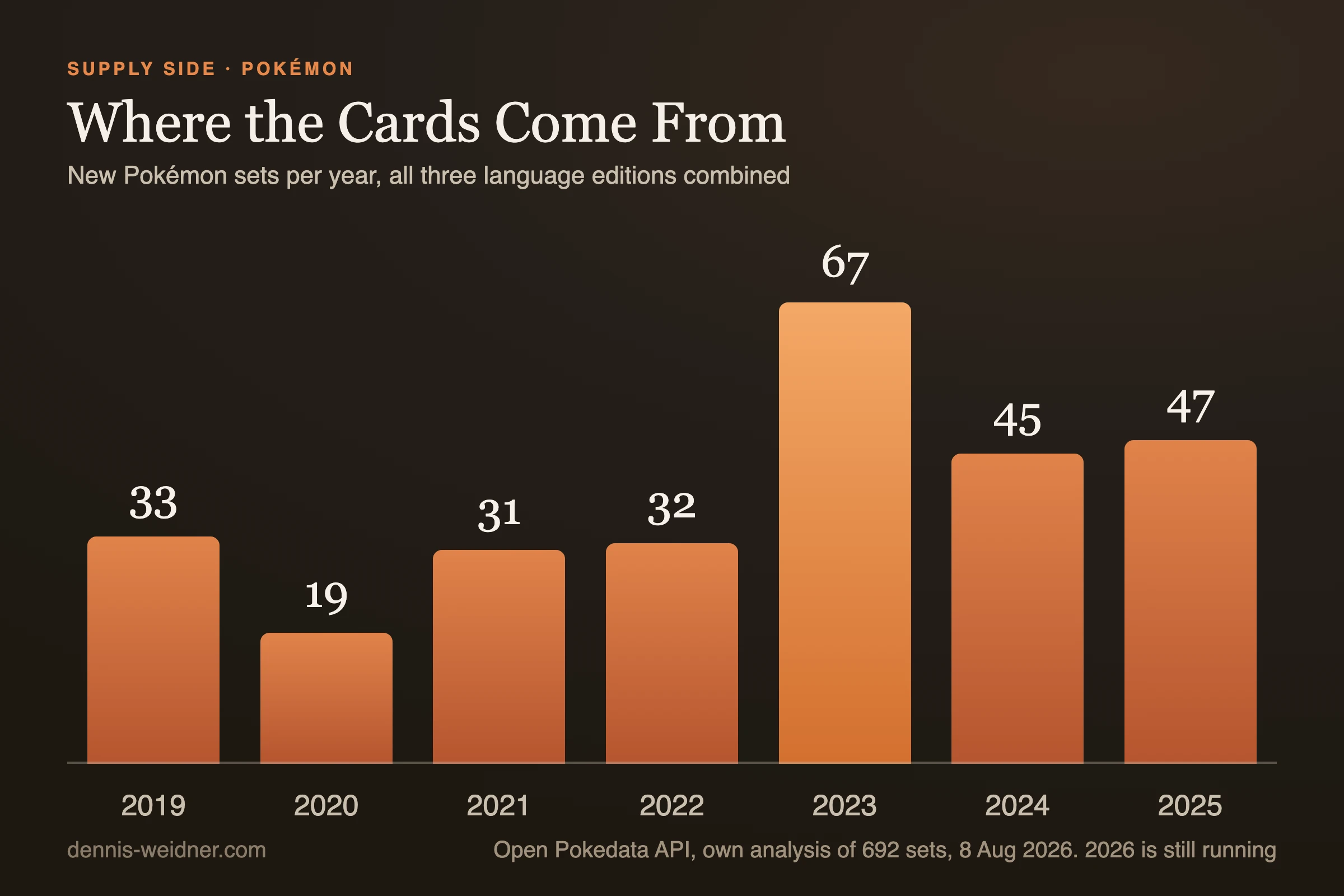
2020 is the year with the fewest new sets, 2023 by far the record year, and since then the number has stayed well above the pre-pandemic level. If you wonder why one marketplace moves 110 million cards a year, half the answer is here.
Except this open world has two limits, and both hit the European dealer precisely.
First, it is anchored to the American price. Every card record at Pokedata carries a tcgplayer_id, the identifier of the US platform. There is no reference to Cardmarket. That is not sloppiness, it is the logical consequence of one side keeping its identifiers open and the other not. The open Pokémon data world is anchored to the American market because the European one no longer has an open door.
Second, open is not the same as reliable. The statistics endpoint returns 23 records per card with fields such as average, minimum, maximum, median, transaction count and standard deviation. There is no field documentation, and doing the arithmetic shows why that matters: for the Base Set Charizard, an average of 466.74 sits next to a maximum of 248.50. A mean above the maximum is arithmetically impossible, so the fields mean something other than their names suggest. Those figures are therefore no good as price evidence. Anyone who puts them into an article unchecked is publishing a number they cannot explain.
That is the actual situation, in one sentence: for European card prices there is currently no open, documented and programmatically usable route. There is a closed source that has the prices, and open sources that either point at the US market or cannot explain their own fields.
That leaves the fee question from above. Cardmarket does have a help page called Prices and Fees. It carries four tiles: shipping costs, trustee service fee, import VAT and currency exchange rates. Not one of them states the seller commission. The trustee fee tile leads to a detailed description of the procedure with deadlines (chase the arrival confirmation after two working days, involve customer service after three more, then a seven-day deadline, report a loss after fourteen days) and states no amount. For the amount the page points to the separate fee table. The marketplace's central pricing information is thus not on the page sellers open first.
What This Means for Dealers, Collectors and Tool Builders
For commercial sellers the situation is comfortable and risky at once. Comfortable, because five percent is cheap by marketplace standards and has been stable for five years. Risky, because the dependency is total: stock, price discovery, reputation and payment all sit on one platform. Anyone caught in a rating spiral there has no second leg to stand on. The professional seller guide makes clear how formal this status is: trade licence, photo ID, and for German dealers a mandatory VAT ID.
For private collectors little changes, but one point deserves attention: the prices you see on Cardmarket are asking and selling prices on that one platform. They are the best available reference for Europe, but they are not an objective market value. For graded cards in slabs, European and American price levels regularly drift apart.
For anyone building tools, the message is clearest. A business model built on open access to somebody else's marketplace data stands on somebody else's ground. That lesson is not new, it is just still fresh in this industry. If you want to build, you need either an explicit partnership or a data base of your own.
What I Take From This for Slabhit
I am not a neutral observer on this topic. With Slabhit we are building live shopping for trading cards, and part of why I did this research was to understand what ground we are standing on. Three things stay with me.
First: owning your data is not a luxury, it is the basis of the business. When Europe's largest marketplace closes its interface, every product idea built on its prices is a borrowed idea. What sells in a live show, at what price, to whom, in what condition: that is your own data trail, and it only exists if you handle the transaction yourself.
Second: five percent is the anchor in every seller's head. Every seller in Europe calculates in that number. You can be more expensive, but then the difference has to visibly take work off their hands, and that is exactly where live formats can do something a listing page cannot: sell, rather than wait to be found.
Third: trust is the actual product. The trustee service is technically banal and still the heart of the thing. It solves the oldest problem of distance selling between private individuals. Anyone building something new in this market has to answer that question first, not hope it resolves itself later. How I think about retail in general is on my topic page on e-commerce and live commerce.
What makes this market special, Giel says himself in the Forbes interview, in the most sober sentence about trading cards I have ever read: the only value a card has is future demand, otherwise you are holding a piece of cardboard. Anyone treating trading cards as an asset should know that sentence by heart.
What Cardmarket Does Not State Openly
The help page on prices and fees does not state the seller commission; it appears only in the separate fee table. A limited partnership of this size does not have to disclose its revenue. And the frequently quoted two million users have no dated primary source.
If you have figures that contradict mine, send them to me with a date and a source. I will update this report and note what changed.
Frequently Asked Questions
What commission does Cardmarket charge sellers?
Cardmarket takes five percent of the sale price from the seller. There is no listing fee. For the trustee service on tracked shipments, company statements in the Forbes interview of 26 May 2026 add another 0.5 to 1 percent. The five percent figure has been unchanged since at least 2021.
How many users does Cardmarket have?
It depends on when and what is counted. The most recent company figure dates from 26 May 2026 and gives 735,000 active buyers and 210,000 active sellers, so roughly 945,000 active accounts. A profile from 15 March 2021 reported around 500,000 users from 30 countries. The frequently quoted figure of two million users has no traceable dated primary source.
Who owns Cardmarket?
The operator is Sammelkartenmarkt GmbH & Co. KG in Berlin, local court of Berlin-Charlottenburg, HRA 39760 B. Its general partner is Sammelkartenmarkt Verwaltungs GmbH. According to CEO Robert Giel in the Forbes interview of May 2026, the company is independent and has no external investors.
What revenue does Cardmarket generate?
Revenue is not published, because a limited partnership of this size does not have to disclose a profit and loss statement. What is known is the gross transaction volume: 417 million euros for 2025. At five percent commission that works out to roughly 20.9 million euros in commission income.
Can I use the Cardmarket API for my own tool?
Not at the moment. The official help page states, as of 7 August 2026, that applications for API access are not being accepted. Existing users may not share their credentials with third parties or third-party software. The old interface address api.cardmarket.com now responds with status code 410 and points to apiv2.cardmarket.com.
Are Cardmarket prices the real market value of a card?
They are the best available reference for Europe, but not an objective market value. They are asking and selling prices on a single platform. For graded cards in particular, European and American price levels regularly diverge.
How long has Cardmarket existed?
The company was founded in 2007 and started as Magiccardmarket, a name that still appears as a registered trademark in the legal notice. The expansion to Pokémon, Yu-Gi-Oh! and other games came later, as did today's name Cardmarket.
Is there an open alternative to the Cardmarket API?
For Pokémon yes, but with two limitations. Pokedata provides sets, cards, products and price statistics without registration; on 8 August 2026 the sets endpoint alone returned 692 records. The card records, however, are linked to the US market through a TCGplayer identifier rather than to Cardmarket, and the statistics price fields are undocumented and internally contradictory. For European card prices there is therefore currently no open, documented route.
What is the trustee service and when does it apply?
With the trustee service, Cardmarket holds the buyer's payment until the buyer confirms the shipment has arrived. It applies to tracked shipments. Important, according to Cardmarket's own help page: the tracking status has to read delivered, not merely arrived in the destination country.
Warm regards,
Dennis Weidner
Note: AI tools supported me in writing this article, and some images were edited with AI. I stand behind its content and every statement with my name.