Registering a trade costs €15 online in Berlin and up to €60 in Munich, and online it often takes only minutes. The real work starts afterwards: within one month the tax office expects the tax registration questionnaire, from which it derives the tax number, the prepayments and the VAT treatment. Here is how to get it right.
Registering a Business in Germany: Who Must and When
Anyone starting a trade in Germany must notify the local trade office under Section 14 of the Trade Regulation Act "at the same time", meaning on the first day of activity, not when the first invoice goes out. A trade (Gewerbe) is any independent, continuous activity with the aim of making a profit that is not a liberal profession, not agriculture or forestry, and not the mere management of one's own assets. Online retail counts, as does trading collectible cards on a regular basis, running an agency, a café or a craft business.
Liberal professions do not register a trade. Section 18 of the Income Tax Act lists them: doctors, lawyers, tax advisers, engineers, architects, journalists, interpreters and translators among others, plus scientific, artistic, literary, teaching and educational work. They notify the tax office directly.
The term Kleingewerbe, small trade, appears in no statute. It means a business that does not need a commercially organised operation and is therefore not a commercial enterprise under Section 1(2) of the German Commercial Code. For registration it makes no difference: a small trade is also registered with the trade office; only the commercial register entry and double-entry bookkeeping fall away. A small trade is not the same as the Kleinunternehmer VAT scheme, which is explained below.
Registering Online or in Person: The Process
Almost every large German city now lets you register a trade online, usually via the state's service portal with an account such as BundID or BayernID. In person, you fill in and sign the standard federal form "Gewerbe-Anmeldung". The information required is the same either way:
- name, address and nationality of the owner,
- address of the business premises and start date,
- a precise description of the activity, because chamber, statutory accident insurer and statistics depend on it,
- for a GmbH or UG the commercial register extract, for partnerships the partnership agreement,
- for licensed trades the licence, for example for insurance or real estate brokerage, and for regulated crafts the entry in the craft register.
Under Section 15 of the Trade Regulation Act, the trade office confirms receipt within three days with a certificate, commonly called the Gewerbeschein, and forwards the data to the tax office, the chamber of commerce or crafts, the statutory accident insurer and, where relevant, the commercial register court. The activity description should therefore be precise enough for the classification to be right. "Trade in goods of all kinds" is convenient but often triggers follow-up questions.
The legal form changes who registers and what it costs. A sole trader registers personally. In a GbR or another partnership, every partner notifies the trade, and the fee is charged per partner: €26 per partner in Berlin, €25 in Hamburg. A GmbH or UG registers through its managing directors; Berlin charges €31 for a legal entity with one legal representative and €13 for each additional one. Many cities run a separate procedure for companies not yet entered in the commercial register, because business often starts before the entry.
For a start-up with partners it therefore pays to settle the legal form before registering. A GbR that is later converted into a GmbH registers and deregisters twice, and each change triggers a new tax questionnaire. If you want to bundle several ventures under one roof, plan the structure from the outset.
Cost of Registering a Business: What Cities Charge
Fees are set by the states and municipalities, so they differ noticeably. Online is cheaper almost everywhere. A selection based on the cities' service pages:
| City | Fee for a sole trader | Online |
|---|---|---|
| Berlin | €26 in person | €15, paid by credit card |
| Munich | €50 to €60 depending on legal form | yes, with BayernID |
| Cologne | €26 | yes, certificate instantly as PDF |
| Leipzig | range €22 to €112 | yes, via Amt24 |
| Potsdam | at least €36.60 in person | €30 |
Deregistering a business is free in many places, in Cologne expressly so. The fee is the smallest item of starting up. What gets expensive is registering too late: operating without notification is an administrative offence under Section 146 of the Trade Regulation Act, and late notification to the tax office invites questions.
The Tax Registration Questionnaire
Registration with the trade office is not the end of it. The municipality informs the tax office about the new business, which then expects the tax registration questionnaire, the Fragebogen zur steuerlichen Erfassung. The obligation is set out in Section 138 of the Fiscal Code: the information must be submitted electronically via ELSTER, the tax administration's portal, within one month of opening. Liberal professions file the same questionnaire; for them it is the only notification.
The questionnaire is more than a formality, because the tax office derives three things from it:
- the tax number, without which no compliant invoice can be issued,
- the prepayments of income tax and trade tax, based on the estimated profit,
- VAT treatment: standard taxation or small business scheme, accrual or cash basis, monthly or quarterly returns.
Realism pays when estimating profit. Estimate too low and a large back payment follows the next year. Estimate too high and you tie up cash that is scarce at the start. A plausible twelve-month plan is the best basis, and it helps with every funding application too, as described in funding programs for founders.
The small business VAT scheme under Section 19 of the VAT Act applies if turnover in the previous year was at most €25,000 and does not exceed €100,000 in the current year. Anyone opting out of the scheme to reclaim input VAT on purchases is bound for five years.
After Registration: Chamber, Trade Tax, Business ID
Registration makes every trader a member of the chamber of industry and commerce (IHK) or the chamber of crafts. Fees are modest for small businesses: under Section 3 of the IHK Act, individuals without a commercial register entry pay nothing as long as trade income or profit does not exceed €5,200. Genuine first-time founders pay neither the basic fee nor the levy in the founding year and the following year, and no levy in years three and four, provided profit is at most €25,000.
Trade tax only applies to sole traders and partnerships once trade income exceeds the €24,500 allowance under Section 11 of the Trade Tax Act. The remainder is multiplied by the 3.5 percent base rate and the municipality's multiplier. For sole traders, trade tax is largely credited against income tax under Section 35 of the Income Tax Act; a GmbH gets neither the allowance nor the credit. Why the legal form pays off later is covered in holding company in Germany for founders.
Then there is the business identification number, the Wirtschafts-Identifikationsnummer. Under Section 139c of the Fiscal Code it starts with the letters DE and identifies businesses uniformly and permanently in tax and administrative procedures. Once received, it goes into applications and filings; the tax number on invoices is unaffected.
Business Registrations in Numbers: 2025 Was a Record Year
Registrations rose markedly in 2025. According to the trade notification statistics of the Federal Statistical Office, 762,400 businesses were registered, 6.4 percent more than the year before. About 640,500 of them were genuine new businesses; the rest were takeovers, conversions and relocations.
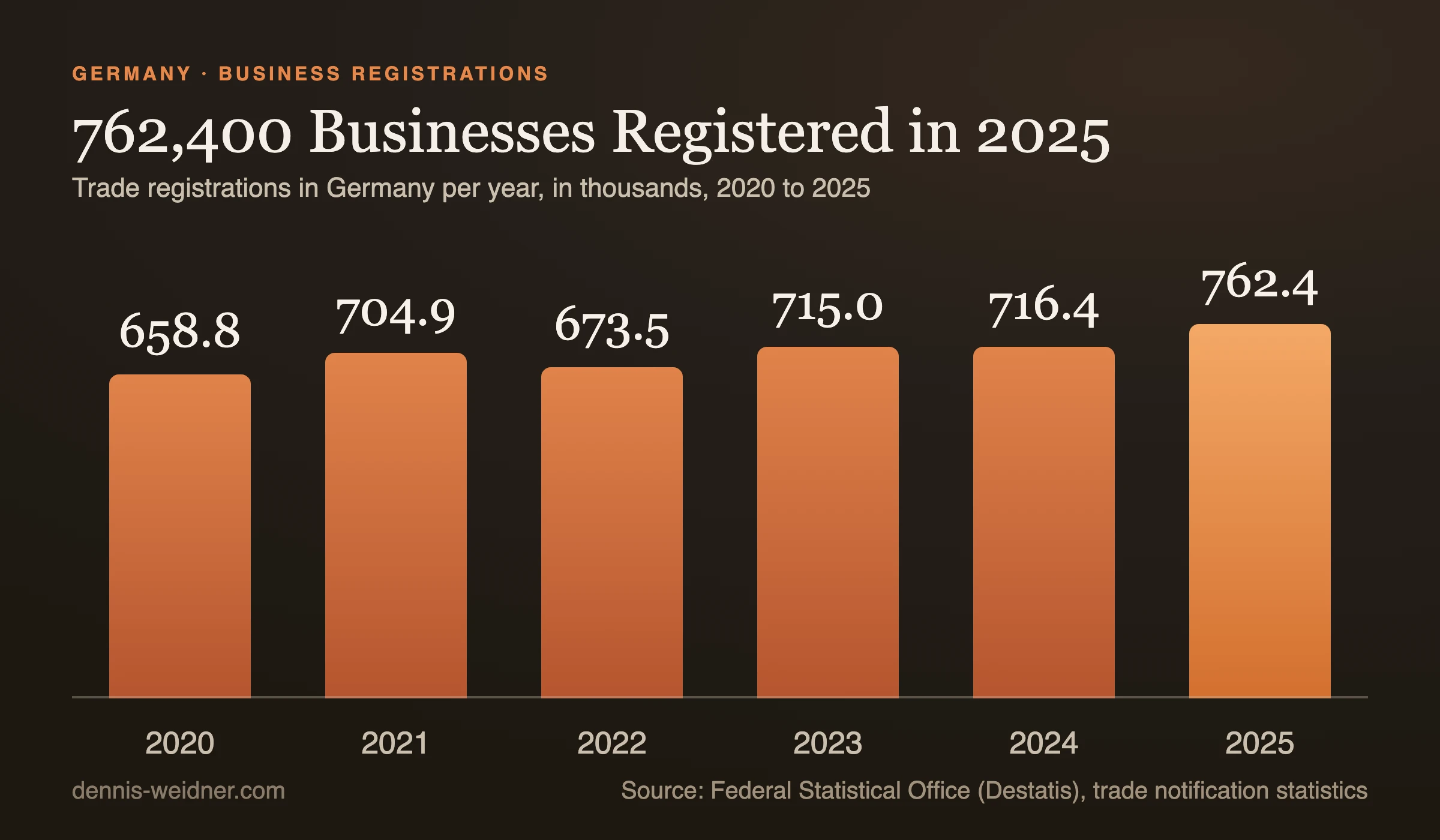
The series shows how resilient the appetite for starting a business in Germany is: after the drop in the first pandemic year and a weaker 2022, the level is now higher than in any year since 2020. A large share are side businesses started alongside a job. For many that is the most sensible path, because it keeps the risk small and tests the business model in the market before the salary stops.
Building several companies in parallel, as I have done for many years, starts with exactly this step for each entity. How I organise it is in how I build several companies at once.
Checklist for Registering a Business in Germany
- Clarify first: trade or liberal profession? Licence or craft register needed? Sole trader, partnership or GmbH?
- Register: online via the service portal or at the trade office, at the latest on the first day of activity, with a precise description.
- Within one month: tax registration questionnaire via ELSTER, with a realistic profit estimate and a deliberate choice on the small business scheme.
- Then: wait for the tax number, open a business account, file receipts properly from day one, check letters from the chamber and the accident insurer.
- In the calendar: VAT returns, prepayment dates and the first tax return, as summarised in what changes for businesses in 2027.
If you trade collectible cards or other collectibles, the line between private sales and a business is drawn in selling trading cards and taxes in Germany.
Frequently Asked Questions
How much does it cost to register a business in Germany?
Fees are set by states and municipalities. In Berlin registration costs €26 in person and €15 online, in Cologne €26, in Munich €50 to €60 depending on legal form, and in Potsdam €30 online. Leipzig states a range of €22 to €112.
When do I have to register my business?
At the same time as the activity starts, as Section 14 of the Trade Regulation Act puts it. Selling or providing services before the trade is registered is an administrative offence.
Do I have to register a small trade (Kleingewerbe)?
Yes. A small trade only means that no commercially organised operation is needed and therefore no commercial register entry. Notification to the trade office is still mandatory, as is the tax registration questionnaire.
When is the tax registration questionnaire due?
Within one month of opening the business, under Section 138(4) of the Fiscal Code. It is submitted electronically via ELSTER. The tax office uses it to issue the tax number and set prepayments.
Do freelancers need to register a trade in Germany?
No. Liberal professions under Section 18 of the Income Tax Act, such as doctors, lawyers, engineers, journalists, translators and artistic or teaching work, do not register with the trade office but notify the tax office directly via the tax registration questionnaire.
Is a small trade the same as the small business VAT scheme?
No. Small trade is a commercial law term affecting the commercial register and bookkeeping. The Kleinunternehmer scheme is a VAT term under Section 19 of the VAT Act: no VAT is charged if turnover was at most €25,000 in the previous year and does not exceed €100,000 in the current year.
Do I have to pay chamber of commerce fees after registering?
Every trader becomes a member. Individuals without a commercial register entry pay no fee as long as trade income or profit does not exceed €5,200. First-time founders are additionally exempt in the founding year and the following year if profit is at most €25,000.
Warm regards,
Dennis Weidner
Note: AI tools supported me in writing this article, and some images were edited with AI. I stand behind its content and every statement with my name.