Almost everyone who hoards trading cards ends up asking the same question: should I get this beauty graded, or leave it raw in the sleeve? Grading, meaning the verified assessment and sealing of a card, can multiply its value. It can also just cost you money and months of waiting. In 2026 the card's value decides, and the break-even sits higher than most people think.
What grading actually is
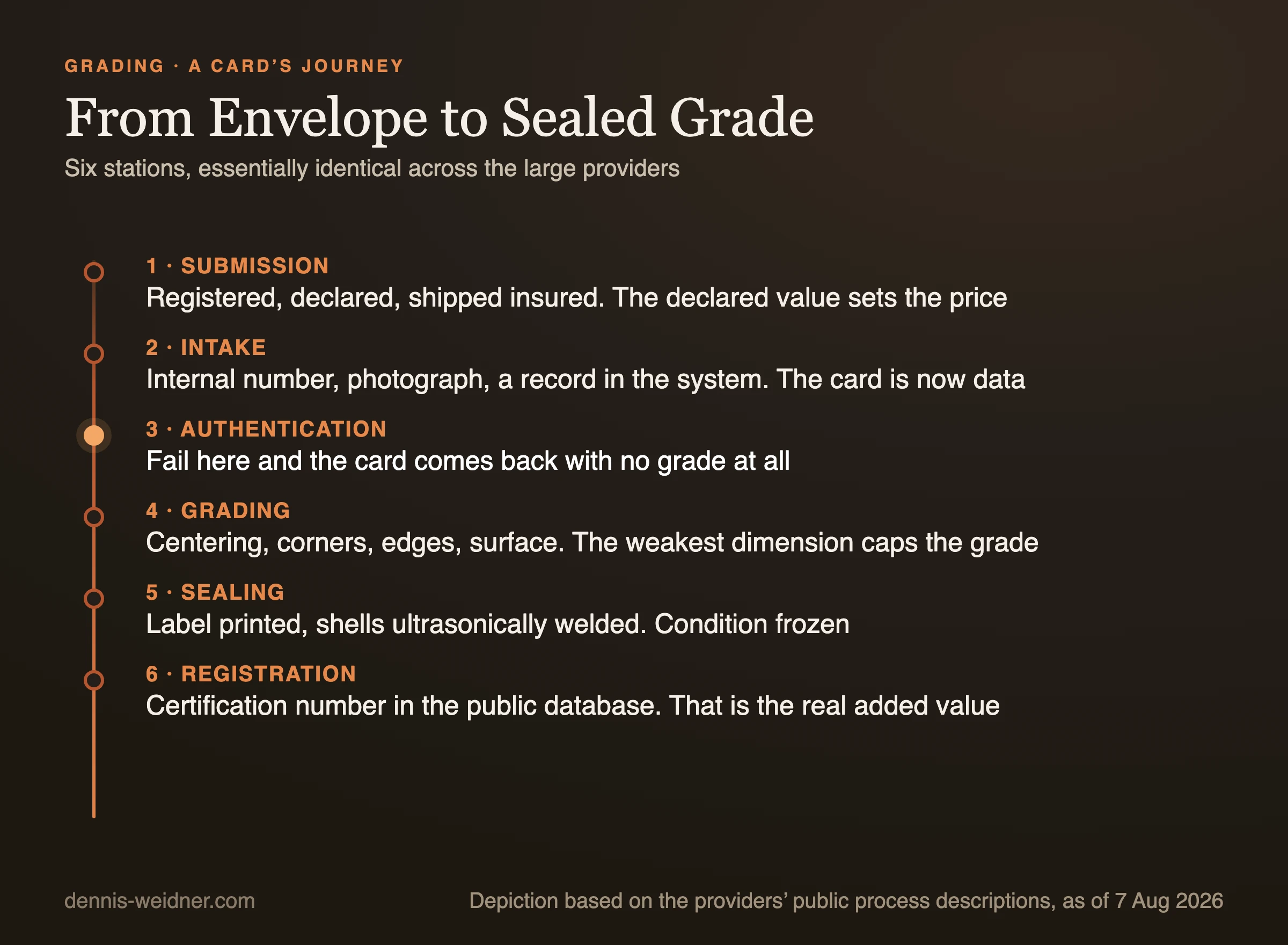
Grading means a specialized company checks your card for authenticity, assesses its condition, and then locks it into a sealed plastic case, the slab. The grade runs on a scale from 1 to 10. Graders look at four things under magnification: centering, corners, edges, and surface. A PSA 10 is called Gem Mint and is essentially flawless, while a PSA 1 is heavily worn. Beckett (BGS) and CGC use the same 1-to-10 logic, some with half grades and subgrades for the four individual criteria. You can find the exact definition of the tiers in the official CGC grading scale.
More on this topic: E-Commerce & Live Commerce, with background, practice and every article in one place.
The appeal is twofold. First, a buyer instantly knows the card is genuine and what condition it is in. Second, the slab makes it tradable like a standardized security. This trust and standardization effect is exactly why graded cards trade at a premium over raw ones. That same trust is what Slabhit, our live shopping platform for collectors, is built on: verified, standardized cards that become instantly tradable on stream.
PSA, CGC, and the German providers compared
The three big international names are PSA, CGC, and Beckett. PSA is the market leader and, to many, the gold standard for resale, especially in Pokémon and US sports cards. The catch in 2026: PSA is based in the US, prices have risen, and the cheap Value tiers under 50 dollars were paused in June 2026 because of a backlog of roughly 14 million cards. According to the official PSA pricing page, the currently available entry point is the Regular level, in the order of around 80 dollars per card, with wait times of several weeks to months.
CGC is the noticeably cheaper alternative and charges no annual membership fee. According to the CGC fee schedule (as of 27 September 2026), the Economy tier costs 20 dollars per card for cards worth up to 1,000 dollars, with an estimated turnaround of 90 working days. Send at least 25 cards worth up to 500 dollars each and the Bulk tier costs 17 dollars, with an estimated 150 working days. Faster tiers cost more and can drop down to a few days. The exact tiers are on the official CGC fee schedule.
For those of us in Germany, a third path opens up. Providers like Platin Grading (PGS) in Cologne, AOG, or M3Grading in Berlin grade locally. The big advantage is not just the language and the short shipping route, but that no card ever clears customs. Shipping to PSA or CGC in the US means outbound shipping, return shipping, and often import VAT on reimport. PGS advertises a fixed price starting at just under 16 euros per card, whether the card is worth 10 euros or 10,000 euros, and without the value-based value charge. The provider itself shows how this looks in a direct cost comparison on its PSA versus PGS page.
The numbers side by side
| Provider | Cheapest entry | Speed (entry) | Resale |
|---|---|---|---|
| PSA (US) | approx. 80 USD (Value tiers paused) | weeks to months | Highest market value, above all Pokémon and sports |
| CGC (US) | 20 USD (Economy) | approx. 90 working days | Strong, usually just below PSA |
| German providers | approx. 16 EUR fixed price | often 1 to 3 weeks | Growing, less established abroad so far |
On top of the base fees, the US providers add round-trip shipping in the order of 30 to 50 euros, plus possible customs and import tax per slab on reimport. That is exactly what pushes the break-even higher.
How much more a graded card is worth
This is the heart of the whole calculation. A card with a top grade trades for significantly more than the same card raw. The range is huge and depends on the card and demand. For sought-after modern cards, the premium of a PSA 10 is roughly three to ten times the raw value, and for genuine key cards it can be far higher. What matters is the brutal jump at the top: between a 9 and a 10 the price often differs by four to ten times. That is where it is decided whether the whole exercise pays off.
The risk here is that you are not guaranteed to get the top grade. A slightly off center or a tiny edge flaw, and the hoped-for 10 becomes a 9. Anyone who sends in a mediocre card hoping for Gem Mint usually just burns the fee.
At what card value grading pays off
Calculate conservatively. Take the base fee, add shipping, and for the US providers add customs and import tax. With PSA or CGC from Germany you quickly land at 60 to 100 euros total per card. As a rough rule of thumb: for shipping to the US, a card should be worth at least around 80 to 150 euros raw for grading to make sense. With the German fixed-price providers this threshold drops significantly, because customs and the value charge disappear, often down toward 30 to 50 euros of card value.
And then there is the market side. Card prices swing hard. In the correction of 2022 and 2023 many cards lost 30 to 50 percent of their boom value. Add to that ever better fakes, by now even cloned slabs with genuine certificate numbers. A pure number check is no longer enough today. Grading protects against your own card being faked, but not against a falling market. This standardization and trust logic, by the way, is the same one that drives the entire trade in collectible cards, and the reason the topic fascinates me as a founder in e-commerce and live commerce. For more on why I build in this world, see my About me page.
Frequently Asked Questions
At what value is grading worth it?
Rule of thumb: for shipping to PSA or CGC in the US, a raw card should be worth at least around 80 to 150 euros, because shipping, customs, and fees add up. With German fixed-price providers without customs, the threshold often drops to 30 to 50 euros of card value.
Is PSA or CGC better?
PSA usually achieves the highest resale prices and is seen as the gold standard, but it is more expensive and slower. CGC is cheaper, charges no annual fee, and usually lands just below PSA on resale. For moderate values, both are often more expensive than a German provider.
What do the grades from 1 to 10 mean?
Centering, corners, edges, and surface are assessed. A 10 (Gem Mint) is essentially flawless, a 1 heavily worn. The price jump between a 9 and a 10 is enormous, often four to ten times.
What are the risks of grading?
You are not guaranteed the top grade you hope for, the market can fall, and fakes keep getting better, up to cloned slabs with genuine certificate numbers. So when buying graded cards, check not just the number but the slab itself.
Warmly,
Dennis Weidner
Note: AI tools supported me in writing this article, and some images were edited with AI. I stand behind its content and every statement with my name.