
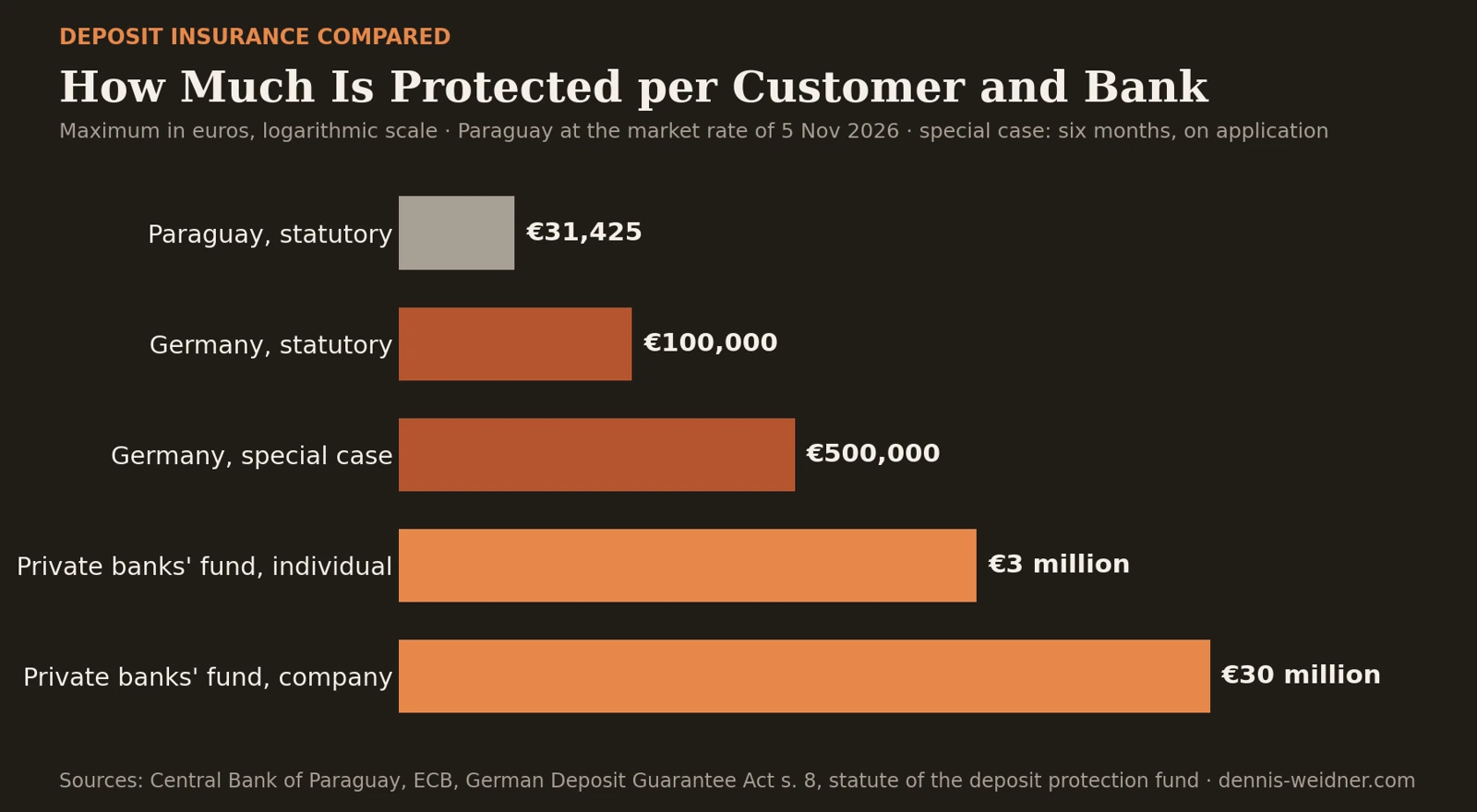
In Germany, deposit insurance protects bank balances up to €100,000 per customer and bank, for individuals just as for a GmbH, UG or partnership, and the compensation is paid without any application within seven working days. Whatever sits above that is only covered by law in a special case of up to €500,000; otherwise it depends on which bank holds the money, and there is no legal claim to that part. Paraguay is showing right now how quickly this stops being theory: on 2 November 2026 the central bank decided to resolve Ueno Bank, the bank of almost three million customers. Protection there is capped at 228.3 million guaraníes per customer, roughly €31,400 at the market rate of 5 November. My take as a business owner: deposit insurance is a good safety net, but it does not replace spreading your company's money with intent.
As of 6 November 2026. The situation in Paraguay is still developing.
More on this topic: Finance & Crypto Assets, with background, practice and every article in one place.
Deposit Insurance: Key Facts at a Glance
- €100,000 per customer and bank is protected by German law, however many accounts you hold there, and that includes partnerships and limited companies.
- 7 working days: that is how fast the money must be paid once the compensation case has been declared, with no application needed.
- €500,000 applies for six months after special credits such as the sale of a privately used residential property, but only on application with proof.
- Up to €3 million and €30 million are covered on top by the private banks' fund for individuals and companies, falling to €1 million and €10 million from 2030, with no legal claim.
- 90 percent, at most €20,000 is paid by investor compensation at investment firms without a banking licence; shares and ETFs in your custody account remain your property anyway.
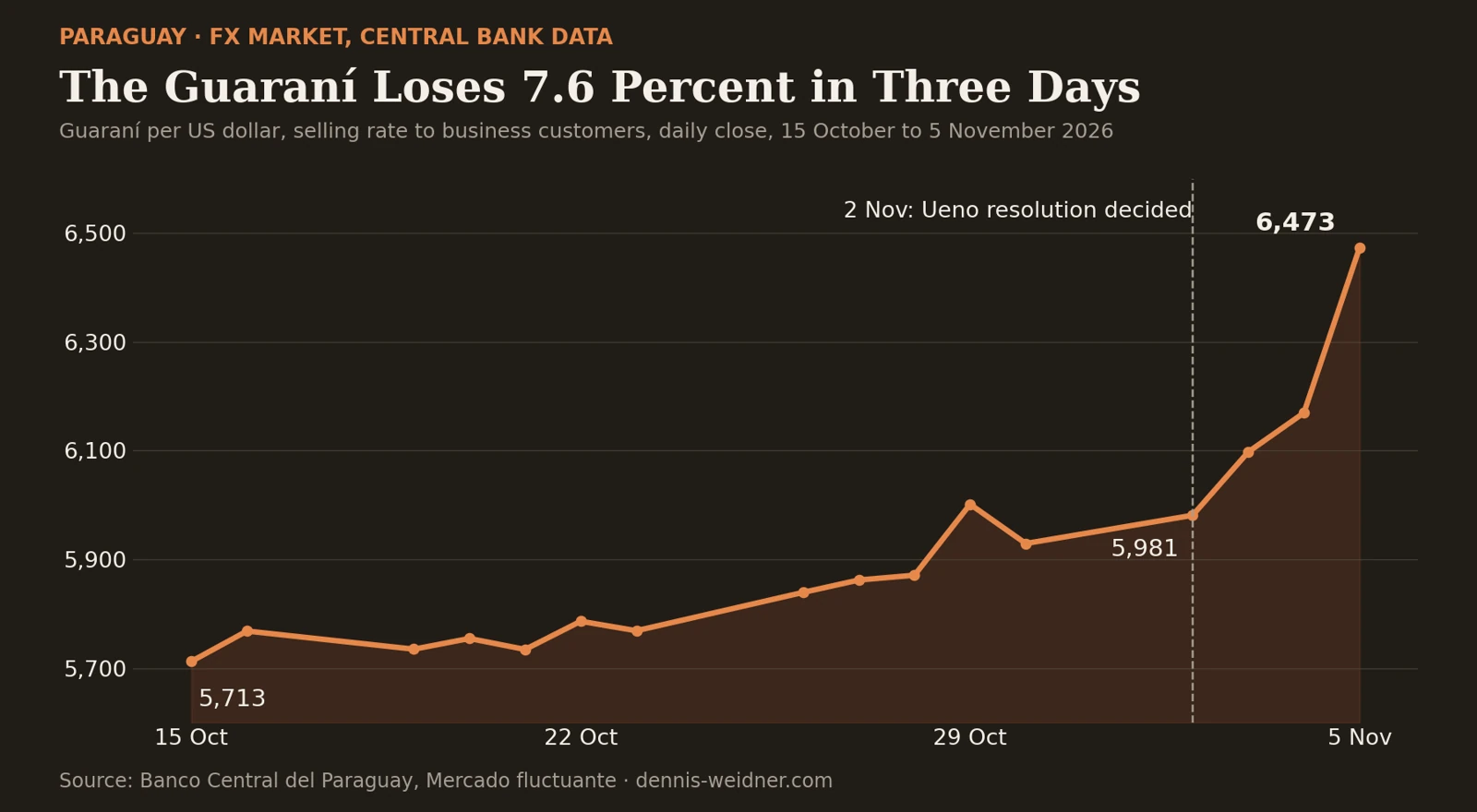
- 7.6 percent is what the guaraní lost against the dollar in the three days after the decision, and the protected amount of Ueno customers lost with it.
Paraguay's Banking Crisis: What Happened at Ueno Bank
Paraguay's central bank unanimously decided on 2 November to resolve Ueno Bank under Law 2334/03 on deposit guarantees and bank resolution. Its solvency ratio stood at 5.56 percent against a required minimum of 12 percent. In June 2026 Ueno had about 2.94 million customers, according to the Argentine newspaper Perfil. The social security institute IPS had placed around $355 million there, about 9 percent of its portfolio, and some 32,000 pensioners received their pension through the bank.
Ueno was no niche lender. The bank claimed more than 60 percent of adults in the country as customers, and eight executives have been arrested and 27 people charged, reports the Associated Press. In total almost $850 million of public money was held at Ueno, writes Al Jazeera.
Politically, the case has shaken the country. President Santiago Peña submitted his resignation on 5 November. By the evening it had not been accepted: the joint session of both chambers lost its quorum when deputies of his Colorado Party walked out, so Peña formally stayed in office. Earlier, the lower house had unanimously opened impeachment proceedings by 78 votes, reports La Nación. That same evening the Senate convened as a court, and Peña said he would face the trial; removal requires a two-thirds majority there, according to La Nación and the AP. What interests me here, though, is the question every account holder asks, in Asunción as in Hamburg: what happens to my money?
Deposit Insurance in Paraguay: Who Gets Their Money Back
Paraguay protects 228.3 million guaraníes per customer and bank, which equals 75 monthly minimum wages. First in line for their full balance are customers who held no more than 10 million guaraníes in total, owe Ueno nothing and have an active account at another bank in the country, the central bank said according to crypto.news. According to Perfil, payouts run within 15 calendar days until 17 November and can be extended to 2 December. For around 280,000 customers who only banked with Ueno, accounts are being opened at other banks, the AP reports.
For me, that condition is the real lesson: those who already had a second bank get their money fastest. And there is a second catch that hardly anyone mentions. The protection is fixed in guaraníes, and the guaraní fell after the decision. On 2 November business customers had to pay 5,981 guaraníes per dollar in the foreign exchange market, according to the central bank, and 6,473 on 5 November. Within three days the maximum was no longer worth $38,170, but only $35,271.
Deposit Insurance in Germany: €100,000 per Customer and Bank
In Germany the Deposit Guarantee Act sets the rules: €100,000 per depositor and bank, regardless of the number of accounts, the currency and the place where the accounts are held. Current accounts, instant access savings, fixed-term deposits and savings books are covered. With a joint account each holder has a separate claim, so a married couple reaches €200,000. Dollar or franc accounts are protected too, but they are converted into euros at the ECB reference rate of the day the compensation case is declared. The currency risk stays with you, just as in Paraguay.
What matters for business owners: according to BaFin, individuals as well as partnerships and corporations are protected, so a GmbH and a UG are too. Excluded are, among others, public authorities and financial companies such as banks, insurers and funds, as section 6 of the Act lists. Once the compensation case has been declared, the guarantee scheme pays within seven working days, without you having to apply. Up to €500,000 applies for six months if the balance comes from the sale of a privately used residential property, from certain insurance or compensation payments or from payments tied to life events such as marriage, divorce, retirement or redundancy. That part, however, has to be claimed in writing with proof.
Who pays depends on the banking group. For private and public-law banks it is the Compensation Scheme of German Banks, for savings banks and cooperative banks their own protection schemes, which have been recognised as statutory deposit guarantee schemes since 2015, explains the Bundesbank. For comparison: in the United States deposits are insured to at least $250,000 at each bank, according to the FDIC.
What Happens to My Money if My Bank Fails?
The short answer: up to €100,000 you get it back, above that it becomes a claim in the insolvency proceedings. The process starts when BaFin declares the compensation case. The responsible scheme then pays out on the basis of the bank's records. Whatever lies above the limit and is not taken over by a voluntary fund, you file as a creditor and wait for the dividend.
If a bank is resolved instead of going insolvent, the owners bear the losses first and the creditors second. Covered deposits up to €100,000 remain untouched. Deposits of individuals and of small and medium-sized enterprises above that amount are used last, according to BaFin, in a resolution as in an insolvency. That is a priority, not a guarantee.
Custody accounts work differently. Shares, ETFs and fund units are not covered by deposit insurance; they belong to you and the bank merely holds them. In an insolvency you can demand their return or have the account transferred to another bank, unless the securities serve as collateral for a loan. Legally this is segregation under section 47 of the Insolvency Code. Money owed from securities business, such as distributions or sale proceeds, counts as a deposit at a bank and is protected up to €100,000. At investment firms without a banking licence, investor compensation applies: 90 percent, at most €20,000, under section 4 of the Investor Compensation Act; it also steps in when a firm can no longer return securities held in custody. Among those without a claim are companies that must prepare a management report, that is medium-sized and large corporations, under section 3 of the Act.
Deposit Insurance Above €100,000: Private Banks, Savings Banks, Cooperative Banks
Above the statutory limit, it comes down to where you bank. The private banks' deposit protection fund currently covers up to €3 million per individual and up to €30 million per company outside the financial sector, but never more than 8.75 percent of the respective bank's own funds. From 1 January 2030 the limits fall to €1 million and €10 million. For companies there is a further condition: fixed-term deposits with a term of more than twelve months are not protected, nor are promissory note loans and registered bonds. And the fund's statute states explicitly that there is no legal claim to its benefits. The fund lists the participating banks under participating credit institutions.
Savings banks and cooperative banks take a different route. Their institutional protection is meant to stop a bank from failing in the first place rather than compensate customers afterwards. Since the savings banks' scheme was set up in the 1970s, no member institution has become insolvent and no customer has lost deposits, according to the German Savings Banks Association. For cooperative banks, the voluntary protection scheme of the BVR, in place for more than 80 years, continues to operate alongside the statutory BVR Institutssicherung.
I consider both strong promises. Still, I would only plan with the €100,000 you have a claim to. The rest is a commitment whose limits can change: at the private banks' fund they stood at €5 million and €50 million until the end of 2024.
Business Accounts and Deposit Insurance: A GmbH With €400,000
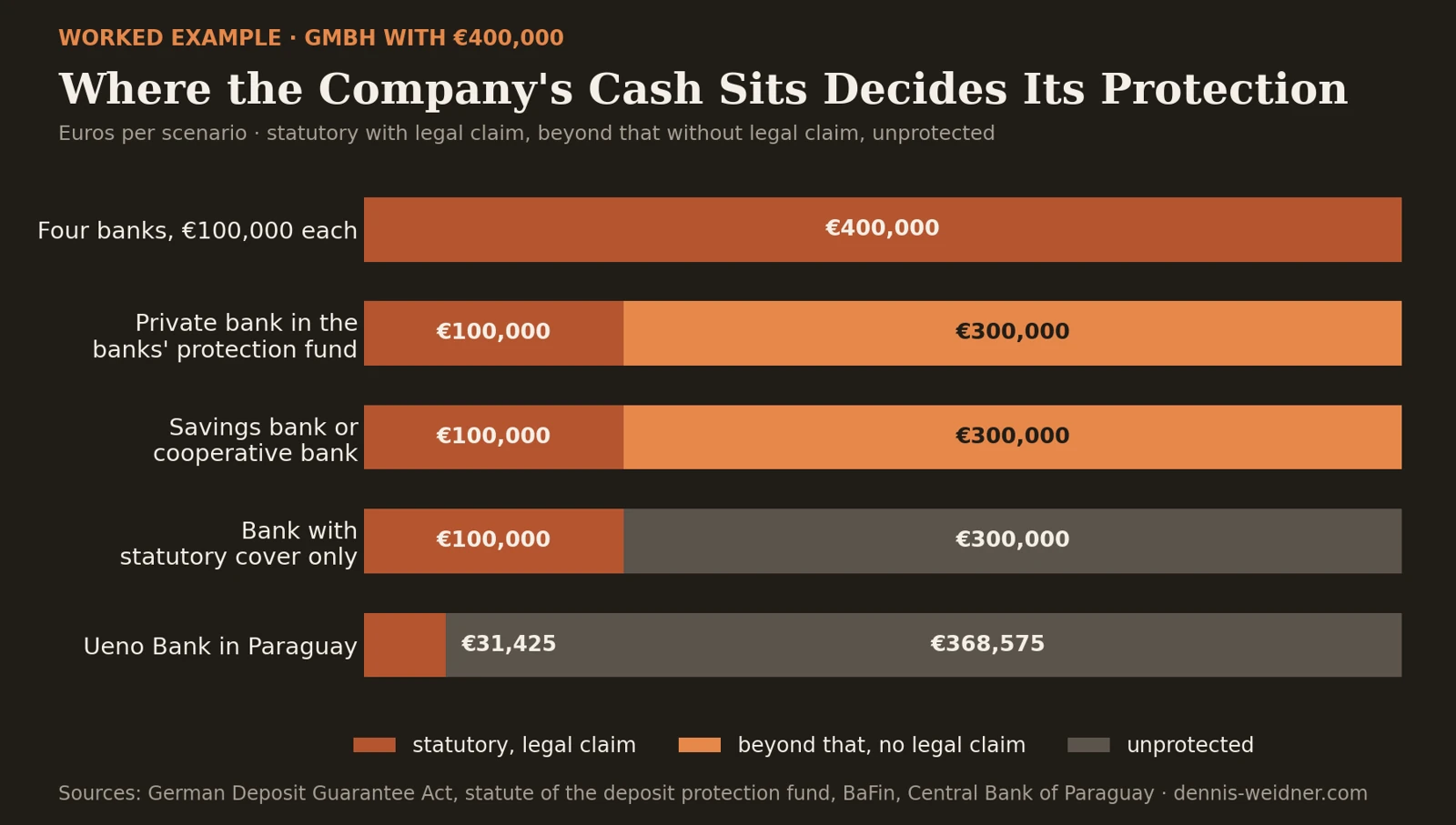
Take a GmbH that holds €400,000 in its account after a good year or a funding round. How much of it is protected depends entirely on where the money sits:
| Where the €400,000 sits | Statutory, with legal claim | Beyond that, no legal claim | Unprotected |
|---|---|---|---|
| One bank with statutory cover only | €100,000 | €0 | €300,000 |
| One private bank in the deposit protection fund | €100,000 | €300,000 | €0 |
| One savings bank or cooperative bank | €100,000 | €300,000 via institutional protection | €0 |
| Four banks with €100,000 each | €400,000 | €0 | €0 |
| Ueno Bank in Paraguay, value on 5 November | €31,425 | €0 | €368,575 |
At the private banks' fund this applies only to balances and fixed-term deposits with terms of up to twelve months. Savings and cooperative banks set no fixed compensation amount above €100,000: institutional protection aims to keep the bank itself going, so that all deposits stay available. The Paraguay figure is converted at the business customer exchange rate reported by Paraguay's central bank and the ECB rate of 5 November.
Two details that are often overlooked. First, every operating company is a depositor in its own right, with its own €100,000 per bank. The holding company itself deserves a closer look: if its principal activity is acquiring and holding participations, it can count as a financial institution under EU banking law, and section 6 no. 4 of the Act excludes their deposits; a pure industrial holding company with no stakes in financial firms is protected. Best clarify with your bank in advance how your holding is classified. How such a structure is set up is covered in my piece on the holding company for founders in Germany. Second, for an account clearly designated as an open trust account, for example for rent deposits or client money, section 7 of the Act looks at the beneficiary, not the account holder, provided the trust relationship is proven.
What Business Owners Can Learn From Paraguay's Bank Failure
- Open the second bank account before the crisis. In Paraguay, those who already had an active account at another bank got their money fastest. A second business account costs little; German readers will find an overview in the business account comparison at Gründerfreunde (in German).
- Plan liquidity for the waiting period. Seven working days sound short until salaries, rent and VAT fall in exactly that week. I would keep enough in the second account to cover several weeks of fixed costs without the main bank.
- Avoid concentration, even as a large organisation. Paraguay's social security institute had 9 percent of its portfolio at Ueno. At Silicon Valley Bank, customers withdrew more than $40 billion on 9 March 2023, and the bank expected another $100 billion the next day, according to the Federal Reserve's review. That all depositors got their money in the end was due to an exceptional government decision, not to a legal claim.
- Think about currency. Anyone holding dollars in the company account is protected, but carries the exchange rate risk up to the reference date themselves.
- Take the responsibility seriously. As a managing director you manage the company's money, not your own. How far personal liability reaches is summed up in managing director liability in a German GmbH.
Whether bitcoin and stablecoins offer people in Paraguay a way out is something the CryptoTicker newsroom has analysed using Ueno Bank as the example. More on money, tax and crypto assets is collected under Finance & Crypto Assets. This article is not investment or legal advice.
I would like to know how you handle it: does your company's money sit at one bank or at several? Feel free to write to me.
Frequently Asked Questions
How much deposit insurance is there in Germany?
By law, €100,000 per customer and bank is protected, regardless of the number of accounts. In special cases, such as after selling a privately used residential property, up to €500,000 is covered for six months, and that part has to be claimed with proof.
Does deposit insurance cover a business account?
Yes. Partnerships and corporations are protected up to €100,000 per bank just like individuals, so a GmbH and a UG are as well. Public authorities and financial companies, among others, are excluded.
What happens to my money if my bank fails?
Up to €100,000, the guarantee scheme pays within seven working days after the compensation case has been declared, without an application. Anything above that is taken over by a voluntary fund, depending on the bank, or becomes a claim in the insolvency proceedings.
Are shares and ETFs in a custody account covered by deposit insurance?
No, and they do not need to be. Securities remain the customer's property and can be reclaimed or transferred to another bank in an insolvency. Money owed from securities business counts as a deposit at a bank; at investment firms without a banking licence, investor compensation pays 90 percent, at most €20,000.
Is money above €100,000 safe?
At private banks in the deposit protection fund, up to €3 million per individual and €30 million per company are currently covered, while savings banks and cooperative banks protect the bank as a whole through institutional protection. There is no legal claim to that part; only the special case of up to €500,000 is statutory.
What do Ueno Bank customers in Paraguay get back?
Protection is 228.3 million guaraníes per customer, around $35,300 or €31,400 at the market rate of 5 November. Customers with no more than 10 million guaraníes, no debts at Ueno and an account at another bank are paid first and in full.
Warm regards,
Dennis Weidner
Cover image: closed bank branch with a cordoned-off cash machine. Symbolic image, created with AI.
Note: AI tools supported me in writing this article, and some images were edited with AI. I stand behind its content and every statement with my name.