In the US and Asia, live commerce has long been everyday life, a host goes live, shows products, and the community bids and buys in real time. In Germany it was smirked at for a long time. I am convinced that 2026 is the year the market tips over here. And with Slabhit I am building on exactly that.
Why it did not catch on so far
The ingredients were there, but not together. What was missing was platforms that feel right for the German market, trust, and a community that was ready. US providers are pushing into Europe, but here they often feel like a stopgap: English-only, unclear on data protection, without a real feel for local retail.
More on this topic: E-Commerce & Live Commerce, with background, practice and every article in one place.
Trust is everything in live commerce. When goods worth three or four figures change hands during a show, the buyer has to be sure that everything is genuine and fair. This is exactly the point at which it is decided whether a market matures or stays a niche. Anyone who takes that seriously treats trust as a business model, not as a marketing phrase.
What is changing right now
The numbers back the timing. Worldwide, the social commerce market is estimated at around 1.9 trillion dollars for 2026 according to Grand View Research, and the fastest-growing segment of all is video and live commerce. This is no longer a niche trend, this is the direction of retail.
On top of that, a generation that sees shopping as entertainment has grown up. The technology is mature, mobile bandwidth is no longer an issue. And the collector and trading communities, from trading cards to sneakers, are organized online and have money to spend. What is missing is a platform that brings together curation, trust, and German market knowledge, instead of just translating a US product.
That is exactly where we come in. At its core, live commerce is the digital extension of retail: a merchant is no longer tied to opening hours and floor space, their show also sells at eight in the evening, across all of Germany, with the advisory quality of a physical store.
A look at China and the US
If you want to know where this is heading, look at China. There, live commerce is no longer an experiment but a load-bearing part of online retail. On platforms like Taobao Live and Douyin, the Chinese TikTok, hosts sell cosmetics, electronics, and fashion in shows with audiences in the millions. In its widely cited analysis, McKinsey estimates that sales initiated by live shows could account for as much as 10 to 20 percent of all e-commerce by 2026, see McKinsey. This is not a distant vision, it is already happening.
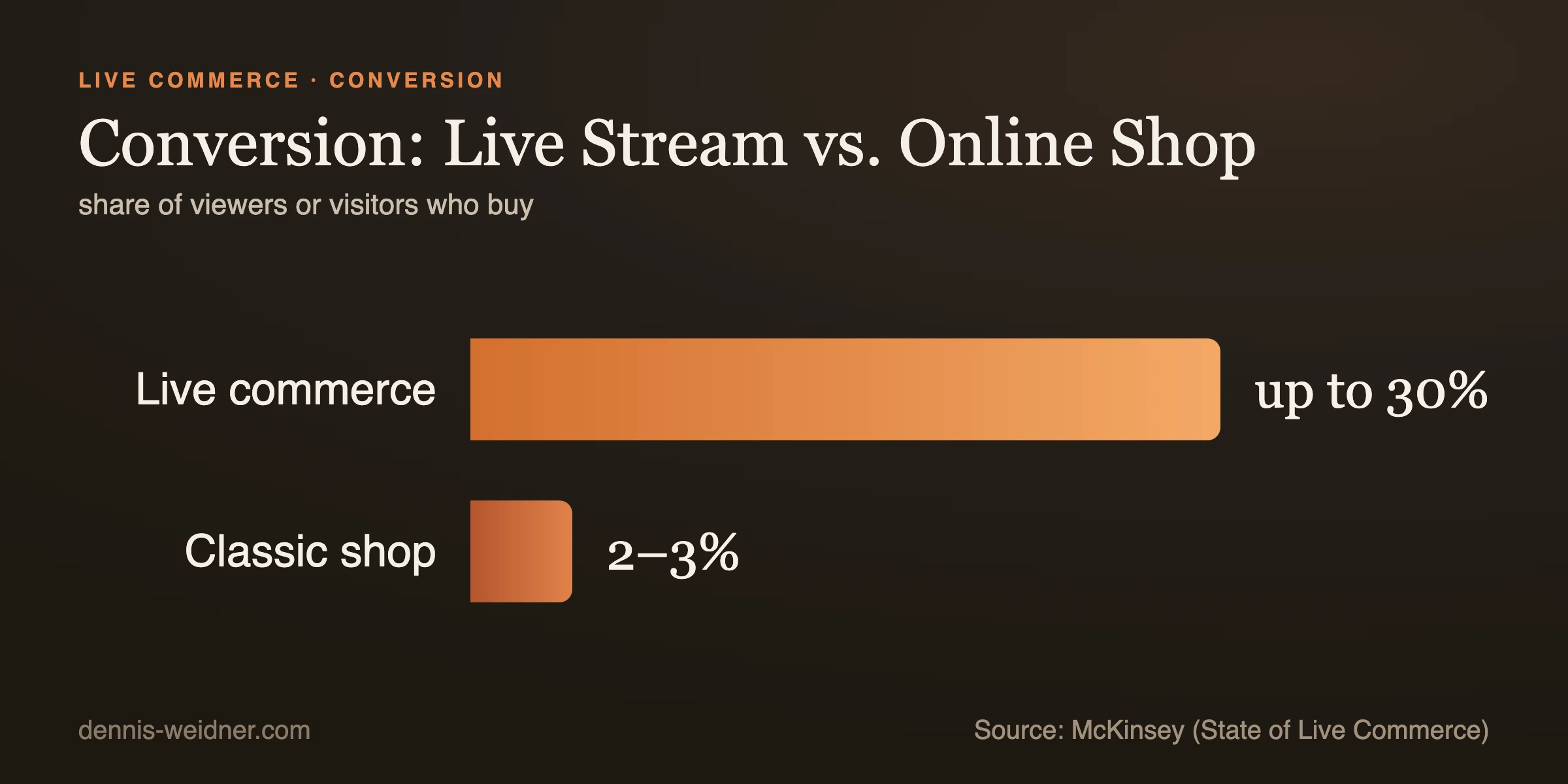
And the US shows it is not purely an Asian phenomenon. Platforms like Whatnot have proven that live auctions for trading cards, sneakers, and vinyl work in the West, provided the community is right and the curation is genuine. Germany lags on a time delay, but the curve looks the same everywhere: first skepticism, then a tipping point, then normality. That tipping point is exactly what I expect here for 2026.
Where live commerce catches on first
Live commerce does not work equally well everywhere. It catches on first where a product carries explanation, emotion, or scarcity. A trading card with a condition grade, a rare sneaker, a piece of jewelry, a watch: these are things you would rather be shown, live, turned in the hand, in detail, before you buy.
Collector markets. Cards, coins, comics. Here condition determines value, and that is exactly what a live show can demonstrate credibly. Why I am starting precisely here I lay out in more detail in the live commerce market in numbers.
Experience goods. Fashion, beauty, fine foods. The appeal lies in the moment, in the recommendation of a host you trust. The experience beats the catalog, and the purchase decision comes from a feeling, not from a filtered list.
What this means for merchants
Anyone running brick-and-mortar or small online retail today gains an additional channel that has nothing to do with discount wars and everything to do with closeness and experience. One example: a trading-card dealer who otherwise spends weekends at fairs can reach the same customers on a Tuesday evening in a one-hour show, with no travel costs, no booth fee, with buyers from all over the country. That is the real opportunity: not the next marketplace, but a new way of connecting with customers. How to show a product in short clips that people grasp in a second without sound is what Tesla's kickflip video for the new Roadster demonstrates.
Why people buy in these shows, and often more than they planned, has solid psychological reasons. Anyone who wants to understand them will find the mechanics behind it in the psychology of live shopping. The market is tipping, and the only question is who is on board early enough.
Frequently Asked Questions
What is live commerce?
Selling through a live show: a host presents products in a stream, answers questions in real time, and viewers buy or bid directly out of the broadcast.
Why Germany, and why 2026?
Because for the first time all the ingredients come together: mature technology, online communities with money to spend, an entertainment-instead-of-catalog expectation, and platforms with German market knowledge and data protection.
Which merchants is it worth it for?
Above all for curated ranges with explanatory or collector value that live on closeness, advice, and experience, not for pure discount goods.
How big is live commerce in China already?
Very big. On platforms like Taobao Live and Douyin, live shopping is a firm part of everyday life, and according to McKinsey, sales initiated by live shows could account for 10 to 20 percent of all e-commerce by 2026.
Warm regards,
Dennis Weidner
Note: AI tools supported me in writing this article, and some images were edited with AI. I stand behind its content and every statement with my name.