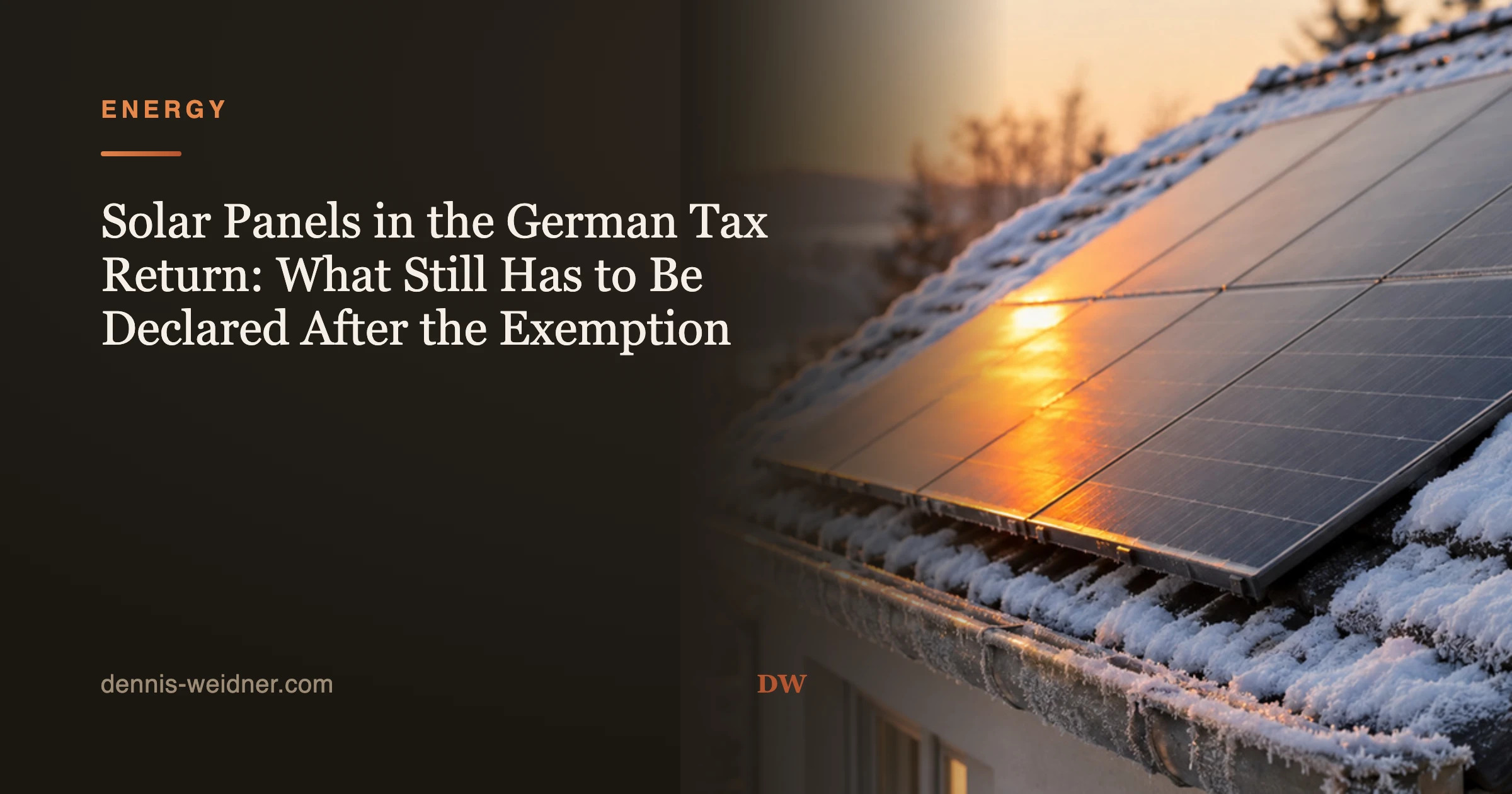
For most solar systems on German roofs, nothing has belonged in the tax return since 2022: feed-in income and self-consumption are tax-free, and no profit calculation is needed. What matters are the capacity limits per building and the 100 kWp threshold. Knowing them tells you what to enter for 2026, and you can still deduct the installation under Section 35a.
Solar Panels and Tax in Germany: What Has Applied Since 2022
For most solar systems on German roofs, tax has been a non-issue since 2022, and that is exactly what causes uncertainty every January. Section 3 No. 72 of the Income Tax Act exempts receipts and private use from systems on, at or in buildings as long as certain capacity limits are met. The feed-in tariff, power for your own household and charging your electric car all stay completely out of the calculation.
The law goes one step further: if all receipts from an activity are exempt under this provision, no profit has to be calculated. The cash-basis profit statement for the solar system falls away, as does the trade income schedule. The exemption applies to receipts and private use since 1 January 2022, regardless of when the system was commissioned.
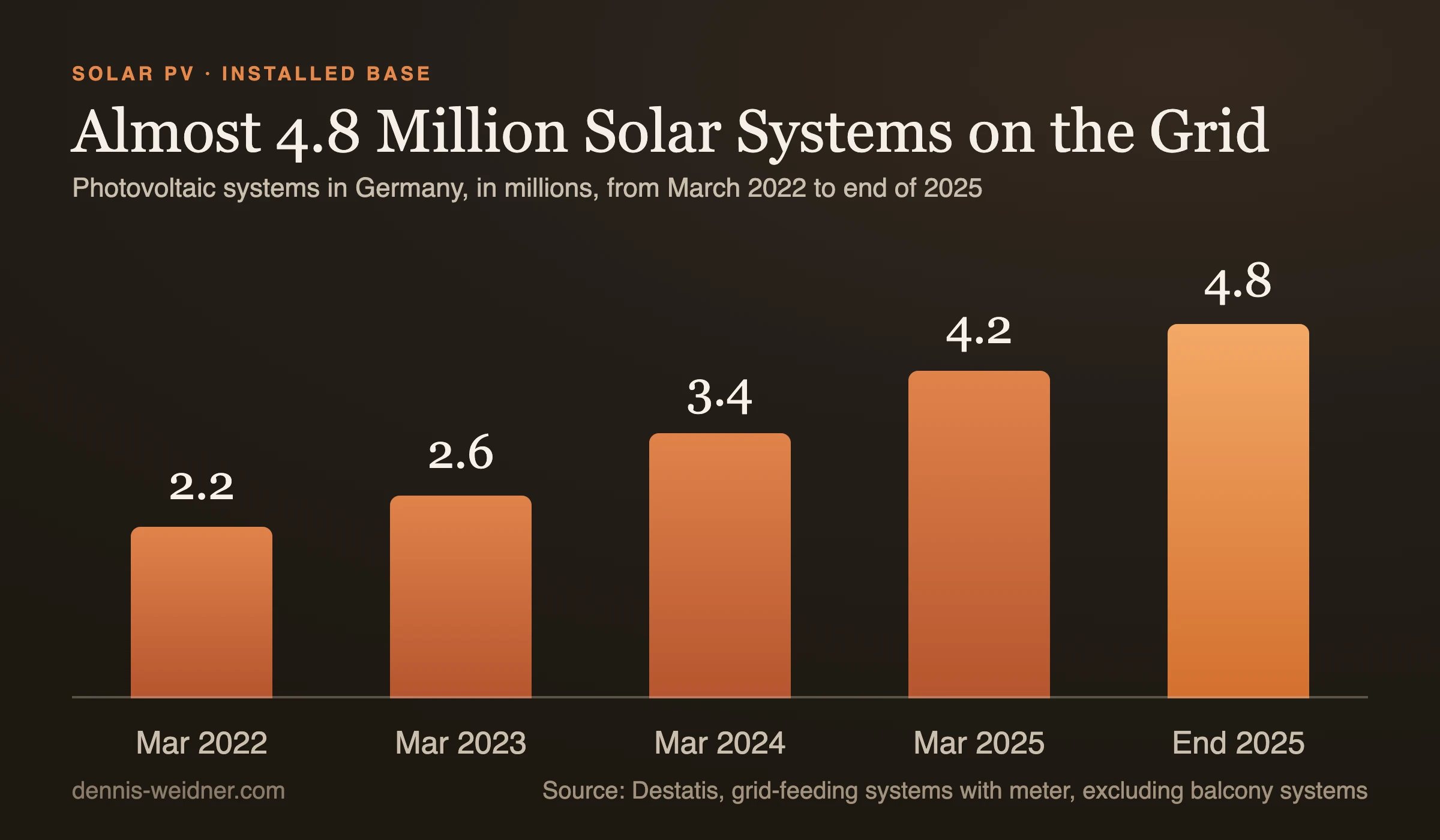
How many households and businesses this affects is clear from the statistics. According to the Federal Statistical Office, almost 4.8 million photovoltaic systems with about 106,200 megawatts were on the grid at the end of 2025, balcony systems not included.
The Capacity Limits of the Exemption, Old and New
What counts is the gross capacity in kilowatt peak recorded in the Market Master Data Register. Since the 2024 Annual Tax Act, more generous limits apply to new systems: up to 30 kWp per residential or commercial unit. Under Section 52(4) of the Income Tax Act, the new version applies to systems acquired, commissioned or extended after 31 December 2024. Older systems keep the limits that the Finance Ministry guidance of 17 July 2023 summarises in a table:
| Building | System acquired by end of 2024 | System acquired or extended from 2025 |
|---|---|---|
| Single-family house | 30 kWp | 30 kWp |
| Two- or multi-family house | 15 kWp per dwelling | 30 kWp per dwelling |
| Mixed-use building | 15 kWp per residential or commercial unit | 30 kWp per residential or commercial unit |
| Commercial building with one unit | 30 kWp | 30 kWp |
| Cap per taxpayer | 100 kWp (all-or-nothing threshold) | 100 kWp (all-or-nothing threshold) |
The 100 kWp cap per taxpayer or partnership is an all-or-nothing threshold. Anyone operating more loses the exemption for all systems under paragraph 17 of the guidance, not just for the excess. Ground-mounted systems are never covered and do not count towards the cap either. If you extend a system, check first whether the extension moves it into the new version and whether the total stays below 100 kWp.
Two points are often overlooked. The operator does not have to own the building; a rented roof qualifies too. And the exemption applies equally to individuals, partnerships and corporations, including the system on the roof of your own GmbH.
Solar Panels in the 2026 Tax Return: What to Enter
For the typical rooftop system on a single-family house the answer is: nothing for the system itself. No receipts, no depreciation, no expenses. The flip side is in paragraph 21 of the guidance: costs connected with an exempt system are not deductible, and no investment deduction is available for it either.
One exception is real money for many homeowners. Under paragraph 28 of the guidance, an exempt system on an owner-occupied home is treated as operated without profit motive for the purposes of Section 35a of the Income Tax Act. The labour share of the installation invoice can therefore be claimed as a tradesman service: 20 percent of labour costs, at most €1,200 a year, deducted directly from the tax bill. On €3,000 of labour that is €600. You need an invoice and payment to the installer's bank account. If the system was financed with a subsidised loan or a tax-free grant, the reduction does not apply.
| Case | Income tax | VAT | What goes into the 2026 return |
|---|---|---|---|
| Rooftop system within the limits | tax-free, no profit to calculate | bought at 0%; as a small business no VAT and no return | nothing for the system; installation labour possibly under Section 35a |
| Balcony solar system | tax-free | bought at 0% | nothing |
| Rooftop systems over 100 kWp in total or too large for the building | taxable, profit calculation | standard VAT or small business scheme depending on turnover | profit statement (EÜR), trade schedule, possibly VAT return |
| Ground-mounted system | taxable | general rules | profit statement, trade schedule |
| System belongs to another business | tax-free only for feed-in, sales and private use | depends on the business | within that business's profit |
Systems outside the limits and systems belonging to another business remain taxable. If, say, a craft business mainly uses the solar power itself, the system is part of that business, and under paragraph 24 only the share fed into the grid, sold or used privately is exempt. For the power consumed in the business, expenses remain deductible.
VAT: Zero Rate on Purchase, Small Business Scheme in Operation
Since 2023, operators of small systems buy without VAT. Section 12(3) of the VAT Act sets the rate for solar modules, essential components and battery storage including installation at zero percent if the system is on or near dwellings or certain public buildings. With a gross capacity of up to 30 kWp in the Market Master Data Register, that condition is deemed met.
Anyone feeding power into the grid for payment is a business for VAT purposes. For almost all private operators, the small business scheme under Section 19 of the VAT Act applies: no VAT on the feed-in and, since 2025, no VAT return either. It is different for operators who bought before 2023 and opted out of the scheme at the time to reclaim input VAT. That election binds for five calendar years; anyone still within it continues to file VAT returns.
Trade tax is just as clear. Section 3 No. 32 of the Trade Tax Act exempts operators whose activity is limited to generating and selling power from a building-mounted system of up to 30 kilowatts.
Battery Storage, Wallbox and Balcony Solar
Battery storage shares the tax treatment of the system. It is covered by the zero rate on purchase, and power flowing from it into the household is exempt private use. The same applies to charging a private electric car: the Finance Ministry lists it expressly in paragraph 10 among the private uses covered by the exemption. Anyone selling power to others at their own wallbox earns receipts that are exempt as well.
A balcony solar system falls within the limits anyway. If you receive no payment for it, there is nothing to tax and nothing to enter in the return. It still has to be registered in the Market Master Data Register, because the capacity recorded there is the basis for every limit in this article.
How storage and controllable devices pay off with dynamic tariffs is covered in dynamic electricity tariffs in 2026 and Germany's smart meter rollout.
Three Cases From Practice
The single-family house with storage. A 12 kWp system with a battery, commissioned in 2024, bought at the zero VAT rate. Income tax: exempt. VAT: small business, no return. Nothing about the system goes into the 2026 return. If the installation was paid in 2026 with €3,000 of labour, income tax falls by €600 under Section 35a.
The two-family house. One let and one owner-occupied flat, a 45 kWp system. If it was acquired in 2025 or later, it is below the new limit of 60 kWp for two dwellings and exempt, including the power supplied to the tenants. A system of the same size from 2023, by contrast, falls under the old limit of 15 kWp per dwelling, so 30 kWp, and remains taxable. Under Section 52 of the Income Tax Act, the new version only applies to it if it is extended after 2024.
The business owner with a commercial yard. 80 kWp on a commercial building with three units, installed in 2025, plus 25 kWp on the family home, both run by the same taxpayer. Each system stays within the limit for its building; 90 kWp would be allowed on the commercial building. Together, however, they reach 105 kWp, the threshold is exceeded, and the exemption is lost for both. A system that already breaches the limit for its own building does not count towards the 100 kWp; it is simply taxable on its own. Because the limit applies per taxpayer and per partnership, it pays to check who operates which system before any extension.
What the Exemption Means for Returns
The tax exemption changes the economics of a rooftop system more than any change to the feed-in tariff. Previously, the surplus of tariff income and valued self-consumption minus depreciation was taxable, and many operators had their system classed as a hobby for that reason. Today every euro saved and every euro paid flows through in full.
At the same time the tariff itself is shrinking, as described in feed-in tariffs in decline, and the value of a system is shifting to self-consumption. Anyone planning in 2027 should therefore start with the power they use themselves and only then with what they sell. Which subsidies remain is summarised in solar subsidies: what is left, and the changes at the turn of the year are in what changes for businesses in 2027.
Frequently Asked Questions
Do I have to declare my solar panels in my German tax return?
Not for a rooftop system within the limits of Section 3 No. 72 of the Income Tax Act. Receipts and private use are tax-free, no profit is calculated and no profit statement is needed. Only systems outside the limits, ground-mounted systems and systems belonging to another business have to be declared.
Up to what size is a solar system tax-free in Germany?
For systems acquired or extended since 2025, up to 30 kWp per residential or commercial unit. For older systems, 30 kWp on single-family houses and commercial buildings with one unit, and 15 kWp per unit on multi-family and mixed-use buildings. In addition, a 100 kWp threshold applies per taxpayer.
What happens if I operate more than 100 kWp?
The exemption is lost for all systems, because under the Finance Ministry guidance of 17 July 2023 the 100 kWp is an all-or-nothing threshold, not an allowance. Ground-mounted systems do not count towards it.
Can I deduct the installation of a solar system?
Yes, for an exempt system on an owner-occupied home, under Section 35a of the Income Tax Act as a tradesman service: 20 percent of labour costs, at most €1,200 a year. You need an invoice and a bank transfer. Subsidised loans or tax-free grants rule the reduction out.
Do I have to file a VAT return for my solar system?
Not as a small business under the Kleinunternehmer scheme; since 2025 they are exempt from filing unless the tax office expressly asks. Anyone who opted out before 2023 to reclaim input VAT stays bound to standard VAT for five calendar years.
Is solar power used to charge my electric car taxable?
No. Charging a private electric or hybrid vehicle is private use covered by the exemption according to the Finance Ministry guidance. If the vehicle belongs to the business operating the system, there is no private use at all.
Warm regards,
Dennis Weidner
Note: AI tools supported me in writing this article, and some images were edited with AI. I stand behind its content and every statement with my name.