What changes for businesses in Germany in 2027? The minimum wage rises to €14.60, the minijob threshold to €633, and any company with more than €800,000 of turnover in 2026 must send domestic business customers e-invoices only from January. The self-employed receive retirement subsidies for the first time, and two depreciation rules run out at the end of the year. Germany's new rules for businesses, with section, deadline and calculation.
Germany's New Rules for Businesses in 2027: the Overview
The list of changes for 2027 is shorter than in some previous years, and it reaches directly into three parts of a business: payroll, invoicing and investment planning. The table contains only rules that have been promulgated in the Federal Law Gazette (Bundesgesetzblatt), the official journal in which German laws take effect. Values that are reset by ordinance every year, and projects that were still bills before the Bundestag in autumn 2026, are covered in the section on each topic.
| What | From when | Who is affected | Legal basis |
|---|---|---|---|
| Minimum wage €14.60 per hour | 1 January 2027 | all employers | sec. 1 no. 2 MiLoV5 |
| Minijob threshold €633 a month | 1 January 2027 | employers with minijobs | sec. 8(1a) SGB IV |
| Transition zone €633.01 to €2,000 | 1 January 2027 | employers with midijobs | sec. 20(2) SGB IV |
| E-invoices mandatory when sending, if 2026 turnover exceeded €800,000 | supplies from 1 January 2027 | businesses with domestic business customers | sec. 14(2), sec. 27(38) UStG |
| Paper and PDF only up to €800,000 prior-year turnover | until 31 December 2027 | smaller businesses | sec. 27(38) no. 2 UStG |
| Declining-balance depreciation up to 30 percent, electric vehicles 75 percent in year one | acquired by 31 December 2027 | businesses that invest | sec. 7(2) and (2a) EStG |
| Corporate income tax 15 percent, falling afterwards | tax year 2027 | GmbH, UG, AG | sec. 23(1) KStG |
| Retention ends for accounting vouchers from 2018 | 1 January 2027 | everyone keeping books | sec. 147(3) and (4) AO, sec. 257 HGB |
| Retirement account, subsidy for the self-employed too | 1 January 2027 | traders and freelancers | secs. 10a, 84 EStG as amended from 2027 |
| Vehicle tax exemption for electric cars, until end of 2035 at the latest | first registered by 31 December 2030 | owners of electric cars | sec. 3d KraftStG |
I run several companies, and at the turn of a year I sort a list like this by a single question: which change requires a decision, and which merely changes a number in the software? In 2027, three items fall into the first group: e-invoicing above 800,000 euros of turnover, the end of declining-balance depreciation on 31 December 2027, and the retirement account for the self-employed. Everything else the accounts team handles, provided it knows what is coming.
Minimum Wage and Minijobs in 2027: What Employers Pay From January
Germany's statutory minimum wage rises on 1 January 2027 from 13.90 to 14.60 euros gross per hour. That is set out in section 1 no. 2 of the Fifth Minimum Wage Adjustment Ordinance (in German) of 5 November 2025, which fixed both steps for 2026 and 2027 at once. The increase is 70 cents, just over five percent. A full-time job of 40 hours a week, or 173.33 hours a month on the usual conversion, therefore costs around 121 euros more in gross pay per month, before the employer's social security contributions.
The minijob threshold is tied to the minimum wage. A minijob is Germany's form of marginal employment, with reduced charges up to a fixed monthly earnings limit. Section 8(1a) of Social Code Book IV (in German) defines that limit as the monthly pay from ten hours a week at the minimum wage and prescribes the formula: minimum wage times 130, divided by three, rounded up to the next full euro. For 2027 that gives 14.60 × 130 ÷ 3 = 632.67 euros, rounded up to 633 euros a month. Since October 2022 the threshold has moved in lockstep with the minimum wage, and in 2023 it stayed put because the minimum wage did too.
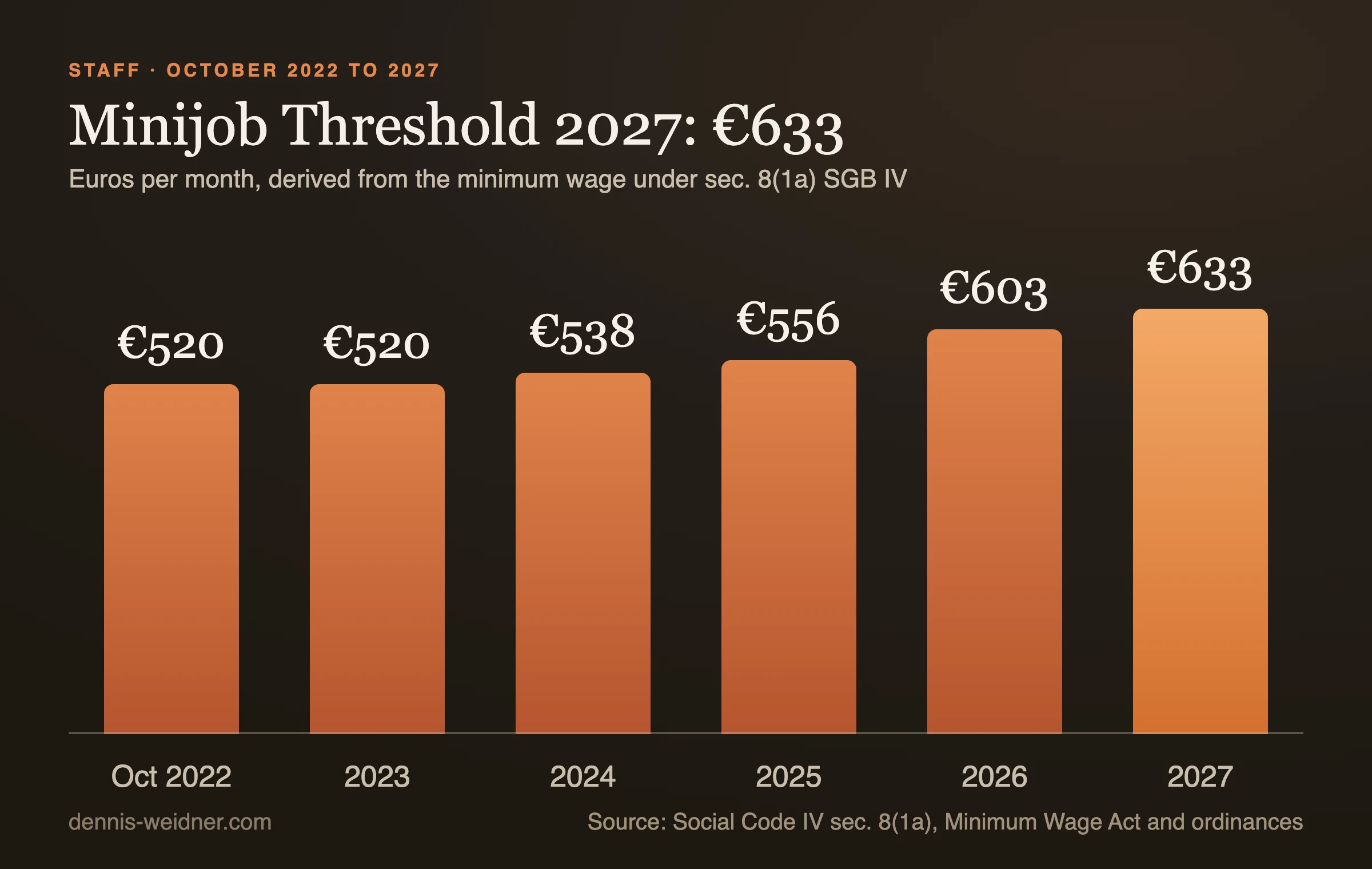
One detail deserves a second look, because it sits in employment contracts. Because of the rounding, the number of hours that fit into a minijob shifts by minutes from year to year. In 2026 it was 603 ÷ 13.90 = 43.38 hours a month; in 2027 it is 633 ÷ 14.60 = 43.36 hours. Anyone who used a 2026 minijob to the limit at minimum wage with 43.38 hours would reach 43.38 × 14.60 = 633.35 euros in 2027, 35 cents above the threshold. Contracts with fixed hours therefore need to be capped at 43.35 hours a month before the first January payroll.
Above the minijob threshold lies the transition zone (Übergangsbereich, often called a midijob), in which employees pay reduced social security contributions. Under section 20(2) of Social Code Book IV it extends to 2,000 euros a month, so in 2027 it runs from 633.01 to 2,000 euros. The factor F used to calculate contributions in this zone is published by the Federal Ministry of Labour and Social Affairs in the Federal Gazette by 31 December for the following year, because it depends on the contribution rates in force on 1 January.
The contribution ceilings, the compulsory health insurance threshold and the reference value (Bezugsgröße) follow the same pattern: they are updated every year by ordinance in line with the previous year's wage growth. The Labour Ministry presented its draft ordinance on the 2027 social security values on 21 September 2026. Employers paying salaries near these ceilings should recalculate their 2027 costs with the figures of the promulgated ordinance.
E-Invoicing in 2027: Who Must Switch in January
The biggest organisational change of 2027 sits in the VAT Act (Umsatzsteuergesetz, UStG). Since 1 January 2025, an invoice between two businesses in Germany must in principle be issued as an e-invoice: a structured format under the European standard that allows automated processing (section 14(1) and (2) UStG). A PDF is not an e-invoice in this sense but an "other invoice". Businesses have had to accept e-invoices since 2025, and the recipient's consent is not required for that. For sending, there are transition periods, and the first one ends on 31 December 2026.
For supplies from 1 January 2027, section 27(38) of the German VAT Act introduces a turnover threshold. Paper, or a PDF with the recipient's consent, may then only be sent by a business whose total turnover in the previous calendar year was no more than 800,000 euros. What counts is total turnover for 2026 as defined in section 19(2) UStG. A business above that line issues every domestic invoice to business customers electronically from January. For everyone else the grace period ends on 31 December 2027; until then, invoices exchanged via EDI in a format that does not meet the requirements of section 14 may also continue. From 1 January 2028 the obligation applies to all.
Permanently exempt are invoices up to 250 euros (section 33 of the VAT Implementing Ordinance, UStDV), travel tickets (section 34 UStDV) and invoices from businesses under the small-business scheme (section 34a UStDV); these may always be sent as other invoices. Invoices to consumers are not affected at all.
For businesses close to the threshold this is a planning question with a fixed cut-off: the 2026 turnover figure decides the whole of 2027. If you will only know it for certain once the annual accounts are drawn up in spring, switch to electronic invoicing in January as a precaution. The law treats the e-invoice as the default anyway; the transition rule is a permission, not an obligation.
Tax in 2027: Depreciation, Corporate Tax and Record Retention
For two depreciation rules, 2027 is the final year. Under section 7 of the German Income Tax Act, movable fixed assets acquired or produced after 30 June 2025 and before 1 January 2028 may be depreciated on a declining-balance basis: at up to three times the straight-line rate and no more than 30 percent of the remaining book value. A machine costing 100,000 euros with a ten-year useful life yields 10,000 euros a year on a straight-line basis, but 30,000 euros in the first full year on a declining balance and 21,000 in the second. In the year of acquisition the amount is prorated by month: buy the machine in July and you claim 15,000 euros in the first year.
Paragraph 2a goes further for purely electric vehicles held as business assets and acquired in the same period: 75 percent of the cost in the first year, then 10, 5, 5, 3 and 2 percent. The monthly proration expressly does not apply here. An electric van costing 60,000 euros and bought in December 2027 reduces 2027 profit by 45,000 euros. Under the current wording, the same purchase in January 2028 falls under neither rule.
For corporations such as the GmbH, Germany's limited liability company, corporate income tax stays at 15 percent in 2027. Section 23 of the Corporate Income Tax Act lowers the rate by one percentage point a year from 2028, down to 10 percent from 2032. That leads to a simple calculation: every euro of business expense reduces corporate tax plus solidarity surcharge by 15.825 cents in 2027 and by 14.77 cents in 2028. An expense of 45,000 euros saves a GmbH around 7,121 euros of these two taxes in 2027, and around 6,647 euros in 2028. Trade tax is unaffected. When a second corporate layer pays off for founders is covered in my article on the holding company in Germany.
The turn of the year also ends a retention period that empties many filing cabinets. Since 2025, accounting vouchers must be kept for eight years instead of ten, as set out in section 147 of the German Fiscal Code and, in identical terms, in section 257 of the Commercial Code (HGB); section 14b UStG sets the same period for invoices. The period starts at the end of the year in which the document was created. On 1 January 2027 that frees vouchers from 2018, business correspondence from 2020 (six years), and books and annual financial statements last posted or drawn up in 2016 (ten years). The period does not expire as long as a document is relevant to a tax whose assessment period is still open, for example during a tax audit or an objection.
On the income tax scale for 2027, the Federal Cabinet adopted the draft Income Tax Reform Act 2027 on 2 September 2026. It covers the basic allowance, the shape of the tax curve, child allowances and the top rates. Without a new law, the basic tax-free allowance would remain at 12,348 euros under section 32a of the Income Tax Act. Sole traders and partners in partnerships are affected directly, because their profit is subject to income tax; in a GmbH, the scale applies to the managing director's salary.
The Retirement Account in 2027: Subsidies for the Self-Employed
On 1 January 2027 the core of the Retirement Provision Reform Act in the Federal Law Gazette takes effect, promulgated on 29 May 2026. New state-subsidised contracts will then also be available as a retirement account invested in the capital markets (Altersvorsorgedepot), without any obligation to guarantee contributions. The old Riester products, Germany's subsidised private pension contracts, may no longer be sold from the turn of the year under section 14(7) of the Pension Contracts Certification Act; existing contracts continue. What the reform means for providers and savers overall is in my overview of Germany's new retirement account.
For business owners, one line in the new section 10a of the Income Tax Act matters most. Anyone under 67 who earns business or professional income under section 15 or section 18(1) nos. 1 to 3 of the Income Tax Act in the contribution year, and files a tax return for that year, becomes directly eligible for the subsidy from 2027. Compulsory members of professional pension schemes (Versorgungswerke) with employment income are added as well. Until now, self-employed people without compulsory state pension insurance were not directly eligible.
Under the new section 84, the basic allowance is 50 percent of the first 360 euros of own contributions per year and 25 percent of the amount between 360.01 and 1,800 euros. Paying in 1,800 euros brings 180 plus 360, i.e. a basic allowance of 540 euros, and contributions of up to 1,800 euros plus the allowance can be deducted as special expenses. For each child for whom child benefit is set in the saver's name, up to 300 euros of child allowance are added. A self-employed mother of two who pays in 1,800 euros therefore receives 1,140 euros a year in allowances. Savers under 25 get a one-off bonus of 200 euros. How that adds up over twenty years is worked through in my article on the retirement account for the self-employed.
There is a gap that affects founders with a GmbH in particular. The new rule is tied to income under section 15 or 18. A shareholder-managing director who draws only a salary from their own GmbH and is not subject to compulsory pension insurance earns employment income under section 19 and is not on this list; dividends, as capital income, are not either. Anyone who also runs a sole proprietorship or a freelance practice with its own profit qualifies through that route.
The child pension (Frühstartrente) is a separate law. Under the government bill (Bundestag document 21/7864), the federal government pays ten euros a month into a retirement account for every child from the age of six until adulthood. It is to start retroactively from 1 January 2026 with children born in 2020, and the first payments are planned for 2027. The Bundestag held its first reading of the bill on 25 September 2026. What ten euros a month can grow into by retirement is calculated in Germany's Child Pension Scheme, Calculated.
Vehicles and Energy in 2027: Electric Cars, CO2 Price and Renewables Law
Electric cars remain exempt from vehicle tax, but the exemption gets shorter every year. Section 3d of the Motor Vehicle Tax Act grants it for vehicles first registered by 31 December 2030, for ten years from first registration, but no later than 31 December 2035. An electric car first registered on 1 March 2027 therefore runs tax-free for eight years and ten months, not ten. For company vehicles, the 75 percent depreciation from the tax section applies on top, but only for purchases until the end of 2027.
For the CO2 price on heating oil, natural gas, petrol and diesel, the Fuel Emissions Trading Act (BEHG) sets a corridor of 55 to 65 euros per tonne for 2026. In autumn 2026 the act did not yet contain a corridor for 2027. In September 2026 the federal government therefore introduced a bill (Bundestag document 21/7869) that would apply the same corridor of 55 to 65 euros to 2027. If it takes effect as drafted, the price in 2027 stays at the 2026 level, and anyone budgeting for a vehicle fleet or gas heating plans with the ceiling of 65 euros.
For new solar and wind installations, the explanatory memorandum to the government's bill for the Renewable Energy Sources Act 2027 (EEG 2027, Bundestag document 21/7867) states that the EU state-aid approval for the EEG 2023 runs until 31 December 2026. The bill is to enter into force on 1 January 2027, and under its section 100 installations commissioned before that date remain under the previous rules. Anyone planning a solar array on a company roof should therefore check which version applies before commissioning. How the feed-in tariff for small installations has developed is covered in Feed-in Tariffs in Decline.
Checklist for Business Owners: Five Points for January 2027
- Establish your 2026 turnover. If total turnover exceeded 800,000 euros, domestic invoices to business customers go out as e-invoices from now on. Below that line you have until 31 December 2027.
- Update wages and minijobs. 14.60 euros an hour from the first January payroll, and minijobs with fixed hours capped at 43.35 hours a month.
- Time your investments. Declining-balance depreciation and the 75 percent rule for electric vehicles apply only to purchases made by 31 December 2027.
- Review your retirement saving. Traders and freelancers are eligible for the subsidy from 2027, provided they file a tax return for the contribution year. Anyone who draws only a managing director's salary should check whether they qualify at all.
- Clear the archive. Accounting vouchers from 2018 can go, unless an open assessment period still ties them.
The changes for 2027 are no upheaval, but three of them carry a date on which a decision is due. Sort those three in January, and they will leave you alone for the rest of the year.
Frequently Asked Questions
What is Germany's minimum wage in 2027?
14.60 euros gross per hour from 1 January 2027. It is set in section 1 no. 2 of the Fifth Minimum Wage Adjustment Ordinance of 5 November 2025. Compared with 13.90 euros in 2026, that is 70 cents or just over five percent more.
How much can a minijobber earn in 2027?
633 euros a month. Under section 8(1a) of Social Code Book IV the threshold follows from the minimum wage: 14.60 euros times 130, divided by three, rounded up to a full euro. At minimum wage, no more than 43.35 hours a month fit into a minijob.
When does my business have to send e-invoices in Germany?
It depends on the previous year's total turnover. If it exceeded 800,000 euros in 2026, invoices to domestic business customers for supplies from 1 January 2027 must be electronic. Up to 800,000 euros, paper or, with the recipient's consent, PDF remain allowed until 31 December 2027. Invoices up to 250 euros, travel tickets and invoices from small businesses under the small-business scheme are permanently exempt.
Is declining-balance depreciation still available in 2027?
Yes, for movable fixed assets acquired or produced after 30 June 2025 and before 1 January 2028. The rate is up to three times the straight-line rate, capped at 30 percent of the remaining book value (section 7(2) of the Income Tax Act). Purely electric vehicles bought in the same period follow their own schedule, with 75 percent in the first year.
Can self-employed people in Germany get the retirement account subsidy from 2027?
Yes. From 2027, taxpayers under 67 with business or professional income under section 15 or section 18(1) nos. 1 to 3 of the Income Tax Act are directly eligible if they file a tax return for the contribution year. With own contributions of 1,800 euros, the basic allowance is 540 euros, plus up to 300 euros per child.
What does Germany's 2027 tax reform change?
On 2 September 2026 the Federal Cabinet adopted a draft Income Tax Reform Act 2027 that changes the basic allowance, the tax curve, child allowances and the top rates. Payroll and tax assessments follow the version promulgated in the Federal Law Gazette. Corporate income tax stays at 15 percent in 2027 regardless and falls from 2028.
Which business records can I destroy from January 2027?
Accounting vouchers and invoices from 2018 (eight years), business correspondence from 2020 (six years), and books and annual financial statements last posted or drawn up in 2016 (ten years). The condition is that the documents are no longer relevant to a tax whose assessment period is still running, for example because of a tax audit or an objection.
Warm regards,
Dennis Weidner
Note: AI tools supported me in writing this article, and some images were edited with AI. I stand behind its content and every statement with my name.