Germany's political centre is currently losing less to the fringes than to itself. In a single week, SPD leader and labour minister Bärbel Bas resigned on 12 October 2026 with accusations against the coalition partner, a clash between Chancellor Friedrich Merz and state premier Manuela Schwesig at the Chancellery became public, the CDU in Saxony-Anhalt decided to leave the chamber during the vote for state premier, and the SPD and the Greens in Berlin paused exploratory talks with Die Linke. On 13 October, Sigmar Gabriel and RND editor-in-chief Eva Quadbeck discussed it all with Markus Lanz on ZDF. My take as an entrepreneur: the parties of the centre talk a lot about the firewall against the AfD and too little about putting out the fires behind it. Right now, ego is beating substance, and that is costing the centre exactly the trust it needs most.
As of 14 October 2026.
More on this topic: Politics & Society, with background, practice and every article in one place.
Markus Lanz on 13 October: Gabriel and Quadbeck on ambition in politics
Tuesday night's show was shaped by the resignation. The guests were Sigmar Gabriel, former SPD leader, vice chancellor and foreign minister, Eva Quadbeck, editor-in-chief of the RedaktionsNetzwerk Deutschland (RND), and investigative journalist Florian Flade, who spoke about the arrest of former BND intelligence chief August Hanning on 6 October. Federal prosecutors accuse him of, among other things, attempted treason; he is presumed innocent (beck-aktuell). What is known about the case, I have pulled together in August Hanning: What Is Known About the Espionage Case. The common thread of the evening was an old rule: anyone who holds responsibility in politics has to put personal ambition behind the job. The episode is available in the ZDF Mediathek.
Gabriel made a remarkable admission. When he was in government, he said, politics was easier because it needed less explaining. Today you first have to analyse where the country stands and explain to people what has changed, on tariffs, energy and costs, and bring them along that way. He explicitly defended Merz and praised him as a strong European and foreign-policy leader, citing Ukraine as an example. In his words, Merz is pursuing "an exceptionally good foreign and European policy". His image for it, in essence: even if the Chancellor walked on water, some would complain that he cannot swim. On air it went like this: "If he can walk on water tomorrow, people will say he can't swim." And he warned the parties of the centre: "We are digging the graves of the big-tent parties, on which the AfD will then dance."
For Gabriel, a state premier who turns against the federal government in Berlin is nothing new. State politicians have done it time and again, because it is the easiest way to collect discontent and turn it into votes. On Manuela Schwesig he said: "She can't play opposition in government when she herself is in Berlin. The SPD likes to do that, I know that too, but it is simply suicidal," as ZDFheute quotes him. He could hardly picture Schwesig as SPD leader in a coalition with Chancellor Merz, and he has little time for the party's dual leadership. His schoolyard image stayed with me: politicians' children are shown videos in which their mother or father is portrayed as a terrible person. That, too, now comes with public office.
Quadbeck put the Schwesig and Merz encounter into context and described a round in which Merz is said to have remarked to journalists that Bas had hardly been seen in Berlin for weeks. Some of those present heard it as a sober observation, others as a put-down. Quadbeck saw the outrage in the SPD as a strategy "to distract from its own chaos now and steer the blame or the debate back towards the CDU, towards the coalition partner". For me, that is the core of this week: the same sentence is read as a statement of fact or as an attack, depending on which camp you sit in. How strongly the vote is gathering at the edges, I described ten days ago in Political Discontent in Germany, using every federal election since 1998.
Bärbel Bas resigns: grief, attacks and a ministry in the middle of pension reform
Bas is giving up both posts and keeping her seat in the Bundestag. In her statement she writes that after her stepdaughter's death she needs time to grieve, and that she currently lacks the strength to carry out government and party work in full. The attacks on her had been "stepped up further" during this time, according to reporting by taz. She had been cancelling appointments since late September. The new labour minister is Alexander Schweitzer from Rhineland-Palatinate; who will take over the party leadership is open.
According to the Süddeutsche Zeitung, citing the SPD leadership, Merz had complained in a background briefing that Bas was so rarely in Berlin, although he had already been told about her situation. Government spokesman Stefan Kornelius sidestepped questions about it: "The Chancellor has spoken about Ms Bas. Those words are what count," the Berliner Zeitung quotes him. One day after the resignation, speaking at the German Employers' Day in Berlin, Merz said of the pension reform, whose recommendations the pension commission handed over in June and whose draft law sits in Bas's ministry: "That is already too long for me." Green parliamentary leader Katharina Dröge called his appearance "truly impossible", according to ZDFheute.
Both things are true at the same time, and both can be said. Grief deserves respect, without any ifs or buts. And a ministry responsible for pension reform and labour market reform needs leadership that is visible in exactly these weeks. That is why every federal ministry has state secretaries. Had the ministry said openly on day one who was deputising for the minister and what would be delivered by when, her absence would never have become a projection screen. Every company works this way: if the managing director drops out, the deputy takes over, and everyone knows it. A ministry's paid senior leadership exists precisely for moments like this.
Schwesig versus Merz: from the climate foundation to the scene at the Chancellery
The encounter at the Chancellery has a long history. It starts with the Climate and Environmental Protection Foundation MV, which the state parliament in Schwerin approved in January 2021, when the state was governed by a coalition of SPD and CDU. EUR 20 million of its money came from Nord Stream 2 AG, a subsidiary of the Russian state group Gazprom; the state contributed EUR 200,000. The foundation was also meant to help complete the pipeline despite threatened US sanctions, and a parliamentary inquiry examined its creation from 2022 onwards (LTO). After Russia's attack on Ukraine, Schwesig called setting it up a mistake.
| Date | What happened |
|---|---|
| January 2021 | Mecklenburg-Western Pomerania's parliament approves the climate foundation, EUR 20m from Nord Stream 2 AG |
| May 2022 | Parliament sets up an inquiry into the foundation |
| March 2023 | Merz calls on Schwesig to resign: "If this were about a CDU man, he would long since be out of office" |
| Summer 2026 | Schwesig campaigns as "The woman against blue", blue being the AfD's colour |
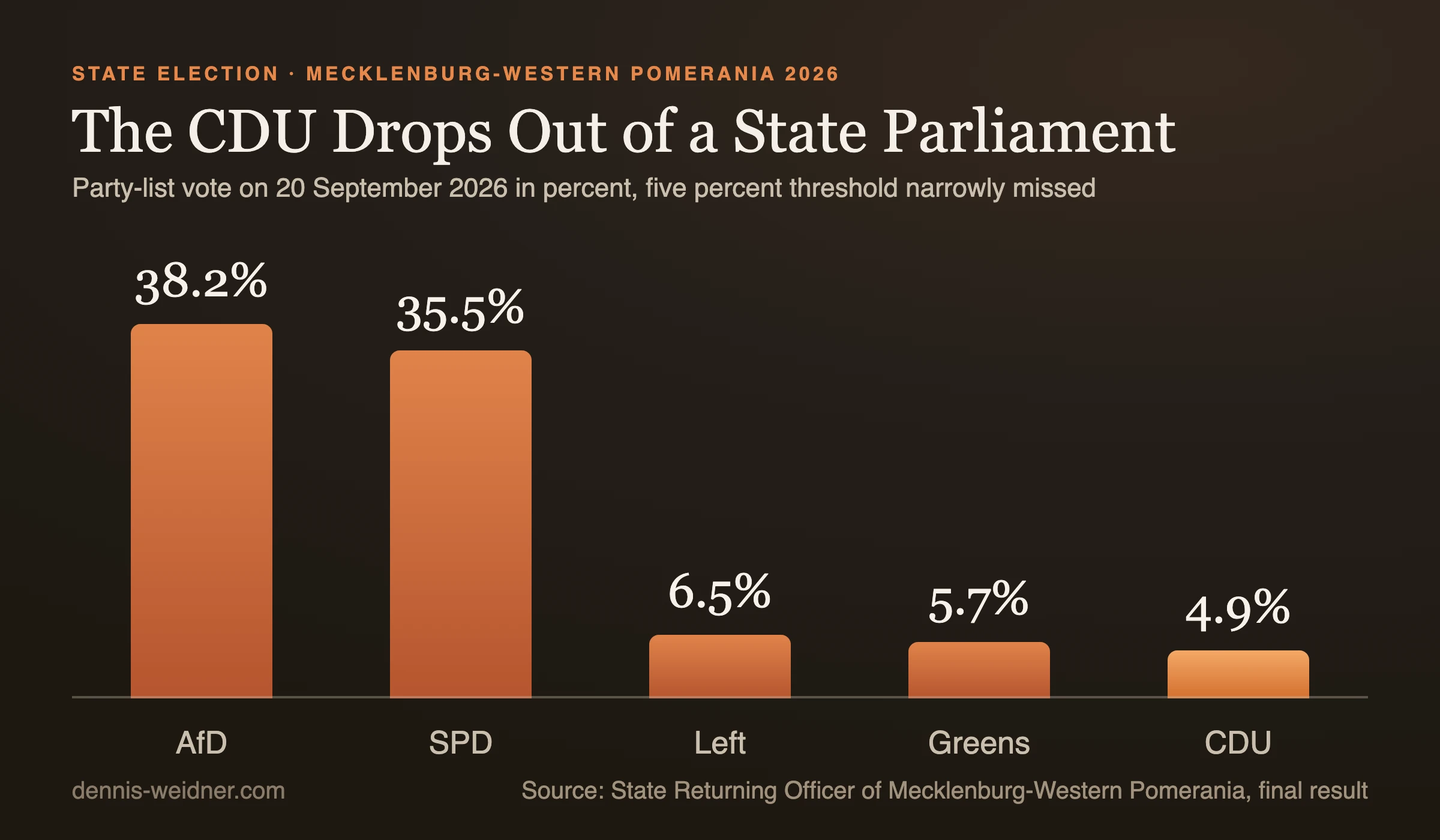
| 20 September 2026 | State election: AfD 38.2%, SPD 35.5%, CDU 4.9%, out of the state parliament for the first time |
| 21 September 2026 | Schwesig: Merz has only five percent approval in her state and should ask himself self-critically what he has done wrong |
| Late September 2026 | Chancellery, according to Der Spiegel: Merz accuses Schwesig of having "destroyed the democratic centre"; she leaves him standing |
| 9 October 2026 | The scene becomes public; Schwesig: "neither as minister-president nor as a woman" |
The 2023 call for her resignation appeared in the Westfalenpost and was reported by t-online. On 20 September the CDU dropped out of a state parliament for the first time; it had never before fallen below five percent in a state election, according to Stuttgarter Zeitung. Schwesig's criticism of the Chancellor the day after is documented in an analysis by ZDFheute, which already describes her as the SPD's leader in all but name.
According to the Spiegel report, summarised by Tagesspiegel, Merz accused her of campaigning as "the woman against blue" less against the AfD than against him. Schwesig called that outrageous, offered, in essence, to arrange an appointment if he wanted to talk, and walked off. She told Der Spiegel: "That is not a factual way of dealing with each other. I will not put up with it, neither as minister-president nor as a woman." The government spokesman has neither confirmed nor denied the scene.
I can understand the Chancellor. Anyone who campaigns publicly against their own federal government and, the day after the election, reads out the Chancellor's approval ratings has to expect that Chancellor to raise it in private. In private is the right place for it. The reply that he is welcome to make an appointment, on the other hand, has no place in a conversation between two heads of government who are both responsible for this country. And the words "as a woman" turn a question of substance into a question of gender. To be fair: Merz entered that territory himself in 2023, when he compared his call for her resignation with a "CDU man". People who treat each other like this no longer govern together, they govern side by side. Should Schwesig take over the SPD leadership, I see hardly any common ground left for this coalition.
Klingbeil and the SPD leadership: accusations without a single example
Lars Klingbeil called the attacks on Bas "indecent". On the ARD news special on 12 October, presenter Markus Preiß asked whether he could name one specific attack. Klingbeil replied: "There were many, you know that too." Asked about his own party leadership, he said: "I am not clinging to my office", Tagesspiegel reports. Markus Söder pointedly declined to comment further.
Anyone who publicly accuses their coalition partner of pushing a grieving minister out of office should be able to say who said what and when. Without an example, an accusation remains that nobody can check and nobody can clear up, and that is exactly what poisons cooperation. I think it would be right for Klingbeil to hand over the party leadership and concentrate fully on his roles as vice chancellor and finance minister. Then the party can make demands and the minister can deliver, without having to perform the balancing act between the two in public every day.
The AfD firewall in Saxony-Anhalt: CDU plans to leave the chamber during the vote for state premier
On the same Tuesday, the CDU group in Saxony-Anhalt's state parliament decided not to take part in December's vote for minister-president and to leave the chamber as a group. 14 of its 15 members voted in favour; one abstained and wants to seek legal advice. The trigger was the election of AfD member Tobias Rausch as parliament president on 6 October: in a secret ballot he received votes from outside the AfD and BSW, and what CDU members said about their own votes did not match the number of abstentions, according to ZDFheute. Walking out is meant to prevent votes from the CDU's own ranks from putting AfD lead candidate Ulrich Siegmund into office.
The AfD holds 39 of the 83 seats and needs 42 votes in the first round. Siegmund wants to stand in that one round only and calls the CDU plan a lack of respect for the will of the voters. A parliamentary group that trusts its own members so little that it would rather not vote at all is passing a vote of no confidence in itself. A ballot is secret so that every member can decide freely and stand by that decision. Clearing the chamber does not protect democracy; it hands the AfD the best story of the year: that the others no longer even dare to vote. How hard it has become to build majorities, I described in Government Formation in Germany.
Berlin: SPD and Greens pause exploratory talks with Die Linke
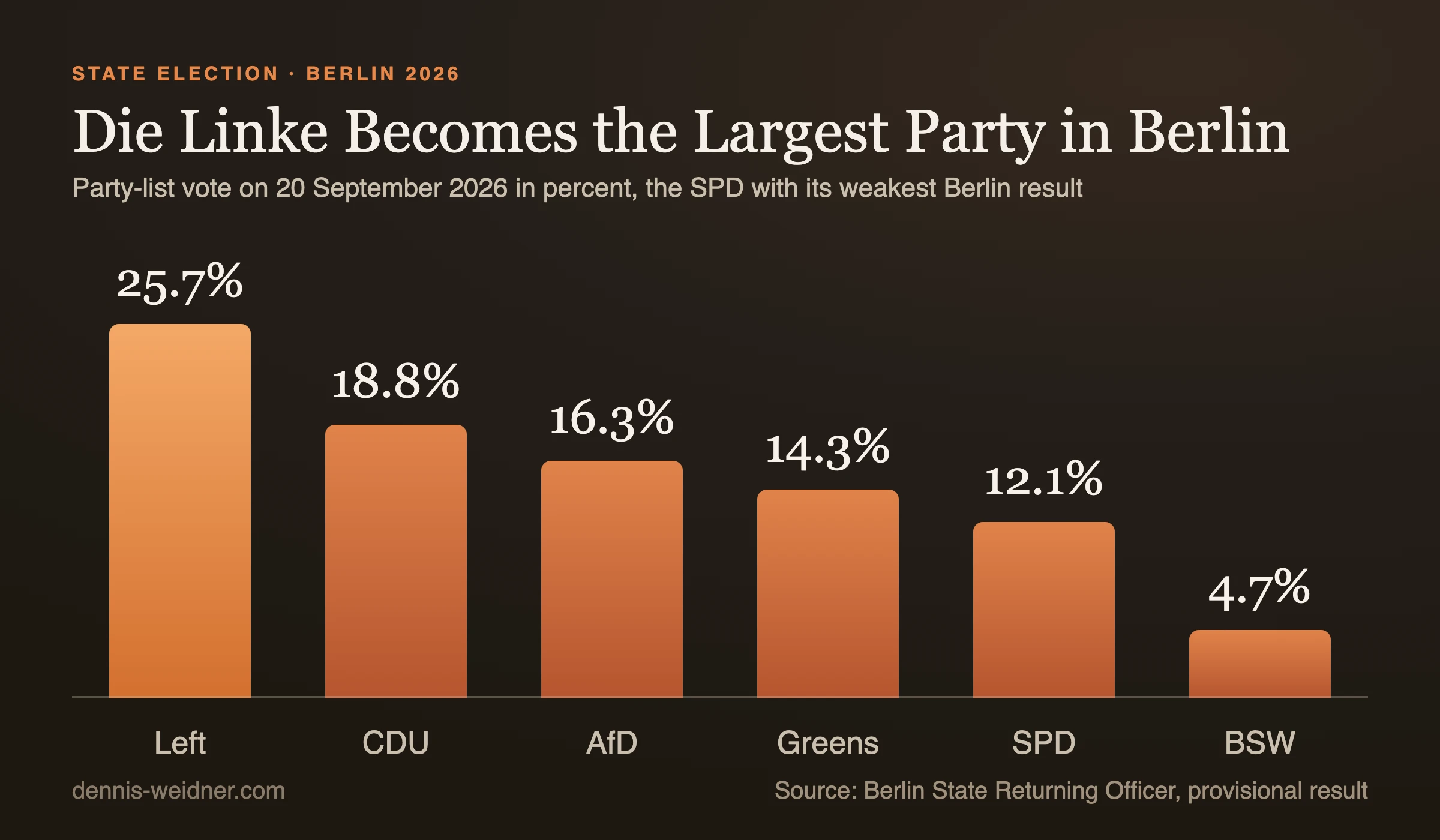
In Berlin, Die Linke won the 20 September election to the state parliament with 25.7 percent and has been holding exploratory talks with the Greens and the SPD. Beforehand, the three parties had agreed how to deal with antisemitic incidents within Die Linke's ranks, up to and including expulsion from the parliamentary group. On 13 October, the new Linke group signed its own declaration on antisemitism and Israel's right to exist. The Greens and the SPD then paused the talks: Die Linke had reached different arrangements within its group, and it now had to be checked whether the joint agreement still applies, said lead candidates Werner Graf and Steffen Krach, according to dpa in Tagesspiegel.
Three years after the Hamas terror attack of 7 October 2023, in which around 1,200 people were killed in Israel, dealing with antisemitism is no side issue, least of all in the capital. What concerns me is the pattern: one week after an agreement, it is already in question whether it still applies. Negotiating like this makes trust almost impossible. We left Berlin a good year and a half ago, and several business partners tell me they plan to do the same. A capital that entrepreneurs want to leave should take that as a warning sign.
Germany as a business location: 2017 and today
Gabriel's call for an honest analysis of where the country stands is an invitation to simply do it. 2017 was his last full year in the federal government. Comparing it with today shows how much the conditions have shifted, and also what still holds up.
| Indicator | 2017 | Today |
|---|---|---|
| Real economic growth | +2.8% | +0.2% (2025), 2026 forecast: +1.3% |
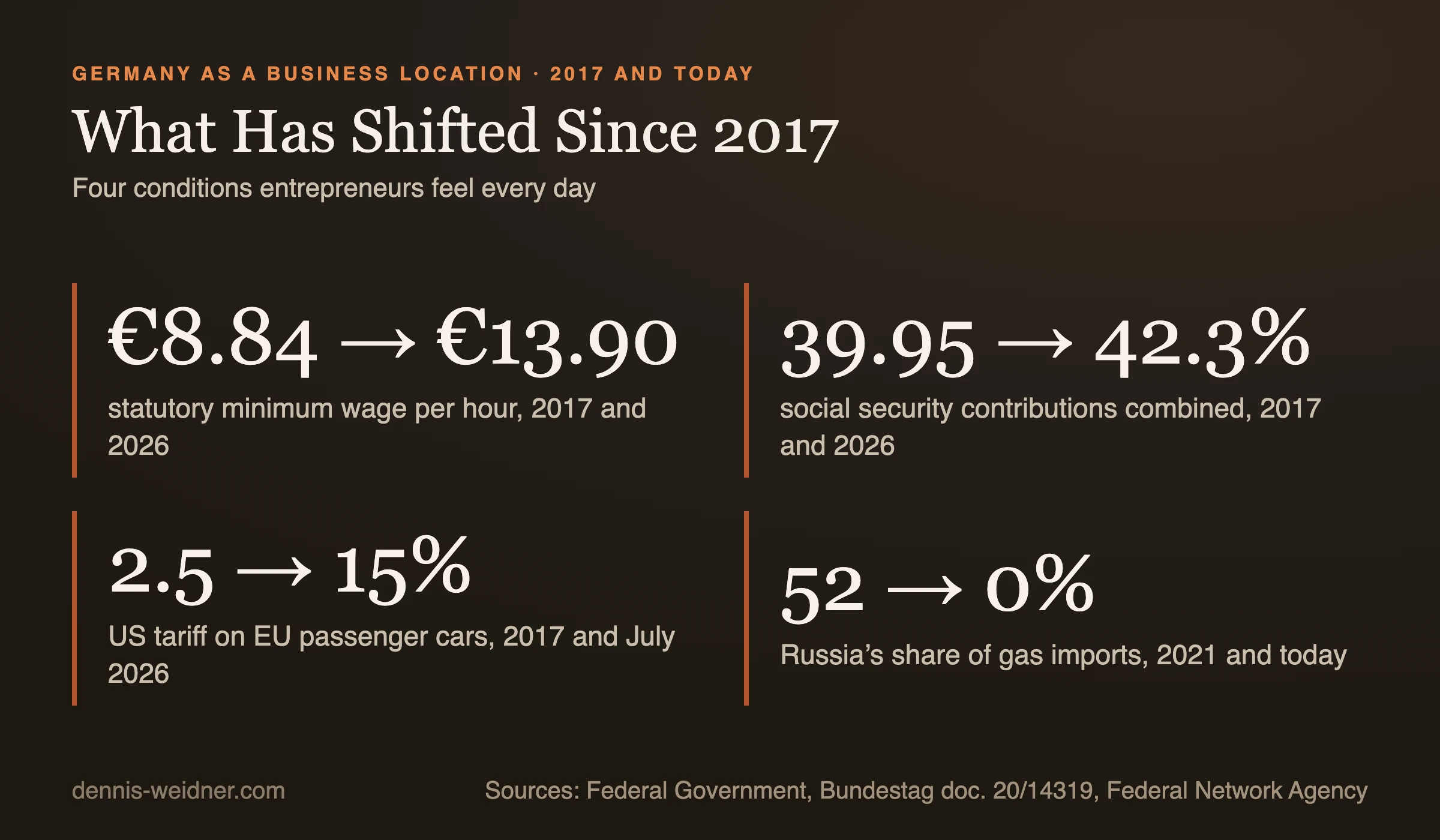
| Statutory minimum wage per hour | EUR 8.84 | EUR 13.90 (2026), EUR 14.60 from 2027 |
| Social security contributions combined | 39.95% | 42.3% (2026) |
| US tariff on EU passenger cars | 2.5% | 15% (as of July 2026) |
| Russia's share of gas imports | 52% (2021) | 0% direct since September 2022 |
| Industrial electricity per kilowatt hour | 17.1 cents | 17.2 cents (2026) |
| Unemployed, annual average | 2.53m | 2.95m (2025) |
| Defence spending as % of GDP | 1.21% | 2.69% (2026, estimate) |
| Rank among the largest economies | 4th | 3rd (2026) |
The economy grew 2.8 percent in real terms in 2017 and just 0.2 percent in 2025, according to the Federal Statistical Office; for 2026, the government expects 1.3 percent in its autumn projection of 8 October. The minimum wage has risen 57 percent since 2017. Social security contributions totalled 39.95 percent in 2017, according to a government reply to the Bundestag, and stand at 42.3 percent today. Russia still supplied 52 percent of Germany's gas imports in 2021 (Federal Network Agency); since September 2022, no gas has come directly from there. The US now levies 15 instead of 2.5 percent on cars from the EU (Federal Government). Unemployment rose to 2.95 million in 2025 (Federal Employment Agency), and defence spending has more than doubled by NATO's count.
Two figures do not fit the story of decline. At 17.2 cents per kilowatt hour, industrial electricity costs almost exactly what it did in 2017; only the mix has flipped: taxes and levies fell from 9.1 to 2.5 cents, while procurement, grid and sales rose from 8.0 to 14.7 cents, according to the BDEW electricity price analysis. And according to the International Monetary Fund, Germany is the world's third-largest economy in 2026 at around 5.5 trillion US dollars, up from fourth in 2017. So Germany is not doing badly. But the conditions are different from Gabriel's time in government, and that is exactly what politics has to explain today before it sells reforms.
Record revenue and heavy borrowing: what reaches entrepreneurs
The numbers explain why the tone causes so much frustration. The state has never taken in more, and it is still borrowing on a scale rarely seen. Tax revenue for the federal government, states and municipalities reached EUR 989.8 billion in 2025, up 4.4 percent and a record (Federal Statistical Office). At the same time, the public sector deficit grew to EUR 127.3 billion, and municipalities were EUR 31.9 billion in the red, more than at any time since 1990 (Schwäbische Zeitung, citing the Federal Statistical Office). Municipalities are the ones that build schools and roads.
| Indicator | Value |
|---|---|
| Tax revenue, federal, state and municipal, 2025 | EUR 989.8bn, a record |
| Public sector deficit 2025 | EUR 127.3bn |
| of which municipalities | EUR 31.9bn, highest since 1990 |
| New federal borrowing 2026, including special funds | over EUR 180bn, second highest after 2021 |
| Spent from the infrastructure special fund and climate fund in 2025 | EUR 31.4bn of 52.9bn, around 59% |
| Social security contributions 2026, employer and employee | 42.3% of gross pay |
Including special funds, the 2026 federal budget provides for more than EUR 180 billion in new borrowing; only in the Covid year 2021 was it higher (ZDFheute). Of the money earmarked for infrastructure and climate protection, only EUR 31.4 billion of 52.9 billion was actually spent in 2025, according to the finance ministry's report to the Bundestag budget committee. And on every euro of gross pay, social security contributions average 42.3 percent in 2026, with the employer paying around half (2026 contribution rates at Haufe).
I am an entrepreneur myself, and I am not satisfied with this development. Taxes, social contributions, documentation duties, ever more registers and filings: the burden keeps growing and relief comes late. The phased cut in corporation tax from 2028 that has been passed is a start. But I look in vain for a single measure over the last five to ten years that has noticeably made entrepreneurs' day-to-day lives easier. When a state has record revenue, takes on record debt and still cannot get its schools renovated, the mood in the country almost explains itself. What I would like to see from the state as a founder is set out in more detail in Entrepreneurs and Politics.
Political centre and AfD firewall: does Germany's centre still exist?
In Mecklenburg-Western Pomerania, the AfD and Die Linke together won 44.7 percent, the CDU and SPD 40.4 percent. In Saxony-Anhalt on 6 September, the two parties at the edges even won a majority of the vote. Arithmetically, the centre has shrunk, but for me it is not a seating plan in parliament. It is a way of working: compromise on substance, fairness in tone, reliability in agreements. That is exactly what is missing right now, across party lines.
The firewall, or Brandmauer, refers to a December 2018 resolution of the CDU party congress rejecting coalitions and similar forms of cooperation with the AfD and with Die Linke, as Hessischer Rundfunk reports. The firewall is the image for it: it is meant to stop a fire from spreading to the house next door. Saxony-Anhalt shows how hard it is to hold in practice, where the AfD is by far the largest group and the CDU would rather leave the chamber than trust a secret ballot.
The parties of the centre talk a lot about the firewall and too little about putting out the fires behind it. They are busy with themselves, with slights and leadership questions, and more and more people feel it no longer matters who is in government. On top of that comes a climate in which a misleading sentence is exploited on social media for days against whoever said it. How algorithms reward this escalation, I wrote about in Social Media Algorithms and Radicalisation.
I would like to be more involved in politics. As an entrepreneur, you learn to describe problems, prioritise them and solve them. That will not win you a prize for the friendliest tone, and in a system where empathy and headlines count for more than facts, people like me hold back. The profile a politician needs today is demanding: take a lot, argue the substance correctly, not court sympathy but convince through action and bring people along. And then still find majorities without caving on every question.
What would help now
The situation is serious, and it can be solved. What it needs is not a new face at the top but an understanding among everyone involved about tone, goals and priorities. Five points would make a real difference:
- Explain first, then reform. An analysis of where the country stands that everyone can follow: what has changed since 2017 and why some things therefore have to change.
- Settle conflicts internally, make results public. Anyone who attacks the coalition partner in public names facts or refrains.
- Separate roles. Party leadership and government office in different hands, and in every ministry a deputy who is visible from day one.
- A substantive agenda with dates. Pension reform into cabinet, investment money actually spent on building, social contributions held stable, and obligations cut that entrepreneurs feel every day.
- Respect the free mandate. Members of parliament are bound only by their conscience, as Article 38 of the Basic Law puts it. A group that takes this seriously stays in the chamber for a vote.
When the centre delivers again, people come back. Elections have shown that in both directions. I am convinced this country has the strength for it, and I would welcome your view of this week through the contact form. I reply to every message.
Frequently asked questions
What does the AfD firewall (Brandmauer) mean?
It refers to the CDU party congress resolution of December 2018 rejecting coalitions and similar forms of cooperation with the AfD and with Die Linke. The firewall is the image for it: it is meant to stop a fire from spreading. How far "similar forms of cooperation" reach is still disputed.
What is meant by Germany's political centre?
Usually the parties that form governments without the fringes, today mainly the CDU/CSU, SPD, Greens and FDP. For me, the centre is above all a way of working: compromise on substance, fairness in tone, reliability in agreements. In Mecklenburg-Western Pomerania on 20 September, the CDU and SPD together won 40.4 percent, the AfD and Die Linke 44.7.
Who were Markus Lanz's guests on 13 October 2026?
Sigmar Gabriel, former SPD leader and foreign minister, RND editor-in-chief Eva Quadbeck and investigative journalist Florian Flade. Topics included Bärbel Bas's resignation, the state of the SPD and the coalition, economic and reform policy, and the arrest of former BND intelligence chief August Hanning.
Why did Bärbel Bas resign?
Bas gives two reasons: after the death of her stepdaughter she needs time to grieve, and public attacks on her were stepped up during this period, including from the ranks of the coalition partner. She resigned as labour minister and SPD co-leader on 12 October 2026 and remains a member of the Bundestag.
What happened between Manuela Schwesig and Friedrich Merz at the Chancellery?
According to Der Spiegel, Merz accused the minister-president in late September of having campaigned against him rather than against the AfD and of having destroyed the democratic centre. Schwesig called that outrageous, offered an appointment and left. The government spokesman has neither confirmed nor denied the scene.
Why does the CDU in Saxony-Anhalt plan to leave the chamber during the vote for state premier?
The group wants to prevent votes from its own ranks from putting AfD candidate Ulrich Siegmund into office in a secret ballot. The trigger was the election of the AfD parliament president on 6 October, who also received votes from outside the AfD and BSW. The AfD holds 39 of 83 seats and needs 42 votes in the first round.
Why were the exploratory talks in Berlin paused?
The SPD and the Greens want to check whether the rules on antisemitism agreed beforehand still apply after Die Linke's parliamentary group adopted its own declaration on 13 October. Die Linke won the election on 20 September with 25.7 percent.
Best,
Dennis Weidner
Note: AI tools supported me in writing this article, and some images were edited with AI. I stand behind its content and every statement with my name.