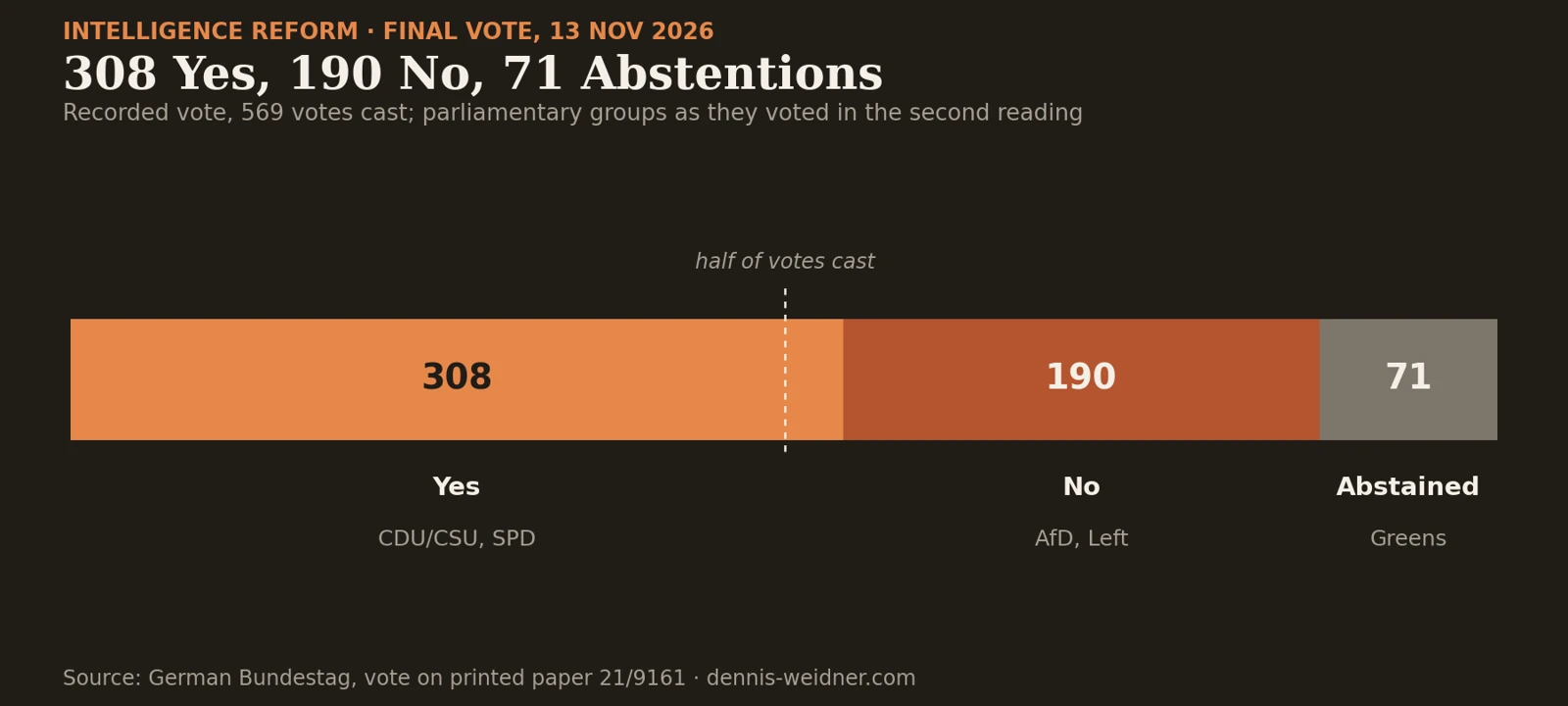
The Bundestag passed the reform of Germany's foreign intelligence service, the BND, and its domestic intelligence agency, the Federal Office for the Protection of the Constitution (BfV), on Friday, 13 November 2026, with 308 votes in favour, 190 against and 71 abstentions. For the first time, German intelligence services may not only watch but act: take down servers run by state hackers, divert data streams during cyberattacks, disable explosives and, under strict conditions, secretly enter homes. Force against people, arrests and open searches remain reserved for the police. Oversight lies with a body of former judges that must approve serious measures in advance. The government justifies it with hybrid attacks such as the explosives-laden drone at Leipzig/Halle airport in August. The Left and the AfD speak of a new secret police; the Greens abstained. Here is what the services may now do, who oversees them and what it means for businesses.
Germany's Intelligence Reform at a Glance
- 308 to 190 with 71 abstentions: the CDU/CSU and SPD voted in favour, the AfD and the Left against, the Greens abstained.
- Powers to intervene for the first time: the BND may shut down servers of state hacker groups abroad; the BfV may disable explosives, weapons and attack tools at home.
- Secret entry into homes: the BfV and the BND may enter, for example to read out data, but only under high thresholds and after prior review.
- 6 and 13 months: how long the BND may store unreviewed content and traffic data from foreign intelligence gathering.
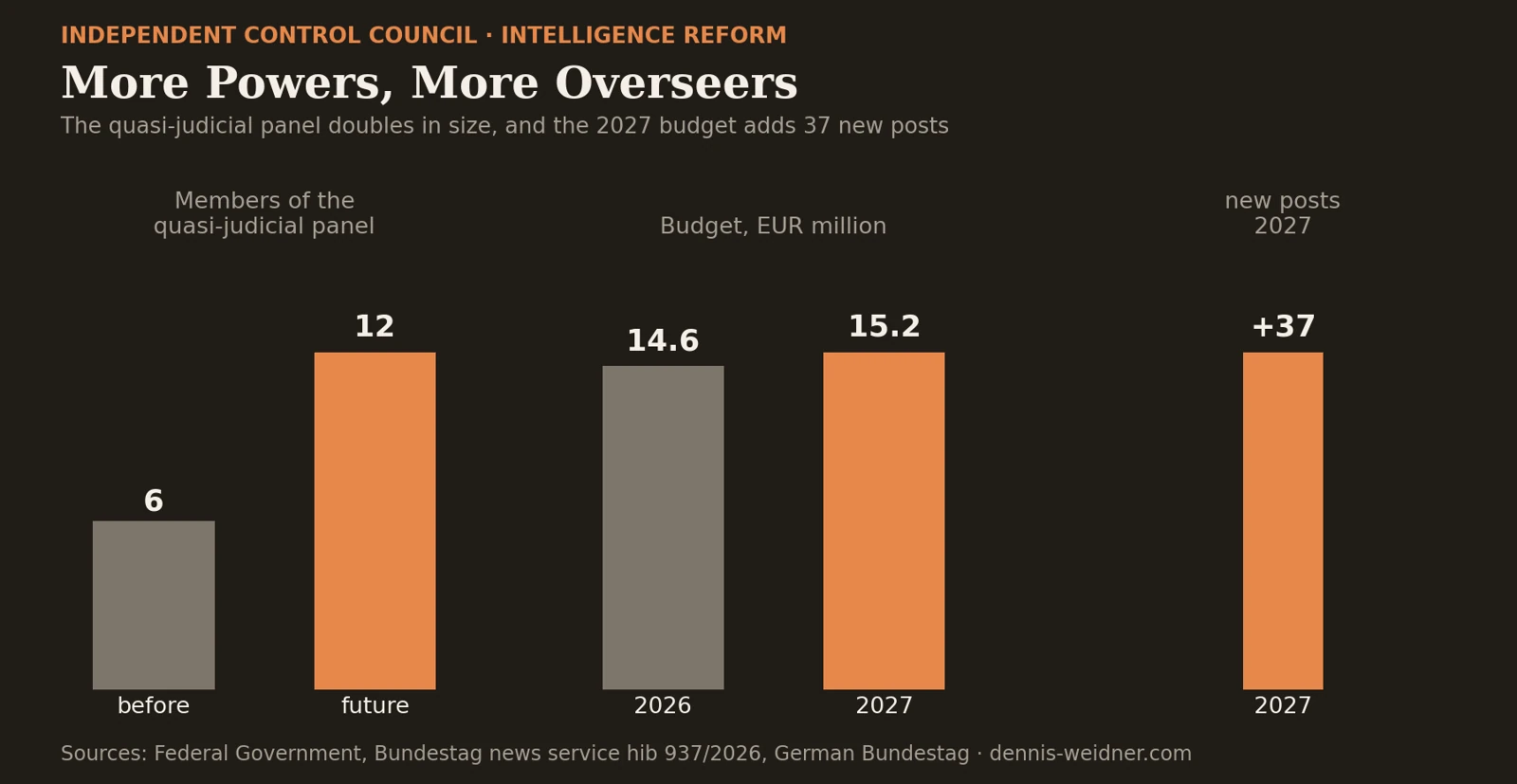
- 12 instead of 6 members: the quasi-judicial panel of the Independent Control Council doubles in size and approves serious measures in advance.
- Age 16: in narrowly defined exceptions, minors from 16 may be run as informants.
- 31 December 2026: the law is due to take effect; until then, a BND signals intelligence rule objected to by the Federal Constitutional Court continues to apply.
Germany's Intelligence Reform: What the Bundestag Passed
The Bundestag adopted the government's bill reforming intelligence law in the version amended by its home affairs committee. It combines a new Federal Constitution Protection Act, a new BND Act and new rules for the Independent Control Council. In the recorded vote, 569 members cast a ballot according to the Bundestag: 308 yes, 190 no, 71 abstentions. Interior Minister Alexander Dobrindt (CSU) called it a "reform of the century" that turns intelligence agencies into "real secret services".
More on this topic: Politics & Society, with background, practice and every article in one place.
After hearing expert witnesses, the coalition added another 97 pages of amendments, taz reports. Doctors and psychotherapists are now better protected from BND surveillance, and confidential conversations with an AI are protected from spying just like conversations between people. With the votes of the CDU/CSU, SPD and Greens, the Bundestag also announced that it will strengthen its Parliamentary Oversight Panel next year.
Why Germany Kept Its Intelligence Services on a Short Leash
German intelligence services have so far been allowed to gather information but not to act, and there is a historical reason. Under National Socialism, the Gestapo combined secret service and police powers in one organisation. The Western Allies therefore stipulated in their "police letter" of 14 April 1949 that a future domestic service must not have police powers. This became the separation principle: intelligence services gather information, the police intervene.
That came at a price. Several planned attacks in Germany in recent years were only prevented because foreign services, for example from the United States, supplied the decisive tip-off, writes beck-aktuell. Nina Warken (CDU), the chancellery minister responsible for the BND, put it this way in the Bundestag: foreign powers "disguise sabotage as accidents, espionage as business and propaganda as opinion".
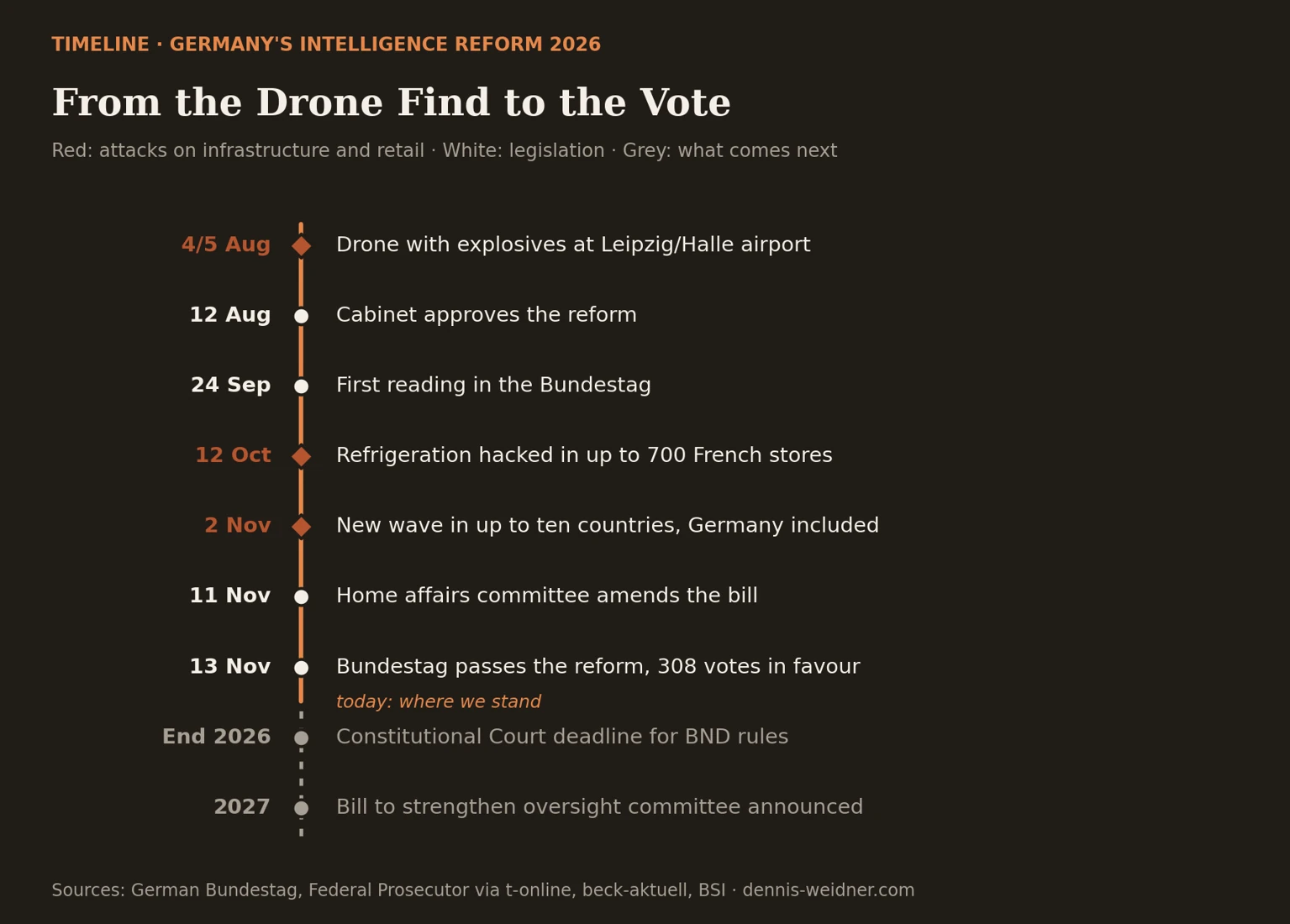
The past few months have shown what that looks like. On the night of 5 August, a man working the night shift at Leipzig/Halle airport discovered a drone carrying Semtex plastic explosive and a detonator near a Ukrainian cargo aircraft. The Federal Prosecutor speaks of a serious attack on transport and logistics infrastructure, t-online reports. It was not stopped by a defence system but by that man. In October and November, supermarket refrigeration systems in several European countries were apparently manipulated remotely, and the BSI, Germany's cybersecurity agency, confirmed interference in Germany too. Who was behind it is still unclear. What it means for the affected retailers is covered in my piece on the supermarket fridge cyberattack.
What the BND and BfV May Do After Germany's Intelligence Reform
The new powers are numerous and tied to conditions. The main ones according to the Bundestag, the federal government and ZDF:
| Power | Who | Condition and oversight |
|---|---|---|
| Disable explosives, weapons and attack tools; divert or block data streams during cyberattacks; delete stolen data | BfV | Only for particular threats and when the police cannot act in time or the information comes from a foreign service that forbids passing it on; prior review by the Control Council |
| Secretly enter homes and business premises, for example to read out data or disable weapons | BfV and BND | Very high thresholds, prior review by the Control Council |
| Remote searches of devices, monitoring of encrypted communications, AI analysis, biometric image matching on the internet | BfV; the BND may probe foreign IT systems abroad and also use AI and biometric matching | Access to privately used devices only after review by the Control Council |
| Request information from payment providers, platforms and carmakers; "freeze" traffic data at the provider | BfV (freezing also BND) | Frozen data may only be viewed once suspicion hardens |
| Shut down servers of state hackers, disrupt disinformation networks and weapons supply chains | BND, abroad | In case of imminent danger or a specific threat from foreign powers; subsequent review by the Control Council |
| Store unreviewed data from foreign intelligence gathering | BND | Content up to 6 months, traffic data up to 13 months; every measure approved by the Control Council |
| Run minors from 16 as informants; investigate organised crime structures | BfV | Minors only in narrowly defined exceptions; organised crime only where it supports espionage, sabotage or extremism |
One sentence from the interior ministry's explanation shows how wide the range is: access to IT systems runs from minimally intrusive measures, "such as those against a smart fridge", to a privately used mobile phone. The connected fridge is therefore not only a target for attackers but explicitly also a possible target of state access.
Who Oversees the Intelligence Services After the Reform
Oversight is concentrated in the Independent Control Council. It takes over the tasks of the previous G10 Commission and data protection supervision of the services. Its quasi-judicial panel grows from six to twelve members, elected by the Bundestag's Parliamentary Oversight Panel. It must approve particularly serious measures in advance, may inspect the services unannounced and is to report to the public regularly. People affected can turn to the council directly. In the 2027 budget, it is to receive 37 new posts for this.
Another clause was added in committee: the federal BfV may restrict cooperation with individual state offices if important security interests would otherwise be seriously harmed, for example, the government says, if a state office can no longer guarantee the protection of classified information. This requires the consent of a majority of the state offices; in urgent cases the federal office decides alone. The AfD called it a "lex AfD" in the Bundestag.
Criticism of the Intelligence Reform: A New Secret Police?
The Left rejects the reform. Its member Clara Bünger accused Dobrindt of abolishing the separation principle and building "blanket AI mass surveillance": "You are creating a new German secret police." The AfD also voted against; its member Christian Wirth spoke of an "attack on the rule of law".
The Greens took a more nuanced line. Konstantin von Notz called the reform overdue and a good day for security, and his group backed the BND act and the Control Council. He said no to the new domestic intelligence act because of biometric internet matching without relevant thresholds, minors as informants and overly broad data transfers to private parties. The coalition lacked "any sensitivity for civil rights", he said, and would get into "real trouble" at the Federal Constitutional Court. A motion to vote on the parts separately failed, and in the end the group abstained.
The coalition pushed back. Sonja Eichwede (SPD) stressed that the BfV may only intervene when the police cannot, so the separation principle still applies. Dobrindt accused the Left and the AfD of forgetting history: "The Stasi and the Gestapo were secret services without any oversight. Today we have the most closely supervised secret services there have ever been."
What Germany's Intelligence Reform Means for Businesses
For entrepreneurs, more changes than the headlines suggest:
- Defence against cyberattacks: if a foreign state is behind an attack, the BfV may in future divert data streams and delete stolen data on the attackers' servers, and the BND may disrupt their infrastructure abroad. The first line of defence is still your own network: no controllers directly on the internet, remote maintenance only via VPN with a second factor, timely updates.
- Information requests: payment providers, platforms and carmakers can be asked for information, and telecoms providers must preserve traffic data on order. Anyone holding such data should have a clear process for who reviews and answers requests.
- Hosting: according to the government, the services may in rare cases also enter the IT of domestic hosting providers, for example if a provider fails to cooperate despite a legal duty. Cooperation is the safer route.
- AI in the company: confidential conversations with an AI are now protected like conversations between people. If you use AI assistants at work, you should still know where your data sits. How we build AI agents for companies is explained at Weidner & Friends.
My View: Right Direction, but Oversight Has to Deliver
I think the reform is right at its core. Anyone who has seen a security incident at a service provider spill over into their own business, as we did in October with our hosting provider Railway, knows how much you depend on attackers being stopped before they arrive. That an explosives drone at an airport was found by a man on the night shift and not by a defence system says a lot about the state of our security. A foreign intelligence service that may only watch state hackers' servers is a spectator in this situation. Even the Greens see it that way.
On domestic intelligence, I understand the concern. Secretly entering homes, falsifying data, running minors as sources: these are interventions where a state has to prove it is in control. I will therefore judge the reform not by Dobrindt's "reform of the century" but by two figures the Control Council should publish in future: how often such measures were requested and how often it refused them. An oversight body that never says no is not overseeing anything.
And one more thing belongs to the full picture: security is currently being financed on credit. Spending on intelligence services and IT security is among the areas the federal government finances outside the debt brake. How much that adds up to is in my piece on Germany's 2027 budget. Why I speak up as an entrepreneur is explained under Entrepreneurs and Politics.
What Happens Next With Germany's Intelligence Reform
The law now goes to the Bundesrat, the chamber of the federal states, and must then be signed and promulgated. Time is pressing: a BND signals intelligence rule objected to by the Federal Constitutional Court only applies until the end of 2026, and the government says the new law is due to take effect on 31 December 2026. The Greens, the Left and the AfD expect parts of the new domestic powers not to survive in Karlsruhe, and I expect a constitutional complaint. Next year the Bundestag also wants to table a bill extending the rights of its Parliamentary Oversight Panel. More on government and security can be found under Politics and Society.
Cover photo: headquarters of the Federal Intelligence Service in Berlin, 23 March 2026, cropped. Photo: NutzerAusBerlin, Wikimedia Commons, public domain (CC0).
Frequently Asked Questions About Germany's Intelligence Reform
What may Germany's domestic intelligence agency do after the reform?
For the first time it may intervene in particular threats, for example by disabling explosives and weapons, diverting data streams during cyberattacks or deleting stolen data. Under high thresholds it may secretly enter homes. Force against people, arrests and open searches remain reserved for the police.
Can the BfV now secretly enter homes?
Yes, but only under very high thresholds and with prior approval, for example to read out data from a device or disable weapons. It may only act if the police cannot avert the danger in time or if the tip-off comes from a foreign service that does not allow it to be passed to the police. The BND may also secretly enter homes under strict conditions.
What may the BND do in future?
The Federal Intelligence Service may intervene actively abroad, for example by shutting down servers of state hacker groups or disrupting disinformation networks. It may store unreviewed data from foreign intelligence gathering, content for up to six months and traffic data for up to 13 months.
Who oversees the BND and the BfV?
Primarily the Independent Control Council. Its quasi-judicial panel grows from six to twelve members and approves serious measures in advance. The Bundestag's Parliamentary Oversight Panel remains in place, and the Bundestag plans to table a bill giving it more rights in 2027.
How did the Bundestag vote on the intelligence reform?
Of 569 votes cast, 308 were yes, 190 no and 71 abstentions. The CDU/CSU and SPD voted in favour, the AfD and the Left against, and the Greens abstained.
Is the intelligence reform constitutional?
That is disputed. The Greens, the Left and the AfD consider parts of the new domestic powers unconstitutional and expect them to fail in Karlsruhe. The coalition points to prior review by the Independent Control Council. In the end, the Federal Constitutional Court is likely to decide.
Warm regards,
Dennis Weidner
Note: AI tools supported me in writing this article, and some images were edited with AI. I stand behind its content and every statement with my name.