The Bundestag's budget committee approved Germany's 2027 federal budget early on Friday, 13 November 2026. The final committee session, known in Berlin as the Bereinigungssitzung, ran from 2:30 pm on Thursday to 5:55 am on Friday and voted on around 2,000 motions. The result is spending of 560.92 billion euros, more than ever before, and 122.97 billion euros of new borrowing in the core budget. Add the special funds for infrastructure and the armed forces, and Germany takes on about 208 billion euros of new debt in a single year. The planned plastics tax is gone, the sugar tax is delayed to 2028, and whether the electricity tax is cut for everyone will be decided by the coalition leaders on Tuesday. The Bundestag votes on 27 November. Here is what was decided overnight, what it means for businesses and taxpayers, and how I read it.
Germany's 2027 Budget at a Glance
- EUR 560.92 billion in spending: 5.48 billion more than the government draft and 6.9 percent more than in 2026.
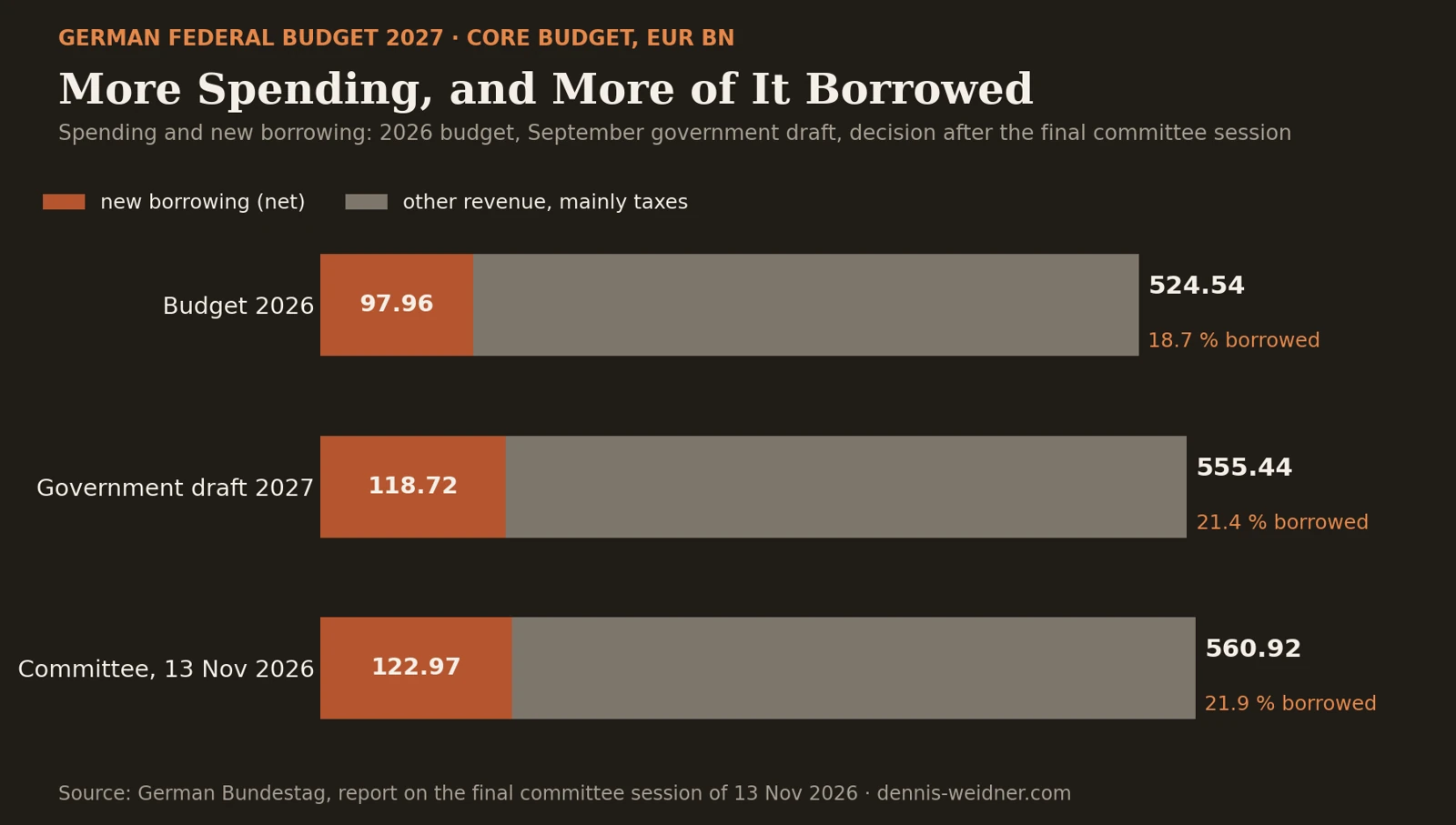
- EUR 122.97 billion of new core borrowing: 4.25 billion more than planned, a little over one euro in every five spent.
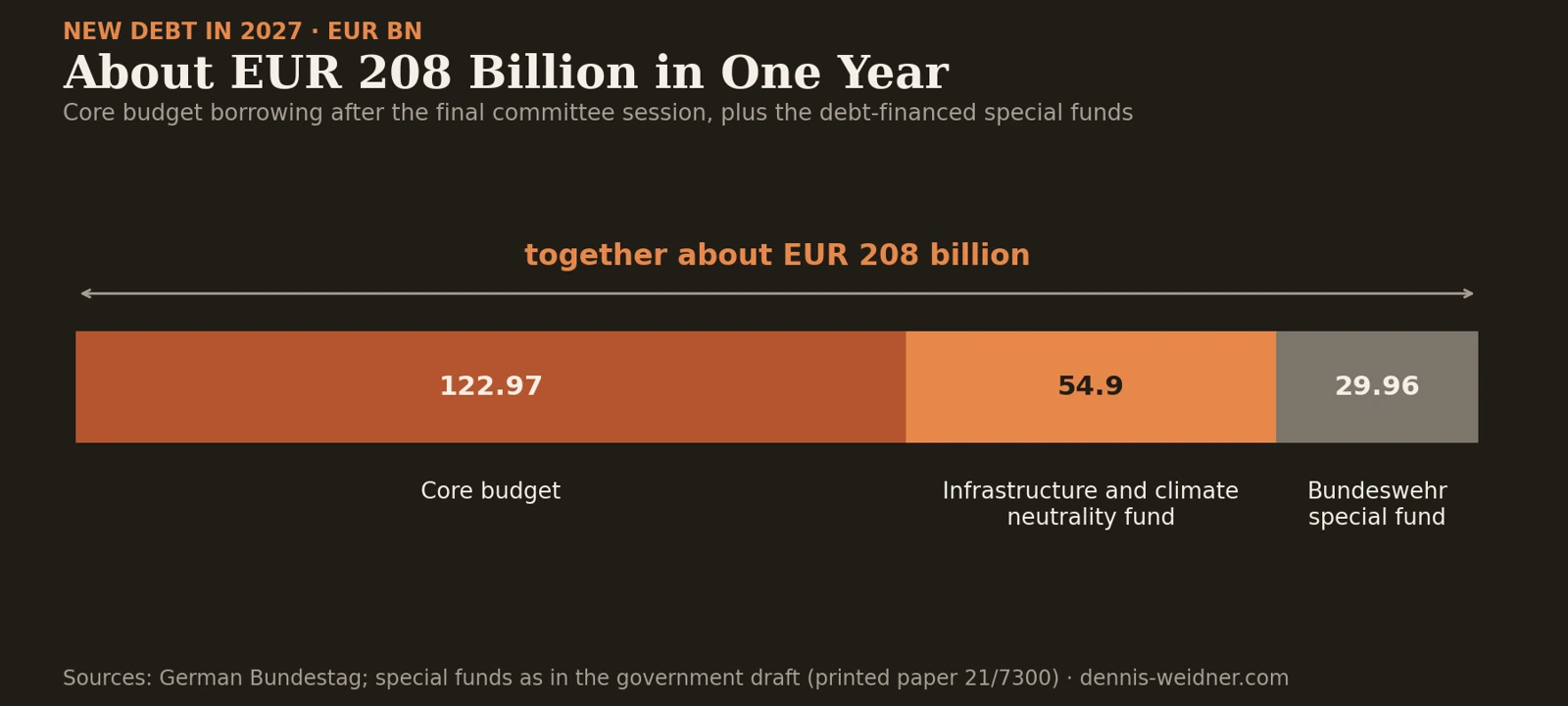
- About EUR 208 billion of new debt in total: including 54.9 billion from the infrastructure and climate neutrality fund and 29.96 billion from the Bundeswehr special fund.
- EUR 38.43 billion counts towards the debt brake: exactly the legal ceiling; 84.55 billion falls under the exemption for defence and security.
- A EUR 34 billion gap: the amount the coalition says its budget experts had to close in the final session.
- Plastics tax dropped, sugar tax from 1 January 2028: the electricity tax cut for everyone (about 5 billion euros) remains open until the coalition committee meets on 17 November.
- 27 November: final vote in the Bundestag, with budget week starting on 24 November.
Germany's 2027 Budget: The Figures After the Final Committee Session
The Bereinigungssitzung is the last round in which the budget committee turns the government draft into hard numbers. It writes in everything that has changed since the summer: the new tax estimate, coalition decisions and requests from the ministries. According to the Bundestag's own report, this year's session began at 2:30 pm on Thursday and ended at 5:55 am on Friday, a little over 15 hours later. The draft passed with the votes of the CDU/CSU and SPD; the AfD, the Greens and the Left voted against, and every opposition amendment failed.
More on this topic: Politics & Society, with background, practice and every article in one place.
The bottom line is 560.92 billion euros of spending, 36.4 billion more than the 524.54 billion in the current year. Tax revenue is estimated at 396.21 billion euros, 1.49 billion more than in the draft. Investment rose by 5.58 billion overnight to 61.85 billion euros. For future years, the federal government may enter into obligations of up to 377.77 billion euros, known as commitment appropriations. Of that, 296.88 billion goes to the defence ministry, almost four in every five euros the federal government may already tie up for later years.
New Debt in Germany's 2027 Budget: About EUR 208 Billion
In the core budget, the federal government will take on 122.97 billion euros of net new borrowing in 2027, after 97.96 billion this year. Only 38.43 billion of that counts towards the debt brake, which, according to the Bundestag, puts the budget exactly at the permitted ceiling. The other 84.55 billion falls under the exemption the constitution has allowed since 2025 for defence and certain security spending.
On top of that come two funds with their own borrowing authority. The government draft planned 54.9 billion euros of market borrowing for the infrastructure and climate neutrality fund, and the Bundeswehr special fund adds 29.96 billion euros of spending financed through its own loans. Together that makes about 208 billion euros of new debt in one year. A year ago, after the same session for the 2026 budget, the equivalent figure was more than 180 billion.
The CDU/CSU parliamentary group still calls it a balanced budget. Formally, that is correct: Article 110 of the Basic Law requires revenue and spending to balance, and borrowing counts as revenue. On paper, every federal budget is balanced. In economic terms, it means that a little over one euro in every five the federal government spends in 2027 is borrowed.
What the Final Session Changed in Germany's 2027 Budget
The broad lines stayed; the detail moved. The main changes according to the Bundestag's report:
| Ministry budget | Decision 2027 | Change vs. draft | Behind it |
|---|---|---|---|
| Labour and social affairs | EUR 203.29 bn | +1.82 bn | Loan to the Federal Employment Agency raised by 3 to 8.2 bn; basic income support and pension subsidies cut |
| Defence | EUR 109.75 bn | unchanged | Shifts within the budget; commitment appropriations up by almost 5 to 296.88 bn; plus 29.96 bn from the special fund |
| General financial administration | EUR 49.70 bn | +2.82 bn | An extra 4 bn for stakes in energy companies |
| Transport | EUR 25.35 bn | −1.08 bn | Investment by the federal motorway company cut by 1.98 to 2.38 bn; commitment appropriations for the rail expansion plan up by 4.34 bn |
| Education, family, seniors, women and youth | EUR 15.93 bn | +0.45 bn | 396 million more for child maintenance advances |
| Health | EUR 15.12 bn | +0.78 bn | Subsidy to the health fund up by 650 million |
| Housing, urban development and construction | EUR 7.85 bn | +0.34 bn | 320 million for a stake in an affordable housing company |
The transport budget stands out. It shrinks while the overall budget grows, because the federal motorway company, Autobahn GmbH, is to borrow on its own from 2027 and receive truck toll revenue from 2028, as VerkehrsRundschau reports. The debt for roads moves out of the budget into a federally owned company. It does not get any smaller.
One detail ties in with the security situation. The central reserve of 500 million euros for the EU's NIS2 cybersecurity directive is being dissolved, and the funds needed now sit in the ministries' own budgets, mostly for staff and IT, according to the Bundestag's parliamentary news service. The Independent Control Council, which already oversees the BND's surveillance, gets 37 new posts because of the intelligence reform. What a cyberattack does in practice is something I described using the example of hacked supermarket refrigeration systems.
Germany's 2027 Budget and Taxes: No Plastics Tax, Sugar Tax in 2028, Electricity Tax Open
The parliamentary group leaders had agreed on some of the most contentious points the day before. According to the CDU/CSU group, the coalition is dropping the planned plastics tax and the increase in the sparkling wine tax. The tax on sugary drinks will start on 1 January 2028, six months later than planned. In return, job cuts in the federal administration are to be more ambitious.
The electricity tax is still open. So far, only manufacturing, agriculture and forestry pay the EU minimum rate through a tax relief. That previously temporary relief has been permanent since 1 January 2026 and covers around 600,000 companies according to the Bundestag. Households, retailers, restaurants and service firms still pay the full rate of 20.50 euros per megawatt hour under Section 3 of the Electricity Tax Act, or 2.05 cents per kilowatt hour. A cut for everyone was in the coalition agreement, would cost about 5 billion euros according to ZDF, and has no funding so far. The coalition committee is due to decide on Tuesday.
What a cut to the European minimum would deliver is easy to work out. The Energy Taxation Directive requires at least 1 euro per megawatt hour for private consumers and 0.50 euros for business use:
| Consumer | Electricity per year | Electricity tax today | At the EU minimum | Annual saving |
|---|---|---|---|---|
| Private household | 3,000 kWh | EUR 61.50 plus VAT | EUR 3.00 plus VAT | EUR 69.62 incl. VAT, about EUR 5.80 a month |
| Small office | 15,000 kWh | EUR 307.50 | EUR 7.50 | EUR 300 net |
| Café or shop | 40,000 kWh | EUR 820 | EUR 20 | EUR 800 net |
For businesses, VAT is a pass-through item, so the table shows net amounts. For a household it is a few euros a month; for a shop or café, a few hundred euros a year. The bigger value is the signal: the cut for everyone has been in the coalition agreement since spring 2025 and has still not been delivered for households, retailers and service firms.
Interest in Germany's 2027 Budget: What the Debt Costs
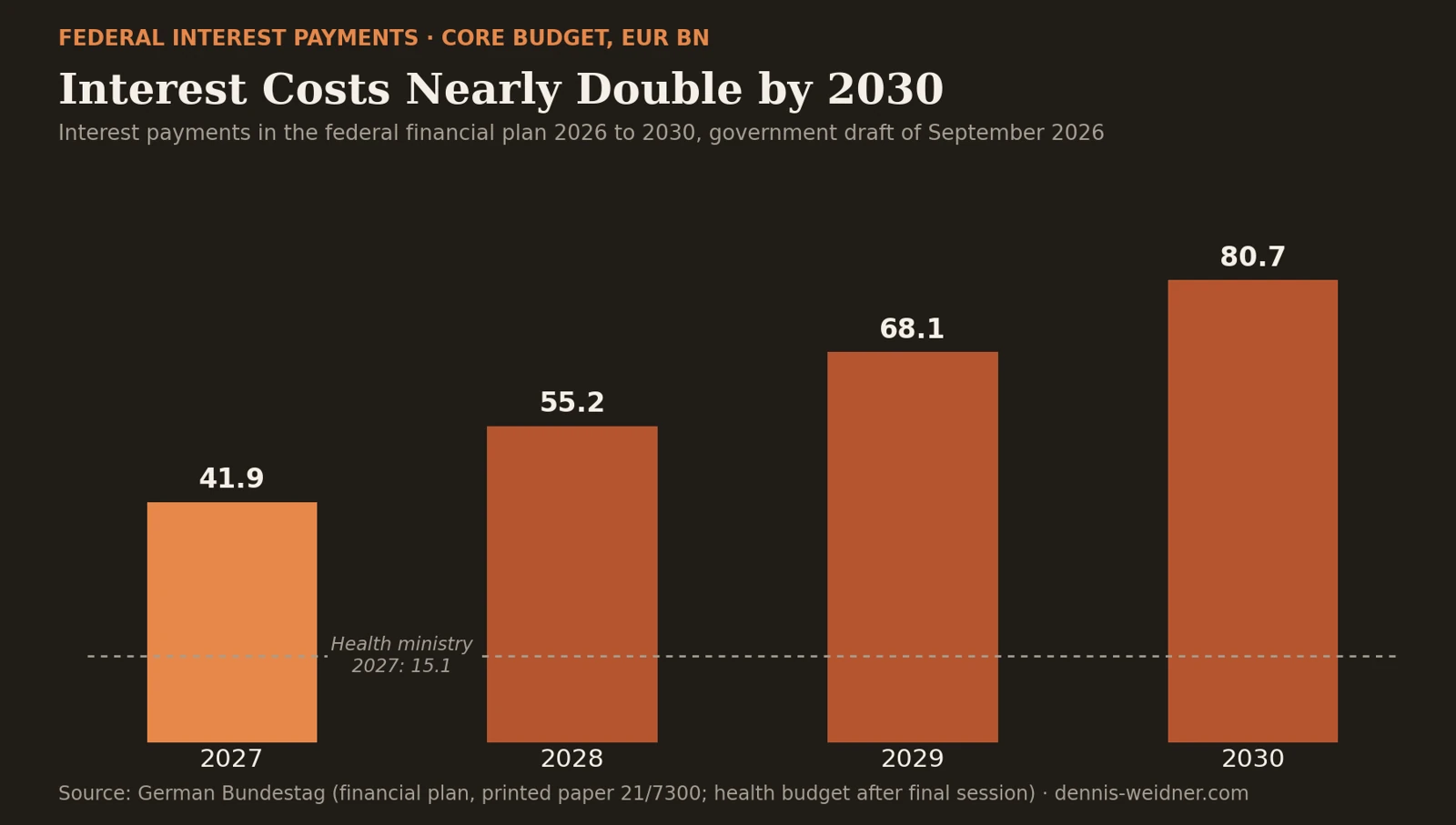
The federal government expects to spend about 41.9 billion euros on interest in the 2027 core budget, according to the financial plan Finance Minister Lars Klingbeil presented to the Bundestag on 8 September. By 2030 the figure is set to reach 80.7 billion, almost double. The government attributes the rise to higher debt and higher yields on federal securities. Already in 2027, the federal government will spend almost three times as much on interest as on the entire health ministry.
This worries more than the opposition and economists. Mathias Middelberg, a senior CDU budget politician, said after the session, according to his parliamentary group, that the coalition would have to tackle spending cuts much harder in the coming years. Voters see it the same way: in ZDF's Politbarometer poll, 61 percent want budget gaps closed through savings, 21 percent through higher taxes and only 9 percent through new debt.
What Germany's 2027 Budget Means for Businesses
For companies, five points matter most:
- Electricity tax: anyone outside manufacturing is still waiting. Tuesday will show whether anything changes. For 2027 I would plan with the full rate.
- Sugar tax: drinks makers and restaurants get six more months of lead time; the start date is now 1 January 2028.
- Plastics tax: it is not coming. EU obligations on packaging and recycled content are not affected.
- Orders: commitment appropriations of almost 297 billion euros for future defence spending and more money for rail, cybersecurity and drone defence are a market, including for SMEs and young companies that want to become suppliers.
- Logistics: anyone who depends on the motorways should follow the financing reform of Autobahn GmbH. It is to receive toll revenue from 2028, and whoever collects the toll has an interest in its level.
For founders, what Finance Minister Lars Klingbeil said when he presented the draft in September still applies: growth needs private capital so that start-ups stay in Germany. No budget can do that on its own. That is why we invest our own capital and our own work in young companies; how that works is explained at Weidner Ventures.
My View: Germany's 2027 Budget Buys Time
I have run companies for years, and companies borrow too. Good debt finances investment that later earns more than it costs. In the 2027 core budget, however, new borrowing of 122.97 billion euros is twice as high as investment of 61.85 billion. A large part of it pays for defence, which is necessary but earns no return; the rest covers running costs. At the same time, interest costs nearly double by 2030, and the hard decisions are pushed into the financial plan for later.
The coalition closed a 34 billion euro gap overnight, as SPD budget spokesman Thorsten Rudolph rightly points out. The coalition has not broken down how exactly it closed the gap. The Bundestag's report shows cuts, for example at Autobahn GmbH, in basic income support and in pension subsidies. Overall, spending and borrowing still went up.
There is good news in this budget. Investment rises to 61.85 billion euros, rail gets more planning certainty, and cybersecurity is finally treated as a task for every ministry rather than a central reserve. The opposition is scathing: Green budget spokesman Sebastian Schäfer calls it a shack without foundations, and the Left's Dietmar Bartsch speaks of record debt in the spirit of "after us, the deluge". I do not think it is quite that bad. But the core point holds: this budget buys time, and the bill arrives with the interest.
What bothers me most is the electricity tax. A promise left unkept for a year and a half costs trust, and in politics right now trust matters more than any single billion. Middelberg said it himself on ZDF: if you promise citizens something, you have to keep it. Why so many people are losing faith in the political centre is something I wrote about in my piece on political discontent in Germany. Why I get involved as an entrepreneur at all is explained under Entrepreneurs and Politics.
What Happens Next With Germany's 2027 Budget
On Tuesday, 17 November, the coalition committee meets, mainly about the electricity tax. From 24 to 27 November the Bundestag debates the budget in second and third reading, with the final vote scheduled for Friday, 27 November. The Bundesrat, the chamber of the federal states, deals with it afterwards. If the electricity tax cut does come, ZDF reports it could still be added during budget week.
On the same day the budget committee approved the budget, the Bundestag passed the major reform of Germany's foreign intelligence service BND and its domestic intelligence agency. What the services will be allowed to do and who will oversee them is the subject of a separate piece. More on government and business can be found under Politics and Society.
Cover photo: Reichstag building in Berlin at night, 6 November 2025, cropped. Photo: Leonhard Lenz, Wikimedia Commons, public domain (CC0).
Frequently Asked Questions About Germany's 2027 Budget
How big is Germany's federal budget for 2027?
After the final committee session on 13 November 2026, the budget provides for spending of 560.92 billion euros. That is 5.48 billion more than the government draft and 6.9 percent more than in 2026. The Bundestag takes the final vote on 27 November.
How much new debt will Germany take on in 2027?
122.97 billion euros in the core budget. On top of that come loans from the special funds: in the government draft, 54.9 billion for infrastructure and climate neutrality and 29.96 billion for the Bundeswehr. Together that is about 208 billion euros.
What is the Bereinigungssitzung?
The budget committee's last session before the Bundestag vote. It adjusts the government draft to new tax estimates and decisions. For the 2027 budget it ran from 2:30 pm on Thursday to 5:55 am on Friday, and the committee voted on around 2,000 motions.
Will Germany cut the electricity tax for everyone?
That is still open. The cut for everyone is not funded in the 2027 budget so far and would cost about 5 billion euros. The coalition committee is due to decide on 17 November. For manufacturing, agriculture and forestry, the EU minimum rate has applied permanently since 1 January 2026.
Is Germany introducing a sugar tax?
Yes, but later. The tax on sugary drinks is due to start on 1 January 2028, six months later than planned. The coalition has dropped the plastics tax and the higher sparkling wine tax.
Does the 2027 budget comply with the debt brake?
Formally, yes. Of the 122.97 billion euros of borrowing, only 38.43 billion counts towards the debt brake, exactly the permitted ceiling. 84.55 billion falls under the exemption for defence and security, and the special funds have their own borrowing authority.
Warm regards,
Dennis Weidner
Note: AI tools supported me in writing this article, and some images were edited with AI. I stand behind its content and every statement with my name.