Two weeks after the night of rioting on 31 October, the figures are higher than the first reports, and there is still no overall tally. In the five German cities with the worst violence, police forces and interior ministries report at least 285 injured officers, up from 167 in the first reports. In Hamburg, Berlin, Frankfurt and Cologne at least 341 people were arrested or taken into custody, plus several in Stuttgart. According to published figures, exactly one of them is on remand: an 18-year-old in Frankfurt. Hesse's interior minister now counts 73 suspects, Berlin police have opened 87 investigations, and in Cologne a court refused to issue an arrest warrant. The Bundestag has held two topical debates, and Hesse wants tougher penalties through the Bundesrat. On 20 November the initiative “Gen Z regelt” is calling for protests again. Here is what has happened since Halloween night, what is still open, and what I take from it.
Germany's Halloween Riots: Two Weeks On in Brief
- 285 injured officers: Frankfurt 181, Hamburg 42, Berlin 32, Cologne 23, Stuttgart 7. The first reports said 167, and Hesse's interior minister speaks of far more than 500 nationwide.
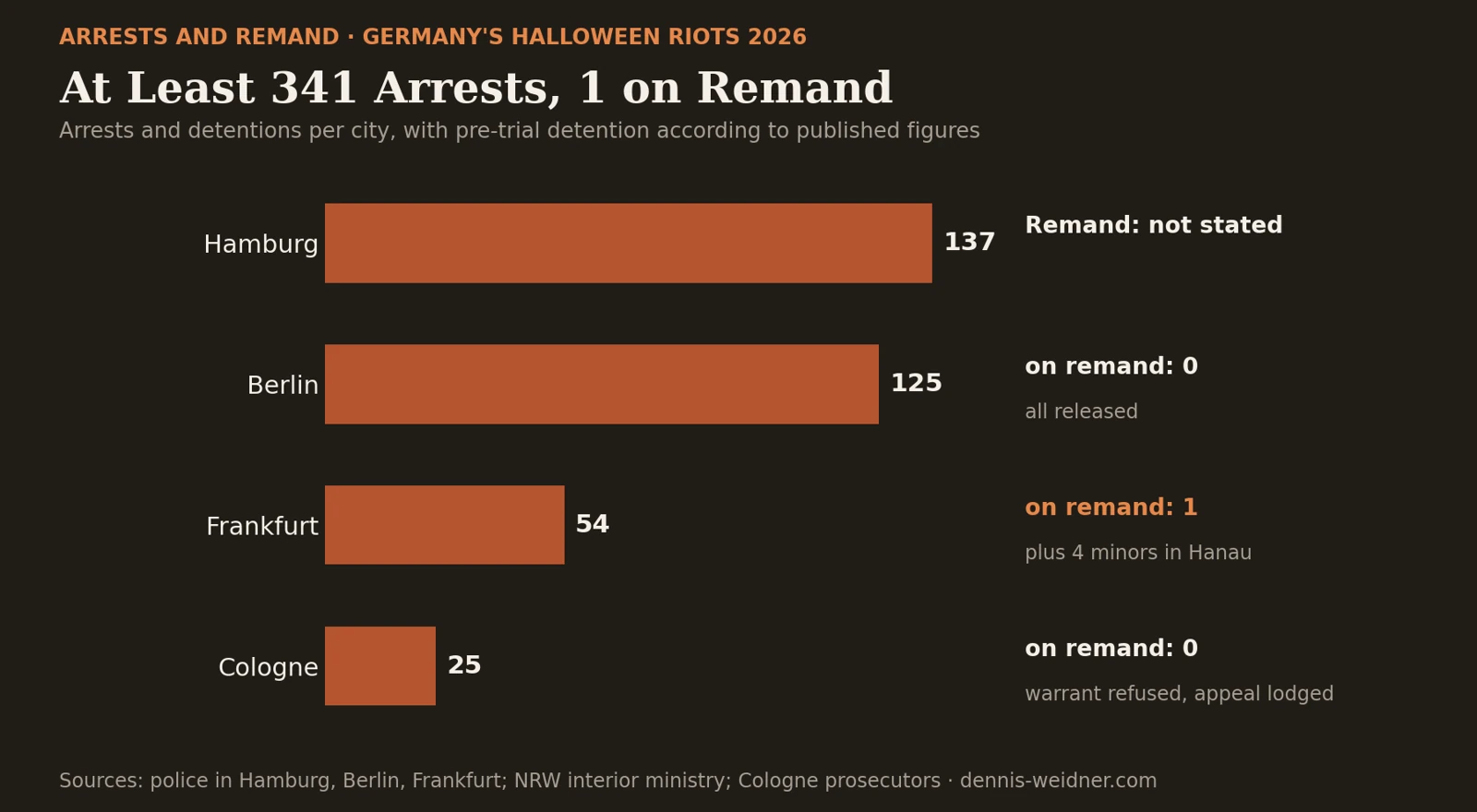
- At least 341 arrests and detentions: Hamburg 137, Berlin 125, Frankfurt 54, Cologne 25, plus several in Stuttgart.
- 1 person on remand: an 18-year-old in Frankfurt accused of stealing a firearm. In Berlin all 125 people arrested were released.
- More than 200 investigations in Cologne: plus 87 in Berlin and 73 suspects in Frankfurt, while in Hamburg no case has reached the public prosecutor yet.
- More than 21,000 police officers: over 18,500 from the states and 2,682 from the Federal Police were deployed on 31 October according to the Federal Interior Ministry, and nobody has named the cost.
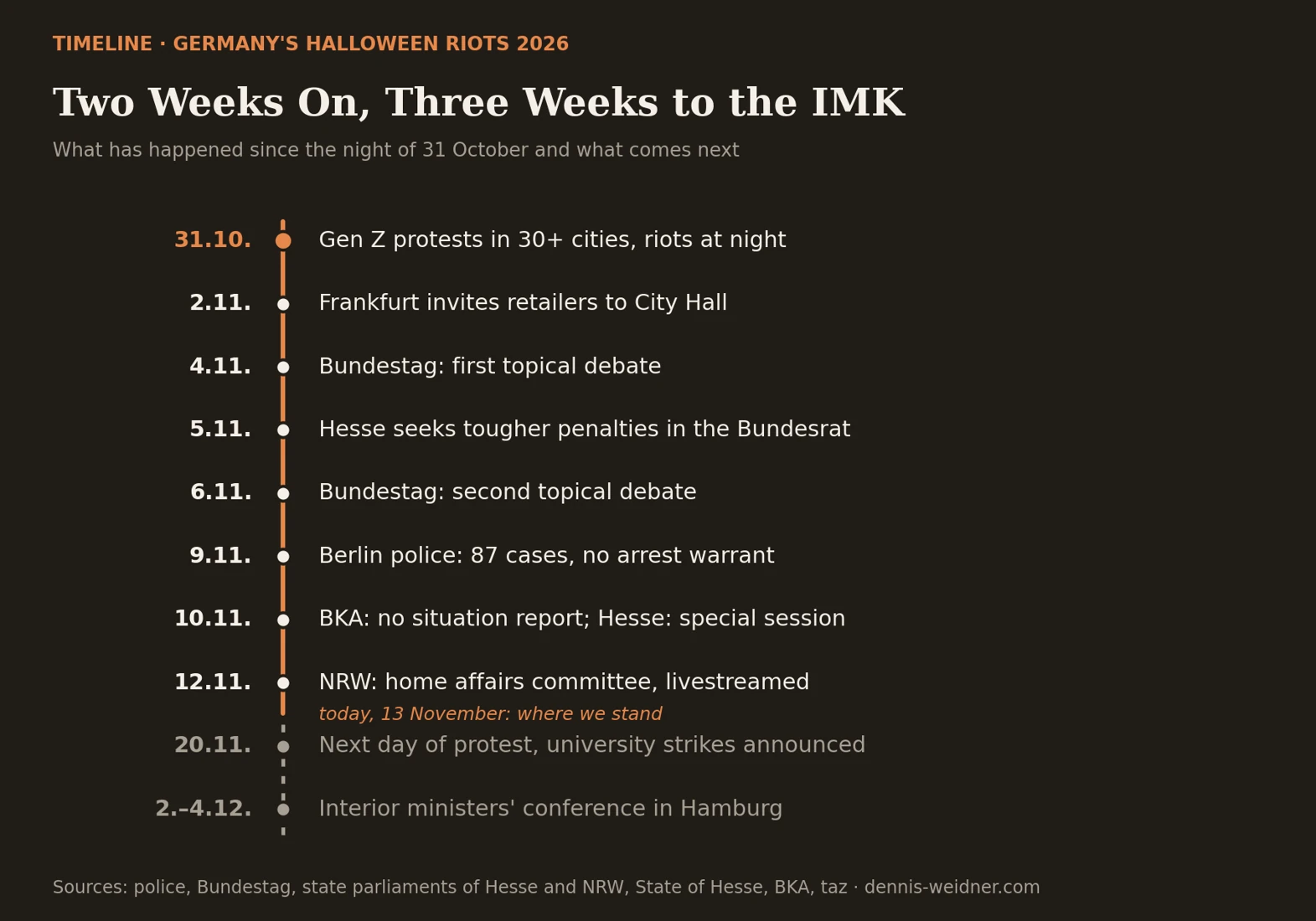
- 4 and 6 November: two topical debates in the Bundestag. Hesse is asking the Bundesrat to make violence from a crowd against emergency services a particularly serious breach of the peace as a rule.
- 10 and 12 November: a special session in Wiesbaden without a broadcast or published minutes of the discussion, the home affairs committee in Düsseldorf with a published written report.
- 20 November: the next day of protest, announced in 34 cities in early November, with a separate day of protest by the Federal Conference of School Students on the same day and strikes announced at up to 35 universities. Conditions are set by the local assembly authorities.
Germany's Halloween Riots in Numbers: The Tally Two Weeks Later
The longer the authorities count, the larger the toll becomes. In Frankfurt the police reported 100 injured officers on the day after the riots. On 10 November, Hesse's interior minister Roman Poseck told the state parliament's home affairs committee the figure was 181, and 13 of them are still unfit for duty. In Hamburg the number rose from 12 to 42 injured officers, as Hamburg police wrote to me on 4 November. The city's government confirmed the figure in its reply to a question from CDU group leader Dennis Thering, reported by the Hamburger Abendblatt on 12 November: 15 of the 42 officers were unable to continue their duty, and 1,328 officers were deployed. In Stuttgart the city gives seven injured police officers, the police had reported five that evening. On 11 November, Stuttgart police reported 36 identified suspects.
More on this topic: Politics & Society, with background, practice and every article in one place.

No authority has added these figures up, the totals in this article are mine. On 5 November Poseck wrote in a press release that there had been “far more than 500 injured” across Germany, without breaking the figure down. The gap between 285 documented and more than 500 mentioned injuries is exactly what this article is about: anyone who wants to know what the night did in total has to piece it together themselves. That is not a criticism of the police forces who answered me, each of them counts separately and partly by its own rules.
| City | Injured officers | Arrests and custody | Investigations and detention | As of |
|---|---|---|---|---|
| Frankfurt | 181, 13 unfit for duty | 54, plus 4 minors at Hanau station | 73 suspects, 1 on remand | 10 November, remand 4 November |
| Hamburg | 42, 15 unfit for duty | 129 provisional arrests, 8 taken into custody | around 40 criminal complaints, 85 exclusion orders; no case with the public prosecutor yet | 2, 4, 11 and 12 November |
| Berlin | 32 | 125, all released | 87 investigations, no arrest warrant | reply 9 November, figures 4 November |
| Cologne | 23, 1 unfit for duty | 1 arrest, 24 taken into custody during the assembly operation | more than 200 investigations, state security investigation team of around 30 officers, one arrest warrant refused, appeal lodged | 4 November, state parliament report; investigations 9 November |
| Stuttgart | 7 | several | around 50 offences, 36 suspects, criminal police investigation team | 2 and 11 November |
| Total | 285 | at least 341 | 1 on remand |
For context: my first article on the night gives around 325 arrests, because it only counts the minimum figure from the first Cologne police report and includes the four minors from Hanau station, who may already be in the Frankfurt figure. The NRW interior ministry's report to the state parliament gives one arrest and 24 people taken into custody during the Cologne assembly operation, which brings the total to at least 341. No authority has yet put a figure on the damage. Frankfurt police count around 45 damaged premises and ten shops that were looted, entered without permission or robbed. The interior ministry in Düsseldorf wrote to me that, as a rule, the police do not calculate the total cost of operations.
A comparison from North Rhine-Westphalia shows how unusual the night was. According to the report to the home affairs committee, around 9,000 police officers were on duty across the state, compared with around 5,000 on a normal day. The annual Halloween survey counts 72 people taken into custody for the whole night, up from 47 the year before, and 24 complaints of resisting police officers, up from 12. In Cologne alone, more than 1,000 officers were deployed, according to Cologne police. For Germany as a whole, the Federal Interior Ministry gave a figure for the first time in reply to my enquiry: in connection with the protests on 31 October, more than 18,500 state police officers and 2,682 Federal Police officers were deployed, more than 21,000 in total. The ministry does not say what the operation cost, as planning, execution and funding are matters for the states.
Investigations After the Riots: Cases, Arrest Warrants, Suspects
Two weeks after the night, most cases are at an early stage, and almost everyone arrested is free again. Frankfurt has moved furthest: prosecutors there are working with a special police unit and are investigating breach of the peace, dangerous bodily harm, burglary and assaults on police officers, among other offences, hessenschau reports. On 10 November minister Poseck put the number of suspects at 73 and said it was rising steadily. About two thirds are under 21, two are under 14. More than half were already known to the police, and only about a quarter live in Frankfurt itself.
In Berlin the police have opened 87 investigations, seven of them on suspicion of particularly serious breach of the peace. All 125 people arrested were released, and no arrest warrant was issued. The Berlin chief public prosecutor's office wrote to me on 5 November that the cases had not yet been passed to the Berlin public prosecutor. In Cologne a state security investigation team has been working on all offences of the night since 2 November. According to Cologne police, around 30 investigators are evaluating image and video material and following up more than 200 tips. By 9 November the police had opened more than 200 investigations in connection with Halloween night, among other things for breach of the peace, dangerous bodily harm, assaults on police officers and offences under the Explosives Act. The police stress that the demonstration must be distinguished from what happened on Halloween night. The police kettle at the demonstration is a separate matter: according to t-online, Cologne's police chief told the city council on 12 November that identities had been checked in 935 cases. Criminal proceedings had been opened against 927 people, the remaining eight were children below the age of criminal responsibility. In total, eight children and 92 young people were among those kettled. On 4 November the public prosecutor was handling one case in which the local court refused the requested arrest warrant because it saw no risk of flight. The prosecutors have appealed, and no decision had been made on 4 November. In Stuttgart the criminal police have also set up an investigation team. In Hamburg no case has reached the judiciary yet: the spokesperson for Hamburg's public prosecutors wrote to me on 11 November that no files had been submitted so far and that all cases were still being handled by the police.
One detail from the Düsseldorf report shows how early the authorities expected violence. Since 28 October, Düsseldorf prosecutors had been investigating on suspicion of conspiracy to commit particularly serious robbery, most recently against four suspects. According to a police informant, incendiary devices were to be used against police officers to make looting on the Königsallee shopping street possible. Searches on 30 October found no incendiary devices, and the preliminary evaluation found no indications of planned offences. No arrest warrants were sought for lack of strong suspicion.
Why Almost Nobody Is on Remand
Pre-trial detention is not a punishment, it secures the proceedings. Under Section 112 of the German Code of Criminal Procedure it requires strong suspicion and a ground for detention, such as a risk of flight or of tampering with evidence. For repeated offences such as particularly serious breach of the peace or dangerous bodily harm, a risk of reoffending can also be enough under Section 112a, subject to strict conditions. For juveniles, Section 72 of the Youth Courts Act raises the bar further: remand is only allowed if milder measures are not sufficient. For someone with a fixed address who is not planning to disappear, there is often no ground for detention in the first place. That almost everyone is free again is therefore the rule of law, not an acquittal.
Hesse is betting on tougher penalties. In the Bundesrat committees, the state has proposed tightening the federal government's bill to strengthen the criminal law protection of the community: anyone who joins in violence against emergency services from within a crowd should as a rule be punished for particularly serious breach of the peace, with six months to ten years in prison. My position as an entrepreneur: a consequence works when it comes quickly, not only when it is severe. Frankfurt criminal law professor Matthias Jahn does not expect draconian sentences, because serious breach of the peace is hard to prove. That makes speed all the more important for what can be proved: theft, criminal damage, assaults on police officers, many of them on video. For adults and young adults aged 18 and over there is the accelerated procedure, for juveniles under 18 Section 79 of the Youth Courts Act rules it out and leaves the simplified juvenile procedure. With two thirds of the suspects under 21, that affects a large share of the Frankfurt cases. If the first judgments only come next summer, the night will have had no visible consequence for those responsible, however high the maximum sentence.
Home Affairs Committees After the Riots: Who Deals With It in Public
Four state parliaments and the Bundestag have dealt with the night or could have, and each handles it differently. Düsseldorf is the most open, Wiesbaden the most closed. North Rhine-Westphalia's interior ministry has submitted a 22-page report to the home affairs committee, which the state parliament publishes, and the committee met on 12 November. In Hesse, the home affairs committee met in a special session on 10 November on requests for reports from the Greens and the FDP. Visitors and the press were allowed to listen, but there was no sound or video, and no minutes of the discussion will be published, only a record of decisions, as the state parliament's press officer wrote to me.
| Parliament | What has happened since 31 October | Public |
|---|---|---|
| Bundestag | Topical debates on 4 November at the request of the AfD and on 6 November at the request of the Left; the five parliamentary groups have not answered me so far | Broadcast and plenary record |
| Hesse state parliament | Special session of the home affairs committee on 10 November, oral report by the interior minister | Attendance in person, no broadcast, no published minutes of the discussion |
| North Rhine-Westphalia state parliament | Written report by the interior ministry, home affairs committee on 12 November | Report published |
| Hamburg state parliament | Home affairs committee on 5 November without an agenda item, discussion only as a self-referral by unanimous consent; plenary agenda for 11 November without a separate item; written question by the CDU | Written question and answer are published |
| Berlin House of Representatives | New parliament since 29 October, no home affairs committee had been set up by 4 November | No session on the night |
When 181 police officers are injured in one city in a single night, the minister's full report belongs online, with figures and the questions asked by members of parliament. North Rhine-Westphalia shows that this is possible. The report from Düsseldorf is revealing: it describes how the rioting in Cologne moved from the cathedral to the ring roads during the night and how the police prevented attempted looting. The “Gen Z regelt” demonstrations were largely free of disruption, it says, but in Cologne violent groups used them “as a stage”. The ministry does not rule out that the strong mobilisation by “Gen Z regelt” and calls on social media to create “French conditions” particularly appealed to violent groups on Halloween. How platforms amplify calls like these is something I described in my article on social media algorithms and radicalisation.
The Dispute Over Who Rioted: What Politicians and Figures Say
The fiercest debate of the past two weeks is about who the rioters were. Federal interior minister Alexander Dobrindt told the Bundestag about violent left-wing extremists and “troublemakers from a migrant milieu”. Defence minister Boris Pistorius had already objected on ZDF on 1 November: if that were the case it would certainly be right to say so, but he did not know whether it was. Hesse's interior minister Poseck defended his description of the rioters as “predominantly shaped by migration” in the home affairs committee, saying that if the group of offenders is not named, something essential for drawing conclusions is concealed. According to his figures, of the 73 suspects in Frankfurt, 30 hold German citizenship, 17 dual citizenship and 26 another citizenship. In Berlin, according to the police's answer to me, 91 of the 125 people arrested hold German citizenship. The Federal Interior Ministry wrote to me on 11 November that, according to findings so far, the riots were shaped in particular by young, thrill-seeking and generally criminal milieus, and that people without German citizenship were also frequently involved. It gives no figures and refers questions about those arrested and possible deportations to the states. In Hamburg, according to the city government's reply to Dennis Thering, the state criminal police found that eight groups classified as extremist by the domestic intelligence service were involved in the demonstrations or the rioting, among them Roter Aufbau and Thawra Hamburg.
I think it is right to name groups of offenders when the figures support it, and just as right to give the figures in full. The police crime statistics count citizenships, they do not record a migration background. For preparing for 20 November, two other points from Wiesbaden seem more important to me: more than half of the Frankfurt suspects were known to the police, and three quarters did not come from Frankfurt. That points to groups looking for an occasion and travelling to it. The organisers of the protests have distanced themselves from the violence, and according to the police many of the night-time offenders showed no recognisable political motive. Anyone who wants to protect the demonstrators has to stop precisely these groups in advance, not ban the demonstration.
Retailers After the Riots: Support, Insurance, Criminal Complaints
For retailers on Frankfurt's Zeil, the key question two weeks on is who pays for the damage. The city invited retailers to City Hall on 2 November. Mayor Mike Josef announced that the city would consider financial support through its city marketing company if insurers do not pay or only pay in part, and Minister-President Boris Rhein promised quick and unbureaucratic help from the state. The Hesse retail association is calling for a hardship scheme, and individual businesses reported revenue losses of 65 to 100 percent. By 13 November the city and the state had not named an amount or an application route. In the state parliament, the FDP tabled a motion for the debate on 12 November that calls, among other things, for support for businesses that suffered damage. The police, on the other hand, are visible: from the Monday to the Saturday after the night they checked 945 people on the Zeil, filed 31 criminal complaints and issued 72 orders to leave, hessenschau reports.
On insurance, the first step is to read your own policy. The German Insurance Association does not expect to record the claims centrally and wrote to me that not every riot is legally civil commotion: under the model terms, a not insignificant number of people must be set in motion in a way that disturbs public peace and order and commit violence against people or property. Many property policies exclude civil commotion, but it can be added. What this means for a shop is explained in the guide to civil commotion and insurance on gruenderfreunde.de, in German.
One point has a deadline: under German criminal law, criminal damage and trespass are generally only prosecuted on request, although for criminal damage the public prosecutor can act without a request if it sees a special public interest. The request must be filed within three months, starting from the moment the injured party knows the offence and the offender. Anyone who has reported the offence should state the request for prosecution explicitly.
Gen Z Demands: What Has Become of the Protesters' Concerns
After two weeks of debate about the riots, it has almost been forgotten why tens of thousands of people in Germany took to the streets peacefully on 31 October. Fewer turned out than hoped, as the organisers had expected at least 182,000, according to tagesschau. Protest researcher Nina Kolleck of the University of Potsdam suggested on tagesschau24 that concern about violence played a part. “Gen Z regelt” lists education and health, rising living costs, unfair distribution, conscription, surveillance and climate change. On 2 November, according to ZDF, Chancellor Friedrich Merz admitted shortcomings on affordable housing and said education minister Karin Prien would deepen the dialogue with the young generation. Prien herself said on 1 November, according to WDR, that the young people's concerns are justified and highly relevant. The education union GEW is calling for an education summit, and the SPD parliamentary group in the Bundestag is calling for an education summit of the federal government, states and municipalities, WDR reports. Nobody has named a date for it yet. In the Bundestag, the second topical debate on 6 November was explicitly about taking the demands seriously.
I take these concerns seriously, especially as an entrepreneur. Those demonstrating today for affordable housing and better schools are tomorrow's employees, founders and customers. This is about the future of a whole generation, and the riots must not be the only thing that remains of this autumn. Why so many people no longer feel represented by politics is something I wrote about in my article on political discontent in Germany.
Gen Z Protest on 20 November: What Is Planned for the Next Day of Protest
On Friday, 20 November, the Gen Z protests are set to continue: “Gen Z regelt” is calling for demonstrations again as part of an international youth strike day. In early November its website listed 34 cities, five of which the alliance organises itself: Cologne, Munich, Berlin, Hamburg and Frankfurt. On the same day the Federal Conference of School Students, which represents pupils, is planning its own day of protest. It had distanced itself from 31 October because of the initiative's unclear organisational structure. The education union GEW, the Federal Parents' Council and Fridays for Future have reportedly signed up, according to WDR, and whether the two alliances are coordinating is unclear, tagesschau says. “Gen Z regelt” has distanced itself from the violence, a spokesperson saying it had no influence on what happened after the rallies ended, as tagesschau reports. New is the group “Gen Z regelt Studis”, which according to taz wants to strike at up to 35 universities in 33 cities if student assemblies vote for it. In Berlin, 15,000 participants have been registered, according to a dpa report of 13 November published by Tagesspiegel. Frankfurt faces a test as early as 14 November: for a “Gen Z regelt” rally at the Hauptwache, Frankfurt police are deploying more officers than on 31 October and are prepared to control all access points to the Zeil if necessary. According to the police, there are no concrete indications of planned rioting.
Whether the assemblies go ahead and under what conditions is decided by the local assembly authority: in Frankfurt the public order office, in North Rhine-Westphalia the district police authorities, in Hamburg and Berlin the police. Hesse's interior minister has announced a “package of measures” for Frankfurt, including possible conditions and preventive detention, meaning people can be held in advance where this is indispensable to prevent an imminent offence. North Rhine-Westphalia has ordered the riot police to be as available as possible by decree and wants to examine restrictions up to a ban if there are concrete signs of new violence. Stuttgart's mayor also wants this examined if the organisers do not cooperate. Legally, a ban remains the last resort, as Frankfurt law professor Jahn pointed out to hessenschau. I have set out who is responsible for what in my follow-up article on responsibility after the riots.
My Press Enquiries After the Riots: 30 Offices, 24 Replies
Since 1 November I have been asking the federal government, the states, the police, public prosecutors and parliaments. By the deadline on 10 November, 21 of 30 offices had replied. On 11 November I followed up with the others and asked for a reply by 18 November. Since then the Federal Interior Ministry, the Hamburg public prosecutor and Cologne police have replied, bringing the total to 24 of 30. Still outstanding are the Hesse interior ministry and the five parliamentary groups in the Bundestag. Who replied what and when is in my overview of responsibility and replies.
The most important finding from 24 replies is not a number but a gap. The Federal Criminal Police Office is not producing a separate situation report on the night. Where offences were politically motivated, they are part of the statistics on politically motivated crime and cannot be shown separately there. Berlin police pass their figures to the Senate Department for the Interior, and in Hesse the interior minister presented the figures to the state parliament. Nobody has named an office that brings together injuries, arrests, cases, damage and costs for Germany as a whole. The Federal Interior Ministry, too, refers to the states for arrests, cases and costs.
Interior Ministers' Conference in December: What Belongs on the Table After the Riots
The interior ministers of the German states meet in Hamburg from 2 to 4 December, chaired this year by Hamburg's interior senator Andy Grote. No agenda has been published yet, and the Hamburg interior authority has told me to expect an advance statement, probably on 25 November. This is the place where the states can agree on a joint account, because policing is a matter for the states.
My demand as an entrepreneur is the same as ten days ago, only more specific: after every night of rioting that affects several states, a public overall account belongs on the table within 30 days. For 31 October that would be 30 November, two days before the conference. It should list, per state, the officers deployed and injured, arrests, cases and arrest warrants, the damage and the cost of the operation. It also means public committee sessions with a published report, as in Düsseldorf, and for retailers an application route for support that opens before Christmas. Every company knows its damage after two weeks. The same should apply to the state, in other words to our tax money.
I am staying on it and will add here what the committees, the conference and the outstanding offices deliver. You will find more articles under Politics and Society, and why I get involved in these debates as an entrepreneur at all is set out under Entrepreneurs and Politics.
Cover photo: “Gen Z regelt” demonstration at the Brandenburg Gate in Berlin, 31 October 2026, cropped. Photo: Roy Zuo, Wikimedia Commons, licence CC BY-SA 4.0.
Frequently Asked Questions on Germany's Halloween Riots Two Weeks On
How many police officers were injured in Germany's Halloween riots?
In the five cities with the worst violence, at least 285 officers: 181 in Frankfurt, 42 in Hamburg, 32 in Berlin, 23 in Cologne and 7 in Stuttgart. The first reports said 167. Hesse's interior minister speaks of far more than 500 injured nationwide, and there is no official national total.
How many arrests were made after the Halloween riots?
Taken together, at least 341 arrests and detentions: 137 in Hamburg, 125 in Berlin, 54 in Frankfurt and 25 during the Cologne assembly operation, plus several in Stuttgart. The total is my own sum of the figures from police and interior ministries, no authority has added them up.
Is anyone on remand after the riots?
According to published figures, one person: an 18-year-old in Frankfurt accused of stealing a firearm from a gun shop. In Berlin everyone arrested was released, and in Cologne a court refused an arrest warrant, against which the prosecutors have appealed.
Will the Gen Z protest on 20 November go ahead?
In early November protests were announced in 34 cities, along with a separate day of protest by the Federal Conference of School Students and strikes at universities. Whether they take place and under what conditions is decided by each city's assembly authority. A ban is only permitted as a last resort.
Who pays retailers for the riot damage?
First their own insurer, if civil commotion is covered. The city of Frankfurt is considering support through its city marketing company, and the state has promised quick help. Retailers also have a claim for damages against the offenders.
Is there a national account of the riots on 31 October?
No. The Federal Criminal Police Office is not producing a separate situation report, and nobody has named an office to me that brings together damage and costs. The interior ministers' conference from 2 to 4 December would be the place to agree on a joint account.
Warm regards,
Dennis Weidner
Note: AI tools supported me in writing this article, and some images were edited with AI. I stand behind its content and every statement with my name.