August Hanning, former president of Germany's Federal Intelligence Service (BND), was arrested on 6 October 2026 and is in pre-trial detention. Federal prosecutors accuse him of attempted treason and working as an agent for a foreign intelligence service, among other offences. His former chief of staff, Manfred D., is alleged to have handed him close to 2,000 BND documents for payment between 2010 and June 2022. Neither man has been charged, and both are presumed innocent. This piece sets out what is established and what remains open, how the BND is organised and who oversees it, and why the case matters to me as an entrepreneur.
As of 14 October 2026.
More on this topic: Politics & Society, with background, practice and every article in one place.
What Federal Prosecutors Accuse August Hanning Of
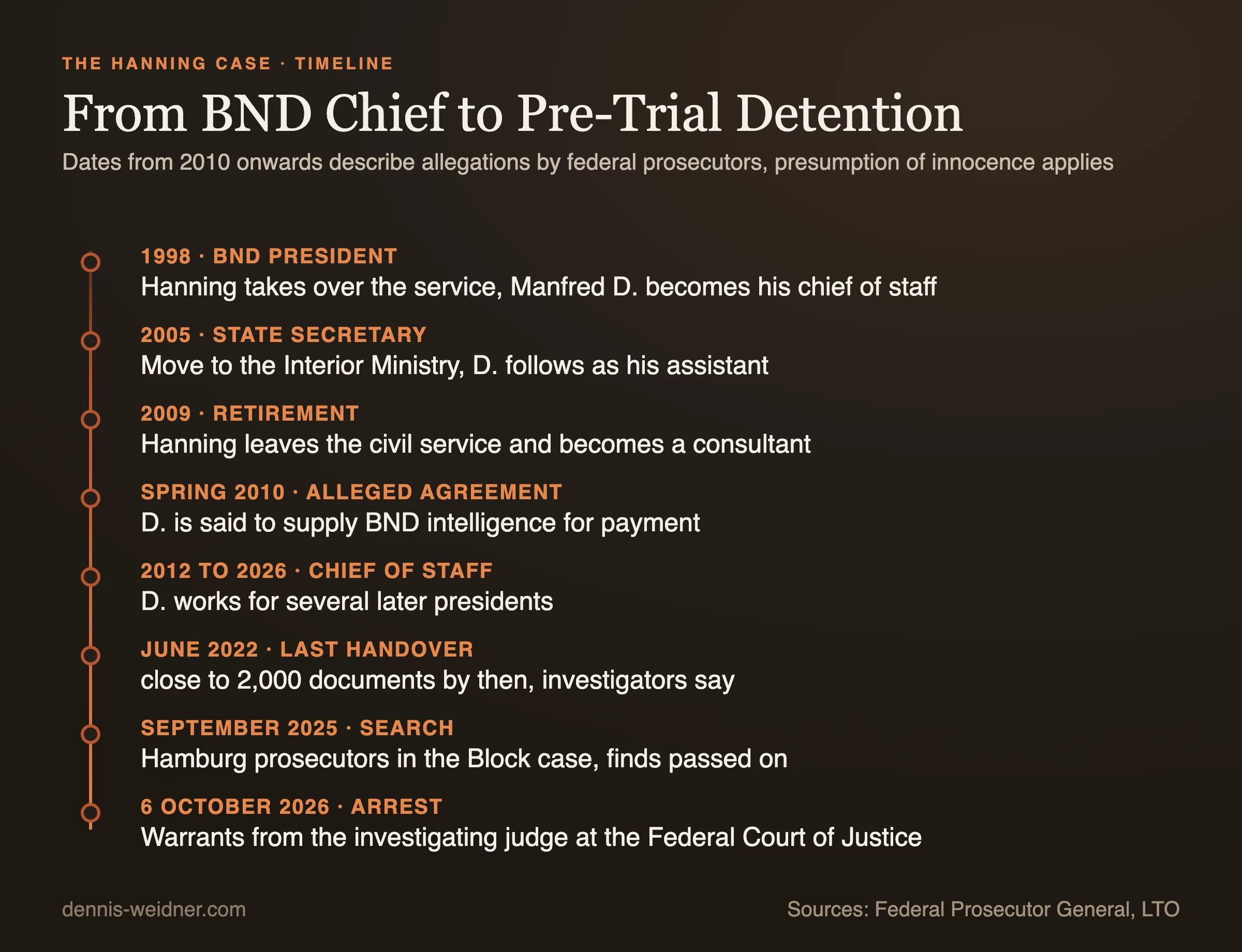
Early on 6 October, officers of the Federal Criminal Police Office (BKA) arrested Hanning in Nordwalde in the Münsterland region and, almost simultaneously, Manfred D. in the Bavarian district of Bad Tölz-Wolfratshausen. Premises there and in Berlin were searched. The arrests were based on warrants from the investigating judge at the Federal Court of Justice, who ordered both men held on 6 and 7 October. That is how the Federal Prosecutor General describes it in statements of 6 October and 7 October.
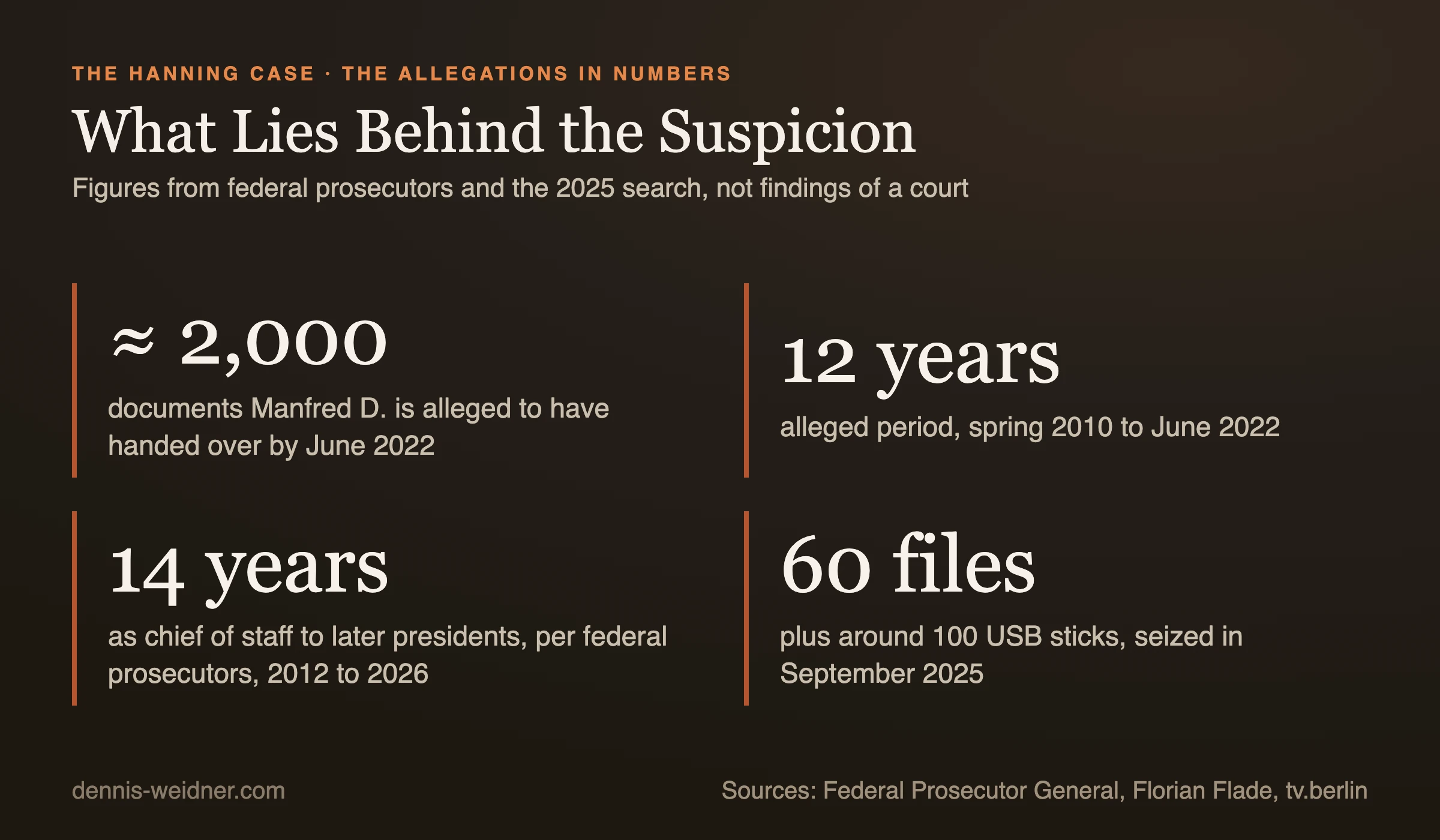
According to the prosecutors, there is strong suspicion that Hanning committed treasonous espionage, gathered state secrets, attempted treason and carried out activities as an agent of a foreign intelligence service. Manfred D. is accused of aiding him. On the current state of the investigation, the two men agreed, probably in spring 2010, that D. would keep supplying the former president with intelligence from the service in return for payment, which Hanning was to use profitably in his consulting work. By June 2022, close to 2,000 documents are said to have changed hands, many of them classified. According to WDR journalist Florian Flade, a three-digit number of them were marked "VS-Vertraulich" or "VS-Geheim", the German equivalents of confidential and secret, as he writes in his blog Verschlusssache.
The material was meant for the BND's leadership, above all for the weekly intelligence briefing at the Chancellery. Every Tuesday, the heads of the BND, the domestic intelligence agency, military counter-intelligence, the BKA and the Federal Police brief the government's top officials there, as Flade described in 2021. Public broadcasters WDR and NDR and the Süddeutsche Zeitung, citing security sources, report that the papers included reports on Iran's nuclear programme and the Russian military as well as information from foreign partner services. On 13 October the case was discussed on the ZDF talk show Markus Lanz, the same programme that covered the resignation of Bärbel Bas and the state of the political centre, which I analysed in Germany’s Political Centre and the AfD Firewall.
| Allegation | Provision | Statutory sentence |
|---|---|---|
| Treasonous espionage | Section 96(1) Criminal Code | one to ten years' imprisonment |
| Gathering state secrets | Section 96(2) Criminal Code | six months to five years |
| Attempted treason | Section 94(1) with Section 22 Criminal Code | at least one year, up to life in especially serious cases; an attempt may be punished more leniently |
| Agent activity for a foreign intelligence service | Section 99(1) no. 1 Criminal Code | six months to ten years |
The key question will be whether state secrets are involved. Under Section 93 of the Criminal Code, these are facts, objects or findings that are accessible only to a limited group of people and must be kept from a foreign power to avert the danger of a serious disadvantage to Germany's external security. Whether there will be an indictment is for the federal prosecutors to decide once the investigation is complete, and guilt is decided by a criminal division of a Higher Regional Court. Hanning's pension is also at stake: a retired civil servant sentenced to at least six months for treason loses it under Section 59 of the Civil Service Pensions Act.
Manfred D.: Chief of Staff to Several BND Presidents
D. was already chief of staff when Hanning ran the BND from December 1998 to the end of November 2005. He followed him as a seconded assistant to the Federal Interior Ministry, where Hanning was state secretary until November 2009. From March 2012 to March 2026, according to the prosecutors, he was chief of staff to several later presidents and in that role had access to a large amount of classified information. Flade reports that D. was known inside the service by the cover name "A". The current president, Martin Jäger, replaced him after a short time in autumn 2025, after which D. was transferred to Pullach and retired in March 2026.
A chief of staff sees almost everything the top sees: diaries, submissions, speaking notes, requests. Anyone who wanted a meeting with the president had to go through him. Flade therefore asks why the post was never filled by someone else in all those years and who approved a side job of the chief of staff that is now also under investigation. Marc Henrichmann (CDU), who chairs the Bundestag's Parliamentary Oversight Panel, wants to examine whether staff in sensitive areas stay in the same post for too long and how strictly the need-to-know principle is applied, LTO reports.
Who Is August Hanning Alleged to Have Passed Information To?
The prosecutors describe two recipients without naming any country. In one instance, Hanning is alleged to have used classified intelligence from D. to write an analysis for an employee of a foreign intelligence and security apparatus. Whether it reached its addressee is still unclear, the authority says. He is also alleged to have supplied a member of another state intelligence service with political information over several years, partly based on material from D.
Everything beyond that comes from media reporting, not from official statements. Der Spiegel first reported that the analysis was intended for a recipient in Azerbaijan. Azerbaijan has rejected the report; according to Correctiv, Hanning sat on the board of the German-Azerbaijani Forum. There is no evidence of a link between that role and the investigation. According to the news agency AFP, Russia is not involved, and WDR, NDR and SZ report the same for the analysis. Flade writes that investigators are also examining leads to China. The authorities have not said which states are actually involved.
How the Hanning Case Came to Light: A Search in the Block Proceedings
The suspicion surfaced through a chance find. Hamburg prosecutors are investigating the abduction of the children of businesswoman Christina Block on New Year's Eve 2023/24. Christina Block is on trial at Hamburg Regional Court; she denies the charges, there is no verdict and she is presumed innocent. Hamburg prosecutors are also investigating Hanning: for possible involvement in a failed attempt to bring the children back in 2022 and in the abduction at the turn of 2023/24, and on suspicion of planning to discredit the children's father with false allegations, LTO reports. Hanning denies this. According to t-online, the Hamburg State Criminal Police noted internally in November 2025 that he had apparently not been involved in the abduction.
It emerged in the Block trial that the Hamburg State Criminal Police had placed an undercover officer in a security firm close to Hanning and had tapped phones. The search of eight homes and business premises followed in September 2025. Hanning described it himself in a long interview with the Berlin broadcaster tv.berlin, which the station republished after his arrest. On 16 September, he said, 23 police officers from Hamburg arrived, led by a public prosecutor. They took 15 computers, more than 100 USB sticks, his tablet, even his smartwatch, plus 60 files in a van. None of it had anything to do with the Block case, he said; he had merely advised Ms Block twice. Flade confirms the scale: more than a dozen computers, around 100 USB sticks, 60 files.
According to the federal prosecutors, these finds are where the new case began. Hamburg investigators referred the matter to Karlsruhe at the beginning of May 2026, and the federal prosecutors have since been investigating together with the BND and the BKA. Inside the BKA, Flade reports, the case runs under the internal name "Zettel", German for slip of paper.
Hanning sharply criticised the search at the time. In the interview he compared it to a robbery, and in April 2026 he accused the Hamburg judiciary in a formal complaint of a "structural failure of the rule-of-law control mechanisms". Both happened before the matter went to the federal prosecutors, and whether Hanning knew of any treason suspicion at the time is not known. Still, I find the turn remarkable: the very search that a former head of Germany's foreign intelligence service was so outraged about is, according to the federal prosecutors, where the case against him began.
What August Hanning Says About the Allegations
So far his lawyer, Leon Kruse, has spoken publicly about the federal prosecutors' allegations. He confirmed that his client had possessed confidential documents. He denies, however, that Hanning passed on information to Germany's detriment or for payment, and says his client is being wrongly prosecuted, t-online reports. Hanning has always rejected the Hamburg allegations. In the tv.berlin interview he called them groundless and said he had known nothing about the plans surrounding the abduction.
Hanning's Circle: Consulting, Associations and a Latvian Bank
After leaving office in 2009, Hanning worked as a consultant and, by his own account, as a lawyer. According to Swiss newspapers summarised by bluewin, he is still listed as chairman of the board of directors of Lucerne-based Pluteos AG. He sat on the board of the security firm System 360 AG, also based in Lucerne, until May 2026; the company has since distanced itself from him. t-online names his chairmanship of the advisory board of the Intelligence Discussion Group in Germany, where many senior former officials meet, and his work on a border security project in Saudi Arabia. His business dealings had been reported on for years: Stern wrote about a consultancy that did not disclose its owners, and Der Spiegel in 2023 about a series of questionable consulting jobs.
Then there is Latvia's PNB Banka, on whose supervisory board Hanning sat and which collapsed in 2019. The liquidator sued nine former executive and supervisory board members, including former NATO Secretary General Anders Fogh Rasmussen, for around 32 million euros in damages. They are alleged to have backed decisions shortly before the collapse that released the former owner from debts to the bank without adequate consideration. In Hanning's case, according to Bild, up to four million euros are at stake. According to Der Spiegel, a large part of his pension has been garnished, Der Tagesspiegel reports. In February 2022 he wrote to then Chancellor Olaf Scholz asking him to raise the case during the Latvian prime minister's visit. By Hanning's account, no help came. He sees himself as a victim of corrupt Latvian authorities, as he put it on tv.berlin.
Whether money worries have anything to do with the allegations is an open question. According to the federal prosecutors, the alleged arrangement with D. began as early as 2010, years before the bank collapsed.
Federal Intelligence Service (BND): How It Is Organised, How You Get In and Who Oversees It
The Federal Intelligence Service is Germany's foreign intelligence agency, founded on 1 April 1956, as the Federal Agency for Civic Education summarises. It is a higher federal authority within the remit of the Chancellery (Section 1 of the BND Act), where Directorate 7 exercises technical supervision. Its headquarters have been in Berlin since 2019; according to the bpb, just over 1,000 staff still work in Pullach on signals technology and data analysis, plus field offices in Germany and stations abroad. According to the service, it employs around 6,500 people in total. Its president since 2025 has been the diplomat Martin Jäger.
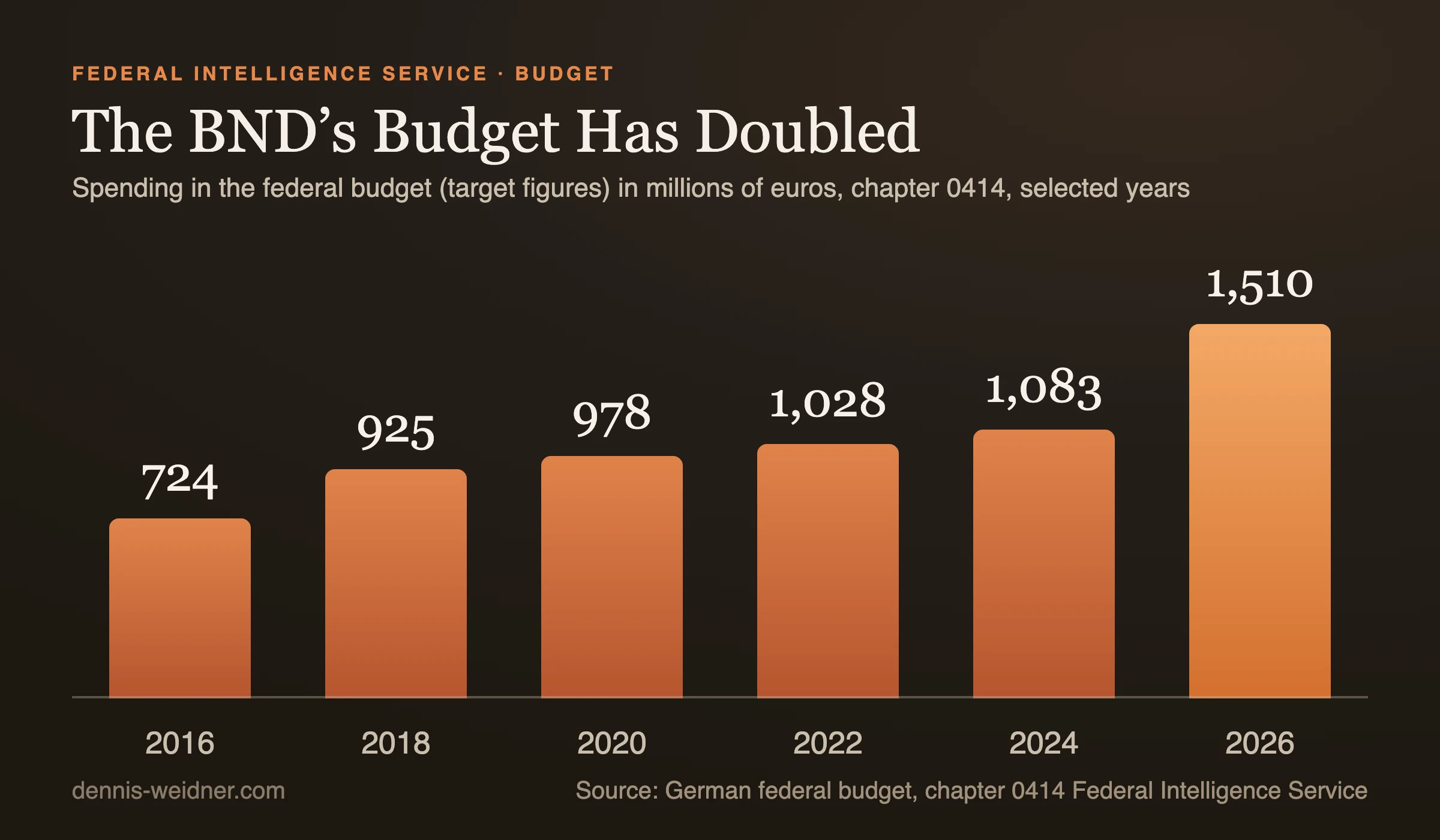
The money is in the federal budget under chapter 0414. For 2026, 1.51 billion euros are budgeted there, in nominal terms more than double the 724 million euros of 2016. What the money is spent on in detail is set out in a secret business plan approved by a confidential committee of the Bundestag.
Anyone who wants to join the BND applies as they would to any federal authority but goes through the strictest level of security vetting, the extended clearance with security investigations under Section 10 of the Security Clearance Act. The BND carries it out itself for its applicants and staff. As a rule, the security declaration is updated every five years and the clearance repeated every ten. The top is filled by politics: the president and officials from pay grade B 6 upwards are political civil servants whom the Federal President can send into temporary retirement at any time (Section 54 of the Federal Civil Service Act). Oversight is spread across several bodies with separate tasks. An overview of the parliamentary and independent oversight bodies is provided by the Federal Data Protection Commissioner:
| Body | Task | Legal basis |
|---|---|---|
| Federal Chancellery | Administrative and technical supervision of the BND | Section 1 BND Act |
| Parliamentary Oversight Panel | Must be fully briefed by the government, may inspect files, has a Permanent Representative | Article 45d Basic Law, Oversight Panel Act |
| Confidential Committee | Approves the services' secret business plans | Section 10a Federal Budget Code |
| G 10 Commission | Decides on interference with the secrecy of telecommunications | Article 10 Act |
| Independent Control Council | Has overseen technical intelligence gathering abroad since 2022 | BND Act, 2021 amendment |
| Federal Data Protection Commissioner | Oversees the handling of personal data | BND Act, Federal Data Protection Act |
Much remains deliberately in the dark: how many people work in which department, how the budget is split, how often internal checks take place. That is exactly why so much depends on the oversight bodies. I asked who supervises the supervisors for a very different authority in How German Tax Offices Are Supervised. For an intelligence service the question is even more pressing, because the public can hardly look over its shoulder.
Security Inside the BND: How Could Papers Leave Unnoticed?
The real question of this case is how papers could allegedly flow out of a service that organises its security in layers, for twelve years, without anyone noticing. On Markus Lanz on 13 October, Flade described how tightly daily life inside the BND is secured: one card for the building, a second for the office, printouts that are numbered and traceable, a security unit that checks right down to people's desks. Anyone working under those conditions does not send an email with an attachment to the outside world or carry a laptop out of the building. "The question is what went wrong for this to be able to happen," Flade said on the programme. The BND, he said, has to "assume the worst case, that all of it could have ended up somewhere".
After the case of BND unit head Carsten L., the service is said to have introduced random bag checks and tightened security vetting, Flade writes. In that case, in which the presumption of innocence also applies, colleagues are said, according to Flade's reporting, to have helped, for example with documents L. was no longer authorised to access. It only came to light because a foreign partner service tipped the BND off.
A chief of staff sits where many of these layers meet. By virtue of the job, he has access to much of what is intended for the president, as the federal prosecutors also stress. Whether D. acted alone, whether others knew and why internal security did not raise the alarm are questions two bodies are now meant to answer: the Oversight Panel has instructed its Permanent Representative to carry out an ad hoc inspection to help resolve "existing structural and organisational problems", and the BND has set up an internal working group. So far, two people are under suspicion.
How seriously the service takes the case shows in a scene Flade describes: President Jäger opened a mandatory video conference for all staff with the words "I am angry". The day before, still ahead of the arrests, he had told the Oversight Panel's public hearing that cooperation with partner services rests on trust and on the certainty that shared information is handled with care.
Earlier BND Scandals and Spy Cases: From Heinz Felfe to Carsten L.
Never before has a former BND president come under suspicion like this, Flade writes. But the BND has faced treason cases and scandals in every decade.
| Year | Case | What it was about | Outcome |
|---|---|---|---|
| 1961 | Heinz Felfe | Head of a counter-intelligence unit, worked for the Soviet KGB | Sentenced to 14 years in 1963, exchanged to East Germany in 1969 |
| 1990 | Gabriele Gast | Analyst, spied for East Germany | Sentenced to six years and nine months in 1991 |
| 2006 | Journalist surveillance affair | The BND monitored journalists until 2005 to find leaks | Report by special investigator Gerhard Schäfer, apology by the president |
| 2014 | Markus R. | More than 200 documents passed to the CIA, offer to a Russian service | Sentenced to eight years in 2016 |
| 2015 | NSA selectors | The BND helped the NSA monitor European targets too | Committee of inquiry, new BND Act in 2016 |
| 2022 | Carsten L. | Alleged to have betrayed secrets to a Russian service | On trial at Berlin's Higher Regional Court since December 2023, no verdict yet |
| 2026 | August Hanning, Manfred D. | Close to 2,000 documents from 2010 to 2022 (allegation) | Pre-trial detention, investigation ongoing |
Hanning's own term includes two chapters that still resonate. The BND source "Curveball" supplied false claims about mobile biological weapons labs in Iraq, which the US used to justify the Iraq war. And on the case of Murat Kurnaz, who was held at Guantánamo for more than four years, Hanning had to answer questions as a witness before a Bundestag committee of inquiry in 2007. Markus R. was convicted of treason by the Munich Higher Regional Court.
What Germany Learned: Oversight, Vetting and Cooling-Off Periods
Almost every scandal has produced new rules. After the NSA affair, the Oversight Panel was given a Permanent Representative with his own staff in 2016, the very post now carrying out the ad hoc inspection. After the Federal Constitutional Court's ruling of May 2020 on surveillance abroad, the Independent Control Council was created and began work at the start of 2022. After the Carsten L. case, the Oversight Panel found in April 2023 that security vetting urgently needed reform. In May 2023 it explicitly warned that officials with in-depth intelligence knowledge were taking up private-sector jobs without any review. It recalled that warning on 7 October 2026.
Why can a former top official work so freely after leaving? Because the obligations after leaving office are time-limited. Under Section 105 of the Federal Civil Service Act, political civil servants and officials with security-sensitive duties must today report any paid work outside the public sector, for five years if they retired at the statutory age and seven years otherwise. Work for a foreign power with a bearing on security matters requires approval during that time, and the authority must prohibit an activity if official interests would suffer. After that, they are free. Only the duty of confidentiality under Section 67 of the Federal Civil Service Act applies for life, together with the duty to hand over official documents on request.
Proposals are now on the table. Calls from within the Oversight Panel are for an approval requirement instead of a duty to report, as the Federal Agency for Civic Education summarises. SPD MP Sonja Eichwede is calling for a lifelong cooling-off period for former leaders of the services. Henrichmann wants senior former officials to disclose work-related contacts, especially when they are paid. At the same time, the Bundestag is debating a reform that would give the services more operational powers.
Why the Hanning Case Damages Trust in the State
An intelligence service lives on trust, both outside and inside. Partner services only share information if they are sure it will be protected. Citizens only accept far-reaching powers if they trust that someone is keeping a close eye. And we entrepreneurs hand the state data every day: tax returns, payroll reports, details of beneficial owners. We do so because we assume it will treat that data with care. Every case like this costs some of that trust, and the mood in the country is already tense, as I described in Political Discontent in Germany.
I think it is a mistake to locate the threats to the state mainly in one party. The cases of recent years show that serious damage can also come from within: from authorities, from networks, from conflicts of interest among people who had access. That deserves to be discussed just as openly.
And there were signs of conflicts of interest. Hanning's consulting had been reported on critically for years, and the lawsuit from Latvia has also been known for years. That concerned his business, not the allegation of betraying secrets, but it was reason enough to look more closely. The Oversight Panel warned in 2023 about unreviewed post-service jobs, and Henrichmann says the Hanning matter has occupied the panel for some time. Why it ultimately took a chance find by Hamburg police is something the inquiry has to answer.
At the same time, the case shows that the rule of law works. A prosecutor's office comes across something and passes it on, the federal prosecutors investigate with the BND and the BKA, a judge reviews the detention, Parliament exercises oversight. No one is above it, not even a former president. That is good news.
What I Take From the Hanning Case as an Entrepreneur
In my companies a simple principle applies: access goes to those who need it for their job, and whoever leaves hands it all back. That is not a matter of mistrust but of diligence. The law sees it the same way: under Section 2 of the Trade Secrets Act, a trade secret is only protected if its owner takes appropriate confidentiality measures. What every medium-sized company has to do for its customer data, the state must do all the more for its secrets. Five things I take away:
- Rotate key positions. Whoever manages the papers at the top should not sit in the same chair for more than a decade.
- Review access, do not just grant it. A log only helps if someone regularly looks at it.
- Disclose side jobs and review them again. An approval from ten years ago is no blank cheque for today.
- Take departures seriously. Documents back, access closed, next jobs and contacts discussed openly.
- Bring warning signs together. Press reports, lawsuits and tips from partners belong on one desk, not in five files.
For politics, in my view, that means an approval requirement instead of a duty to report for post-service jobs of former senior security officials, combined with an obligation to disclose paid mandates and contacts. For former presidents and vice-presidents of the services, I would rule out paid work for foreign states and foreign security agencies for good. More on how I see the relationship between the state and entrepreneurs is in Entrepreneurs and Politics. How do you see the case? Write to me via the contact form, I reply to every message.
Frequently Asked Questions
What is August Hanning accused of?
Federal prosecutors see strong suspicion of treasonous espionage, gathering state secrets, attempted treason and agent activity for a foreign intelligence service. He is alleged to have received close to 2,000 BND documents between 2010 and June 2022 and used them in his consulting work. Hanning has not been charged and is presumed innocent.
What counts as treason under German law?
Under Section 94 of the Criminal Code, treason is committed by anyone who passes a state secret to a foreign power or otherwise lets it reach unauthorised persons, in order to disadvantage Germany or favour a foreign power, and thereby creates the danger of a serious disadvantage to Germany's external security. The sentence is at least one year, up to life in especially serious cases. Hanning is accused of attempted treason.
Who is Manfred D.?
Hanning's former chief of staff at the BND, later chief of staff to several subsequent presidents from March 2012 to March 2026. He is alleged to have handed Hanning the documents for payment and is accused of aiding him. He too is presumed innocent.
Who is Hanning alleged to have passed information to?
According to the federal prosecutors, in one case he wrote an analysis for an employee of a foreign intelligence and security apparatus; whether it arrived is unclear. He is also alleged to have supplied a member of another state intelligence service with political information for years. The authority does not name the countries; media report on Azerbaijan, which rejects the claims.
How did investigators come across Hanning?
Through a search by Hamburg prosecutors in September 2025 in the proceedings over the abduction of Christina Block's children. Hamburg investigators referred the finds to the federal prosecutors at the beginning of May 2026.
Who oversees the BND?
The Federal Chancellery exercises administrative and technical supervision. In addition, there are the Bundestag's Parliamentary Oversight Panel, the Confidential Committee for the budget, the G 10 Commission, the Independent Control Council for technical intelligence and the Federal Data Protection Commissioner.
How long are former BND staff barred from moving into business?
There is no general ban, but there is a duty to report, and work for a foreign power requires approval. Political civil servants and officials with security-sensitive duties must report any paid work for five or seven years, and the authority can prohibit it. The duty of confidentiality applies for life.
Best,
Dennis Weidner
Note: AI tools supported me in writing this article, and some images were edited with AI. I stand behind its content and every statement with my name.