
Since 14 October 2026, the state security senate of the Hanseatic Higher Regional Court in Hamburg has been hearing the case over the sabotage of the Nord Stream pipelines. The defendant is Serhii K., a Ukrainian and former military officer. Federal prosecutors accuse him of leading a small group that attached explosive charges to the gas pipelines in the Baltic Sea in September 2022 and treat this as a war crime. Through his lawyers he denies the charges, and he is presumed innocent. Sixteen hearing days are scheduled up to 17 December, and the operators Nord Stream AG and Nord Stream 2 AG are not allowed to take part as joint plaintiffs. What interests me most about this case is how the German state organises a trial of this size and who decides what along the way, which is why it belongs in my series Entrepreneurs and Politics.
Updated on 27 October 2026: On the second hearing day, the court rejected the defence motion to discontinue the proceedings. The defence had argued that, as a former officer of a Ukrainian special unit, K. is bound by a duty of secrecy and therefore cannot defend himself fairly; two sworn statements by former superiors were read out, neither of which released him from that duty. "Under German law, the defendant is not restricted in his defence," the presiding judge said, according to Handelsblatt. The court would only see a bar to proceedings if German authorities had put the defendant in an inescapable position through contradictory conduct, as otherwise foreign agents could always invoke their home services, the taz reports. The trial resumes on 4 November, and K. continues to be presumed innocent.
More on this topic: Politics & Society, with background, practice and every article in one place.
As of 27 October 2026.
Key points at a glance
- Federal prosecutors filed the indictment on 30 June 2026 and the court admitted it on 2 September: a war crime under section 11 of the German Code of Crimes against International Law, causing an explosion, destruction of structures and disruption of public utilities.
- Hamburg hears the case because, according to the indictment, the yacht was chartered in Rostock and key parts of the operation started there, and the state of Mecklenburg-Western Pomerania transferred its state security cases to the Hanseatic Higher Regional Court by treaty in 2012.
- On 30 September 2026 the 3rd Criminal Senate refused joint-plaintiff status to both operators. Under section 396 of the Code of Criminal Procedure, that decision cannot be appealed.
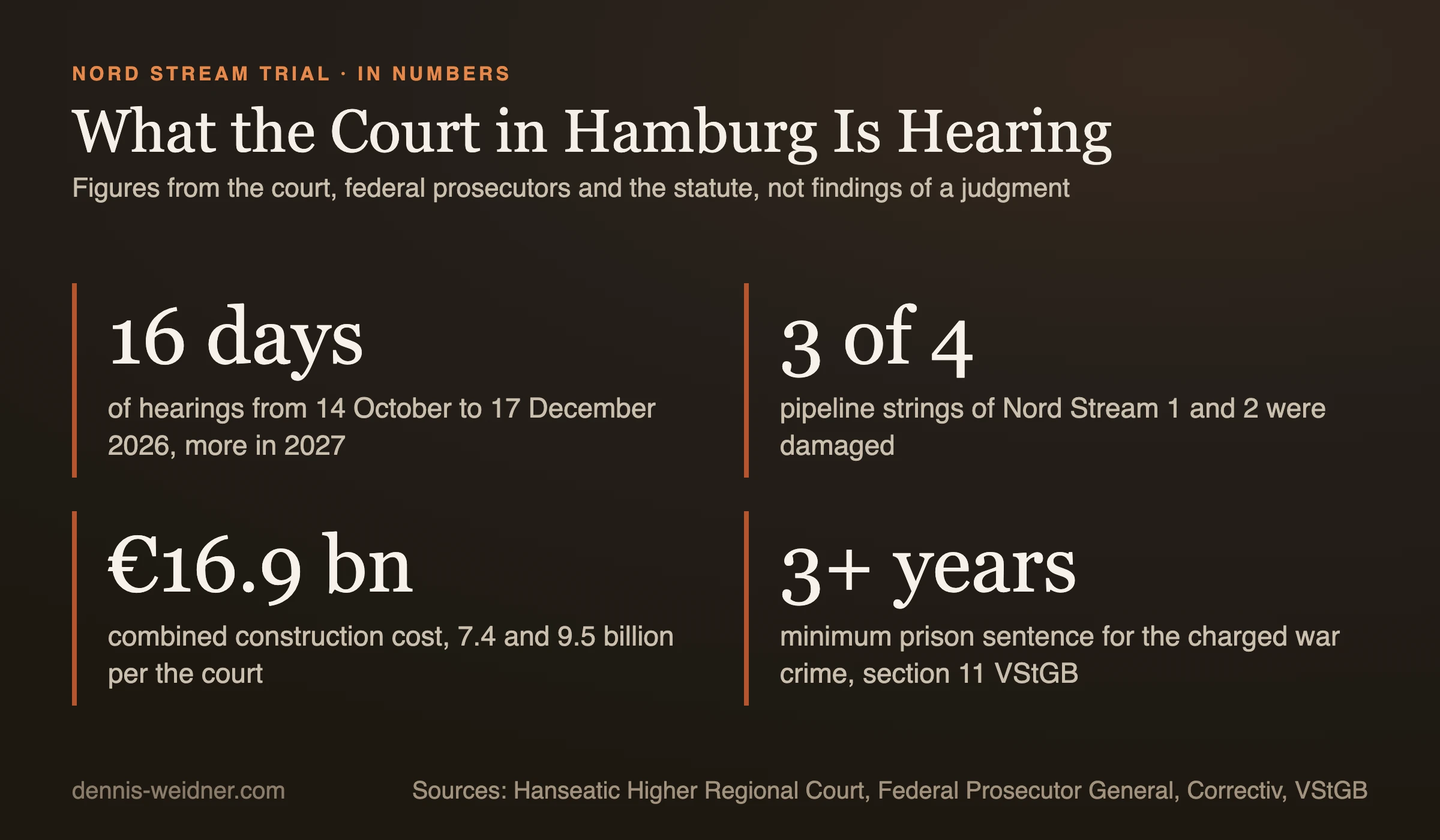
- Sixteen hearing days from 14 October to 17 December 2026, each from 9:30 am to 4 pm, with two days a week planned for January and February 2027.
- Journalists had to apply for accreditation by 24 September, photos and filming are only allowed before each session begins, and proceedings are interpreted into Ukrainian.
- A second suspect, the diver Vladimir Z., was arrested in Croatia on 19 August 2026, and a Croatian court approved his handover to Germany in September. He faces separate proceedings.
What the Nord Stream trial is about
The indictment describes the sequence of events as follows. Serhii K. was an officer in the Ukrainian army in 2022. After Russia's full-scale invasion began, he and other military personnel are alleged to have drawn up a plan "on behalf of state authorities in Ukraine" to destroy the Nord Stream 1 and Nord Stream 2 pipelines, so that Russia could no longer use its gas revenues to fund the war. A group of professional divers, a skipper and an explosives expert is said to have formed under his command.
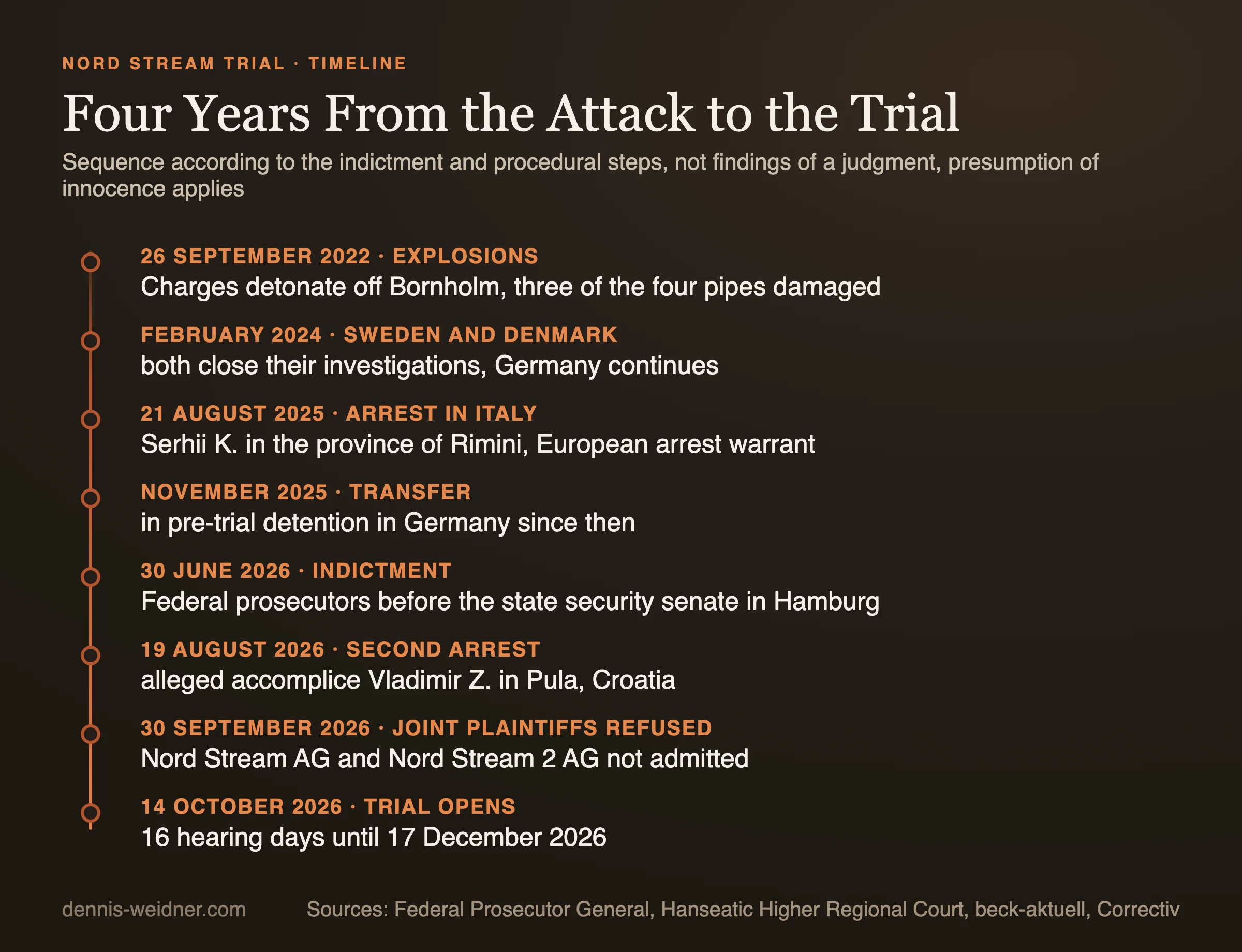
On 4 September 2022, K. allegedly entered Germany from Poland on a forged Ukrainian passport. The group is alleged to have boarded a sailing yacht that intermediaries had chartered from a company in Rostock using forged identity papers, and to have carried militarily usable high explosives to waters near the Danish island of Bornholm. By 22 September, explosive charges with time fuses are said to have been fixed to the pipelines on the seabed, and they detonated on 26 September 2022. That is how the Federal Prosecutor General's statement of 2 July 2026 puts it.
Three of the four pipes were damaged, Correctiv reports. According to federal prosecutors, before the attack Nord Stream 1 carried about half of the natural gas Germany needed each year for energy. Russia, however, had already throttled the flow several times and then stopped it completely, as the legal news site LTO summarises.
Italian officers arrested K. in the province of Rimini on 21 August 2025 on a European arrest warrant. He was transferred to Germany in November 2025 and has been in pre-trial detention since. He denies involvement in the attack, Al Jazeera reports. His Hamburg defence lawyer Jes Meyer-Lohkamp says prosecutors have not provided any direct, conclusive evidence of his client's involvement, and that the court will also have to determine whether Nord Stream was a legitimate military target, Radio Free Europe reports. That is the defence's position. According to Correctiv, investigators gathered tourist photos, a speed camera image, traces on the yacht, travel data from the Polish border authority, internet search data and recordings of phone calls made from detention in Italy. Whether this evidence holds up is for the senate alone to decide once the evidence has been heard.
Why the Hanseatic Higher Regional Court in Hamburg hears the case
Hamburg hears the case because it has been charged as a war crime and the link leads to Mecklenburg-Western Pomerania. Offences under the Code of Crimes against International Law go to a higher regional court at first instance, under section 120(1) no. 8 of the Courts Constitution Act, and the prosecution there is conducted by the Federal Prosecutor General (section 142a), not by a state prosecutor's office.
The pipelines make landfall in Lubmin near Greifswald, the yacht was chartered in Rostock according to the indictment, and according to the federal prosecutors' statement on Vladimir Z. it also set sail from there. Strictly speaking, that would point to the Higher Regional Court in Rostock. In 2012, however, Mecklenburg-Western Pomerania, Hamburg and Schleswig-Holstein created a joint state security senate at the Hanseatic Higher Regional Court by treaty, LTO explains. The law expressly allows such agreements between states (section 120(5)). In these cases the court exercises federal jurisdiction, and the states can claim back the costs from the federal government (section 120(6) and (7)).
That a German court may rule on an act committed in international waters off Bornholm follows from the Code of Crimes against International Law itself. It applies to the offences in sections 6 to 12, which include war crimes, even when the act was committed abroad and has no link to Germany (section 1). For the charged attack on civilian objects, section 11 provides for a prison sentence of at least three years, or at least one year in less serious cases.
This is the central legal question of the trial. The law protects civilian objects "as long as they are protected as such by international humanitarian law". The defence wants the court to examine whether Nord Stream was a legitimate military target. His Italian lawyer Nicola Canestrini had argued during the extradition proceedings that soldiers who carry out orders that are not obviously criminal may not be prosecuted for them, according to Correctiv. On immunity, the Federal Court of Justice ruled in 2021 that functional immunity does not shield a lower-ranking foreign official from German prosecution for war crimes, in a case concerning torture by an Afghan officer (judgment 3 StR 564/19). How that line applies to an attack on a gas pipeline will be decided first by the senate in Hamburg and then, if necessary, by the Federal Court of Justice.
Joint plaintiffs: why Nord Stream AG may not join the prosecution
The operators may not act as joint plaintiffs because damage to a pipeline is not among the offences for which the law grants that status automatically, and because the senate saw no "special reasons" for an exception. The 3rd Criminal Senate decided this in orders of 30 September 2026.
In a German criminal trial, a joint plaintiff is more than a witness. They may attend the entire hearing, ask questions, submit motions to take evidence, challenge judges and object to the presiding judge's orders, and they can be represented by a lawyer (section 397 of the Code of Criminal Procedure). The role is automatic only for victims of certain offences, such as sexual offences, attempted homicide or bodily harm (section 395(1)). Everyone else needs special reasons under subsection 3, "in particular because of the serious consequences of the offence".
Nord Stream AG and Nord Stream 2 AG, both Swiss public limited companies with Gazprom as majority or sole shareholder, put forward several such reasons, according to LTO including the protection of undersea pipelines under international law and the interests of their creditors. The senate answered the main ones as follows:
| The operators' argument | The senate's answer |
|---|---|
| The destruction amounted to "existential damage". | Repairs are put at mid three-digit million amounts per operator, while the pipelines cost 7.4 and 9.5 billion euros to build. By usual standards, that is not a total economic loss. |
| The economic consequences were severe. | Anything beyond the physical damage stems from the political reaction to Russia's military intervention in Ukraine, not from the explosions, and is disregarded. |
| They needed to defend themselves against blame. | There is currently no indication that the defendant or the defence will assign such blame. If that changes, the operators may apply again. |
| They lacked evidence for damages claims. | Civil procedure offers adequate means for civil claims, and the senate sees no "serious lack of evidence". |
| The chain of command and the role of foreign authorities had to be clarified. | A criminal trial establishes the defendant's act and guilt. Searching for further parties liable for damages, or establishing grounds for Russian reparation claims against Ukraine, is not its task. |
The court decides on admission after hearing the prosecution and the defendant, and in cases under section 395(3) that decision cannot be appealed (section 396(2)). The senate therefore has the last word. In LTO's assessment, the only remaining route for the operators is a constitutional complaint.
As an entrepreneur, I find this decision instructive precisely because it sounds harsh. A company with hundreds of millions in damage still does not get a seat at the table in the criminal trial. Criminal proceedings belong to the state. They ask about one person's guilt, not about compensation. That does not leave injured companies without rights. Through a lawyer they can inspect the files if they show a legitimate interest (section 406e), ask to be informed about the progress of the case (section 406d), bring claims against the accused directly in the criminal trial through adhesion proceedings (section 403), or sue in the civil courts.
A trial with special measures: accreditation, security and interpreters
The hearing is public, but the presiding judge controls access. In principle every hearing before the trial court, including the pronouncement of the judgment, is public, while audio and video recordings for publication are prohibited; only archive recordings for historical purposes may be permitted by the court in cases of outstanding historical significance (section 169 of the Courts Constitution Act). Order in the courtroom is the presiding judge's responsibility (section 176), and that provision is the basis for the order of 2 September 2026 regulating media access.
It sets out a two-stage procedure. Journalists and media outlets had to apply for accreditation by email on a set form by noon on 24 September. Each media outlet receives at most one reserved seat in the public gallery, and accreditation alone does not guarantee a seat: access is decided in a second step. Camera crews and photographers have a separate procedure, may only work in the courtroom before the session begins, and if space is short, a pool arrangement applies in which one team films for everyone. The order cites the high level of attention from Hamburg, national and international media and the need to treat all reporters equally. Reserving seats for the press follows from number 125 of the German guidelines for criminal proceedings. According to NDR, around 150 media representatives had registered for the opening, including from Ukraine, the US, Russia and China.
Many media outlets from Germany and abroad have registered, and the hearing is interpreted into Ukrainian, according to Correctiv. Participants who do not speak German are given an interpreter, and journalists may also use interpretation (section 185). According to LTO, the trial opens under heightened security. Hearings run from 9:30 am to 4 pm, and the opening session on 14 October was scheduled for 11 am, the court announced.
| In the Nord Stream trial | Public? | Legal basis |
|---|---|---|
| Hearing and pronouncement of the judgment | Yes, including for members of the public without accreditation, as far as space allows | Section 169(1) sentence 1 Courts Constitution Act |
| Audio and video recordings during the hearing | No, only archive recordings for historical purposes may be permitted | Section 169(1) sentence 2 and (2) |
| Images before the session begins | Yes, under the presiding judge's order, via a pool if necessary | Section 176 |
| Individual parts of the hearing | Exclusion of the public possible, for example if state security or witnesses are at risk | Section 172 |
| The judges' deliberations | No, judges must keep them secret even after leaving office | Section 43 German Judiciary Act |
| Investigation files | No. The defence, the accused and victims may inspect them, others only with a legitimate interest via a lawyer | Sections 147, 406e and 475 Code of Criminal Procedure |
Who decides what in the Nord Stream case
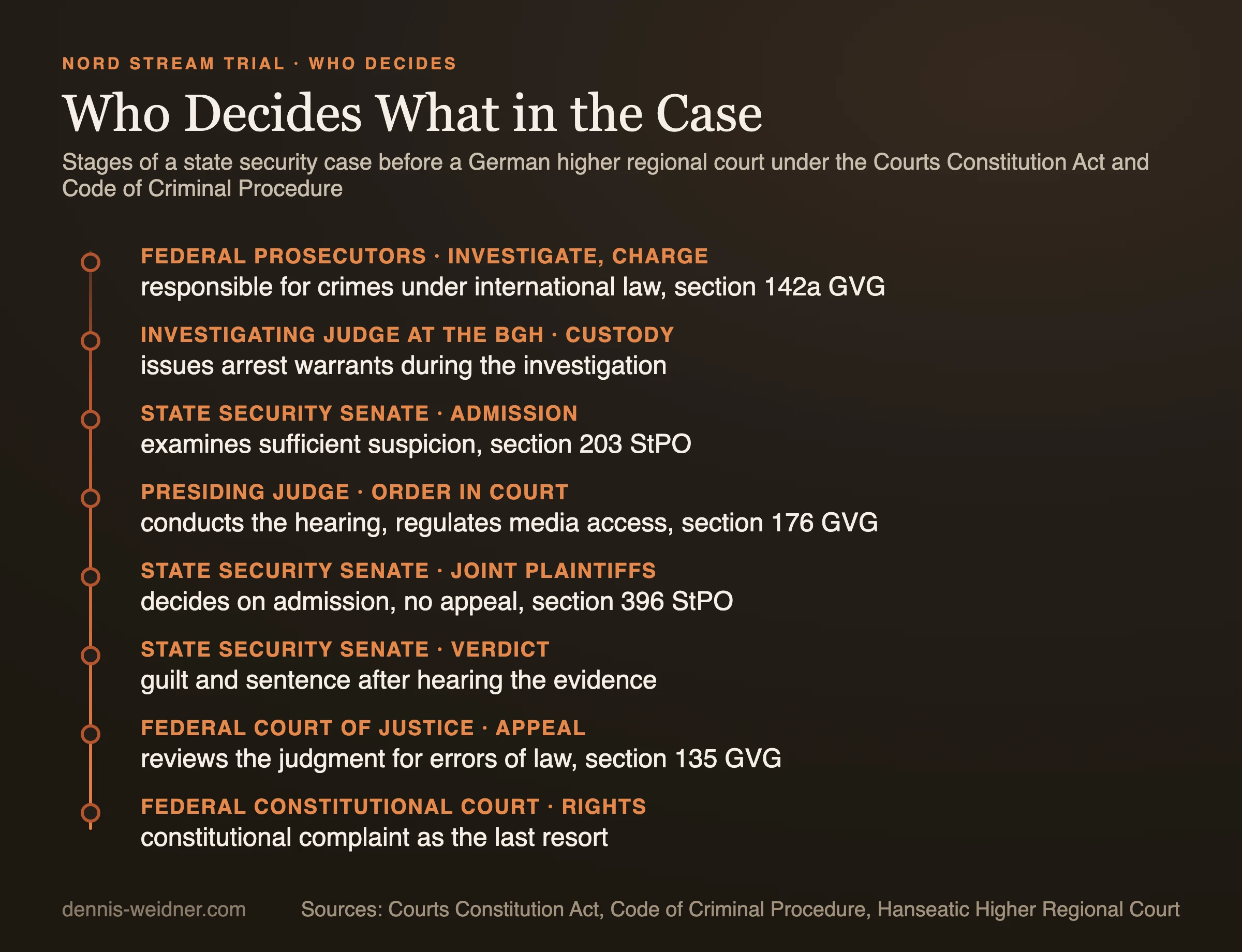
Each stage is decided by a different body, and the verdict in the end is for the senate alone. Federal prosecutors investigate and bring charges. During the investigation, arrest warrants are issued by the investigating judge at the Federal Court of Justice; once charges are filed, the senate decides on custody (section 125 of the Code of Criminal Procedure). Whether a trial takes place at all is examined by the senate in interim proceedings: it opens the main proceedings only if the accused "appears sufficiently suspected" (section 203 of the Code of Criminal Procedure). It decides on opening with five judges and determines at the same time whether it will hear the case with three or five judges (section 122 of the Courts Constitution Act).
In the main hearing, the presiding judge conducts the proceedings, examines the defendant and takes the evidence (section 238). If a participant objects to one of his orders, the full senate decides. The only appeal against the judgment is an appeal on points of law to the Federal Court of Justice (section 135); there is no second trial on the facts in state security cases. After that, a constitutional complaint to the Federal Constitutional Court remains.
The same federal prosecutors are currently handling a second major state security case, as the August Hanning case shows. There the proceedings are, as of mid-October, still at the very beginning before the investigating judge, and no charges have been filed.
How long the trial will take and what takes the time
Sixteen hearing days are scheduled before Christmas, the second was on 27 October. For January and February 2027 the court plans two days a week, and scheduling with the parties is still under way. On that plan, a verdict is not to be expected before 2027.
One reason for the length is the principle of personal examination. If evidence rests on what a person perceived, that person must testify in the main hearing, and an earlier record may not replace their examination (section 250). Witnesses, investigators and experts on whose observations the indictment rests must therefore in principle appear before the senate in person. Material from other countries adds to this. Sweden closed its investigation on 7 February 2024 for lack of jurisdiction, and according to media reports Swedish evidence can be made available to German investigators (beck-aktuell), and Denmark followed a few weeks later (t-online).
The trial concerns only one defendant. The alleged accomplice Vladimir Z., a trained diver according to federal prosecutors, was arrested in Pula, Croatia, on 19 August 2026 and is to be brought before the investigating judge at the Federal Court of Justice once transferred (Federal Prosecutor General). A Croatian court approved his handover to Germany in September. Poland had already detained him once in 2025 and did not extradite him. He too is presumed innocent.
The Nord Stream sabotage and geopolitics: who disputes what
Politically the case is charged; in the courtroom it is only background. Federal prosecutors assume an operation on behalf of state authorities in Ukraine. President Volodymyr Zelenskyy has said he was "never officially" involved in any such operation, according to Correctiv. Kremlin spokesman Dmitry Peskov said before the trial that Moscow expects both the perpetrators and those who ordered the attack to be named, AP reports. In 2023 the White House called a report by journalist Seymour Hersh, claiming the United States was behind the attack, "utterly false" (Blick). In Poland, a court refused to extradite Vladimir Z. in 2025.
Germany has since restructured its gas supply. In 2025, 44 percent of imports came from Norway, 24 percent from the Netherlands and 21 percent from Belgium, with 10.3 percent arriving through LNG terminals, the Federal Network Agency reports. How closely regional politics and the pipeline were once intertwined is shown by the climate foundation in Mecklenburg-Western Pomerania, which I described in my piece on Germany's political centre and the AfD firewall.
I have no theory of my own about who did it, and I do not need one. A state under the rule of law proves itself precisely when a court rules on the evidence, even if the outcome may prove awkward for an ally. That a case this sensitive is being heard in public, with interpreters and clear rules for the press, strikes me as a strength.
What entrepreneurs can learn: "not substantiated", the duty to give notice and the right to be heard
The decision on the joint plaintiffs has a quality I would like to see from courts more often: it explains point by point why an application fails. In my own civil and labour court cases I have experienced the opposite. Submissions were rejected as "not substantiated" without it being clear to us what exactly was missing. One of my companies has also been before the Federal Labour Court, in a case on paying commissions in cryptocurrency that many media outlets covered. The court established as a matter of principle that commissions can be agreed in Ether as a payment in kind, provided this is in the employee's interest and the part of the pay that cannot be seized is paid in money (Federal Labour Court, 10 AZR 80/24). Decisions like that move the law forward, including for everyone who was not involved.
"Not substantiated" means a party has asserted a fact but not set out concretely enough who did what and when. I consider it a flaw in the system when a case fails on that point without the party knowing beforehand what is missing. The law actually sees it the same way. Under section 139 of the Code of Civil Procedure, the court must work towards the parties completing insufficient information. It may only base its decision on a point a party has evidently overlooked if it has pointed this out beforehand, and such notices must be given as early as possible and recorded in the file. In labour courts the same applies via section 46(2) of the Labour Courts Act. Behind this stands the right to be heard in Article 103(1) of the Basic Law.
What you can do as a party in a German court:
- Present facts so that an outsider can check them: who, when, where, what, and the evidence for each assertion.
- Expressly ask the court for a notice if it is unclear whether your submission is sufficient.
- After a notice, apply for a deadline to file a written statement if you cannot respond immediately (section 139(5)).
- Check the record: a notice only counts if it is in the file (section 139(4)).
- Against a surprising judgment, consider an appeal. If no appeal is available, a complaint of a violation of the right to be heard remains, within two weeks of becoming aware of it (section 321a, in labour courts section 78a of the Labour Courts Act).
- As an injured company in criminal proceedings, apply for access to the files through a lawyer and register claims in adhesion proceedings.
How oversight of and complaints about public authorities work is something I examined using the example of how German tax offices are supervised. Who speaks for business owners and the self-employed in Berlin is shown in my analysis of Germany's lobby register.
What happens next in the Nord Stream trial
On 14 October the federal prosecutors read out the indictment, which K. followed through a Ukrainian interpreter; he made no statement on the charges, public broadcaster NDR reports. According to his defence lawyers, as an officer of the Ukrainian armed forces he has no permission to testify and therefore has to "defend himself with his hands tied"; they applied for the proceedings to be discontinued. The court rejected that on 27 October, holding that under German law the defendant is not restricted in his defence. One of his lawyers called the pipelines a financial, military and political weapon of Russia, because the revenue benefited the state waging the war of aggression. K. is presumed innocent.
The trial opened on 14 October as scheduled, the first public hearing of the evidence after four years of investigation, Al Jazeera and Reuters report. K. denies any involvement. On the second hearing day, 27 October, the court ruled on that motion; from 4 November it sits two days a week in November and December. I am following the trial and will update this article on the important days, for instance when the defendant responds to the charges, when jurisdiction is disputed and when the verdict is handed down, each time with the date at the top of the text.
Frequently asked questions
When does the Nord Stream trial start and how long will it last?
The main hearing began on 14 October 2026 before the Hanseatic Higher Regional Court in Hamburg. Sixteen hearing days are scheduled up to 17 December 2026, with two days a week planned for January and February 2027. On that plan, a verdict is not to be expected before 2027. On 27 October the court rejected the defence motion to discontinue the proceedings.
Why is the Nord Stream trial taking place in Hamburg?
War crimes are heard at first instance by a higher regional court. According to the indictment, the yacht was chartered in Rostock and set sail from there, and Mecklenburg-Western Pomerania transferred its state security cases to the Hanseatic Higher Regional Court by treaty in 2012.
What is Serhii K. accused of?
Federal prosecutors accuse him of committing, as a co-perpetrator, the war crime of attacking civilian objects, as well as causing an explosion, destruction of structures and disruption of public utilities. He is alleged to have led the group that attached explosive charges to the pipelines in September 2022. He denies this, and he is presumed innocent.
Why is Nord Stream AG not a joint plaintiff?
Damage to a pipeline is not among the offences for which joint-plaintiff status is automatic. The senate saw no special reasons for an exception: the repair is not a total economic loss, and damages can be pursued in civil proceedings. The decision of 30 September 2026 cannot be appealed.
Can members of the public attend the Nord Stream trial?
Yes, the hearing is public. Some seats in the public gallery are reserved for accredited journalists, and the rest are open to the public as far as space allows. Audio and video recordings for publication are prohibited during the hearing.
What sentence does a war crime under section 11 of the Code of Crimes against International Law carry?
For an attack on civilian objects, the code provides for a prison sentence of at least three years, or at least one year in less serious cases. Guilt and sentence are decided by the senate alone after hearing the evidence.
What can I do if a German court calls my submission "not substantiated"?
Under section 139 of the Code of Civil Procedure, the court must point out beforehand what is missing and give you the chance to add to it. Expressly ask for a notice, apply for a deadline to respond in writing and, against a surprising judgment, consider an appeal or, if none is available, a complaint of a violation of the right to be heard within two weeks.
Best,
Dennis Weidner
Note: AI tools supported me in writing this article, and some images were edited with AI. I stand behind its content and every statement with my name.