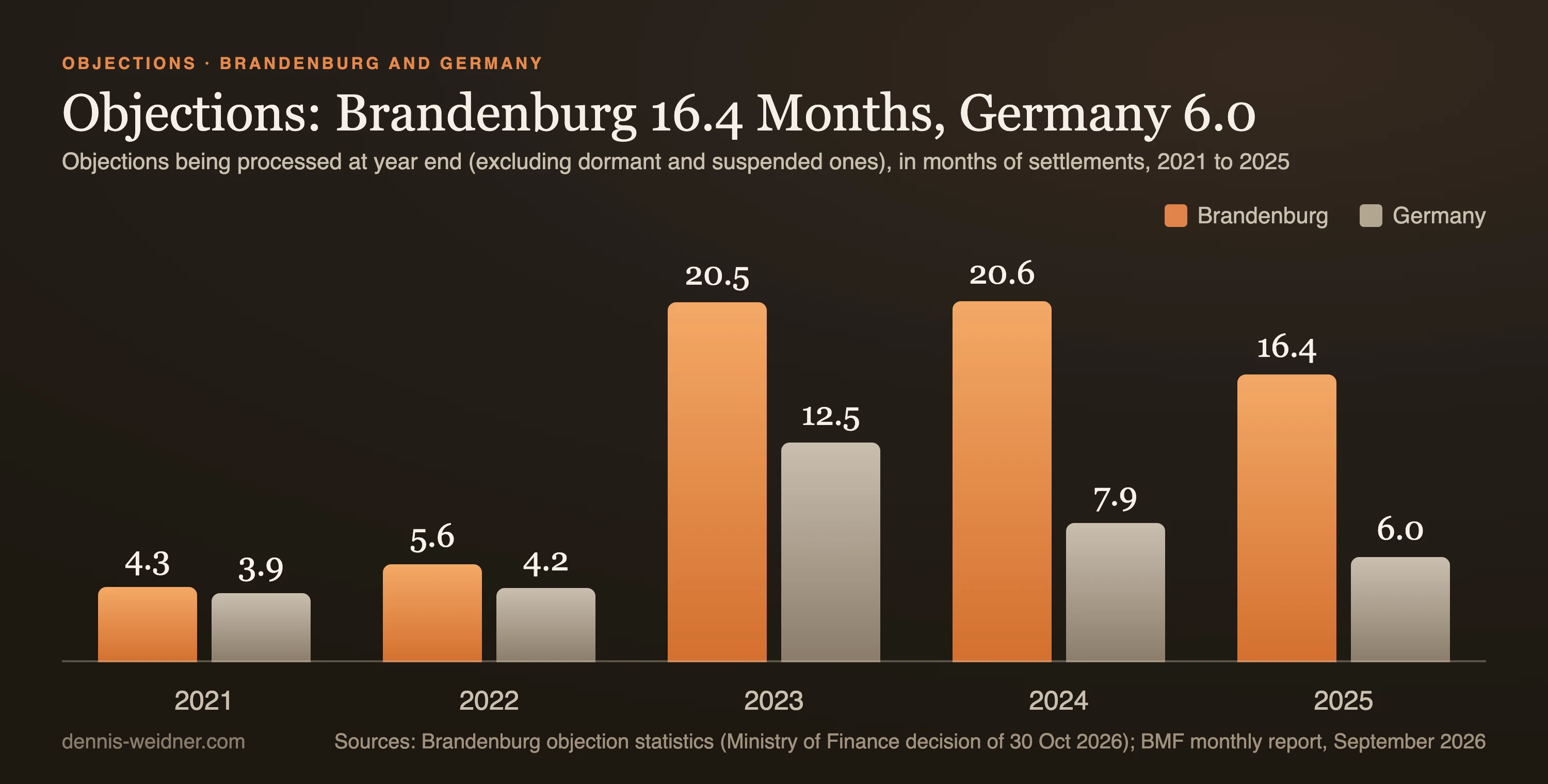
At the end of 2025, the tax offices in Brandenburg had 160,603 objections being processed, almost five times as many as at the end of 2020. At the 2025 pace, that is 16.4 months of work, against around 6 nationwide according to the Federal Ministry of Finance's figures. The Brandenburg statistics were released to me free of charge by the state Ministry of Finance in Potsdam, in a decision dated 30 October 2026 on my information request. For income tax returns the state measures processing time precisely, 47.6 days on average. How long an objection takes on average, how long an input VAT refund takes and how many supervisory complaints are made is not available to the ministry. Berlin excluded access to information on matters of tax administration by law in spring 2026, but the Senate Department for Finance still sent me anonymous figures: 431,699 objections were outstanding there at the end of 2025. The federal government points to the states.
As of 18 November 2026. Not legal or tax advice, see the note at the end.
More on this topic: Finance & Crypto Assets, with background, practice and every article in one place.
It started over lunch. A business owner told me how he had cut his tax bill with the investment deduction and had been waiting since early 2025 for around 77,000 euros of input VAT. Afterwards I wanted to know: is this a one-off, or are there numbers? I looked in the parliamentary databases of Berlin and Brandenburg, at the Federal Ministry of Finance, the Federal Statistical Office and on FragDenStaat. And for gruenderfreunde.de I asked three authorities directly: the Federal Ministry of Finance, the Brandenburg Ministry of Finance and Berlin's Senate Department for Finance.
Processing Times at German Tax Offices in Brandenburg and Berlin
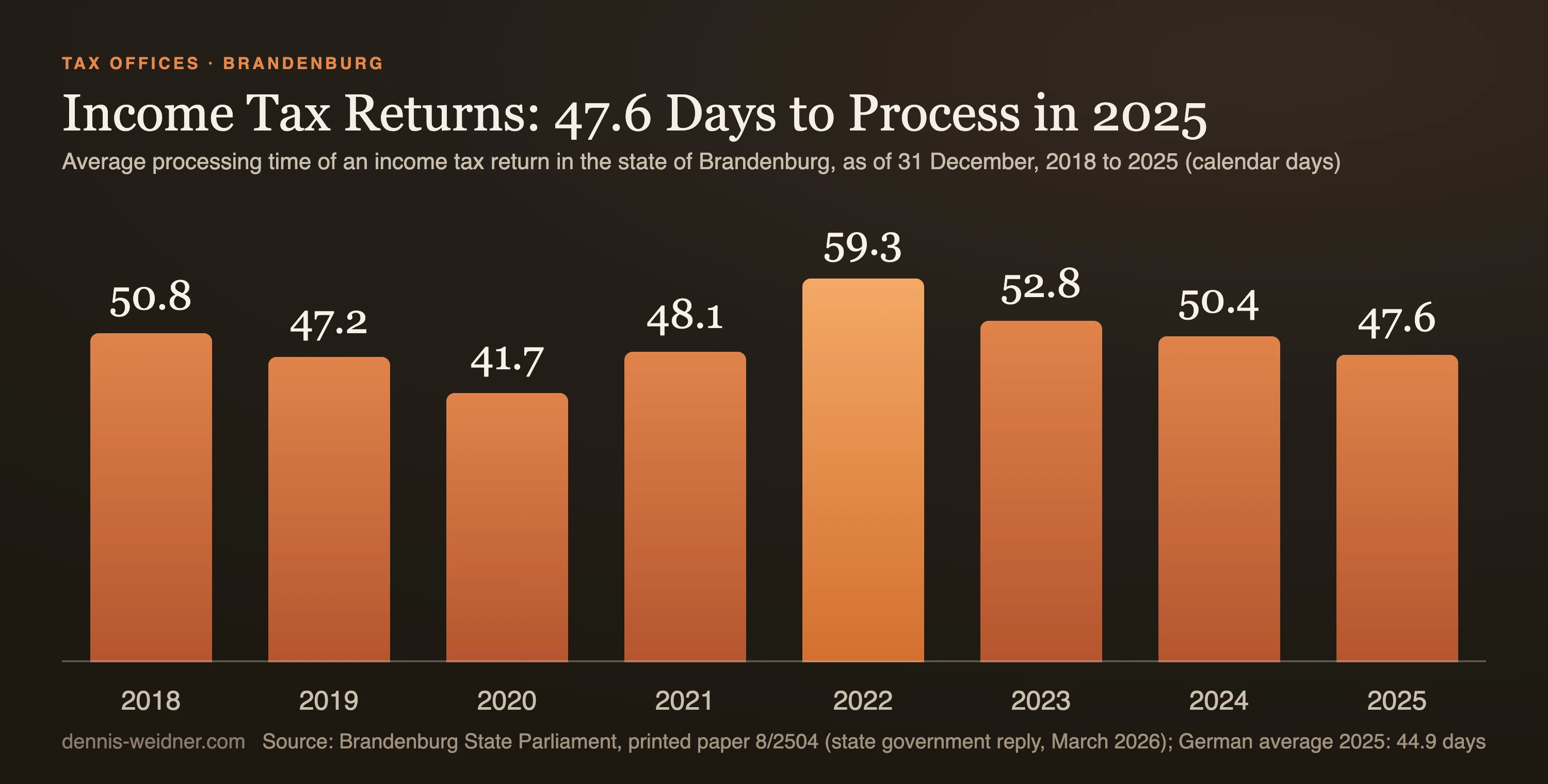
Brandenburg disclosed its figures in reply to a question from state MP Sven Hornauf (BSW) (printed paper 8/2504). The average processing time of an income tax return was 47.6 days in 2025, after 50.4 days in 2024 and 59.3 days in the peak year 2022. The state's target is 48 days, which it narrowly meets. The German average in 2025 was 44.9 days.
Almost three weeks separate the offices. Eberswalde took 36.9 days on average in 2025, Potsdam 55.2 and Calau 57.0. The state's tax administration had 3,417 posts as of 30 September 2025, of which 124.87 were vacant. The state government considers processing-time rankings by private tax portals of little value: Smartsteuer, for example, covered only 1.45 percent of all returns for 2024.
Other states inform taxpayers directly about the wait for their tax assessment. In Baden-Württemberg, tax offices post their processing status online; the Friedrichshafen tax office wrote on 19 October 2026 that it was processing the income tax returns received by 6 August (processing status, Friedrichshafen tax office). North Rhine-Westphalia gives a range: more than 95 percent of all income tax returns are processed within two weeks to five months, more than 97 percent within six months (NRW tax administration). According to the tax administration, the time taken in an individual case depends on whether there are queries or documents have to be submitted later.
For Berlin, the Senate Department for Finance sent me the average processing times for income tax assessments on 13 November 2026, for the state and for each tax office, 2020 to 2025. In 2025 Berlin's tax offices took 47 days on average for returns for the previous year and 58 for older years. In 2020 the figures were 39 and 51; Berlin was fastest in 2021 with 36 days. Between offices, returns for the previous year took 37 days in Neukölln and 55 in Spandau in 2025. Berlin does not agree targets with its tax offices. The Senate had published processing times before: in 2019 it set them out per tax office for the assessment years 2010 to 2017, separately for employees and other taxpayers (printed paper 18/19927). In 2024 it followed with figures for the Schöneberg tax office, which in 2023 took 40 calendar days on average for income tax returns of non-employees for the previous year and 57 for the year before that, and 35 and 41 for employees, counted from receipt to assessment, and tells taxpayers to expect 7 to 9 weeks as a rule. Its staff, measured against the nationwide staffing benchmark, fell from 86.9 percent in 2021 to 80.0 percent in 2023, while the sickness rate rose from 7.0 to 13.2 percent (printed paper 19/18514). The Senate estimates that the units handling objections need 226.5 instead of 198.5 full-time posts (printed paper 19/25705).
| Metric | Value | Source |
|---|---|---|
| Income tax processing time, Brandenburg 2025 | 47.6 days (target 48) | Paper 8/2504 |
| German average 2025 | 44.9 days | Paper 8/2504 |
| Fastest and slowest office in Brandenburg 2025 | Eberswalde 36.9, Calau 57.0 days | Paper 8/2504 |
| Schöneberg tax office, income tax of non-employees 2023 | 40 days (previous year), 57 days (year before) | Paper 19/18514 |
| Staff at Schöneberg tax office 2023 | 80.0% of benchmark (2021: 86.9%) | Paper 19/18514 |
| Average duration of an objection in Brandenburg | not available | Ministry decision 30 Oct 2026 |
| Duration of input VAT refunds in Brandenburg | not collected separately | Ministry decision 30 Oct 2026 |
Objections at the German Tax Office: What Brandenburg's Statistics Show About Processing Time
Brandenburg measures the processing time of a tax return precisely, but there is no average duration for objections. Data on the average time until an objection is settled are not available, the Ministry of Finance writes in its decision of 30 October 2026. Steering is by the age of cases: the ministry agrees targets with the offices for the share of objections older than six months, in 2025 mostly 20 percent, 30 percent for Kyritz and Luckenwalde. What also exists are the objection statistics every state reports to the Federal Ministry of Finance. Brandenburg released them for 2020 to 2025, office by office, free of charge and a little over three weeks after the request.
According to them, the state's 13 tax offices had 359,286 objections open at the end of 2025. 198,683 of them were dormant or suspended, often because a court case on the legal question is still pending. 160,603 were being processed, against 34,264 at the end of 2020. The jump came in 2023 with 304,934 new objections, three times as many as in previous years. The statistics do not break down by tax; nationwide, the Federal Ministry of Finance attributes the many dormant cases of these years mainly to objections over the property tax reform.
A measure of the wait can still be read from the figures. Dividing the objections being processed by the number the offices settle each month shows how many months they would need at the same pace to clear the backlog if nothing new came in. In Brandenburg that was 16.4 months at the end of 2025. With the federal ministry's figures, the national value is 6.0 months (Federal Ministry of Finance monthly report, September 2026). In 2021 the two were almost level, at 4.3 and 3.9 months.
Part of the gap may come down to counting. Nationwide, 78 percent of open objections were dormant or suspended at the end of 2025, in Brandenburg 55 percent, and dormant cases do not count as being processed. But the gap remains when all open objections are counted, dormant or not: they equal 36.7 months of settlements in Brandenburg and 27.3 nationwide. Brandenburg settled 2.6 percent of all objections in Germany in 2025 but held 3.5 percent of the open ones at year end. Its offices are settling more than before: in 2025 they settled 117,543 objections, 15.5 percent more than a year earlier, against an increase of 9.4 percent nationwide.
The share of relief hardly differs between the state and the country as a whole: 63.4 percent of the objections settled in 2025 ended this way in Brandenburg, 63.1 percent nationwide. Brandenburg's offices issued formal decisions less often, in 12.5 percent of cases against 16.9 percent nationwide, but partial decisions more often (3.5 against 1.0 percent). In the finance court, claimants against Brandenburg's offices succeed less often than before: in 2025 the court upheld 12.3 percent of settled cases in full or in part, against 16.7 percent in 2020 and 21.1 percent in the peak year 2022. Inaction actions, filed because an office does not decide on an objection, number 186 over the six years according to the ministry, 34 of them in 2025.
The state has worked on staffing. On 30 September 2021, 420.98 posts at the tax offices were vacant, four years later 124.87, and the staffing rate rose from 87.7 to 96.3 percent. In 2025 the backlog being processed fell for the first time since 2021, by almost 8 percent. It is still more than five times as large as at the end of 2021.

The figures for all 13 offices, from Frankfurt (Oder) at 23.2 months to Strausberg at 8.5, are on gruenderfreunde.de in Einsprüche beim Finanzamt: Wo sie in Brandenburg am längsten liegen (in German), together with the state's statistics as PDF files.
Objections Against the German Tax Office in Numbers: What 63 Percent Relief Means
Tax offices across Germany received 4.1 million objections in 2025, 30 percent fewer than a year earlier. 4.5 million were settled. 63.1 percent of them ended with relief, meaning the tax office granted the objection. 17.1 percent were withdrawn and 16.9 percent ended with a formal decision (Federal Ministry of Finance monthly report, September 2026).
That does not mean the tax office was wrong in almost two out of three cases. The ministry itself points out that many cases of relief rest on information submitted later or on a narrowed request. It does mean that objecting is not pettiness but the normal course of a procedure in which the first assessment is often not the last word. At the end of 2025, 10.1 million objections were open, 7.9 million of them dormant or suspended; the ministry attributes the sharp rise since 2023 mainly to the property tax reform. 45,778 lawsuits were filed, around 1 percent of the objections settled.
Berlin shows what this looks like in one state, again on property tax: 279,020 objections against property tax value assessments, of which only 7,179 had been settled by relief, 3,949 by withdrawal and 781 by decision by February 2024, while 223,516 were suspended (printed paper 19/18402). The ministry does not publish objection statistics by state, even though it compiles its figures from the states' reports. Brandenburg released its report on request, and so did Berlin on my request of 4 November: in 2025 it received 288,339 objections and settled 272,536, and 431,699 were outstanding at the end of the year, around 2.7 times as many as at the end of 2020 (158,932). In 2023 property tax pushed receipts to 459,592. Berlin's overview does not show suspended cases separately. At the 2025 pace, Berlin's whole backlog equals around 19 months of work, against 36.7 in Brandenburg and 27.3 nationwide. What an objection achieves in an individual case is covered in Incorrect Tax Assessment in Germany.
Suing at the Berlin-Brandenburg Finance Court: Duration and Success Rate
Anyone suing the tax office waits longer in Berlin and Brandenburg than elsewhere. The finance court in Cottbus settled 2,581 cases in 2025 in an average of 16.5 months, against 13.9 months nationwide. Cases decided on the merits by judgment or court decision took 23.8 months on average. 60 cases ran for more than six years (Federal Statistical Office, finance courts 2025).
| 2025 | Berlin-Brandenburg Finance Court | Germany |
|---|---|---|
| New cases | 2,469 | 24,886 |
| Settled cases | 2,581 | 24,948 |
| Average duration | 16.5 months | 13.9 months |
| Duration with a decision on the merits (judgment, court decision) | 23.8 months | 22.4 months |
| Claim upheld in full or in part, share of judgments and court decisions | 18.9% | 17.3% |
| Case resolved on the merits (often the tax office giving way) | 27.1% | 34.5% |
| Action withdrawn | 30.6% | 29.8% |
The success rate in court looks small but understates success. More than a quarter of cases end because the matter is resolved, often because the tax office amends the assessment in full or in part during proceedings. The statistics do not record this as a win for the claimant. How to sue and which deadlines apply is explained in German Tax Court: Deadlines and Costs.
Supervisory Complaints and Petitions Against the Tax Office: What Gets Counted
Neither Berlin nor Brandenburg has published a figure for supervisory complaints against tax offices. At the Brandenburg Ministry of Finance it is not even recorded: according to its own statement, the ministry does not collect or evaluate supervisory complaints statistically. Complaints about individual staff are generally decided by the head of the tax office concerned, the ministry only handles complaints about office heads. Before the request I had searched the parliamentary documentation of both states for the last three legislative periods by title and keyword, plus the requests on FragDenStaat mentioning a supervisory complaint. There were hits on job centres and universities, none on tax offices. Neither Brandenburg nor Berlin counts inaction objections separately; the statistics treat them as ordinary objections.
Berlin does count part of the supervisory complaints. The Senate Department for Finance, which supervises Berlin's tax offices, received 166 complaints about them in 2025, and between 92 and 107 a year from 2020 to 2024. In 2025 most concerned the Mitte/Tiergarten (17), Marzahn-Hellersdorf (15) and Treptow-Köpenick (14) tax offices. Complaints made directly to a tax office are not recorded, nor is how many were justified. In the Senate Department's view that would not make sense either, since in most cases whether a complaint was justified cannot be determined with certainty.
Only petitions are counted. In 2025 Berlin's petitions committee received 1,756 submissions, 37 of them on taxes and finance. Of 50 cases closed in that area, 2 were positive and 6 partly positive (printed paper 19/3300). Brandenburg received 513 petitions between October 2024 and October 2025, 4.6 percent of them on taxes and finance (printed paper 8/2170). The Bundestag counted 12,399 petitions in 2025, 1,108 in the Finance Ministry's area. On individual tax assessments it states it has no means of influence for lack of federal jurisdiction (printed paper 21/6000). Tax offices are state authorities. What a complaint achieves there and who handles it is covered in How German Tax Offices Are Supervised.
Costs: Winning Against the German Tax Office Often Still Costs Money
In civil proceedings the loser pays the winner's legal costs (Section 91 ZPO). In general administrative law the authority reimburses necessary costs where an administrative appeal (Widerspruch) succeeds (Section 80 VwVfG). In tax law neither applies to the objection: anyone who wins at the tax office with a tax adviser pays the fee themselves. The Federal Constitutional Court held this compatible with the Basic Law as early as 1973 (BVerfGE 35, 283).
Only before the finance court does this change. The losing side bears the costs. If the tax office gives way during proceedings, it generally bears them too (Section 138(2) FGO), unless the claimant submitted documents too late; if it gives way only in part, costs are split. In Brandenburg, 244 lawsuits ended in 2025 because the matter was resolved, 38 of them with costs for the tax office, 72 with costs for the claimant and 134 with costs split. But only the statutory fees of an adviser are reimbursed (Section 139(3) FGO); a higher agreed fee stays with the claimant. The costs of the preceding objection are only reimbursed if the court expressly declares the adviser's involvement necessary.
| Situation | Civil proceedings | Administrative procedure | Tax procedure |
|---|---|---|---|
| Success at the preliminary stage | not applicable | reimbursed under Section 80 VwVfG | no reimbursement |
| Success in court | statutory legal fees reimbursed | statutory costs reimbursed | statutory fees reimbursed, preliminary stage only if the court so declares |
| Other side loses | pays | pays | pays, own expenses not reimbursable |
The same imbalance applies to interest. Paying late costs a late payment surcharge of 1 percent for each month begun (Section 240 AO). Overpaying earns 0.15 percent a month, and only from 15 months after the end of the tax year. Anyone granted suspension of enforcement who eventually loses pays 0.5 percent a month (Section 237 AO). The Federal Fiscal Court considers this 6 percent a year unconstitutional and referred it to the Federal Constitutional Court in 2024 (VIII R 9/23, there 1 BvL 8/24); no decision yet. Details are in Suspension of Enforcement in German Tax Law.
That leaves state liability. In 2007 the Federal Court of Justice ruled that the state must provide resources so that proceedings are completed without avoidable delay, and that overload is no excuse (III ZR 302/05, BGHZ 170, 260, then an overloaded land registry). Anyone seeking damages for a delayed refund must first use the available remedies, otherwise the claim may be lost (Section 839(3) BGB). With the tax office that means: first an inaction objection, after six months an inaction action. How often this succeeds in Brandenburg is not documented: the Ministry of Finance keeps no records of state liability claims and amounts paid, and it has no figures on the costs the state reimburses to claimants after lost or resolved cases either.
Asking the Bundestag, a State Parliament or the Tax Office: How Citizens Get the Numbers
Only parliamentary groups or five percent of members can submit a minor interpellation to the federal government (Section 104 Rules of Procedure of the Bundestag). Every individual MP may, however, put written questions, and any citizen can ask their MP to do so. For individual tax cases the federal level is the wrong address. An MP can, however, ask about the states' objection statistics there, because the reports are held by the Federal Ministry of Finance.
At state level the route is shorter. In Brandenburg every individual MP may submit a minor interpellation, and the government replies within four weeks. The processing-time figures above exist precisely because of this. In Berlin MPs submit written questions, with replies due within three weeks. Citizens can write to their constituency MPs and ask them to put a question.
On freedom of information, Berlin closed the door this spring. On 26 March 2026 the House of Representatives decided that there is no longer a right of access to information on matters of tax administration (printed paper 19/2999, Section 9(3) no. 1 Berlin Freedom of Information Act). Berlin's data protection commissioner, Transparency International and FragDenStaat had criticised this, since tax secrecy already protects individual cases. Whether anonymous statistics fall under the exclusion is unclear. We tested it on 4 November 2026 and asked the Senate Department for Finance for anonymous key figures on the tax offices. The reply came on 13 November, informally by email: processing times for income tax assessments, the objection statistics and the supervisory complaints received by the Senate Department, each for 2020 to 2025. How long approval of a VAT return with a refund takes is not recorded in Berlin. What the parliamentary groups in Berlin say about it is on gruenderfreunde.de in Finanzämter in Berlin: Was Fraktionen und Bund auf unsere Anfrage antworten (in German).
In Brandenburg the File Inspection and Information Access Act applies to the tax administration too, and it works. Our request of 8 October 2026 was decided on 30 October: granted, no costs charged. The limit there is not the law but the files. Information is given on what exists; according to the decision, the Act does not require the authority to obtain data first.
The federal route has not opened so far. Under the Freedom of Information Act, anyone can ask the Federal Ministry of Finance for the state reports on objections from which it builds the national figures; a reply should come within a month, and simple information is free of charge. We did exactly that for gruenderfreunde.de on 8 October 2026. In its interim reply of 26 October, the ministry names the states as the originators of this data and does not consider itself entitled to release it (Section 7(1) of the Act), and for processing times and inaction objections it also cites the supervisory duties of the tax authorities (Section 3 no. 1 letter d). On 4 November we demanded a formal decision; it is still outstanding. The route through the states is shorter, through a question from an MP or a request to the state authority. North Rhine-Westphalia shows that it works elsewhere too: the Düsseldorf-Süd tax office partly released objection figures on request in 2025, while earlier requests to Berlin tax offices were refused or answered with the note that the figures were not available.
| Route | Who may use it | Deadline | Limits |
|---|---|---|---|
| Written question in the Bundestag | any MP, at a citizen's request | about a week | federal level not responsible for individual tax cases |
| Minor interpellation, Brandenburg | any MP | four weeks | only what the government holds |
| Written question, Berlin | MPs | three weeks | only what the Senate holds |
| Petition | anyone | none | no decision in individual cases |
| Freedom of information, Berlin | anyone | without delay | since spring 2026 not for matters of tax administration; anonymous figures were still released on request |
| Freedom of information, Brandenburg | anyone | one month | only what exists; our request decided free of charge after a little over three weeks |
| Freedom of information, federal ministry | anyone | one month | fees possible; for state reports the ministry names the states as originators |
Federal Government and States: Who Is Responsible for Tax Office Processing Times
Tax offices are state authorities (Article 108 of the Basic Law). For taxes that go wholly or partly to the federal government, however, they act on the federal government's behalf, and the Federal Ministry of Finance can issue them instructions. Tax laws are made at federal level, the federal government and the states develop the software together in the KONSENS network, and the Federal Ministry of Finance compiles the objection statistics from the states' reports. Ask for the parts, and each side points to the other. The federal ministry names the states as originators of the figures, the Bundestag's petitions committee has no means of influence on individual tax assessments for lack of federal jurisdiction, and Berlin has excluded matters of tax administration from access to information.
Brandenburg shows the other side: it releases what it has, free of charge. It just does not have much. The question of staffing shows how differently the states count. In 2024 Berlin gave the sickness rate of the Schöneberg tax office and its staff measured against the nationwide staffing benchmark. Brandenburg did not record sick days per person from 2020 to 2025 and considers a comparison with a nationwide staffing level impossible because the federal government does not set one and the states are organised differently. Anyone who wants to know whether their tax office is adequately staffed gets a figure, an explanation or no information at all, depending on where they live.
| Question to the Brandenburg Ministry of Finance | Answer in the decision of 30 October 2026 |
|---|---|
| Objections received, settled and open, per office | provided, 2020 to 2025 |
| Average duration of an objection | not available |
| Inaction objections | not recorded separately |
| Inaction actions | provided, 186 in six years |
| Lawsuits against the tax offices and their outcome | provided |
| Time until approval of VAT refunds | not collected separately |
| Applications for suspension of enforcement | not collected separately |
| Costs reimbursed to claimants by the state | not available |
| State liability claims and amounts paid | no records |
| Supervisory complaints | not recorded |
| Vacant posts and staffing rate | provided, 2021 to 2025 |
| Sickness rate | not collected 2020 to 2025 |
| Targets for processing objections | provided |
| Targets for VAT refunds | none exist |
The gap is clearest for VAT. There are no targets for refund cases in Brandenburg; the scope of the review is at the tax office's due discretion, the ministry writes. How long approval of a refund takes is not measured. For a business waiting for 77,000 euros of input VAT, that is exactly the question that matters.
My View: An Authority That Does Not Count Cannot Steer
What surprised me most in this research is not a single number but the gap. The tax administration knows to the cent what every business owner owes and when they are late. How long it takes itself on average for an objection is not available in Brandenburg, and there are not even targets for VAT refunds there. Berlin excluded access to information on matters of tax administration in spring, then sent me anonymous figures anyway. Brandenburg deserves respect for answering every one of my questions and releasing everything it holds. The real finding is how much of it is simply not there. Add the imbalances in costs and interest. That is what I mean when I say the tax office behaves like a sovereign, even though it is an authority handling an entirely normal business transaction.
Four things would change a lot. The states measure the duration of objections and VAT refunds the way they have long measured income tax returns, and publish it for each tax office. The Federal Ministry of Finance publishes the objection statistics by state that it receives anyway. Berlin writes into law what its Senate Department already did on my request: anonymous tax administration statistics do not fall under the exclusion in its Freedom of Information Act. And a successful objection is treated like a successful administrative appeal (Widerspruch), with costs reimbursed. Why I think reform of the tax administration is overdue is set out in Entrepreneurs and Politics. And because there are no numbers, I am collecting cases: anyone who has waited more than six months for an input VAT refund or a tax office decision can write to me through the contact form, with federal state, amount and duration, without a tax number.
Frequently Asked Questions
How long does the tax office in Brandenburg take to process a tax return?
In 2025, an average of 47.6 days for an income tax return, after 50.4 days in 2024. The fastest office was Eberswalde at 36.9 days, the slowest Calau at 57.0. The German average was 44.9 days. The source is the state government's reply in printed paper 8/2504.
How long does an objection at the German tax office take?
According to the Ministry of Finance, no average duration is available in Brandenburg, and the Federal Ministry of Finance's statistics contain none. The backlog works as a comparison: at the end of 2025 the objections being processed equalled 16.4 months of settlements in Brandenburg and 6.0 months nationwide.
How long may the tax office take?
There is no fixed deadline for a tax return. If the tax office does not decide on an application within a reasonable time without giving sufficient reason, an inaction objection is possible (Section 347(1) sentence 2 AO). If an objection is left undecided, an inaction action is generally admissible after six months (Section 46 FGO).
How often does an objection against the German tax office succeed?
In 2025, 63.1 percent of the 4.5 million objections settled nationwide ended with relief, meaning the tax office granted the objection, and 63.4 percent in Brandenburg. This is often due to documents submitted later. The Ministry of Finance does not publish figures by state.
Are legal or adviser costs reimbursed if I win against the tax office?
Not in the objection procedure, unlike an administrative appeal (Widerspruch) under Section 80 VwVfG. Before the finance court the loser bears the costs, but only statutory fees under Section 139 FGO are reimbursed, and for the objection stage only if the court declares the adviser's involvement necessary.
Where can you complain about the tax office?
About individual staff to the head of the tax office; about the head of the office, in Brandenburg to the Ministry of Finance, in Berlin to the Senate Department for Finance, in states with a regional finance directorate or state tax office usually there. A petition to the state parliament is another route. Neither Berlin nor Brandenburg publishes how many such complaints there are. Berlin only counts those made to the Senate Department (2025: 166); the Brandenburg Ministry of Finance does not record them at all. Against an assessment itself, only an objection helps.
Does freedom of information apply to the tax office in Berlin?
No longer for matters of tax administration, as Berlin's House of Representatives decided on 26 March 2026; whether that also covers anonymous statistics is legally open. On our request, the Senate Department for Finance still released anonymous key figures in November 2026. Brandenburg's File Inspection Act still applies, and the objection statistics were released there free of charge on request. At the Federal Ministry of Finance the federal Freedom of Information Act applies.
Note: This article is not legal or tax advice. It describes the situation as of 18 November 2026. Before an objection, a lawsuit or a damages claim, the specific case belongs with a tax adviser or a specialist lawyer. Next review: with the formal decision of the Federal Ministry of Finance, after the Federal Constitutional Court rules on suspension interest and with the 2026 figures.
Warm regards,
Dennis Weidner
Note: AI tools supported me in writing this article, and some images were edited with AI. I stand behind its content and every statement with my name.