
Anyone challenging a German tax assessment has one month to file an objection with the tax office and, once the objection is decided, another month to sue at the tax court (Finanzgericht). The court fee for a lawsuit that ends in a judgment ranges from 328 euros at the minimum amount in dispute of 1,500 euros to 4,792 euros at 100,000 euros. The costs of the objection itself are never reimbursed to a business owner at that stage, and the adviser's fees for it only if the owner later wins in court and the court declares the adviser's involvement necessary.
As of 25 September 2026. Not tax advice, see the note at the end.
More on this topic: Finance & Crypto Assets, with background, practice and every article in one place.
Tax Objection Deadline in Germany: When the One Month Actually Starts
Under Section 355 (1) of the Fiscal Code (Abgabenordnung, AO), the objection (Einspruch) must be filed within one month of notification, not of the date printed on the assessment. Section 122 (2) AO sets when that is: a letter sent within Germany counts as notified on the fourth day after it was posted. Until the end of 2024 it was the third day (transition rule: Article 97 Section 1 (15) of the Introductory Act to the Fiscal Code).
Anyone who files through ELSTER, the tax administration's online portal, usually receives the assessment as a document made available for download. Under Section 122a (4) AO, it counts as notified on the fourth day after it was made available, whether or not anyone opens the mailbox.
An example: the assessment is posted on Monday, 9 November 2026. It counts as notified on Friday, 13 November. The month ends on Sunday, 13 December. Because a deadline ending on a weekend moves to the next working day under Section 108 (3) AO, the last day is Monday, 14 December 2026. The further deadlines on the way to court:
| Step | Deadline | Starts with | Rule |
|---|---|---|---|
| Objection | 1 month | Notification, 4th day after posting or upload | Sec. 355, 122, 122a AO |
| Reinstatement at the tax office | 1 month, 1 year at most | End of the obstacle | Sec. 110 AO |
| Lawsuit at the tax court | 1 month | Notification of the objection decision | Sec. 47 FGO |
| Reinstatement at court | 2 weeks, 1 year at most | End of the obstacle | Sec. 56 FGO |
| Complaint against refusal of leave to appeal | 1 month, reasons within 2 months | Service of the full judgment | Sec. 116 FGO |
If you are unsure whether an assessment is right at all, the typical errors and the correction routes outside the objection are covered in my piece on the incorrect tax assessment.
Missed Deadline: Reinstatement Under Section 110 AO
Section 110 AO grants reinstatement (Wiedereinsetzung in den vorigen Stand) to anyone who was prevented from meeting a deadline through no fault of their own. The application must be made within one month after the obstacle ends, and the objection itself must be filed within the same month. One year after the missed deadline, the door closes, except in cases of force majeure.
The decisive sentence is Section 110 (1), second sentence: the fault of a representative is attributed to the person represented. If the accounting firm misses the deadline, legally it is the business owner's mistake. The same applies in court via Section 155 of the Tax Court Code (Finanzgerichtsordnung, FGO) together with Section 85 (2) of the Code of Civil Procedure, and the application period under Section 56 FGO is even shorter there, two weeks. My advice: every deadline also goes into your own calendar. And nobody should let a running deadline lapse on the strength of an article; ask a tax adviser or a specialist tax lawyer right away.
Suing at the German Tax Court: Pre-Trial Procedure, Deadline and Two Shortcuts
As a rule, only someone whose objection failed in whole or in part can sue at the tax court. That is Section 44 (1) FGO. The lawsuit is usually an action for annulment under Section 40 FGO. Under Section 47 (1) FGO the deadline is one month from notification of the objection decision; it is also met if the lawsuit reaches the tax office in time.
Two routes bypass the objection stage. A direct action (Sprungklage) under Section 45 FGO goes straight to court but needs the tax office's consent within one month of receiving the claim; otherwise it is treated as an objection. An action for failure to act (Untätigkeitsklage) under Section 46 FGO is admissible if the tax office does not decide without sufficient reason, normally no earlier than six months after the objection. Anyone who also has to stop enforcement needs a suspension of enforcement, because neither an objection nor a lawsuit halts collection.
What Does a Lawsuit at the German Tax Court Cost? Court Fees by Amount in Dispute
Court fees depend on the amount in dispute, usually the tax at stake (Section 52 (3) of the Court Fees Act, GKG). A tax court case costs 4.0 fee units under No. 6110 of the schedule of costs. If the lawsuit is withdrawn or settled under Section 138 FGO, the rate drops to 2.0 under No. 6111. One fee unit is set by the fee table in Annex 2 to the GKG, raised by the 2025 Costs and Guardian Remuneration Amendment Act. The table also shows an appeal on points of law at the Federal Fiscal Court with 5.0 units (No. 6120).
| Amount in dispute | 1.0 fee unit | Judgment at tax court (4.0) | Withdrawal (2.0) | Appeal at BFH (5.0) | Tax court fee as % of amount |
|---|---|---|---|---|---|
| €1,500 | €82.00 | €328.00 | €164.00 | €410.00 | 21.9% |
| €5,000 | €170.50 | €682.00 | €341.00 | €852.50 | 13.6% |
| €10,000 | €283.00 | €1,132.00 | €566.00 | €1,415.00 | 11.3% |
| €25,000 | €435.50 | €1,742.00 | €871.00 | €2,177.50 | 7.0% |
| €50,000 | €638.00 | €2,552.00 | €1,276.00 | €3,190.00 | 5.1% |
| €100,000 | €1,198.00 | €4,792.00 | €2,396.00 | €5,990.00 | 4.8% |
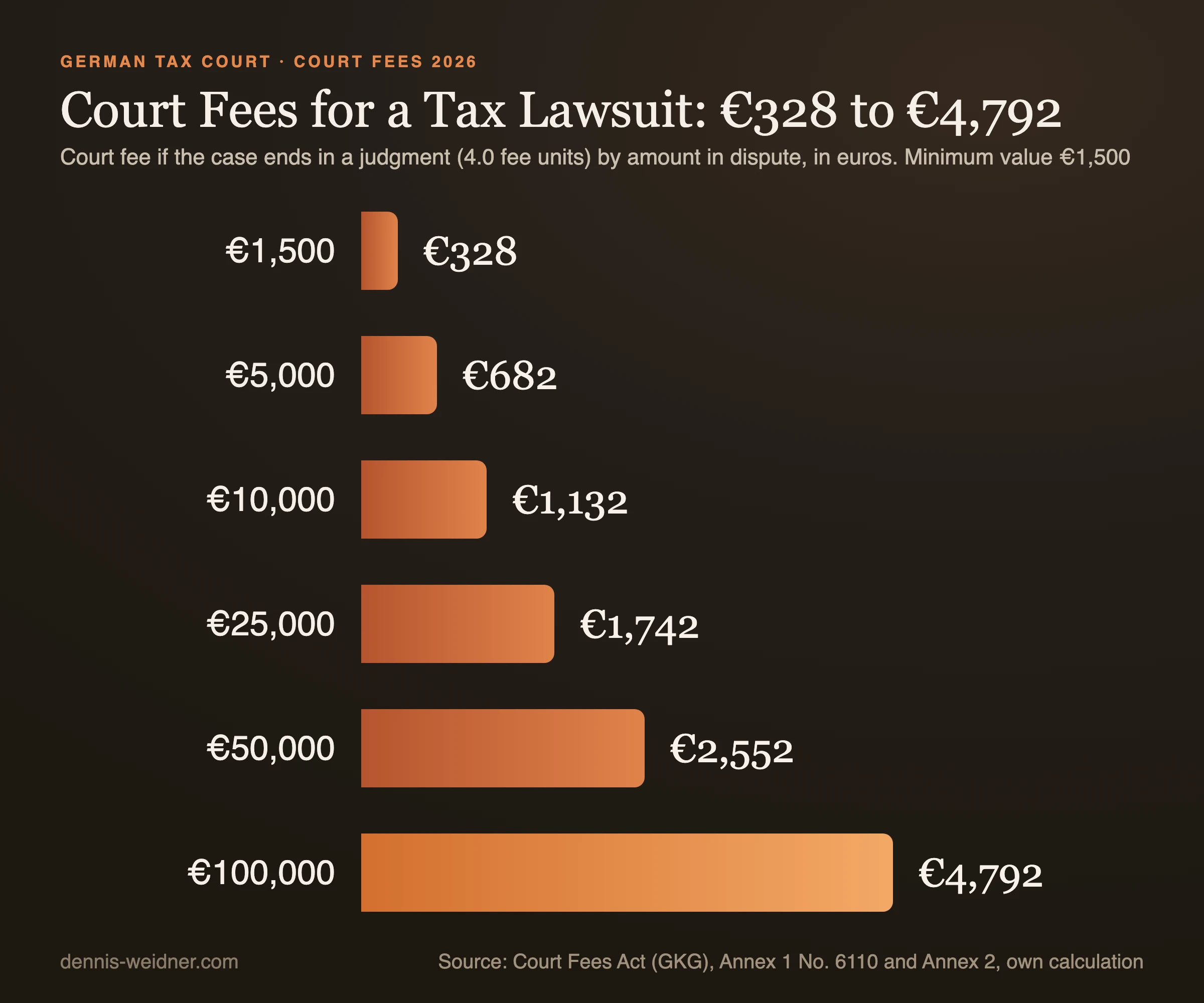
The series shows the real imbalance. Because of the minimum amount in dispute of 1,500 euros under Section 52 (4) No. 1 GKG, even a dispute over 600 euros of tax costs at least 328 euros in court fees, more than half of the amount at stake. The fee falls due when the lawsuit is filed (Section 6 (1) No. 5 GKG) and is first calculated provisionally on the minimum value (Section 52 (5) GKG), so the first invoice is usually 328 euros. If the tax office gives in during the case, it bears the costs under Section 138 (2) FGO. Fees already paid are then refunded, because the state is exempt from court fees under Section 2 GKG.
Who Pays the Tax Adviser? Cost Reimbursement Under Section 139 FGO
In the objection procedure everyone pays their own costs, even if the objection succeeds in full. The Fiscal Code contains no reimbursement rule, and Section 80 of the Administrative Procedure Act, which reimburses the costs of a successful administrative appeal elsewhere in German administrative law, expressly does not apply to tax authorities acting under the AO (Section 2 (2) No. 1 of that Act). One exception is telling: for child benefit (Kindergeld), the family benefits office reimburses the costs of a successful objection under Section 77 of the Income Tax Act.
Only a lawsuit opens the door. Under Section 135 FGO the losing party bears the costs, and under Section 139 (1) FGO these include the costs of the pre-trial objection. The adviser's fees for the objection, however, are only reimbursable under Section 139 (3), third sentence, if the court declares that bringing in an adviser for that stage was necessary. The reverse does not apply: a business owner who loses never reimburses the tax office's own expenses, Section 139 (2) FGO rules that out. And anyone who produces evidence only in court that belonged in the objection can be ordered to pay the costs despite winning (Section 137 FGO).
This is the asymmetry I criticised in the opening piece of this series, Entrepreneurs and Politics. Anyone who files late pays surcharges and interest. If the tax office makes the mistake, you get your rights, but no compensation for time and adviser fees. My wife and I have privately received several assessments with amounts recorded twice and paid for every correction at the objection stage ourselves. More than once my impression afterwards was of being treated as an awkward case: a won objection was followed by the next query. Reimbursement only comes to those who go all the way to court, and that is exactly what the objection is supposed to spare everyone. What I would like instead, binding deadlines for authorities and reimbursement of costs for wrong assessments, is set out in Political Discontent in Germany.
Appeal to the Federal Fiscal Court and the Complaint Against Refusal of Leave
An appeal on points of law (Revision) against a tax court judgment to the Federal Fiscal Court (Bundesfinanzhof, BFH) is only possible if leave is granted. Section 115 (2) FGO names the grounds: fundamental importance, development of the law, or a procedural defect. If the tax court refuses leave, what remains is a complaint against the refusal under Section 116 FGO, to be filed within one month and reasoned within two months of service of the full judgment. Representation is mandatory at the BFH: under Section 62 (4) FGO every party needs a lawyer, tax adviser, auditor or sworn accountant.
According to the Federal Fiscal Court's 2025 annual report, 40 percent of appeals ended wholly or partly in favour of taxpayers, but only 15 percent of complaints against refusal of leave. An appeal took 23 months on average, a complaint 8 months. Add the objection and the tax court before that, and years pass before a case is settled. The tax office can enforce throughout, which is why, in my view, the separation of powers kicks in too late where the tax office is concerned. An unsuccessful complaint costs 2.0 fee units under No. 6500 of the schedule, which is 1,276 euros at an amount in dispute of 50,000 euros.
Suing the German Tax Office for Damages: State Liability Under Section 839 BGB
Damages for an unlawful assessment or excessive enforcement require a state liability claim (Amtshaftung), with high hurdles. Section 839 of the Civil Code (BGB) requires an intentional or negligent breach of an official duty owed specifically to the injured party. Article 34 of the Basic Law shifts liability to the state whose tax office acted. The regional court (Landgericht) has jurisdiction regardless of the amount (Section 71 (2) No. 2 of the Courts Constitution Act), and a lawyer is mandatory there.
Two rules cut off many claims. For mere negligence, the state is only liable under Section 839 (1), second sentence, if the injured party cannot obtain compensation elsewhere. And under Section 839 (3) the claim lapses entirely if the injured party culpably failed to avert the damage by using a legal remedy. Anyone who files no objection and applies for no suspension of enforcement therefore also loses the damages later. The order is clear: meet the deadline, give reasons for the objection, apply for suspension, and only then think about state liability. More finance topics for business owners are collected under Crypto and Finance.
Frequently Asked Questions
How long do I have to object to a German tax assessment?
One month from notification (Section 355 AO). A letter counts as notified on the fourth day after posting, an assessment made available in ELSTER on the fourth day after upload.
What happens if my tax adviser misses the objection deadline?
The adviser's fault is attributed to you (Section 110 (1) AO), so reinstatement is generally ruled out. What remains is a possible damages claim against the firm.
Do I need a lawyer to sue at a German tax court?
No, you may represent yourself before the tax court (Section 62 (1) FGO).
What is the minimum cost of a lawsuit at the German tax court?
At least 328 euros in court fees if it ends in a judgment, because the amount in dispute is never set below 1,500 euros.
Are the costs of a successful tax objection reimbursed in Germany?
No, the objection procedure has no cost reimbursement, except for child benefit under Section 77 of the Income Tax Act. Adviser fees for the objection are only reimbursed if you then win at the tax court and the court declares the adviser's involvement necessary.
Can I sue the German tax office for damages?
Yes, through state liability under Section 839 BGB and Article 34 of the Basic Law at the regional court. The claim lapses, however, if an objection or a suspension application could have averted the damage.
Note: This article is not tax or legal advice. It describes the legal situation in Germany as of 25 September 2026 and deliberately simplifies: the table contains court fees only, without expenses and adviser fees, and special rules apply to child benefit and attachment orders. If a deadline is running, the case belongs with a tax adviser or specialist tax lawyer immediately.
Best,
Dennis Weidner
Note: AI tools supported me in writing this article, and some images were edited with AI. I stand behind its content and every statement with my name.