On Halloween night 2026, the protests of the German initiative “Gen Z regelt” (roughly “Gen Z sorts it out”) turned violent in several major cities. On the afternoon of 31 October, more than 100,000 young people in over 30 cities marched against military conscription, for more money in education and against the rising cost of living, according to the organisers. In the evening, rioters looted shops on Frankfurt’s Zeil shopping street and broke into a gun shop, barricades burned in Hamburg, police seized Molotov cocktails next to Cologne Cathedral, and in Berlin stones and fireworks were thrown at officers. Police first reported around 200 arrests and detentions and at least 45 injured officers; reports up to 3 November add up to around 250 arrests and detentions and at least 167 injured officers, 100 of them in Frankfurt alone. I will say it plainly: this night was foreseeable, and it is a wake-up call that nobody can afford to ignore this time.
As of 3 November 2026, extended with the police reports and the first replies to my questions. Police figures are preliminary, I will update them.
More on this topic: Politics & Society, with background, practice and every article in one place.
Gen Z Riots in Germany: Key Facts
- 31 October 2026: “Gen Z regelt” calls for protests in more than 30 cities, over 100,000 people attend according to the organisers, the afternoon stays largely peaceful.
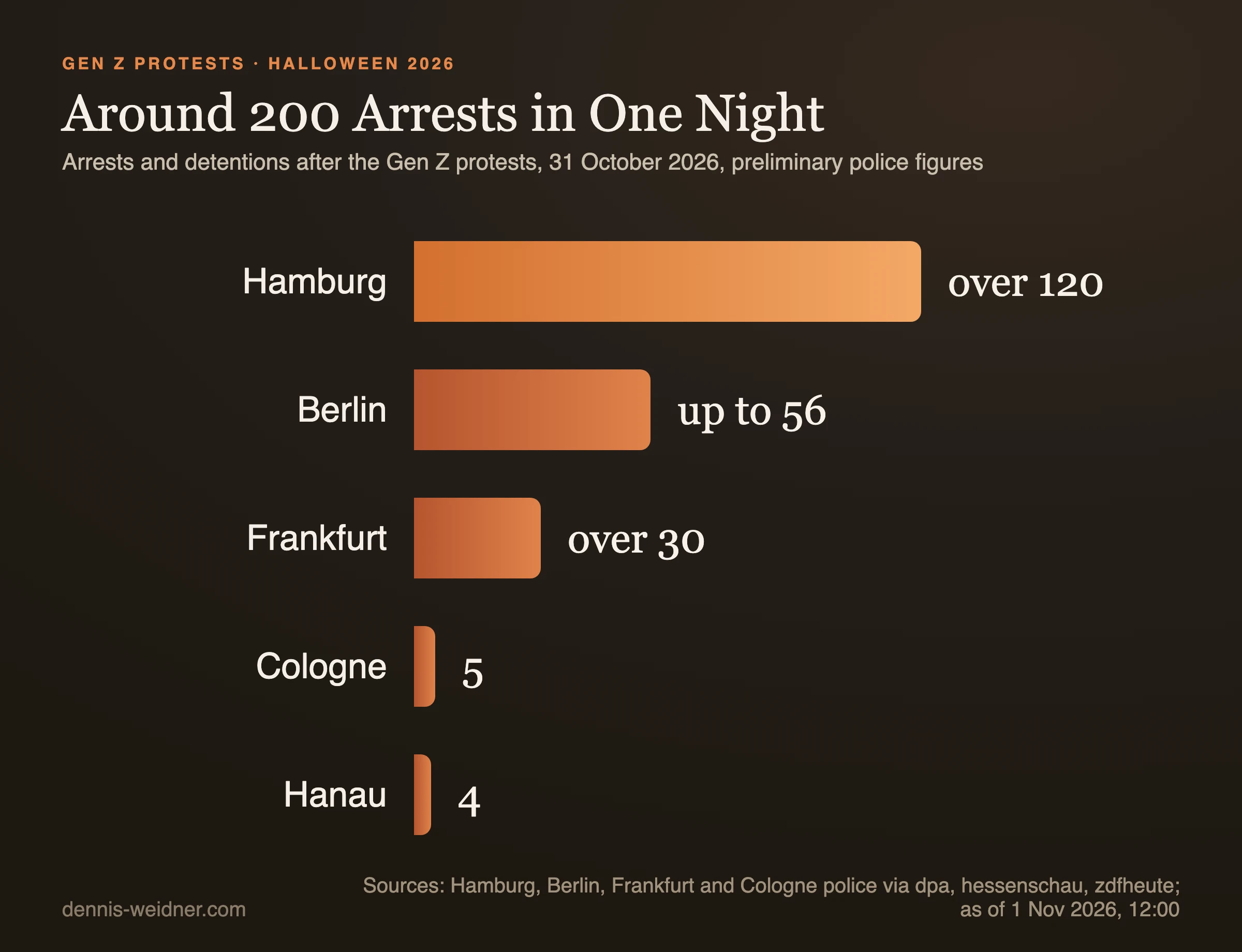
- Now around 325 arrests and detentions according to reports up to 9 November, up from around 250 at first: Hamburg 137, Berlin 125, Frankfurt 54, Cologne at least 5, Hanau 4, plus almost 1,000 identity checks in Cologne alone.
- Now at least 282 injured officers in five cities, up from 167 at first: 180 emergency personnel in Frankfurt, 42 in Hamburg, 32 in Berlin, 23 in Cologne and 5 in Stuttgart. There is still no official national total, and the Federal Criminal Police Office is not producing a separate situation report on the night.
- Around 45 damaged premises and 10 affected shops in Frankfurt according to the police, up from 17 damaged and 5 looted shops at first. According to the police, 2 weapons were stolen from the gun shop that was attacked, and both have been recovered.
- Around 2,600 officers in Hamburg (around 1,300) and Frankfurt (up to 1,300 at peak) alone, with water cannon, special forces and helicopters.
- 9 offices had answered my questions to 24 addresses by 3 November, the deadline is 10 November.
- 20 November 2026: The initiative plans to join Europe-wide protests, and an alliance is calling for an international youth strike day.
What Happened in the Gen Z Protest Cities on Halloween Night
The pictures look alike from city to city: banners, music and speeches in the afternoon, masked groups, pyrotechnics, bottles and stones in the evening. The German police union put it this way: the actual protests were very peaceful, the situation escalated in some cities after they ended. That “after” is exactly the problem. For the shop owner on the Zeil, it makes no difference whether the stone flies an hour after the official end.
Frankfurt: Looting on the Zeil and a Gun Shop
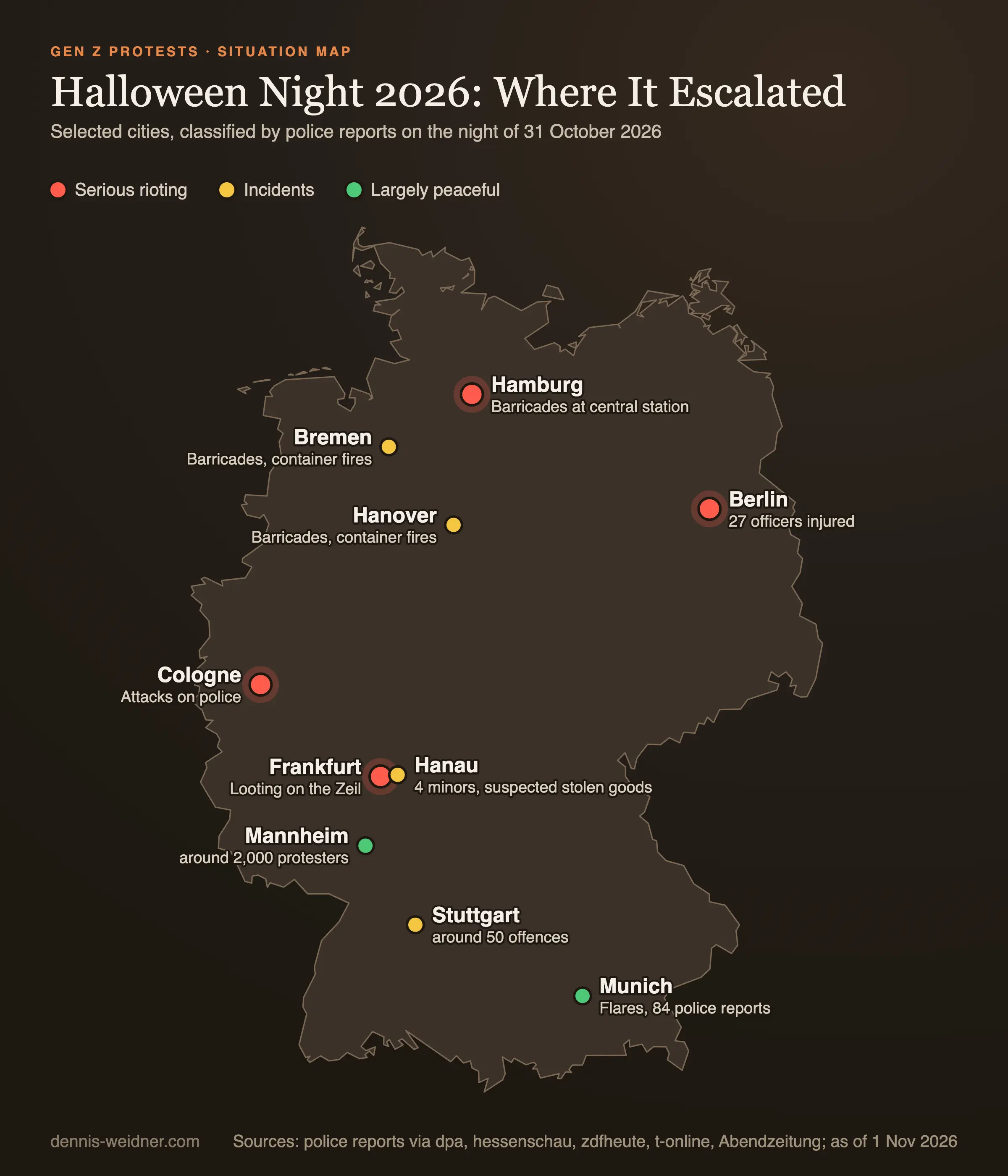
Frankfurt was hit hardest. According to hessenschau, the march itself drew around 8,000 largely peaceful people, and the organisers expressly distanced themselves from the violence. After it ended, rioters broke into shops on the Zeil on Saturday evening, according to police; a shoe shop and a perfumery were looted and shop windows smashed. Police now count five looted and 17 damaged shops. Molotov cocktails were thrown at officers. Rioters also forced their way into a gun shop, where police arrested several people and first reported recovering two weapons; the later report speaks of blank-firing guns. The Zeil was sealed off and special forces moved in, the situation only calmed down around 3 am. On Sunday morning police first reported more than 30 provisional arrests and “considerable” damage. At midday, police and the interior ministry presented a first report: 54 arrests, 100 injured officers, one of them seriously, 87 criminal complaints, 1,225 orders to leave and 366 people checked. Those arrested were aged between 13 and 29. The report gives no total for the damage. In nearby Hanau, four minors were caught with suspected stolen goods from Frankfurt.
Hesse’s interior minister Roman Poseck (CDU) first spoke of a “devastating combination of left-wing extremists and violent young people” and named around 100 violent offenders. On Sunday he put the troublemakers at an estimated 1,000 to 1,500 and described them as predominantly “from a migrant background”, while saying most of those arrested were German citizens. Jost Wiebelhaus of the Frankfurter Laufshop, whose windows were smashed, said everyone had been taken by surprise. At the running shop, the damage was material only.
How far it went is shown by one police car in Frankfurt. In a clip by @monrox.34 with more than 36,000 likes, masked people go at the vehicle with e-scooters while its blue lights are flashing. @reezay.kay filmed the same car afterwards, its rear window smashed.
Hamburg, Cologne, Berlin and the Other Cities
In Hamburg, around 6,700 people demonstrated at the Jungfernstieg at peak, mostly peacefully, according to police. During the march and afterwards, masked people tore construction barriers out of their anchors near the central station and set them alight, police put out the fires with a water cannon. In the Dulsberg district, nearly ten cars burned. Early reports spoke of over 120 people arrested or detained, among them, according to Bild, a 13-year-old who allegedly threw a heavy firework at police, and of eleven injured officers. On 2 November, Hamburg police told me on request of 129 provisional arrests and eight people taken into custody; 120 of the arrests, in the Bremer Reihe area, were on suspicion of aggravated breach of the peace, among them 43 juveniles. Twelve officers were injured.
In Cologne, the protest stayed a stationary rally on the Rhine embankment. Cologne police, who are also the assembly authority in North Rhine-Westphalia, did not allow a march through the city because of masked participants and pyrotechnics. Police say only a stationary rally had ever been registered, the organisers disagree, according to taz. Officers were attacked after the rally ended around 4 pm, and police used water cannon. Late in the evening, bottles and bicycles were thrown at police on the cathedral square. Police seized Molotov cocktails and emergency hammers from masked people. Their first report of 1 November counts 23 injured officers, five damaged patrol cars and almost 1,000 identity checks. The groups roaming the city centre from midnight had no connection to the rally, according to police. In Berlin, police counted around 5,000 people at the Brandenburg Gate, and a separate evening march from Rosenthaler Platz, from which “Gen Z regelt” distanced itself, ended early after eggs, bottles, fireworks and stones were thrown: 27 officers slightly injured, up to 56 people temporarily detained.
Stuttgart police counted around 50 offences and five injured officers, barricades and containers burned in Hanover and Bremen. Munich (around 5,000 people), Mannheim (2,000), Düsseldorf (2,500), Leipzig (7,000) and Dresden (3,000) stayed largely peaceful, although police in Düsseldorf still seized a firework bomb and a knife.
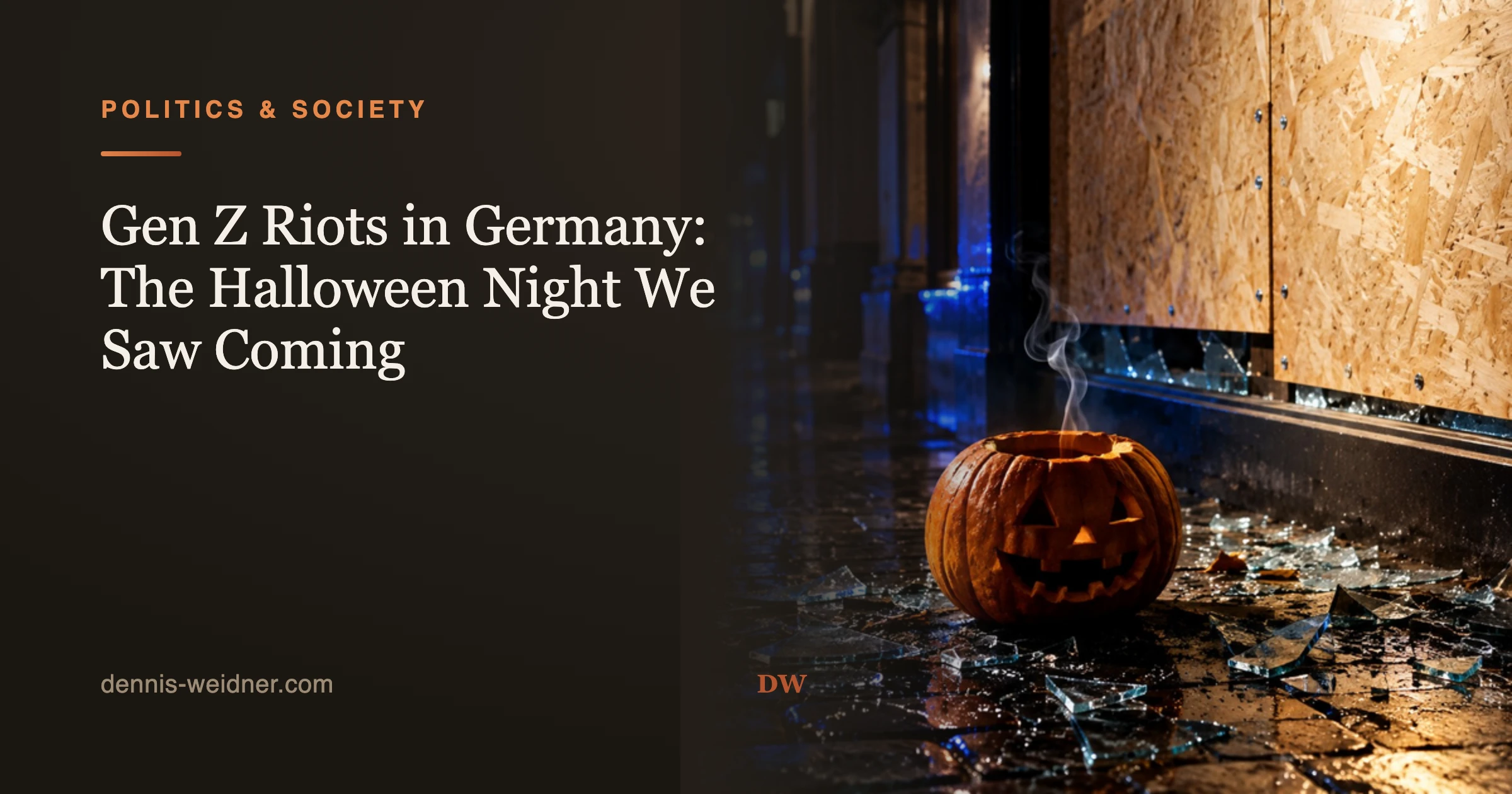
On Sunday morning, street cleaners and shop owners swept up the glass. Under some videos I read comments like “not that much got broken” or “construction fences always fly”. Whoever writes that has never paid rent for a shop. And whoever turns up with a broom the morning after deserves more respect than anyone who filmed the night before.
Gen Z Regelt: Who Is Behind the Protests and What They Want
“Gen Z regelt” is not an established organisation but a call that spread on social media within a few weeks. According to taz, the organising team consists of around 30 people aged 18 to 28 who did not know each other before. The website’s legal notice names an 18-year-old high school student who says he built the site partly with AI. Of the 24 protests planned at the time, the initiative itself ran five, for the rest it was still looking for organisers and stewards. Who funds the initiative is not publicly known.
The demands are broad: no cuts to education, no conscription, relief from living costs, more climate protection, no expansion of state surveillance. Some deserve a debate, education urgently so. Left-wing youth groups supported the protests, Fridays for Future declared its solidarity on Instagram with the young people protesting peacefully. By comparison, Fridays for Future Germany is listed in the Bundestag lobby register and says it is funded mostly through small donations. For “Gen Z regelt”, taz sees no established funders so far, and there is no disclosure. For an initiative that brings over 100,000 people onto the streets, that is not enough.
After the night, the initiative wrote that violence was never part of its movement, and that it had no influence on what happened after the rallies ended. That may be formally true. But whoever calls tens of thousands into city centres on Halloween without running most of the protests itself is responsible for the setting they create.
Why the Gen Z Riots Were Foreseeable
- The press spokesman quit. Co-organiser Gianni Matheja, 21, stepped down after one day, citing repeated calls for violence in internal groups.
- The domestic intelligence service warned that left-wing extremists could exploit the protests, and that foreign-related extremist groups were mobilising too.
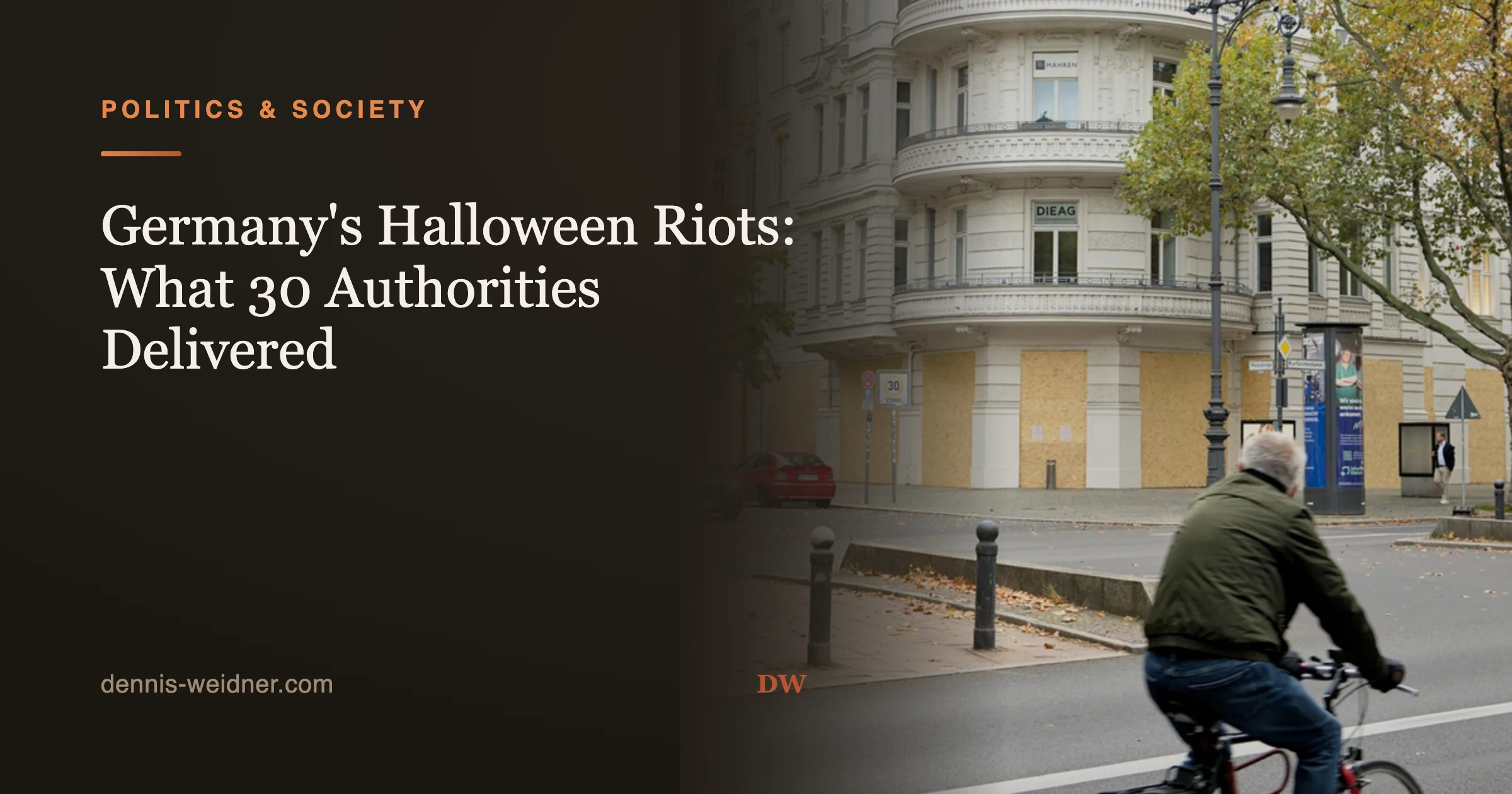
- Retailers boarded up. On Berlin’s Kurfürstendamm, Tiffany, Prada and Gucci covered their windows with chipboard on Friday, Chanel even its pavement signs.
- Halloween and masks. Public broadcaster hessenschau reported in advance how Halloween costumes complicate police work.
- Calls online. Criminal lawyer Nils Genten warned on Instagram on Halloween day that social networks were calling for riots that night.
The protests did not have to take place on Halloween. On a Saturday evening that was itself a public holiday, Reformation Day, in nine states, when masks are normal and young people are out in groups anyway, the pictures of the night were priced in.
Who Rioted: What the Interior Minister and the Police Say
Federal interior minister Alexander Dobrindt (CSU) told Bild that violent left-wing groups and troublemakers from a migrant milieu had hijacked the peaceful protests. Hesse’s interior minister first spoke of left-wing extremists and violent young people, then of troublemakers predominantly “from a migrant background”, while most of those arrested are German citizens. Frankfurt police distinguish between a smaller group that turned violent towards the end of the march and others behind the later looting, above all young men with a migrant background from groups that meet in the city centre at weekends and are known to them. Naming this is not incitement, it is the precondition for solving the problem.
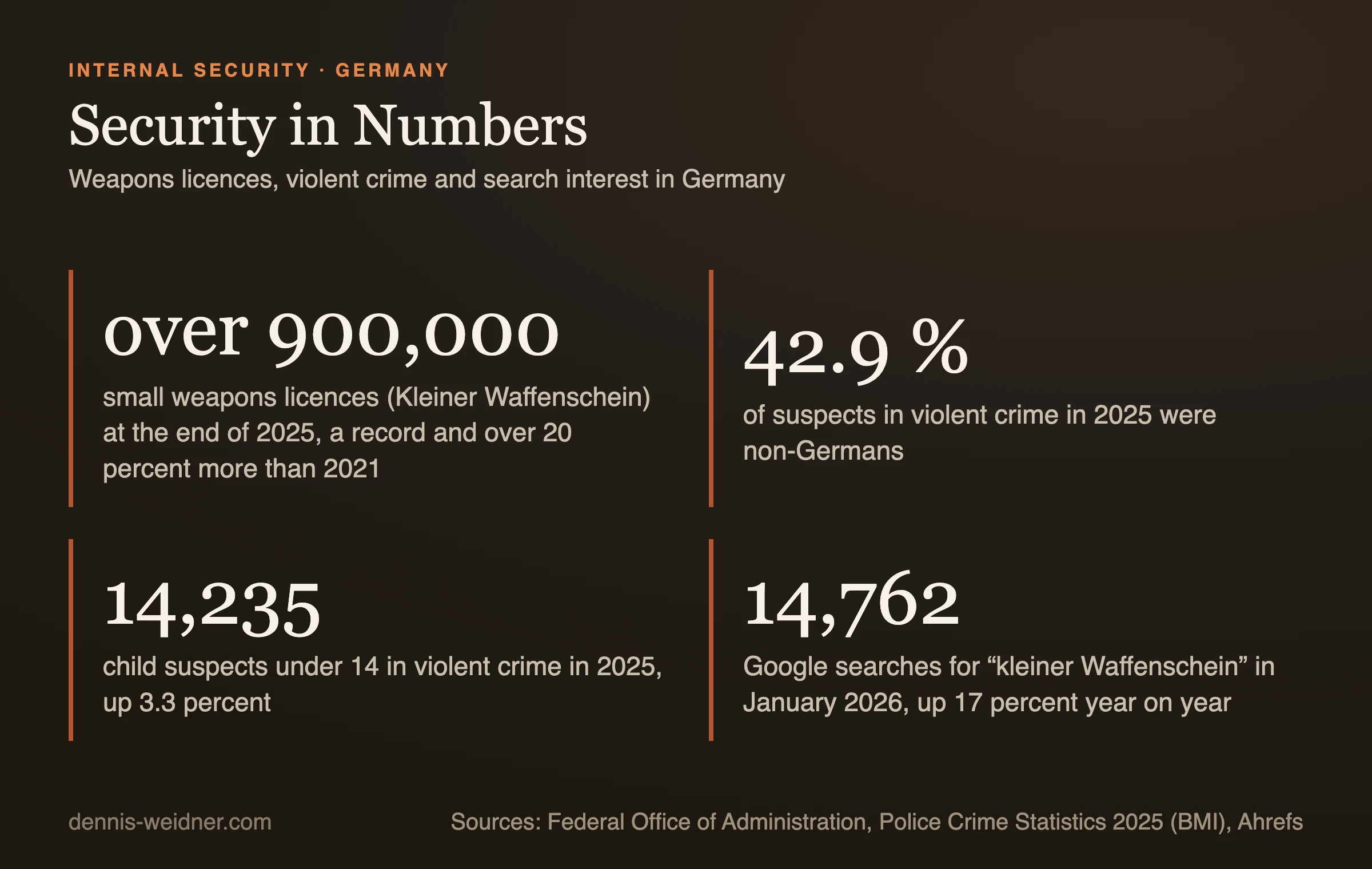
The figures: in the 2025 police crime statistics, 42.9 percent of suspects in violent crime were non-German nationals. Violent crime fell slightly to 212,335 cases, while child suspects under 14 in violent crime rose by 3.3 percent to 14,235. Important for any debate: the statistics record nationality and residence status, not the migration background of German citizens.
Could the Gen Z Protests Have Been Banned?
In short: a ban in advance was legally difficult, conditions were possible, and after this night the situation for 20 November is different. Article 8 of the German Basic Law protects peaceful assembly. Since the Federal Constitutional Court’s Brokdorf decision of 1985, a ban requires concrete facts pointing to an immediate danger, and violent individuals do not strip the peaceful majority of its rights. Authorities can impose route changes, mask bans, glass and firework bans and exclude known offenders. In Stuttgart the march was routed around the inner city, in Cologne police did not allow a march at all. Poseck has since called the 20 November protests into question, while the Frankfurt law professor Matthias Jahn warns against hasty calls for bans. My question to the authorities: how many nights like this does it take until the facts suffice? After 31 October, Molotov cocktails, emergency hammers and a raided gun shop are on the table.
What Rioters Face Under German Law
In Hamburg, 43 of the 120 people arrested in the Bremer Reihe area were juveniles, and in Frankfurt the age range started at 13. Children under 14 cannot be held criminally responsible, so a 13-year-old will not be punished. For 14 to 17-year-olds, juvenile criminal law applies, focused on education: instructions, community service, youth detention of up to four weeks, or youth imprisonment of six months to five years (Section 18 JGG). Adults face up to three years for breach of the peace and six months to ten years for aggravated breach of the peace, for example with looting (Section 125a StGB).
For offenders without German citizenship, Section 54 of the Residence Act establishes a particularly serious interest in expulsion after a conviction for breach of the peace of at least one year, or six months if a weapon was used. The law exists. It needs to be applied. My demand: proceedings in weeks instead of years, youth detention where it belongs, and consistent expulsion where the law allows it.
Who Pays: Business Owners, Insurance and Policing Costs
The bill lands first with those who are not to blame. Retailers on the Zeil or the Kurfürstendamm paid for chipboard, tradespeople, security guards and lost opening hours. Whether insurance pays depends on the small print: in many German contents policies, damage from civil unrest is only covered by an add-on, often called extended coverage, and precautionary costs are usually borne by the retailer. This is not legal advice. In Germany, the state is generally not liable for riot damage. France goes further: under Article L211-10 of its internal security code, the state is liable for damage caused by riotous gatherings.
Hamburg and Frankfurt alone had around 2,600 officers on duty. Nobody has yet put a figure on the cost. Bremen shows that costs can be passed on: the city state bills the German Football League for extra policing at high-risk matches, and the Federal Constitutional Court confirmed this in January 2025. Why should convicted rioters not pay for their deployment too?
Germany and France: How Close Are We to Paris?
On the same Saturday, according to the French interior ministry, 320,000 people protested in France against the high cost of living, 565 were arrested, and night-time curfews applied in parts of Paris. A week earlier the ministry counted 1,314 arrests and 53 injured officers, the weekend before 1,522 looted shops, 2,025 arson attacks and 1,144 injured officers.
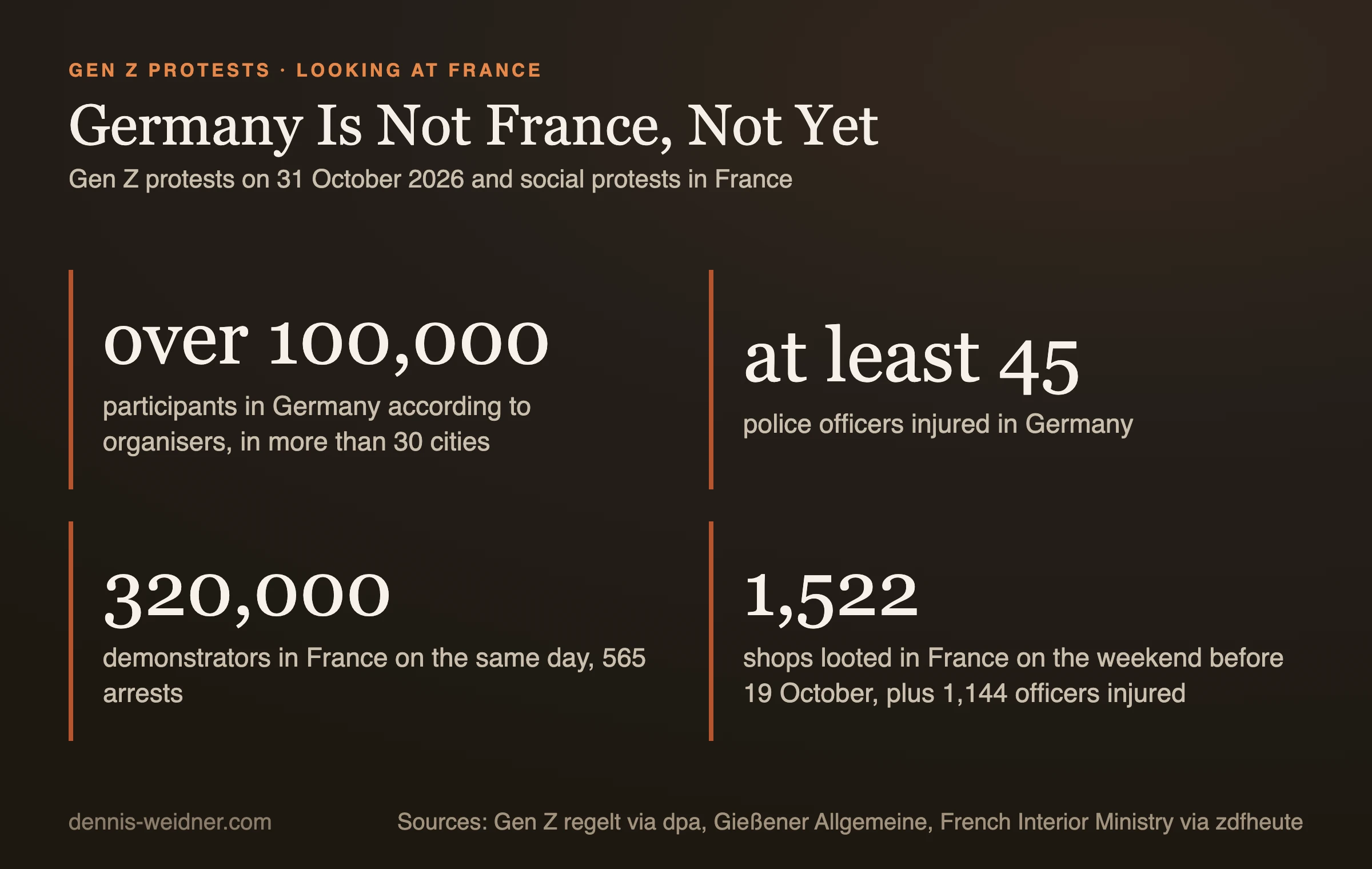
Dobrindt says the police prevented excesses like in Paris, and for this night that is true. The police did a strong job, and my thanks go to every officer who was hit by bottles and fireworks. But France shows what happens when one night turns into a series. The initiative itself calls 31 October “only the first step”.
This was predicted long ago. Thomas L. Kemmerich, briefly Minister-President of Thuringia in 2020, shared a clip on it, “the images from the streets of Europe speak a clear language”. In it, the foreign minister of the United Arab Emirates, Abdullah bin Zayed, warned back in 2017 that Europe believes it understands the Middle East and Islam better than the region itself, and that political correctness and a lack of decision-making would make it produce more extremists (Arab News). For me, that is the core: we ignored such warnings, we do not enforce our own rules, and so we are letting our country slide.
Neubauer, Bohlen and the Silence After the Riots
Two of Germany’s best-known voices backed the protests on Halloween day. Music producer Dieter Bohlen posted “It is right that you are losing your temper”, 49,000 likes. Climate activist Luisa Neubauer wrote “Young people are organising and Germany goes crashout”, 23,000 likes. Both surely meant peaceful protest, but words have an effect. In their Instagram posts there was no word about the looting, the Molotov cocktails and the injured officers by Sunday 1:50 pm, and I found no statement from the chancellor either. Whoever cheers beforehand has to take a position afterwards. Reach is not the currency that matters. Courage and decency are.
Self-Protection Instead of Trust in the State
At the end of 2025, more than 900,000 small weapons licences were registered in Germany, a record and over 20 percent more than in 2021. They allow carrying blank, irritant and signal guns. Searches for “kleiner Waffenschein” reached around 14,800 in January 2026, 17 percent more than a year earlier. I did judo as a teenager and later kickboxing, and I can only recommend that parents send their children to a good club early, not to hit, but to learn confidence, discipline and how to avoid a situation. At the same time, the monopoly on force lies with the state, and self-defence under Section 32 StGB allows only what is necessary against an ongoing unlawful attack. I understand everyone who thinks about leaving, and I have written about emigrating as an entrepreneur.
And then there are clips where you do not know whether to laugh or cry. According to the caption, the police of Saxony-Anhalt posted a video themselves in which a female officer kicks her colleague during a training session. The account @ahmetrefiidener asks: “Is that supposed to make people want to join the police?” Anyone who still wants to join the police today needs a sense of humour, and the political backing that is missing on nights like this one.
The Algorithm as an Accelerant: My Instagram Self-Test
For this article I watched the night on Instagram, video by video. After a few clicks and comments, the algorithm showed me more and more: first riot videos, then angry comments, then influencers from the far right with slogans like “we are taking our homeland back”. I described the mechanism in my piece on social media algorithms and radicalisation. Whoever wants to understand what happened quickly ends up in a hole that radicalises, at any age. Then you no longer side with the one who destroys, but with the one who wants to destroy the other. Both are wrong. We are being pushed into two camps, and the centre that solves problems has delivered too little for years. That is how a powder keg forms. More on this in my piece on the political centre and the AfD firewall.
Some of what circulates there is hard to bear. A clip by @ahmetrefiidener from 1 November shows crowds at night; according to the caption, people are chanting “Juden raus!” (“Jews out!”), while others face criminal complaints just for commenting on the situation. The account does not say where or when it was filmed. For me it is clear: anyone who chants “Jews out” in the middle of Germany may be committing incitement to hatred under section 130 of the German Criminal Code, and that must be prosecuted as consistently as any hateful comment online.
Why Independent Voices Depend on Instagram and X
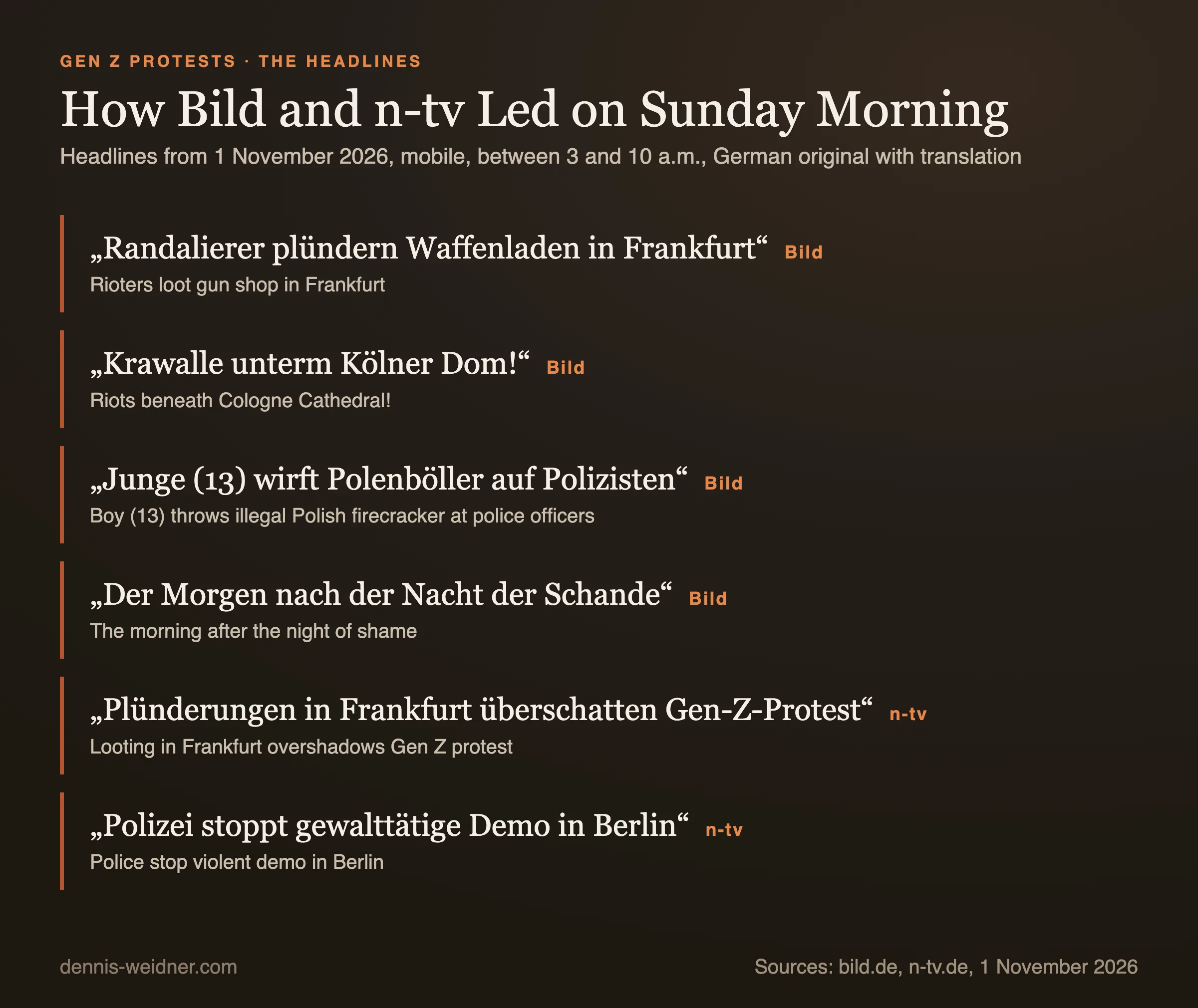
A word on the images in this piece. On Sunday morning, Bild led with “The morning after the night of shame”. The photos behind such headlines usually belong to agencies like dpa. Large publishers pay for licences, an independent author would have to buy each picture individually. I was once sent a cease-and-desist letter by dpa in another context and paid a three-figure sum. That is why I embed Instagram videos here, with the creator’s name and a link to the original.
Ten Questions for Interior Ministers, Committees and Police
Condemnation alone is not enough. I am sending concrete questions to the Bundestag interior committee, the federal interior ministry, the interior committees of the state parliaments in Hesse, Hamburg, North Rhine-Westphalia and Berlin, the police headquarters in Frankfurt, Hamburg, Cologne and Berlin, and the home affairs spokespeople of all parliamentary groups. I will publish the answers here, and the silence too.
- How many officers were deployed nationwide on 31 October, and what did the operation cost?
- How many police vehicles were damaged, and what is the damage to public infrastructure?
- How high is the damage for retailers, and is there support for those affected?
- How many weapons are missing after the raid on the Frankfurt gun shop?
- How are those arrested distributed by age, nationality and residence status, and how many were already known to police?
- How many investigations for breach of the peace are under way, and how many use the simplified juvenile procedure?
- In how many cases are immigration authorities examining expulsion under Section 54 of the Residence Act?
- What did intelligence and police know about calls for violence before 31 October, and why did this not lead to stricter conditions?
- What conditions are planned for the protests announced for 20 November?
- Are the states examining passing policing costs on to convicted offenders?
Update of 12 November: Federal Interior Ministry and Hamburg Public Prosecutor
The Federal Interior Ministry replied on 11 November. According to its press office, more than 18,500 state police officers were deployed across Germany in connection with the protests on 31 October, along with 2,682 officers of the Federal Police. Planning, carrying out and financing the operations lies with the responsible state authorities, the reply says. According to what is known so far, the ministry writes, the riots were shaped in particular by young, thrill-seeking and generally criminal milieus, and people without German citizenship were involved in many cases. For details on those arrested and on expulsions under section 54 of the Residence Act, the ministry refers to the authorities in the states.
According to its spokeswoman on 11 November, the Hamburg public prosecutor's office has not yet received any cases relating to the night. All proceedings are still being handled by the police.
Update of 10 November: Berlin Police and the Federal Criminal Police Office
Berlin Police answered my questions on 9 November. Across the city, 125 people were arrested and 87 investigations opened, seven of them on suspicion of particularly serious breach of the peace. Everyone arrested has been released again, and no arrest warrant was issued. 32 police officers were injured. As of 4 November, those arrested included 6 children, 74 juveniles, 17 young adults and 28 adults, and 91 of them hold German citizenship. One police vehicle was daubed with paint, and the police cannot yet put a figure on the damage. Around 1,500 additional officers were deployed, supported by the Federal Police and the police forces of Mecklenburg-Western Pomerania and Thuringia. The State of Berlin bears the costs, which are covered by a lump sum in the state budget and are not calculated in detail.
The Federal Criminal Police Office is not producing a separate situation report on the night. According to a spokesperson, offences connected with the demonstrations under the title "GenZ" are included in the figures for politically motivated crime but cannot be shown separately there, and reports from the states arrive with a delay. The office had no specific calls for violence before 31 October. By the deadline I had not heard back from the Federal Interior Ministry, the Hesse interior ministry, Cologne Police, the Hamburg public prosecutor or the five parliamentary groups in the Bundestag. I am following up with them and will add whatever arrives here. What has developed in the two weeks after the night is set out in my review two weeks after the Halloween riots. What 30 authorities replied in three weeks is set out in my evaluation three weeks after the Halloween riots.
Update of 7 November: Frankfurt Police Have Replied
Frankfurt am Main Police answered my questions on 6 November; the figures are as of 4 November and provisional. In Frankfurt, 180 emergency personnel were injured, and one officer suffered serious dental injuries from a thrown stone. 54 men were arrested, and one of them is in custody: an 18-year-old is accused of stealing a weapon from the gun shop. Two of those arrested were younger than 14, 13 were between 14 and 17, 22 between 18 and 21 and 17 older than 21, the oldest being 45. Half hold German citizenship, and just under half of those also hold another nationality. Around 45 premises were damaged, and ten shops were looted, entered without permission or hit by theft. Two weapons were stolen from the gun shop, and both have been recovered. The police cannot yet put a figure on the damage; numerous files have come in through the tip-off portal and are now being reviewed.
Two more replies came in: the public prosecutor in Frankfurt is not yet giving any information because the investigation is at a very early stage. The Berlin public prosecutor general writes that the cases have not yet been referred to it and points me to Berlin Police. The deadline for the remaining enquiries runs until 10 November, and I will add whatever arrives here.
Update of 3 November: Who Has Replied So Far
The questions went to 24 addresses at federal, state, police and city level on 1 November, with a deadline of 10 November. By the evening of 3 November, nine offices had replied: one with figures, six referring me elsewhere, two acknowledging receipt. What the offices have replied since, and who is responsible for costs, conditions and support for retailers, is set out in the follow-up article on who pays for the riots.
| Received | Office | Reply |
|---|---|---|
| 1 November | Berlin police | Acknowledgement, extensive requests can take several days |
| 1 November | City of Frankfurt | Questions on the operation to the police; on shops, the city’s press release: talks planned, the city is looking at support |
| 2 November | Berlin Senate, interior and sport | Referred me to Berlin police |
| 2 November | Frankfurt public order office | Questions on the operation to the police, the rest to the city press office |
| 2 November | Hesse state parliament | Referred me to the interior ministry, pointed to a Greens request for a report and the session on 25 November or earlier |
| 2 November | North Rhine-Westphalia state parliament | Referred me to the interior ministry, investigations to the public prosecutors |
| 2 November | Bundestag press office | The questions fall within the remit of the federal government |
| 2 November | Frankfurt police | Acknowledgement, will try to meet the deadline |
| 2 November | Hamburg police | Preliminary report: 129 provisional arrests, eight people taken into custody, twelve injured officers, around 40 criminal complaints; no assessment yet of future protests |
By then I had no reply from the federal interior ministry, the interior ministries of Hesse, Hamburg and North Rhine-Westphalia, Cologne police or the five Bundestag groups. Cologne police have published their own report. The deadline runs until 10 November for everyone, and I will add whatever arrives here.
Correction of 3 November: This article first said the city of Cologne had banned the march. In North Rhine-Westphalia the police are the assembly authority, and police chief Hermanns defended the ban himself.
My Position as a Founder From Hamburg
I grew up in Hamburg, including in neighbourhoods now called problem areas. I have many friends with foreign roots, and there was trouble back then too. But there were limits: you did not kick someone lying on the ground. Today I see videos of pupils doing exactly that, and a night in which children throw fireworks at police. I am currently neutral in party terms, but I understand everyone who votes for the AfD. Many of these voters are not just protesting. They want their country to be safer again, and they can no longer accept how first the previous coalition and now the government of the CDU/CSU and SPD handle these problems. What choice do they have? The Greens? Anyone who does not want climate protection to trump everything while the economy is shut down cannot vote for them. The Left Party? Anyone who goes to work every morning does not vote for a party that would rather hand money out than see it earned first. And since Christian Lindner left, the FDP is gone; it is not even in the Bundestag any more. That does not leave much. I notice in myself how quickly you end up seeing yourself as a protest voter, and anyone who had to vote today may well conclude that the AfD is a party you can vote for. I share neither attitude nor values with some people in individual state branches and currents of the party. But there are also people with real expertise there, for example in economic and defence policy. And in another inquiry, at first only the AfD group got back to us. When we asked all five parliamentary groups in the Berlin House of Representatives for gruenderfreunde.de on 8 October why the tax administration has been exempt from the freedom of information act since April (printed paper 19/2999), so citizens can no longer check how fast their tax offices work, only the AfD group’s press spokesman answered, on the same morning, and nobody else has done so by today, 1 November. According to him, the group chair turned it into a written question to the Senate. The Left, the Greens, the CDU and the SPD sent nothing, not even an acknowledgement. Just imagine that. On 1 November we asked them again and gave them until 9 November. On 3 November the CDU group replied as well, and I will set out its answer alongside the others once the deadline has passed. By then there was no reply from the Left, the Greens or the SPD. Who actually supervises tax offices is explained in my piece on how German tax offices are supervised. If the centre does not solve the problems and answers every criticism only with the firewall, it drives people there. We are no longer in an election campaign. We are in reality, and reality demands change within weeks, not years. More on what entrepreneurs expect from politics in entrepreneurs and politics and on political discontent in Germany. Further pieces in politics and society. Write to me about how you experienced the night, I answer every message.
Frequently Asked Questions About the Gen Z Riots in Germany
What is “Gen Z regelt”?
A protest initiative that formed on social media in October 2026, with an organising team of around 30 people aged 18 to 28. It calls for more money for education, no conscription, relief from living costs and more climate protection. On 31 October 2026 it called for protests in over 30 German cities.
Which cities saw riots after the Gen Z protests?
Serious rioting occurred in Frankfurt, Hamburg, Cologne and Berlin, with incidents in Stuttgart, Hanover, Bremen and Hanau. Munich, Mannheim, Düsseldorf, Leipzig and Dresden stayed largely peaceful.
How many arrests were there on Halloween 2026?
Around 250 arrests and detentions according to preliminary police figures up to 3 November: Hamburg 137, Berlin up to 56, Frankfurt 54, Cologne at least 5 and Hanau 4. At least 167 officers were injured, 100 of them in Frankfurt alone.
What do young rioters face in Germany?
Children under 14 are not criminally responsible. For 14 to 17-year-olds, juvenile law applies with instructions, community service, youth detention of up to four weeks or youth imprisonment of six months to five years. Adults face six months to ten years for aggravated breach of the peace such as looting.
Does insurance cover looting in Germany?
It depends on the policy. Damage from civil unrest, including looting, is often only covered by an add-on. Precautionary costs such as boarding up windows are usually borne by the retailer.
Best,
Dennis Weidner
Note: AI tools supported me in writing this article, and some images were edited with AI. I stand behind its content and every statement with my name.