So far, nobody has named me a single body that adds up, for all of Germany, what the riot night of 31 October cost. On 1 November I wrote to 24 addresses at federal, state, police and city level. After 48 hours, nine had replied: six referred me elsewhere, two confirmed receipt, and one delivered figures, Hamburg Police. By the deadline of 10 November, 21 of the 30 bodies I asked had replied, including by now Berlin Police and the Federal Criminal Police Office. This article shows who answered what, who is responsible for what and who foots the bill. The organisers of "Gen Z regelt" have distanced themselves from the violence, and according to hessenschau the Frankfurt demonstration of around 8,000 people stayed largely peaceful.
Gen Z Riots in Germany: Key Points on Responsibility
- 30 bodies, 21 replies: That is the position on 10 November, when the deadline ended. 9 bodies had not been in touch by then, among them the Federal Interior Ministry and the five parliamentary groups in the Bundestag. 48 hours after my enquiry of 1 November, it was 24 addresses and 9 replies.
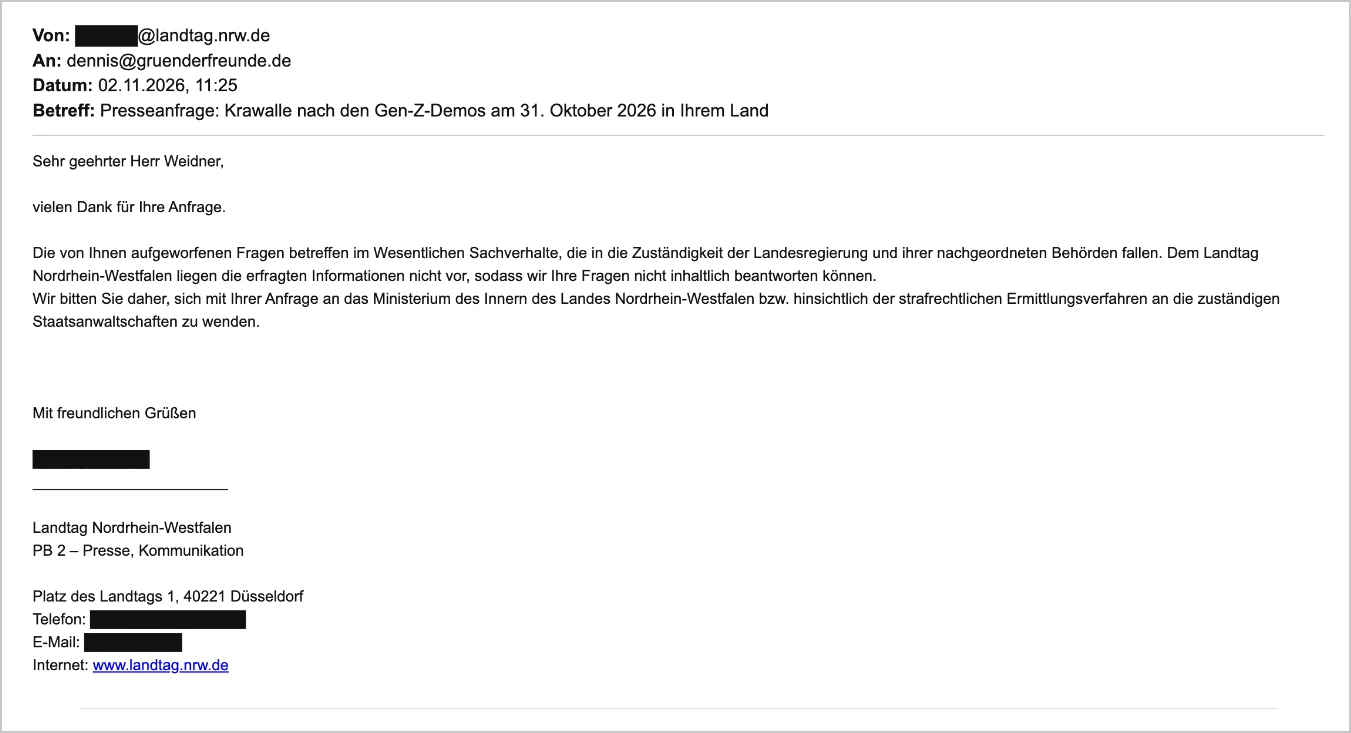
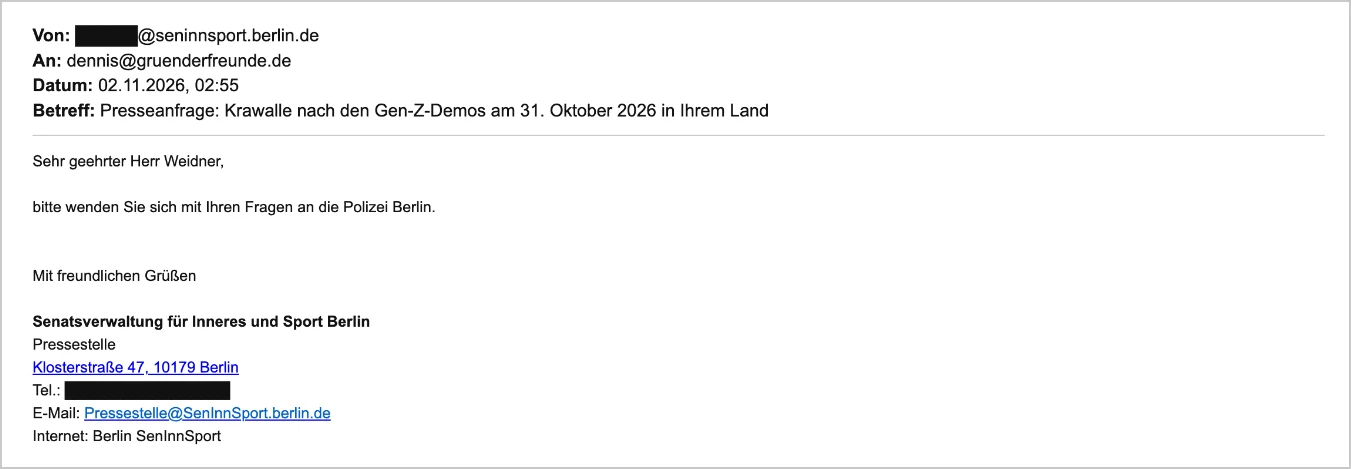
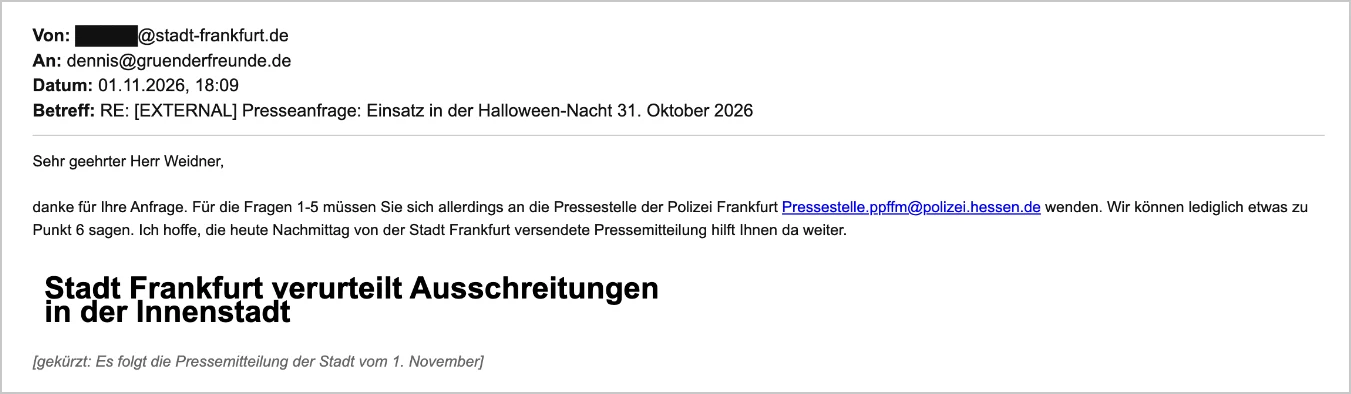
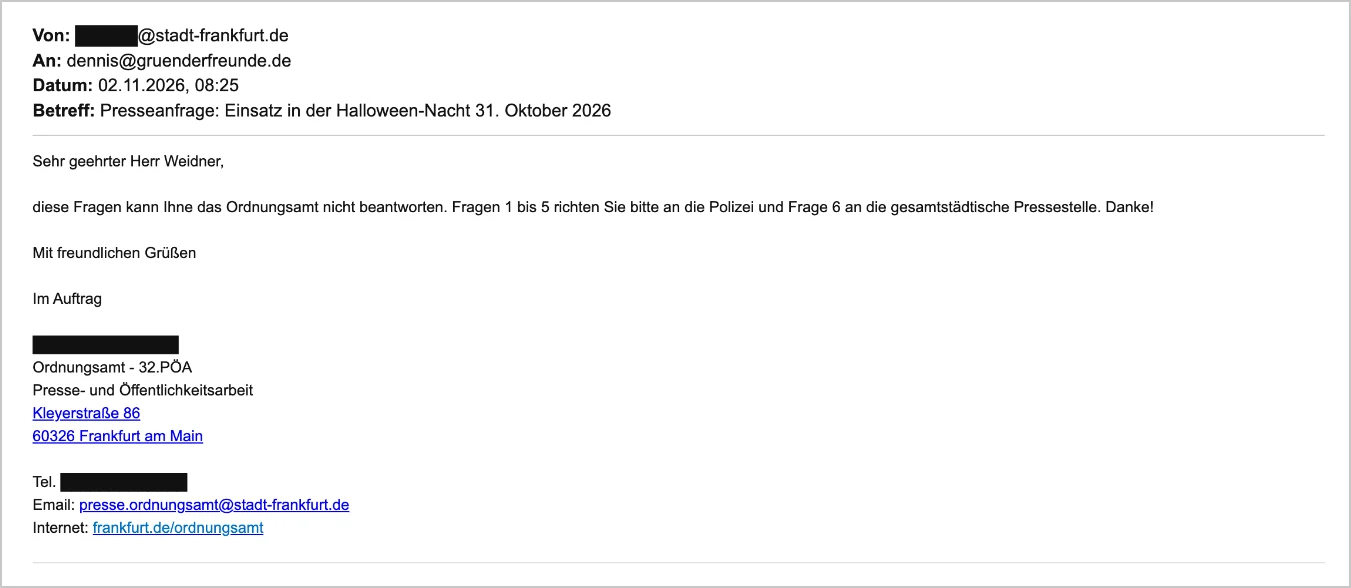
- 6 referrals: The Bundestag, two state parliaments, the Berlin Senate, and the city and public order office of Frankfurt each name another body as responsible.
- 1 set of figures: Hamburg Police reports 129 provisional arrests and now 42 injured officers, up from 12 at first.
- 2 to 4 December: The Conference of Interior Ministers meets under Hamburg's chair, the obvious place for an overall account.
- 65 to 100 percent: That is how high revenue losses at individual businesses in Frankfurt are, according to the Hesse retail association.
- 20 November: Conditions on the next demonstrations, or a ban, are decided by the local assembly authority, not by the federal government.
Press Enquiry on the Gen Z Riots: What I Asked
After my first article on the riots, I sent four enquiries on 1 November between 15:39 and 15:43 German time: to the Federal Interior Ministry and the Bundestag's interior committee, to the press offices and home affairs spokespeople of the five parliamentary groups in the Bundestag, to the interior ministries and state parliaments of Hesse, Hamburg, North Rhine-Westphalia and Berlin, and to the police in Frankfurt, Hamburg, Cologne and Berlin and the city of Frankfurt.
More on this topic: Politics & Society, with background, practice and every article in one place.
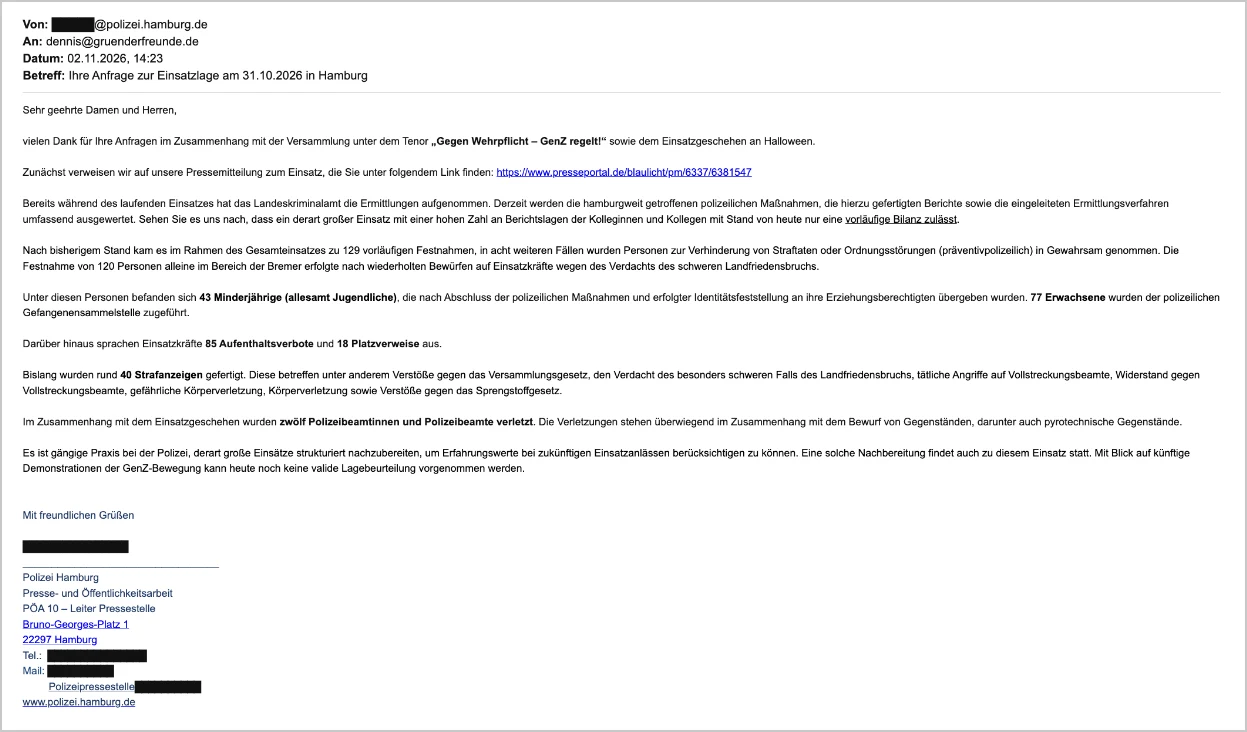
The questions were simple: How many officers were deployed, what did it cost, how high is the damage, who was arrested, and what happens on 20 November? I also announced that I would publish the replies. That is what I am doing here. Names and direct numbers are blacked out, because this is about the institutions and not about the people who work there. The emails are in German, and the captions summarise them.
Replies to the Press Enquiry: The First 48 Hours
By Tuesday, 3 November, 15:43 German time, it looked like this:
| Received | Body | Reply | Type |
|---|---|---|---|
| 1 Nov, 15:49 | Berlin Police | Received, extensive enquiries can take several days | Automatic reply |
| 1 Nov, 18:09 | City of Frankfurt | Questions 1 to 5 go to the police, on question 6 the city's press release | Referral, partial answer |
| 2 Nov, 02:55 | Berlin Senate, Interior and Sport | Contact Berlin Police | Referral |
| 2 Nov, 08:25 | Frankfurt public order office | Questions 1 to 5 go to the police, question 6 to the city's press office | Referral |
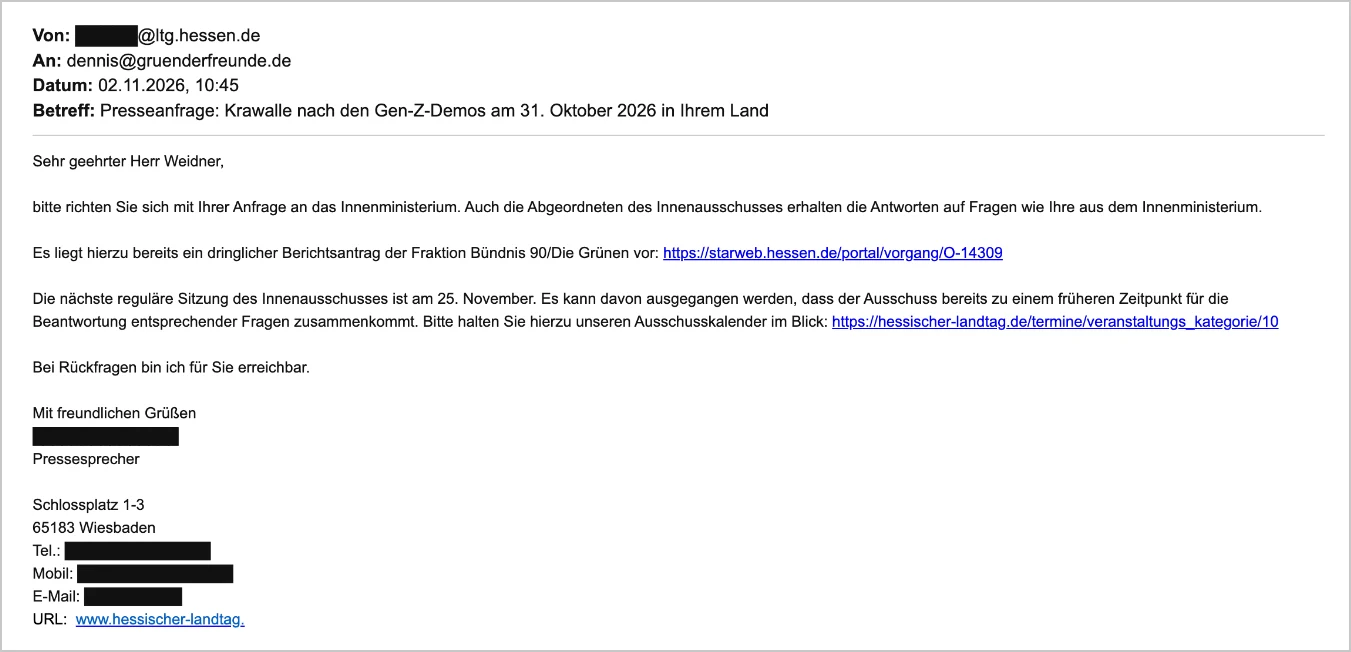
| 2 Nov, 10:45 | Hesse state parliament | Contact the interior ministry, note on a request for a report and on meeting dates | Referral with pointers |
| 2 Nov, 11:25 | North Rhine-Westphalia state parliament | Contact the interior ministry, investigations go to the public prosecutors | Referral |
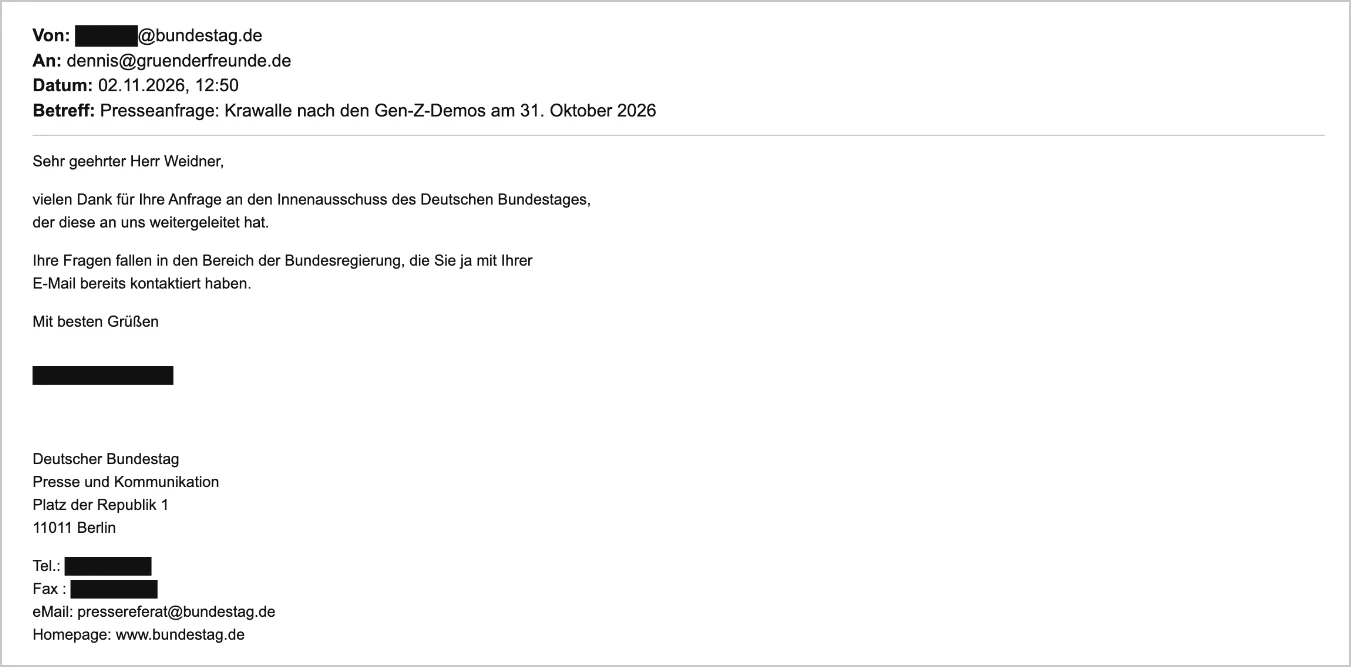
| 2 Nov, 12:50 | Bundestag, press office | The questions fall within the remit of the federal government | Referral |
| 2 Nov, 13:47 | Frankfurt Police | Received, will try to meet the deadline | Confirmation of receipt |
| 2 Nov, 14:23 | Hamburg Police | Provisional figures | Answer |
At that point I had not yet heard from the Federal Interior Ministry, the interior ministries of Hesse, Hamburg and North Rhine-Westphalia, Cologne Police or any of the five parliamentary groups. The deadline of 10 November is still running, and I will add whatever comes in. On 4 November I followed up with every body in a targeted way and also wrote to the Federal Criminal Police Office, the Federal Police, the public prosecutors in Frankfurt, Cologne, Hamburg and Berlin, the parliaments of Hamburg and Berlin, the German Association of Cities, the insurance association GDV and the German retail federation HDE.
Update of 12 November: Federal Interior Ministry and Hamburg Public Prosecutor
Two more replies arrived on 11 November. That brings the count to 23 of the 30 bodies I asked.
Federal Interior Ministry: According to its press office, more than 18,500 state police officers were deployed across Germany in connection with the protests on 31 October, along with 2,682 officers of the Federal Police. Averting danger, including police protection of assemblies, is a matter for the states under the division of powers in the Basic Law, the ministry writes; planning, carrying out and financing the police measures therefore lies with the responsible state authorities.
For details on those arrested, the ministry refers to the responsible authorities in the states. According to what is known so far, it says, the riots were shaped in particular by young, thrill-seeking and generally criminal milieus, and people without German citizenship were involved in many cases. On the question of how many expulsions under section 54 of the Residence Act are being examined, the ministry also names the state authorities as the point of contact.
On what was known before 31 October and on the protests announced for 20 November, the press office states: the ministry and the federal security authorities monitor security-relevant developments in general and assess their effects on the security situation. This includes threat assessments and close exchange with the states as the occasion requires. The security authorities at federal and state level are analysing the events of 31 October in order to draw conclusions for the future. Further details of the security authorities' findings cannot be disclosed as a matter of principle.
Hamburg public prosecutor: According to its spokeswoman on 11 November, the public prosecutor's office has not yet received any cases relating to the night. All proceedings are still being handled by the police.
Update of 11 November: Cologne Public Prosecutor and the Parliaments in Hamburg and Berlin
I am adding three replies from 4 and 5 November here; they are among the 21 bodies that replied by the deadline.
Cologne public prosecutor: So far one investigation into the night is pending there; the remaining cases are still with the police for investigation. In that one case, the prosecutor's office applied to the Cologne local court for an arrest warrant, among other things on strong suspicion of dangerous bodily harm and a breach of the Assembly Act. The court did not issue it because it saw no ground for detention, in particular no risk of flight. The prosecutor's office has appealed; no decision had been taken as of 4 November.
Hamburg city parliament: Its interior committee met on 5 November; the night of 31 October was not on its agenda. The committee chair had announced plans to raise the topic at the meeting on the committee's own initiative, which required the unanimous consent of the committee members. I am asking whether that happened. The agenda of the city parliament's session on 11 November has no separate item on the night. The parliament's office also pointed to the written question by Dennis Thering.
Berlin House of Representatives: After the election of 20 September, the new House constituted itself on 29 October 2026. According to its press office on 4 November, no committee for home affairs had yet been set up. So far, no interior committee in Berlin's parliament has been able to deal with the night.
Update of 10 November: Who Replied by the Deadline
The deadline for my enquiries ends on 10 November. Of the 30 bodies I asked, 21 have replied and 9 had not been in touch by then. Two replies have come in since 7 November, and none of the five parliamentary groups in the Bundestag has replied so far:
| Body | Reply by 10 November |
|---|---|
| Berlin Police | 9 November: 125 arrests, 87 investigations, 32 injured police officers, around 1,500 additional officers. The State of Berlin bears the costs, which are not calculated in detail. The report goes to the Senate Department for the Interior and Sport. |
| Federal Criminal Police Office | 10 November: no separate situation report; the offences are included in the figures for politically motivated crime but cannot be shown separately. No specific calls for violence known beforehand. |
| Federal Interior Ministry | no reply yet |
| Hesse interior ministry | no reply yet |
| Cologne Police | no reply yet |
| Hamburg public prosecutor | no reply yet |
| CDU/CSU group | no reply yet |
| SPD group | no reply yet |
| Alliance 90/The Greens group | no reply yet |
| The Left group | no reply yet |
| AfD group | no reply yet |
After ten days, the picture is this: nobody has named me a body that adds up the damage and costs of the night for all of Germany. The Federal Criminal Police Office counts politically motivated offences, and Berlin Police passes its report to the Senate Department for the Interior and Sport. The Berlin Police figures in detail are in the update to my first article on the riots. I am following up with the bodies that have not replied and will add whatever arrives here.
Update of 7 November: Police and Public Prosecutors
Frankfurt Police have now replied: 180 injured emergency personnel and 54 arrests as of 4 November, plus around 45 damaged premises and 10 affected shops. The details are in the update to my first article on the riots. The public prosecutor in Frankfurt is not yet giving any information because the investigation is at a very early stage. The Berlin public prosecutor general writes that the cases have not yet been referred to it and points to Berlin Police. In Hamburg, CDU member Dennis Thering has submitted a written question about 31 October to the city parliament. The deadline for the remaining enquiries runs until 10 November.
Update of 4 November: Who Has Replied Since
Since the status above, more bodies have replied. Hamburg Police now reports 42 injured officers, up from 12 at first. A spokesperson for the North Rhine-Westphalia interior ministry cites, based on initial provisional reports, 72 people in custody statewide, three provisional arrests, 397 criminal proceedings, 1,013 orders to leave and 37 injured officers, and writes that the police as a rule do not record total costs for operations. Frankfurt's public order office confirms that the decision on the assembly notified for 20 November rests with the assembly authority within that office. The chair of the Conference of Interior Ministers expects to publish an advance statement on 25 November. Replies are still outstanding from the Federal Interior Ministry, the Federal Criminal Police Office, the Hesse interior ministry, Cologne Police, the public prosecutors in Hamburg and Berlin and the five parliamentary groups; the deadline runs until 10 November.
Who Refers to Whom: The Replies from the Bundestag, State Parliaments and City
Each of these replies is correct in itself. A state parliament keeps no deployment statistics, a city no list of arrests. The Hesse state parliament even helped me very concretely. The finding lies in the sum: anyone who follows the chain moves one step further down each time and so far ends up with individual police headquarters, not with an overall picture. Whether the interior ministries have more will become clear by 10 November.
Hamburg Police and Frankfurt Police: What the Operational Authorities Say
The reply I would have wished for from everyone came 22 hours and 40 minutes after my enquiry, from the head of the press office of Hamburg Police. On a provisional basis it names 129 provisional arrests and eight people taken into custody, 43 minors and 77 adults among 120 of those arrested, plus 85 bans from the area, 18 orders to leave, around 40 criminal complaints and twelve injured officers. It also says openly what is not yet possible: the evaluation is ongoing, and no valid assessment of future demonstrations can be made yet. That is exactly the tone that builds trust.
Frankfurt Police confirmed that it is trying to meet the deadline and may not manage it. I understand that well: in Frankfurt, hessenschau reports 100 injured police officers and more than 50 arrests. It matters more to me that the answer comes than when it comes.

Who Is Responsible for What During Riots in Germany
Policing in Germany is a matter for the states, which follows from Article 30 of the Basic Law. The federal government runs the Federal Police and the Federal Criminal Police Office but does not command state police operations. Coordination happens through the Conference of Interior Ministers, chaired in 2026 by Hamburg's interior senator Andy Grote. Reports come together nationally mainly for politically motivated crime: the state criminal police offices report it to the Federal Criminal Police Office. According to this description, that is not a total bill of damage and deployment costs.
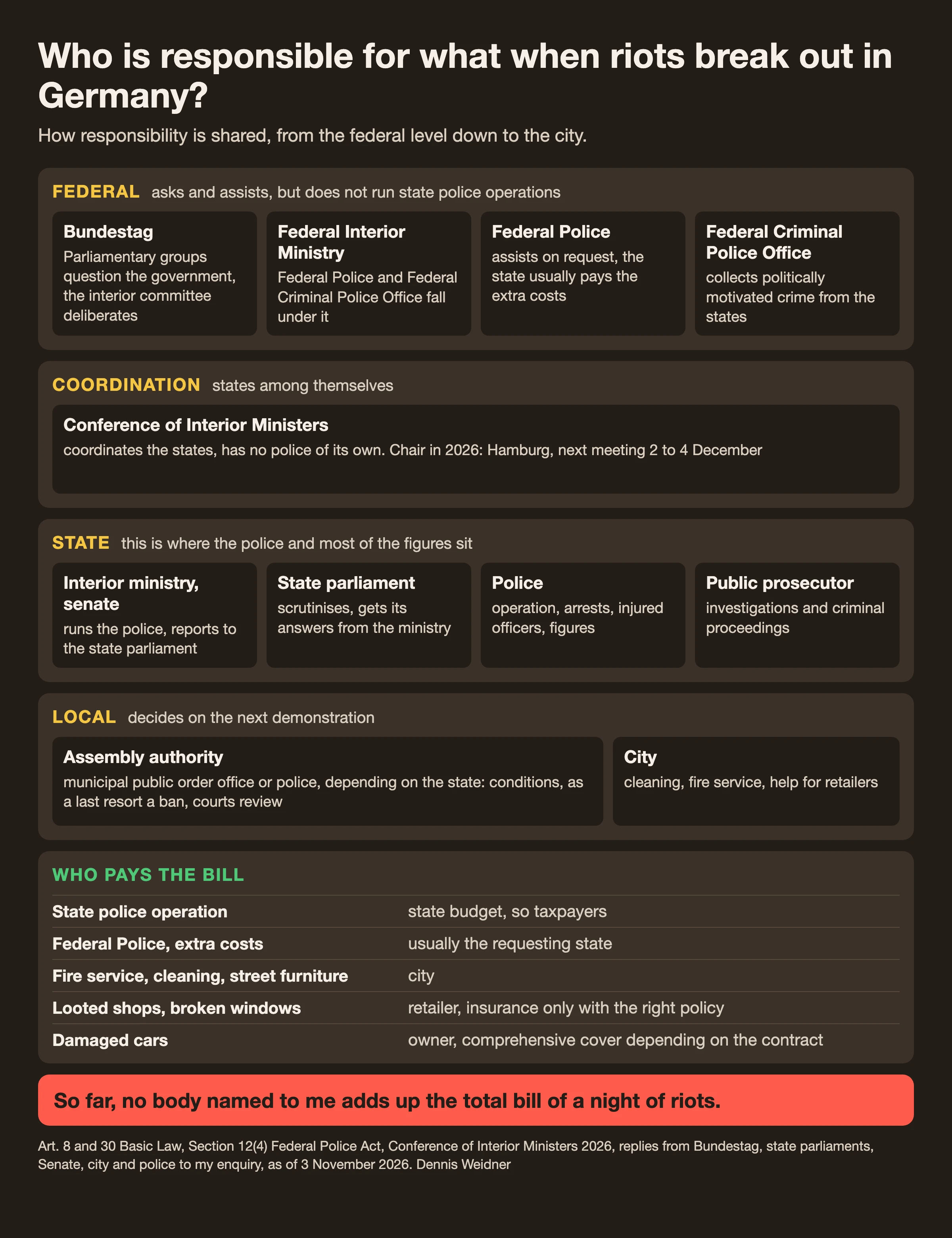
From the replies and the laws, it follows which question belongs where:
| Body | Right for | Wrong address for |
|---|---|---|
| Police press office | Operational figures, arrests, injured officers, leads | Political assessment, costs to the state |
| Public prosecutor | Number and status of investigations | Operational planning |
| Interior ministry, senate | Statewide figures, costs, consequences, the government's position | Individual criminal cases |
| State parliament | Meeting dates, parliamentary papers, requests for reports | Deployment figures |
| Bundestag | Committee dates, parliamentary proceedings | Questions for the federal government |
| Federal Interior Ministry | Federal Police, Federal Criminal Police Office, the federal government's position | State police operations |
| City | Damage to city property, help on the ground | Police questions |
| Assembly authority | Notified assemblies, conditions, bans | Criminal proceedings |
| Parliamentary groups | Political assessment, their own parliamentary questions | Official figures |
The press has a right to information from public authorities, directly under the Basic Law at federal level and under the press laws of the states. But it only extends as far as the information exists. That could be the blind spot: what nobody compiles, nobody has to hand over.
Who Pays for the Gen Z Riots in Germany
A state police operation is paid from the state budget, in other words by us as taxpayers. If the Federal Police helps, the requesting state generally bears the extra costs under Section 12(4) of the Federal Police Act. That is the wording since the October 2026 revision, and the rule existed before. From 2015 to 2018 the Federal Police billed the states between €1.5 million and €5.2 million a year for this. The Bremen fee upheld by the Federal Constitutional Court in January 2025 applies to for-profit events with more than 5,000 people, such as high-risk football matches. Demonstrations are not covered.
Fire service, cleaning and public facilities are paid by the city, which in Berlin and Hamburg again means the state. Looted shops and smashed windows stay with the retailer and their insurer first, and insurers only pay for civil unrest with the right policy, as I explained on gruenderfreunde.de for retailers and restaurateurs, in German. The Hesse retail association reports revenue losses of 65 to 100 percent at individual businesses and is calling for a hardship scheme. The city of Frankfurt promises quick help and points to insurers first.
Add all of this up and you get a sum that nobody has reported for this night so far. Yet this very sum is the basis for any honest debate on conditions, prevention and penalties.
Are you a retailer, restaurateur or car owner who suffered damage that night? Write to me through the contact form, I answer every message.
Who Can Ban the Demonstrations on 20 November
The local assembly authority is responsible, and in the end courts rule on its decision. Each state decides who that is: in Hamburg and Berlin it is the police, in North Rhine-Westphalia the district police authority, in Hesse the municipal public order authority. There is no federal authority that could ban demonstrations across Germany.
Nor are demonstrations in Germany approved. Article 8 of the Basic Law guarantees all Germans the right to assemble peacefully and unarmed without notification or permission, and outdoors this can be restricted by law. The assembly laws therefore require an outdoor demonstration to be notified in advance, usually no later than 48 hours before it is announced. It does not need a permit. The authority can impose conditions and, as a last resort, ban it. Hesse's interior minister Roman Poseck has publicly questioned whether the assemblies on 20 November can go ahead as planned, and a legal scholar in the same report warns against hasty calls for bans. I have asked Frankfurt's public order office whether it is the assembly authority there and what will be decided by when.
What the Bundestag and the Conference of Interior Ministers Can Do Now
The Bundestag has a simple tool: any parliamentary group can use a minor interpellation to ask the federal government about federal deployment costs and what the states have reported. That is exactly what I asked all five groups about. I will put their replies side by side once they are in.
My demand as an entrepreneur is simple: After every night of riots that hits several states, a public overall account should be on the table within 30 days, with officers deployed, costs, injuries, damage, proceedings and who pays what. The Conference of Interior Ministers can decide this on 2 to 4 December in Hamburg, and the states would have to implement it. Every company would put a figure on such damage. The same should apply to the state, and thus to our tax money.
I know this pattern from another investigation, by the way: with tax offices too, the Federal Finance Ministry refers to the states for figures. How little can be checked from outside is the subject of my article on how German tax offices are supervised. Why I get involved in such debates as an entrepreneur at all is explained in Entrepreneurs and Politics, and more articles are collected under Politics and Society.
Frequently Asked Questions on Responsibility During Riots
Who is responsible for police operations at demonstrations in Germany?
The states. The state police runs the operation, and the interior ministry or senate runs the police. The Federal Police helps on request, and the Conference of Interior Ministers coordinates the states.
Is there a national body with figures on the Gen Z riots?
None has been named to me so far. Politically motivated crime comes together at the Federal Criminal Police Office, but according to the published description that is not a total bill of deployment costs and damage. The Conference of Interior Ministers would be the obvious place to bring it together.
Who pays for police operations during riots?
The state from its budget, so the taxpayers. Extra costs of the Federal Police are generally borne by the requesting state. The Bremen fee upheld by the Federal Constitutional Court applies to for-profit major events, and demonstrations are not covered.
Who can ban a demonstration in Germany?
The local assembly authority, which depending on the state is the municipal public order authority or the police. A ban is the last resort and can be reviewed in court. There is no national authority for bans.
Do authorities have to answer press enquiries?
In principle yes, the press has a right to information from public authorities. It covers existing information and does not oblige an authority to create new statistics. Parliamentary groups in the Bundestag are not part of the public administration and answer voluntarily.
Warm regards,
Dennis Weidner
Note: AI tools supported me in writing this article, and some images were edited with AI. I stand behind its content and every statement with my name.