The 2026 German tax return is due on 2 August 2027 without an adviser and on 29 February 2028 with one. The advised return for 2025 is already due on 1 March 2027. After five years of pandemic extensions, the regular deadlines apply again, and the late filing surcharge comes automatically.
Tax Return 2026 Deadline in Germany: The Dates at a Glance
For the 2026 tax year, Germany is back to the regular deadlines of its Fiscal Code, the Abgabenordnung. If you prepare your return yourself, Section 149(2) of the Fiscal Code gives you seven months after the end of the year. That would be 31 July 2027. Because that day is a Saturday, Section 108(3) moves the deadline to the next working day, 2 August 2027.
If you engage a tax adviser (Steuerberater) or a wage tax assistance association, Section 149(3) gives you considerably more time: until the last day of February in the second following year. 2028 is a leap year, so the deadline for 2026 is 29 February 2028. This applies to income tax, corporate income tax, the trade tax return, the annual VAT return and the partnership returns that determine shared income.
The more urgent date in January 2027 is a different one: the adviser-prepared return for 2025 is due at the end of February 2027. 28 February 2027 is a Sunday, so 1 March 2027 is the last day. Anyone filing 2025 without an adviser was due on 31 July 2026.
| Tax year | Without a tax adviser | With a tax adviser |
|---|---|---|
| 2024 | 31 July 2025 | 30 April 2026 |
| 2025 | 31 July 2026 | 1 March 2027 (28 February is a Sunday) |
| 2026 | 2 August 2027 (31 July is a Saturday) | 29 February 2028 |
The deadline refers to receipt by the tax office. For electronic filing through ELSTER, the tax administration's portal, that is the day the data reach the tax office, which in practice is the day you send it. For business owners this route is mandatory anyway: anyone with business or self-employment income files the income tax return electronically under Section 25(4) of the Income Tax Act.
Why the Adviser Deadline Ends in February Again
From 2020 onwards, the legislature extended the filing deadlines year after year to help tax firms and tax offices through the pandemic. The special rules are set out in Article 97 Section 36 of the Introductory Act to the Fiscal Code. For the tax years 2019 to 2021, advised taxpayers had 20 months; after that the extension was phased out step by step: 19 months for 2022, 17 for 2023, 16 for 2024.
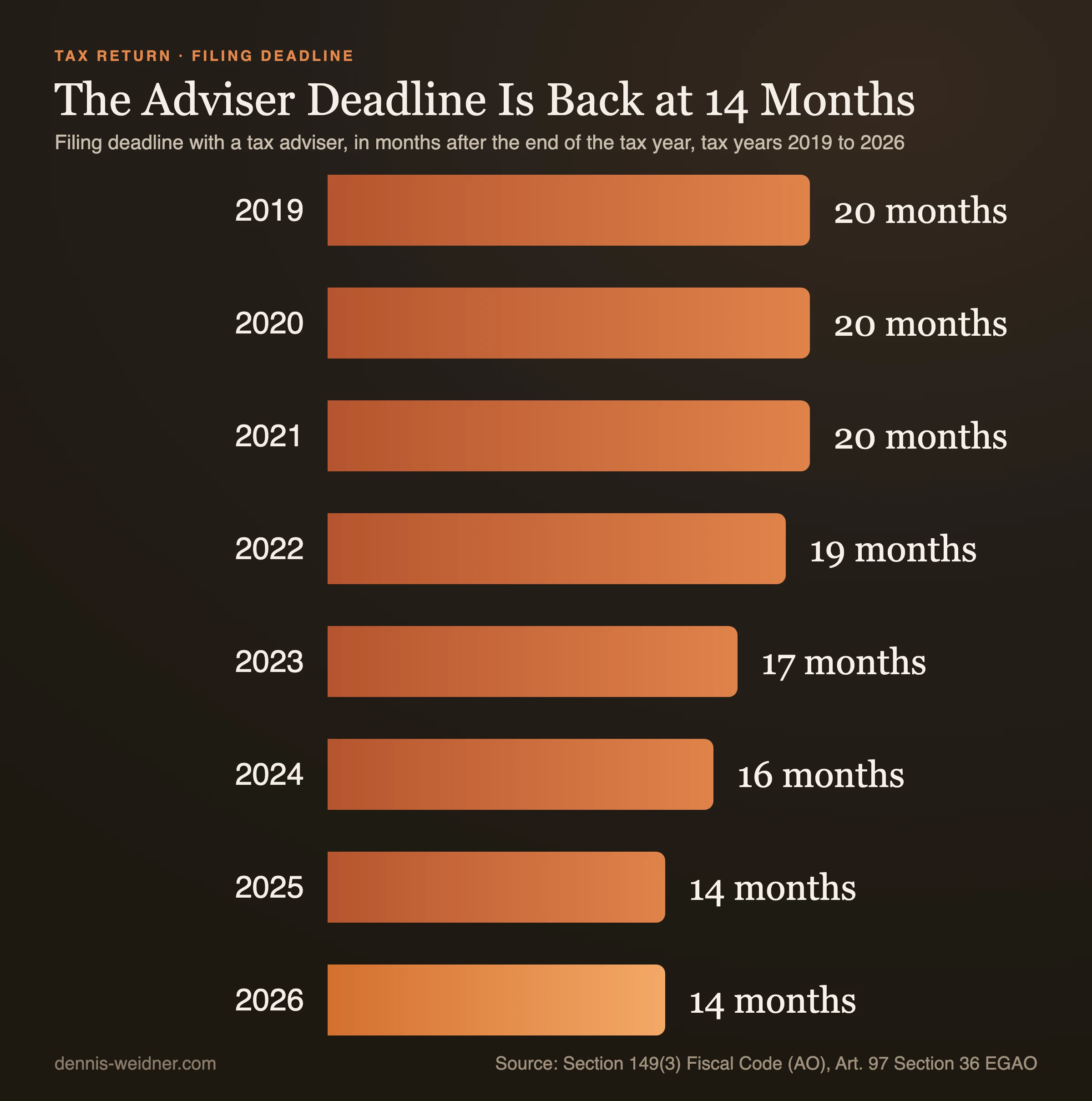
For 2025 and 2026, the law no longer provides any special rule. The standard 14 months apply. For tax firms this means the 2025 returns and the first work on 2026 fall into the same winter. For business owners it means receipts, bank statements and the cash-basis profit statement have to reach the adviser earlier than they have for the past five years.
How I structure the start of the year around this is described in my piece on how I plan my year: the tax paperwork is not a side item there, it is the first fixed date of the quarter.
Who Has to File a Tax Return
A deadline only helps if you know it applies to you. For the self-employed, freelancers and traders, the answer is almost always yes. Under Section 56 of the Income Tax Implementing Regulation, anyone without employment income whose total income exceeds the basic tax-free allowance must file. For 2026 that allowance is €12,348.
Employees with a side activity must file under Section 46(2) No. 1 of the Income Tax Act as soon as their income not subject to wage tax withholding exceeds €410 a year. That covers profits from a small side business just as much as rent from a let flat.
Besides income tax, there are three further returns business owners should keep in view:
- Annual VAT return under Section 18(3) of the VAT Act. Since 2025, small businesses under the Kleinunternehmer scheme are exempt unless the tax office expressly asks for one.
- Trade tax return under Section 14a of the Trade Tax Act: for every GmbH, and for sole traders and partnerships under Section 25 of the Trade Tax Implementing Regulation once trade income exceeds €24,500 or the tax office asks for it.
- Corporate income tax return for every GmbH and UG, plus any separate determination returns.
Which schedules are added depends on the source of income. Rooftop solar has been tax-free in many cases since 2022, as explained in solar panels and the German tax return. If you sold Bitcoin or other crypto assets, the rules are in crypto in the German tax return. And if you have just started, begin with registering a business and the tax registration questionnaire.
Early Filing Orders: When the Tax Office Asks Sooner
The long adviser deadline is not unconditional. Under Section 149(4) of the Fiscal Code, the tax office may require an advised return earlier. The grounds are listed exhaustively in the law:
- the previous year's return was not filed or was filed late,
- subsequent prepayments for the previous year were set shortly before filing,
- prepayments were reduced outside an assessment,
- the last assessment ended with a balance due of at least 25 percent of the tax or more than €10,000,
- a balance due of more than €10,000 is expected for the current year,
- a tax audit is planned,
- a business was opened or closed during the tax year, or partners' losses need to be determined.
On top of that there is an automated random selection. In every case the tax office must allow four months from notification and may not go below the seven-month deadline. Anyone who founded a business in 2026 therefore falls almost automatically into the group that can be asked early. That is no disadvantage if the books are kept up to date anyway.
Late Filing Surcharge Under Section 152 AO: How It Is Calculated
Missing the deadline risks a late filing surcharge, the Verspätungszuschlag. Section 152 of the Fiscal Code works in two stages. At first the surcharge is at the tax office's discretion, and it is waived if the delay is excusable. If the return has still not been filed 14 months after the end of the tax year, however, the tax office must impose the surcharge, and it may do so fully automatically. For the advised 2025 return, that point coincides with the filing deadline.
The amount is precisely defined: 0.25 percent of the assessed tax, less prepayments and tax withheld, for every month or part month, at least €25 per month, rounded down to whole euros and capped at €25,000. Three examples for a 2025 return that arrives on 20 July 2027 instead of 1 March, so five started months late:
| Case | Tax assessed | Prepayments | Base | Per month | Five months late |
|---|---|---|---|---|---|
| A | €18,400 | €12,000 | €6,400 | €25 (minimum) | €125 |
| B | €36,000 | €12,000 | €24,000 | €60 (0.25%) | €300 |
| C | €9,000 | €9,000 | €0 | no mandatory surcharge | €0 |
Case C shows the most important exception: if prepayments and tax withheld cover the assessed tax, the mandatory surcharge does not apply. The same holds if the tax is assessed at zero or a negative amount, and if the tax office has extended the deadline. The surcharge therefore mainly hits those who owe a balance anyway, and that is where it adds up.
Extensions and Interest: What Is Still Possible
An extension is possible under Section 109 of the Fiscal Code, even retroactively. For advised cases there is a hard limit: beyond the end of February in the second following year, the tax office extends only if the taxpayer was prevented without fault, and the adviser's fault is attributed to the taxpayer. An application should therefore be filed before the deadline and give a reason, such as missing documents from a third party.
Interest runs independently of the surcharge. Under Section 233a of the Fiscal Code, interest starts 15 months after the end of the tax year: for 2025 on 1 April 2027, for 2026 on 1 April 2028. Under Section 238 the rate is 0.15 percent per full month, or 1.8 percent a year. On a balance due of €24,000 assessed ten full months after interest starts, that comes to €360.
Interest works both ways; refunds earn it too. If you expect a refund, filing late costs you little. If you owe, you pay surcharge and interest. The smartest response is adjusted prepayments: if you earn considerably more this year than last, apply for higher prepayments yourself and take away the basis for both interest and surcharge.
Three Dates That Belong in Your Calendar
In a group of companies each entity has its own returns, and the deadlines run the same for all of them. That argues for planning them together, as described in holding company in Germany for founders and what changes for businesses in 2027. Three entries are enough for 2027:
- 1 March 2027: advised returns for 2025. From here on there is no extension without a compelling reason.
- 1 April 2027: interest starts for 2025. By then any larger balance due should be known and ideally paid.
- 2 August 2027: 2026 return without an adviser. With an adviser you have until 29 February 2028, but the documents should still be handed over in spring.
A deadline you know costs nothing. The expensive one is the deadline you miss because you thought you had longer. After five years of extensions, that is the biggest risk of 2027.
Frequently Asked Questions
When is the 2026 German tax return due?
Without a tax adviser by 2 August 2027. The statutory seven-month deadline ends on 31 July 2027, a Saturday, so under Section 108(3) of the Fiscal Code the following Monday applies. With a tax adviser or a wage tax assistance association the deadline is 29 February 2028.
When is the 2025 return due if a tax adviser prepares it?
By 1 March 2027. The law names the last day of February 2027, which is 28 February and a Sunday. The pandemic special rules in Article 97 Section 36 EGAO only extend to the 2024 tax year.
How high is the late filing surcharge in Germany?
0.25 percent of the assessed tax less prepayments and tax withheld for every month or part month of delay, at least €25 per month and at most €25,000. With a balance due of €24,000 and five months' delay, that is €300.
When is the late filing surcharge imposed automatically?
When the return has not reached the tax office 14 months after the end of the tax year. Before that the surcharge is discretionary. No mandatory surcharge applies if the tax is zero or negative, if prepayments and tax withheld cover it, or if the deadline was extended.
Can I get an extension for my German tax return?
Yes, under Section 109 of the Fiscal Code, even retroactively. For advised returns there is a limit: beyond the end of February in the second following year an extension is only granted if the taxpayer was prevented without fault, and the adviser's fault counts.
When does interest start on German tax arrears?
Interest starts 15 months after the end of the tax year, so 1 April 2027 for 2025 and 1 April 2028 for 2026. The rate is 0.15 percent per full month, or 1.8 percent a year. Refunds earn interest at the same rate.
Do small businesses under the Kleinunternehmer scheme file a VAT return?
Not since 2025, unless the tax office expressly asks for one. Section 19(1) of the VAT Act exempts small businesses from the filing duties in Section 18(1) to (4). The income tax return and, where applicable, the trade tax return remain mandatory.
Warm regards,
Dennis Weidner
Note: AI tools supported me in writing this article, and some images were edited with AI. I stand behind its content and every statement with my name.