If you sold, swapped or staked Bitcoin or other crypto assets in 2026, your German tax return needs more preparation than in previous years. The rules are the same: a one-year holding period, a threshold below €1,000, staking rewards tax-free below €256. What is new is that exchanges report 2026 to the Federal Central Tax Office for the first time.
Crypto Tax in Germany: The One-Year Holding Rule
Bitcoin, Ether and other crypto assets held privately count as "other assets" for German tax purposes. Under Section 23 of the Income Tax Act, a gain is only taxable if no more than one year passes between purchase and sale. Hold longer and you sell tax-free, whatever the size of the gain. This applies unchanged to the 2026 tax year.
What matters is what counts as a sale. Under paragraph 54 of the Finance Ministry guidance of 6 March 2025, not only swapping into euros is a disposal, but also swapping into another crypto asset and paying for goods or services with crypto. And under paragraph 55, the one-year period starts again with every swap. Anyone who swapped Ether for Solana in spring 2026 disposed of the Ether and started a new period for the Solana.
Dates follow the records of a centralised exchange, or the wallet data for transactions directly on the blockchain. Transaction fees are deductible costs and reduce the gain.
| Transaction | Tax treatment | Where it goes in the return |
|---|---|---|
| Sale for euros within one year | private disposal, Section 23 EStG | Anlage SO, private disposals |
| Swap crypto for crypto within one year | also a disposal, new holding period for the coin received | Anlage SO |
| Paying with crypto | disposal at the agreed euro price | Anlage SO |
| Sale after more than one year | not taxable, also after staking | nothing |
| Staking and lending income | other income, Section 22 No. 3 EStG, threshold below €256 | Anlage SO, services |
| Losses within one year | only offsettable against gains from private disposals | Anlage SO, declare even without gains |
The €1,000 Threshold, and Why €999 Is Different
Since 2024, gains from private disposals remain tax-free if the total gain for the year is less than €1,000; until 2023 the limit was €600. The word "less" matters: this is a threshold, not an allowance. At a total gain of €999, no tax is due. At €1,000, the entire amount is taxable.
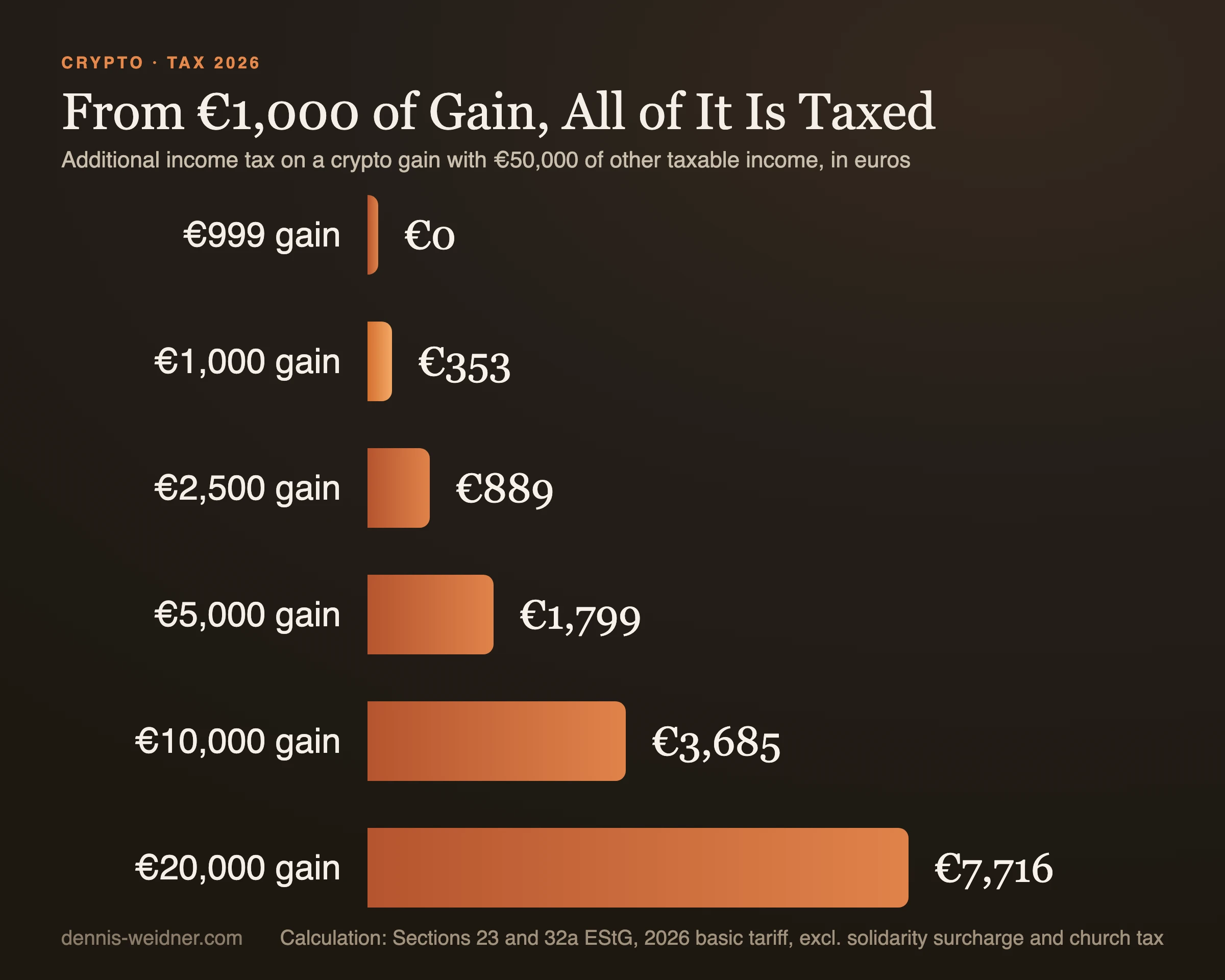
How sharp that edge is shows up with the 2026 income tax tariff: with €50,000 of other taxable income, a crypto gain of €1,000 costs €353 in income tax, at €999 it costs nothing. Two points belong with this. The total gain covers all private disposals in the year, including selling gold, collectibles or trading cards within a year, as explained in selling trading cards and taxes in Germany. And for jointly assessed spouses, each partner has their own threshold.
If you want to realise a small gain in December, run the numbers first. A loss from another position in the same year counts towards the total and can bring it below the threshold.
Example: three transactions and staking in 2026
An investor has four events in 2026. First, in May she sells Bitcoin bought in March 2025, at a gain of €4,000. More than a year lies between purchase and sale, so the gain is not taxable and does not count towards the total. Second, in September she swaps Ether bought in February 2026 for Solana. The market value of the Solana received is €1,400 above the cost of the Ether, a taxable gain. Third, in December she sells part of that Solana at a €600 loss; a new period has been running for the Solana since the swap, so this loss counts for tax too. Fourth, she receives staking rewards worth €180 over the year.
The total gain from private disposals is 1,400 minus 600, so €800, below the threshold. The staking rewards stay below €256. No tax is due, but the transactions still have to be declared so the tax office can verify the thresholds. Without the December sale she would have paid tax on €1,400.
FIFO, Average Cost, Wallet: Which Coins Count as Sold
If you bought in tranches over several years, you have to determine which units you sold. Paragraph 61 of the guidance sets the order: first, specific identification if the units can be matched. If that is not possible, the earliest units count as sold for the holding period, and the value is determined by the average cost method. For simplicity, first in, first out may also be used for the value.
The approach is wallet-based. The method chosen for a wallet stays until all units of that currency there have been sold; only then can it change. If you hold Bitcoin on three exchanges and a hardware wallet, you therefore keep four separate calculations. For an investor who has been buying for years, this choice is often the single most important tax decision, because it determines whether a sale comes from the tax-free old tranche or the taxable young one.
Staking, Lending and Airdrops: Other Income
Staking and lending rewards are not disposal gains but income from services under Section 22 No. 3 of the Income Tax Act. They are valued at the market price when received. They stay tax-free only if all income of this kind together is less than €256 a year, again a threshold.
The coins received count as acquired on receipt and start their own one-year period. The staked coins keep their period: under paragraph 63, staking does not extend the holding period for payment tokens such as Bitcoin or Ether to ten years. If you prefer staking via an exchange-traded product, the differences are covered in crypto ETFs with staking yield.
Losses: Why a Bad Year Belongs in the Return Too
Losses from private disposals may only be offset against gains from such disposals under Section 23(3), not against salary or rental income. What cannot be offset in the same year is carried back to the previous year or forward to future years. For that to work, the loss has to be declared. If you made a loss on crypto within one year in 2026, enter it in Anlage SO even if there is no gain. The tax office then records the remaining loss, and it reduces later gains.
After a volatile year this is real money. A loss of €3,000 from 2026 makes a gain of the same size in 2027 tax-free, provided it has been properly recorded.
Anlage SO and Evidence: What the Tax Office Wants to See
Private disposals and income from services go into Anlage SO, the schedule for other income. Paragraphs 101 to 104 of the guidance describe exactly how the figures are to be supported: with tax reports, structured overviews or the transaction exports from exchanges. For each disposal, date, quantity, type (sale or swap), platform, proceeds and fees in euros, and the method chosen per wallet should be traceable. The tax office can request the CSV files and, in individual cases, screenshots from wallet or account, as well as holdings at 31 December.
The practical conclusion: secure the 2026 exports from every exchange now, before an account is closed or a provider disappears. A tax report from software helps, but it does not replace the raw data behind it.
2026 Is the First Year Exchanges Report
The Crypto Asset Tax Transparency Act, Germany's implementation of the EU directive DAC8, applies for the first time to the 2026 tax year. Under Section 9, crypto service providers report their customers' 2026 transactions to the Federal Central Tax Office by 31 July 2027. The deadline for the 2026 return without an adviser is 2 August 2027. For the first time, the tax office can check the figures against an exchange report. What exactly is reported is covered in DAC8: why the tax office will know more about your crypto.
The future of the holding period is under political discussion; my take is in will the one-year holding period fall? and in my reply to the Bundestag finance committee. For the 2026 return, what counts is the law as it applies to disposals in 2026. Getting your records in order now prepares you for any future rule. More pieces are collected under crypto and finance, and the changes at the turn of the year are in what changes for businesses in 2027.
Frequently Asked Questions
When is a Bitcoin gain tax-free in Germany?
When more than one year passes between purchase and sale, under Section 23(1) sentence 1 No. 2 of the Income Tax Act. Within one year, the gain is only tax-free if the total gain from all private disposals in the year is less than €1,000.
Is swapping crypto for crypto taxable in Germany?
Yes, within the one-year period. Under the Finance Ministry guidance of 6 March 2025, swapping into another crypto asset is a disposal, and a new one-year period starts for the coin received.
Is the €1,000 crypto threshold an allowance?
No, it is a threshold. At a total gain of €999 no tax is due; at €1,000 the whole gain is taxable. With €50,000 of other income, that is about €353 of income tax under the 2026 tariff.
How are staking rewards taxed in Germany?
As other income under Section 22 No. 3 of the Income Tax Act at the market price when received. They are tax-free if all income from services together is less than €256 a year. Staked coins keep their one-year holding period; there is no extension to ten years for payment tokens.
Which method applies if I bought Bitcoin at different times?
Specific identification first. If that is not possible, the earliest units count as sold for the holding period, and the value is determined by the average cost method or, for simplicity, FIFO. The method applies per wallet and stays until all units of that currency there are sold.
Do I have to declare crypto losses in my German tax return?
Yes, if you want to use them later. Losses within the one-year period can only be offset against gains from private disposals, carried back or carried forward. For that they must be declared in Anlage SO and recorded by the tax office.
Does my crypto exchange report my data to the tax office?
Yes, for the first time for 2026. Under the Crypto Asset Tax Transparency Act, providers report 2026 transactions to the Federal Central Tax Office by 31 July 2027, which forwards them to the responsible authorities.
Warm regards,
Dennis Weidner
Note: AI tools supported me in writing this article, and some images were edited with AI. I stand behind its content and every statement with my name.