Every founder stage repeats that failure makes you better. The most solid research on the question finds exactly one percentage point between previously failed founders and first-timers. What follows from that for planning a year.
The Uncomfortable Finding I Start With
There is a line that always lands well on a founder stage: failure makes you better. I believed it myself, and the most solid research on the question disagrees rather clearly.
Gompers, Kovner, Lerner and Scharfstein examined for the Journal of Financial Economics how a founder's earlier outcomes affect their next venture. Their result, published in 2010:
- first-time founders have a 21 percent probability of success
- founders who previously failed reach 22 percent
- founders who were previously successful reach 30 percent
Between a first attempt and a failed prior attempt lies one percentage point. Success persists; failure, in this calculation, teaches almost nothing.
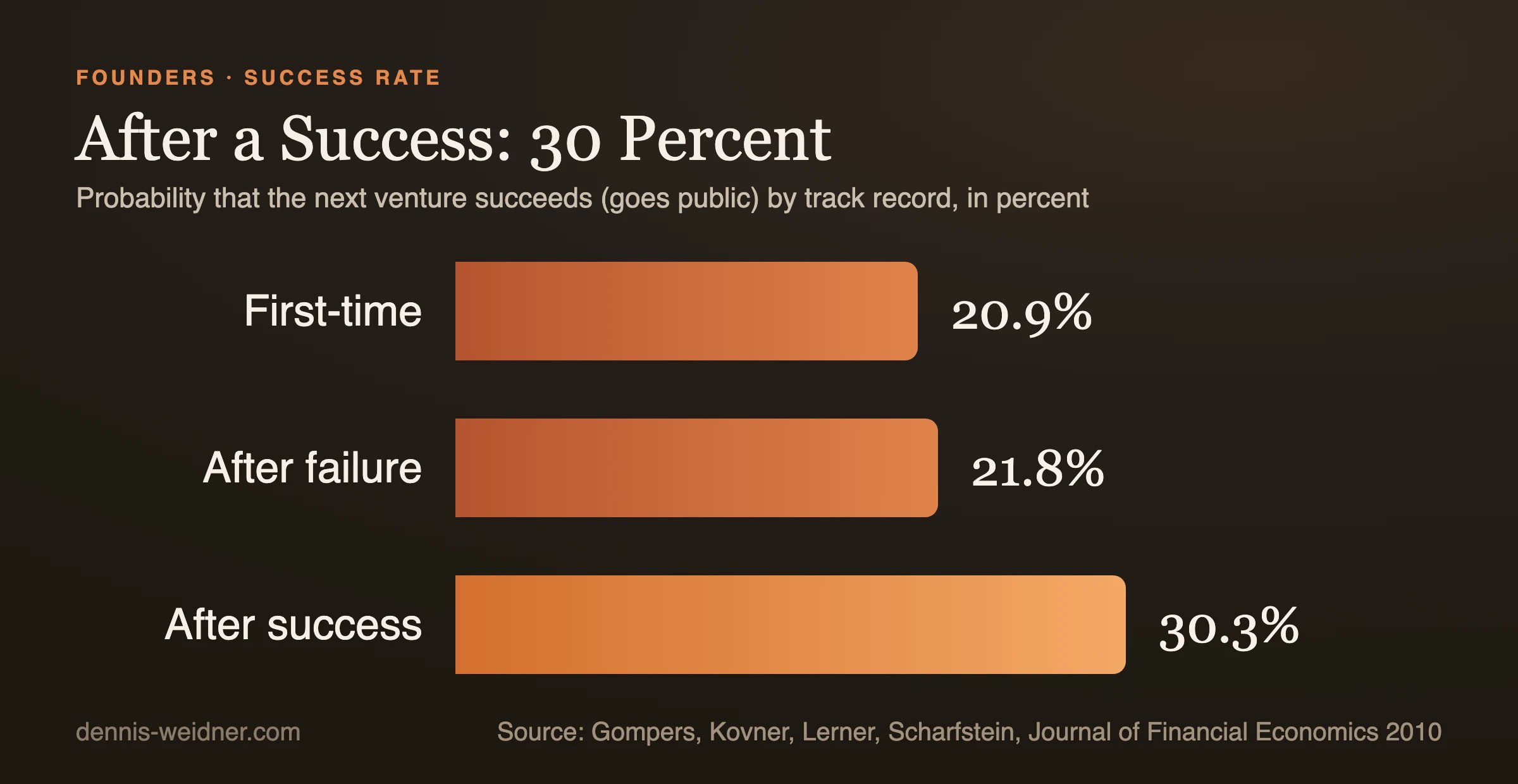
The study examines venture-capital-backed companies in the United States, and "success" there means an initial public offering. A profitable company that never goes public counts as a failure in this arithmetic. The paper is from 2010. Neither point changes the direction, but both change the reach.
What the Study Means for Annual Planning
If experience as such carries so little, then the difference lies not in the number of attempts but in what one takes from an attempt. The study suggests its own explanation: successful founders repeat not their product but their timing and their choice of industry. They get the same kind of decision right again.
For annual planning that means something quite concrete. The question is not "what shall I take on?" but "under which conditions has it worked for me, and am I restoring those?" The first is a statement of intent, the second a checkable claim.
So I build my annual plan from four steps, and the first is the one almost everybody skips.
First: Open Last Year's Plan Before Writing the New One
Most annual plans start on a blank page, and that is the mistake. A plan nobody ever holds against reality costs nothing and yields nothing, and you never notice because you never read it again.
So I begin with last year's plan and go through it line by line, with only three permitted answers: done, not done, or deliberately dropped. Only the middle category is interesting. What I set out to do and then neither did nor deliberately dropped is the actual finding of the year.
In my case it is almost always the same kinds of item: those without a date, those without a named person, and those that depended on a decision somebody else had to make. When the same kind appears on the list a second time, that is not a question of diligence but a design fault in the item itself.
Second: Allocate Attention, Not Time
I am involved in several companies, among them through my holding Weidner Ventures, alongside the agent-built venture builder The Agentics and the live commerce platform Slabhit. The obvious planning question is how to divide the week. I think it is the wrong one.
Time is divisible; attention is not. In any given quarter a company does not need an even share of attention, it needs a particular decision, and often only one person can take it. The planning question is therefore: which decision is pending in which company that nobody but me can take? Everything else is delegable, and where it is not, that is the actual finding.
This produces an uneven distribution, and that is deliberate. One company gets a great deal in one quarter and almost nothing in the next. Give every venture a slice of every week instead and you spread attention so thin that nothing gets decided anywhere.
Third: The Deletion List Before the To-Do List
Every plan I have ever made was too long. That is not ambition, it is that adding is cheap and removing hurts. Deleting an item means admitting you were wrong last year.
So I first write down what I will stop doing, and only then what gets added. The rule is plain: for every new item, one falls away. Not because the number is sacred, but because the constraint forces the question of which existing item is actually weaker than the new one. That question otherwise never gets asked.
Hardest are the items that do not fail but merely fail to grow. A clearly failed project ends itself. One that ticks along a little every year survives every planning round, because it is never bad enough to be noticed.
Fourth: Every Intention Gets a Number That Can Be Wrong
This is the step that turns a statement of intent into a plan. For each item I write down a prediction that can be shown unambiguously right or wrong at year end, with a date and a value.
"Slabhit should grow" is not a plan. "By 30 June we run twelve shows a week" is one, because on 1 July you can look. The value of the number lies not in its precision but in its falsifiability. An intention you cannot miss has not been planned, it has been wished for.
The same goes for the assumptions underneath. For each larger item I note one sentence that would overturn it: the condition under which I stop. Anyone who cannot formulate that sentence does not have a plan, they have a conviction.
What I learn in the engine room along the way I write up continuously on my page about AI in daily work.
Frequently Asked Questions
Does failure really make founders better?
The data barely support it. Gompers, Kovner, Lerner and Scharfstein found in 2010 a 22 percent probability of success for previously failed founders against 21 percent for first-timers, so one percentage point. Previously successful founders reached 30 percent. Success therefore persists far more strongly than failure teaches.
How is success defined in that study?
As an initial public offering. The companies studied were venture-capital-backed firms in the United States. A profitable company that never goes public counts as a failure in that arithmetic. Anyone quoting the figures should carry that definition along, otherwise a narrow claim becomes a general one.
Where should annual planning start?
With last year's plan, not a blank page. Every line gets one of three answers: done, not done, deliberately dropped. The middle category is the informative one, because what you set out to do and then neither did nor deliberately dropped is the actual finding of the year.
How do you allocate attention across several companies?
Unevenly, and deliberately so. Time is divisible; attention is not. The more useful question is not how to divide the week but which decision is pending in which company that nobody else can take. Everything else is delegable, and where it is not, that is the actual finding.
Why a deletion list before a to-do list?
Because adding is cheap and removing hurts. For every new item one falls away, not because the number is sacred but because the constraint forces the question of which existing item is weaker than the new one. The most stubborn are projects that do not fail but merely fail to grow: they survive every planning round because they are never bad enough to be noticed.
What separates a plan from a statement of intent?
Falsifiability. Each item carries a prediction with a date and a value that can be shown right or wrong at year end, plus one sentence that would overturn it. An intention you cannot miss has not been planned, it has been wished for.
Warm regards,
Dennis Weidner
Note: AI tools supported me in writing this article, and some images were edited with AI. I stand behind its content and every statement with my name.