The trading card market whispers a lot about counterfeits and documents very little. Yet both exist: seizures recorded by the tonne, and a handful of checks that need no lab. I collected the numbers that can actually be sourced, sorted the checks, and wrote down where each method reaches its limits.
Fake Pokémon Cards: How Big the Problem Provably Is
Search for fake Pokémon cards and you mostly find two kinds of text: sellers assuring you that everything in their shop is genuine, and guides passing along numbers without a source. I start the other way round, with what can actually be documented, each item with its date.
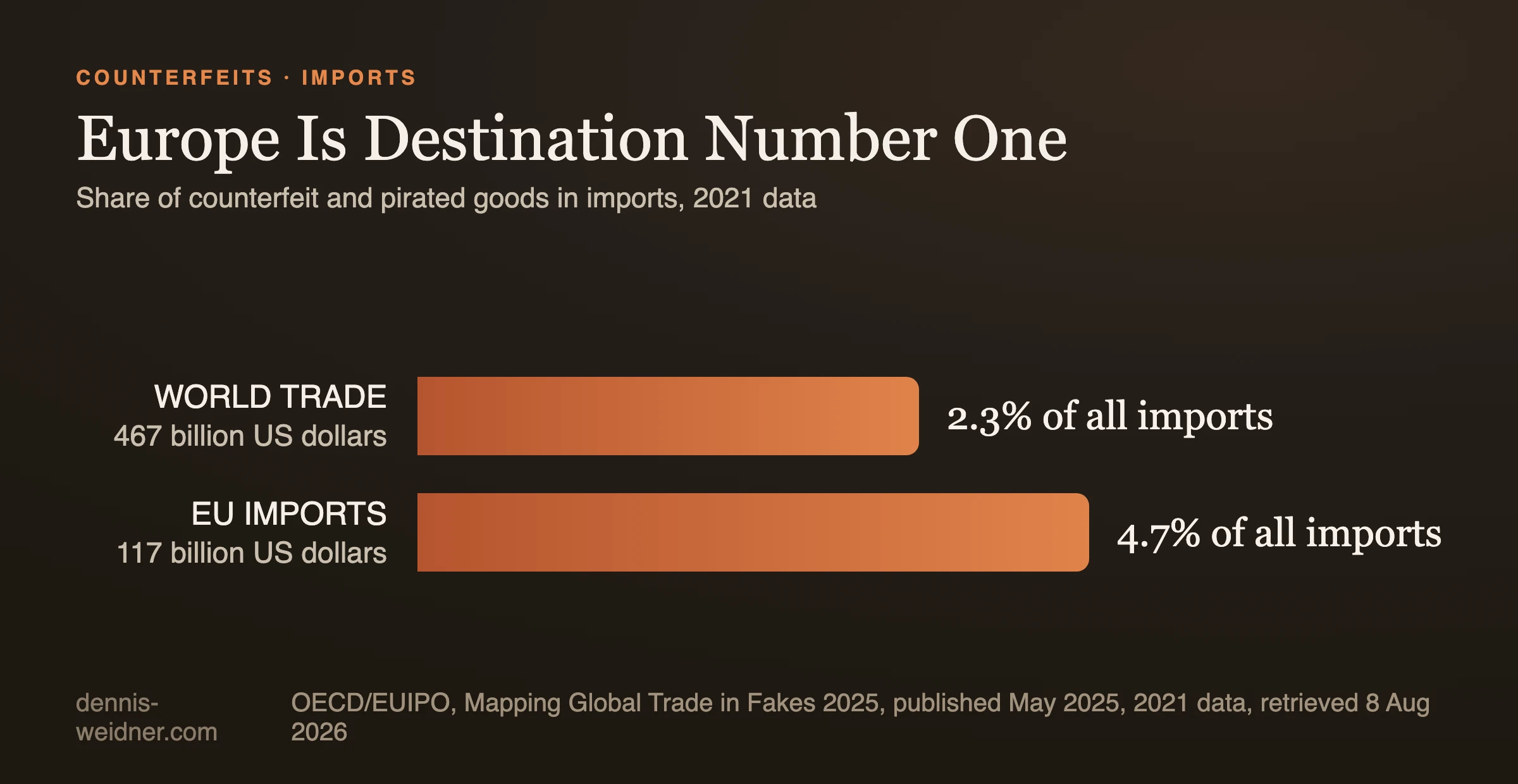
The frame comes from the joint report by the OECD and the EU Intellectual Property Office, Mapping Global Trade in Fakes 2025, published in May 2025 with 2021 data: global trade in counterfeit goods stood at 467 billion US dollars, or 2.3 percent of all world imports. Around 117 billion dollars of it entered the EU, 4.7 percent of all EU imports. The EU share is double the world average; Europe is destination number one. Toys and games have been among the regularly seized product groups in customs data for years.
That trading cards are no footnote in this stream is shown by two documented seizures. In December 2021, customs at Shanghai Pudong airport stopped a shipment of 7.6 tonnes of counterfeit Pokémon cards, destination: the Netherlands, meaning the European market. In September 2023, Ningbo customs reported seizing 970,000 counterfeit Pokémon cards in a single shipment, confirmed after consulting the rights holder. Those are only the finds that were publicly reported, from just two ports of one country.
What does not exist: a serious figure for what percentage of cards offered on marketplaces are fake. Anyone quoting such a rate has estimated it.
Spotting Fakes with the Light Test: How a Real Card Is Built
The most important single test costs nothing and takes five seconds. A genuine Pokémon card is not a printed piece of cardboard but a multi-layer laminate: two printed paper layers around an opaque core. Hold a genuine card against a strong light and it stays largely dark. Most fakes are printed on a single layer and glow through like a postcard.
The light test has two limits you need to know. First, in this simple form it catches the mass of counterfeits, not the top end: multi-layer fakes that pass it do exist by now. Second, it does not replace comparison, because genuine cards from different eras also transmit different amounts of light. The best reference is an unquestionably genuine card from the same era, held right next to it.
Touch helps as a supplement: a genuine card has a defined stiffness and springs back from a gentle flex. Fakes often feel too smooth, too thin or noticeably too thick. The frequently quoted card weight of about 1.7 to 1.8 grams, on the other hand, is only a rough indicator, since it varies by series and finish, and anyone who needs precision scales to justify a suspicion has usually already overlooked other red flags.
Print Pattern, Colours, Card Back: Checking Fake Cards in Detail
After the light test comes the loupe. Offset printing produces a characteristic rosette pattern of fine colour dots. On genuine cards this pattern is even and sharp; cheap fakes show washed-out dots, streaks or coarse pixels under magnification. No microscope needed: a smartphone camera in macro mode is enough for a first impression.
The card back is the second-best checkpoint, because counterfeiters systematically underestimate it. The blue of the back swirl is nuanced and multi-tonal on genuine cards, too dark, too purple or flat on many fakes. Then the classics: spelling errors, wrong fonts, missing accents, misplaced energy symbols, a wrong or missing copyright line. Each of these on its own is disqualifying.
On holo and reverse cards, look at the effect itself: genuine foils and embossing carry patterns that belong to their specific series, while fakes often use generic glitter that looks identical across all cards. And finally context, the cheapest test of all: a sought-after card offered far below market price by a seller with no feedback history is not an opportunity, it is an announcement. What the market price even is and where it forms, I covered in my Cardmarket report.
One related problem deserves its own boundary: there are also genuine cards that have been manipulated, resurfaced or trimmed at the edges. That is not counterfeiting in the strict sense but condition fraud, and I dedicated a separate article to it: card cleaning.
Fake Slabs: When the Case Itself Is the Counterfeit
The most uncomfortable development of recent years: it is no longer just cards being faked but the sealed cases of the grading services, label included, the very tool that is supposed to rule counterfeits out. What a slab is and how grading works has its own explainer; this section is about the case where the case lies.
The good news: this is where checking is easiest, because every certification number is publicly searchable. PSA, Beckett and CGC run online verification: type the number from the label into the provider's database and check that card, year and grade match. Three warning signs remain: a number whose database entry describes a different card, a label with off typography or missing security features, and a case with glue residue or an uneven seam, because genuine cases do get opened and refilled with lesser cards. A slab is a strong authenticity signal, but no substitute for the database check.
Where Fake Cards Are Sold: Marketplaces and the Authentication Gap
Counterfeits are not a flea market phenomenon; they travel the same channels as genuine cards: marketplaces, classifieds, social media and live formats. In my overview of the live shopping platforms, counterfeits in the listings are one of five pain points dealers name again and again across platforms.
What is interesting is how differently the platforms respond. In the US, eBay launched an authenticity guarantee for trading cards in January 2022, back then with a 750 dollar threshold and the Certified Collectibles Group as its authentication partner. The programme has grown considerably since: on its own programme page, as of 9 August 2026, eBay names 200 US dollars as the floor, lists PSA as the authentication partner, requires a signature on delivery above 1,500 dollars, and states explicitly that nothing is graded, only the authenticity of the raw card or the sealed holder is verified.
In Germany, eBay runs its authenticity check for clothing, shoes and sneakers, handbags, watches and jewellery; trading cards do not appear in the German programme pages. Watches and jewellery appear there dozens of times, trading cards not once. Until eBay brings card authentication to Germany, the German card buyer lacks the safety net the American one has had for years.
Cardmarket relies on a different model, feedback history plus its trustee service, and the live platforms largely rely on the seriousness of their sellers. It is exactly this gap between selling speed and verification that makes live formats attractive to counterfeiters: in a stream you decide in seconds, without ever having held the card.
The Legal Side: Buying and Selling Fake Pokémon Cards
Finally, the part sellers need to know before they need it. Whoever sells counterfeit branded goods commits a trademark infringement, which is a criminal offence under section 143 of the German Trademark Act, with a higher sentencing range for commercial-scale dealing. Intent has to be proven, but anyone who keeps selling after being put on notice can no longer claim good faith. Customs is a player too: counterfeit goods can be detained at the border and destroyed, the EU border seizure procedure makes the rights holder part of the process, and The Pokémon Company is among the rights holders using it consistently, as the two seizures in the first section show.
Whoever has bought a fake stands on solid civil ground: a counterfeit card is a material defect, so repair, withdrawal and price reduction apply, and anyone deliberately deceived can additionally rescind the purchase for fraudulent misrepresentation. What decides cases in practice is something else: documentation. Save the listing, save the description, pay through a channel with buyer protection. A legal claim is worth little if the seller was anonymous and the listing is gone.
What Counterfeits Mean for Slabhit
Here too I am not writing as a neutral observer. With Slabhit we are building live shopping for trading cards, and to me the counterfeit question is not a side issue but a founding condition: it is one of the reasons slabhit.de exists at all. A platform that takes authenticity seriously cannot rely on buyers running light tests during a stream. It has to move verification to where it belongs: before the sale, into the platform's responsibility, with transparent criteria for who may sell and what has been checked.
The market is currently confirming this direction from its most expensive end: that eBay built an external authenticator network for its card programme and that Whatnot is valued at 20 billion dollars shows how much capital is looking at this market's trust problem. Trust does not scale by itself; it has to be built. How I think about retail in general is on my topic page on e-commerce and live commerce.
How Many Pokémon Cards Are Fake?
No reliable survey exists on what percentage of listed cards are fake. What is documented is the frame from the OECD/EUIPO report and the two seizures in Shanghai and Ningbo. The checks in sections 2 and 3 are trade knowledge that anyone can reproduce with a genuine card.
Frequently Asked Questions
What is the fastest way to spot a fake Pokémon card?
The light test: a genuine card is a multi-layer laminate with an opaque core and stays largely dark in front of a strong light. Most fakes are single-layer and glow through. The test catches the mass of counterfeits, not the best ones; when in doubt, hold an unquestionably genuine card from the same era next to it.
What does the card back reveal about a fake?
Counterfeiters systematically underestimate the back. The blue of the swirl is multi-tonal on genuine cards, too dark, too purple or flat on many fakes. Add spelling errors, wrong fonts and missing or wrong copyright lines, and each of these alone is disqualifying.
How big is the market for counterfeit trading cards?
No reliable rate exists for trading cards specifically. What is documented: according to the OECD/EUIPO report of May 2025, global counterfeit trade stood at 467 billion US dollars in 2021, with 117 billion entering the EU, 4.7 percent of all EU imports. Documented seizures include 7.6 tonnes of Pokémon cards (Shanghai, December 2021, destination Netherlands) and 970,000 cards (Ningbo, September 2023).
Can a slab be fake?
Yes. Cases and labels of the grading services are being counterfeited too, and genuine cases are sometimes opened and refilled. Checking is easy though: every certification number can be looked up in the online database of PSA, Beckett or CGC. If card, year and grade do not match the entry, walk away.
Does eBay authenticate trading cards?
In the US yes. The programme launched in January 2022 with a 750 dollar threshold and the Certified Collectibles Group as its partner; on its programme page, as of 9 August 2026, eBay names 200 US dollars as the floor and PSA as the authentication partner, with a signature required on delivery above 1,500 dollars. Nothing is graded in the process, only authenticity is verified. In Germany the authenticity check covers clothing, shoes and sneakers, handbags, watches and jewellery; trading cards did not appear in the German programme pages on 9 August 2026.
Is selling fake Pokémon cards a criminal offence in Germany?
Yes. Selling counterfeit branded goods is a trademark infringement, punishable under section 143 of the Trademark Act, with a higher sentencing range for commercial-scale dealing. Anyone who keeps selling after being notified of the fake can no longer claim good faith. Customs can also detain and destroy counterfeit goods at the border.
What are my rights if I bought a fake card?
A counterfeit is a material defect: repair, withdrawal and price reduction apply, plus rescission for fraudulent misrepresentation if you were deliberately deceived. In practice, documentation decides: save the listing and description and pay through a channel with buyer protection, because claims are worth little once the seller has vanished.
Do precision scales help in detecting fakes?
Only as a rough indicator. The often quoted weight of about 1.7 to 1.8 grams varies by series and finish even among genuine cards. The light test, the print pattern under a loupe and the back comparison are more meaningful, and an offer far below market price from a seller with no history remains the strongest warning sign of all.
Warm regards,
Dennis Weidner
Note: AI tools supported me in writing this article, and some images were edited with AI. I stand behind its content and every statement with my name.