Between a microfibre cloth and a recoloured border sit surprisingly few steps in the trading card world. I laid the rules of the marketplaces and the grading companies side by side and found a line that is sharper than the online debate suggests.
One Word, Two Completely Different Things
Card cleaning sounds harmless. Cleaning a card, the way you clean a pair of glasses. In the trading card trade the term actually describes a spectrum that starts at one end with a microfibre cloth and ends at the other with procedures that Cardmarket, in its own rules, explicitly prohibits and answers with exclusion and possible criminal prosecution.
In between lies a grey zone occupied by service providers calling themselves card clinics or restorers. This text draws the line, and not by my gut feeling but along the rules that marketplaces and grading companies have written down themselves.
Why the Temptation Is So Great
The reason is purely arithmetic. At grading companies the overall grade comes from four dimensions, and the weakest one caps the result. A card with perfect corners and centering that fails on a fingerprint trace on the surface loses a whole grade step because of it. Between two grade steps, sought-after cards regularly sit at a multiple of the price.
That defines the temptation: repairing the one weak value does not shift a detail, it shifts the entire price level of the card. And because grading happens after any treatment, nobody inspects the condition beforehand.
What Is Unambiguously Fine
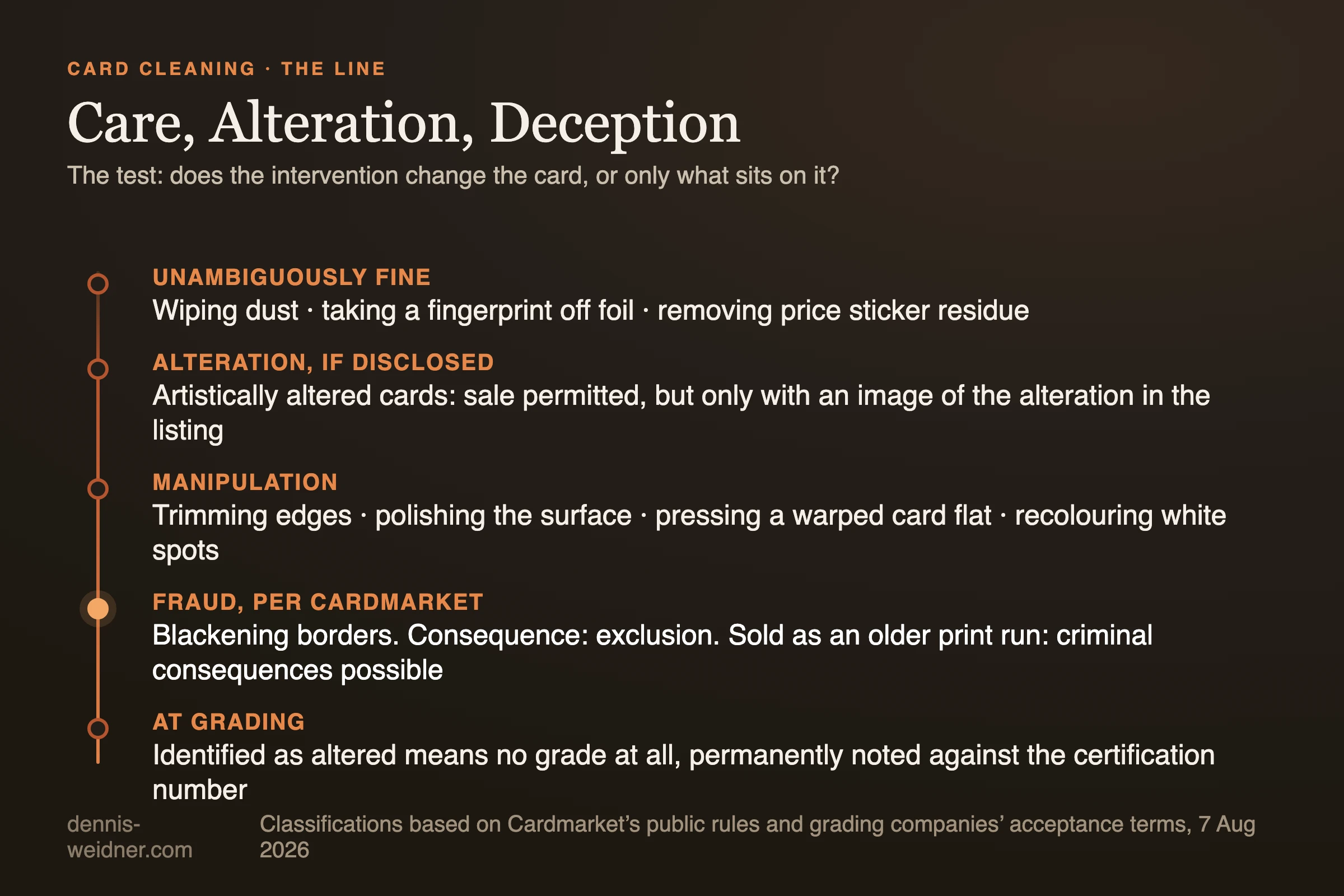
At the harmless end sits everything that removes foreign matter without touching the card itself. Wiping dust off the surface. Taking a fingerprint off a foil card. Getting a hair out of the sleeve. Removing adhesive residue from a price sticker on the back, provided the card surface stays intact.
That is not manipulation, that is care. Nobody expects a card to be sold in the dust that twenty years in an attic left behind. The test is simple: does the intervention change the card, or only what sits on it?
Where the Line Runs, and Who Drew It
It gets interesting with interventions that affect the substance. Here Cardmarket's card condition help page contains a passage that is blunter than anything else I have found on the subject.
On blackening card borders it says, in substance: tampering with the border of a card will always result in a card in Poor condition. Blackening is essentially an act that destroys value, and it is done precisely in order to sell a card for more than its remaining worth. The platform explicitly calls this fraud and announces exclusion. Anyone offering such a card from one print run as an older, more valuable print run must, according to the same page, expect criminal consequences.
The rule for artistically altered cards is just as clear: they may be sold, but only with an image of the modified card in the listing. Altering is not the problem, concealing it is.
From that the line emerges, and it is remarkably sharp:
Permitted is removing what sits on the card. Dust, grease, adhesive residue.
Manipulation is anything that changes the card itself. Colouring borders, trimming edges, sanding or polishing surfaces, pressing a warped card flat under pressure and moisture, touching up white spots along the edges.
The decisive addition: manipulation is not automatically a crime, but concealing it turns it into deception. Selling a pressed card as pressed means selling a treated card. Selling it as untreated means misrepresenting a value-forming property.
What Grading Companies Do About It
Grading companies found their own answer to this problem, and it is harsher than any marketplace rule: a card identified as altered receives no grade at all. It comes back with a corresponding note, and that note stays attached to the card permanently through its certification number.
That is economically elegant, because it inverts the calculation above. Anyone having a card treated to gain one grade step is not risking a worse grade, they are risking the total loss of gradeability. An upside risk becomes a downside risk.
If the card is going to be graded anyway, any treatment beyond dusting is therefore a bad deal. Not for moral reasons, for arithmetic ones.
How Buyers Spot a Treated Card
Without experience you cannot be certain, but four signals are readable even for laypeople:
Borders that are too perfect. Old cards almost always show fine light spots along the edges. A thirty-year-old card with flawless, deep black borders is either a stroke of luck or recoloured.
Dimensions that do not match. Trimmed cards are marginally smaller. Measure and compare against a known card from the same set and you will find it.
A surface with uneven gloss. Polished spots reflect differently from the rest, especially visible in raking light.
A card that is too flat. Older foil cards nearly all warp slightly. One lying perfectly flat may have been in a press.
And the practical advice that beats any inspection: above a certain value you either buy in a slab or you buy from someone you trust to take it back. How a slab comes about and what it delivers is in What a Slab Is.
The Way Out Nobody Talks About Enough
The entire card cleaning debate arises from a single circumstance: the card is already damaged by the time the question comes up. Yet almost all the damage that later makes an intervention tempting happens in storage, and there it is avoidable.
Warping comes from differences in humidity. A foil card consists of layers that expand at different rates. Store cards in a damp cellar or a hot attic and you produce exactly the warp somebody is later meant to press flat. A cupboard in a normally heated room solves the problem before it exists.
White edges come from friction. Cards moved around in loose stacks rub against each other. A soft sleeve costs a few cents and prevents precisely the damage whose later concealment breaches the marketplace rules.
Fingerprints are the smallest problem and the most often mishandled. Grease lifts off with a dry microfibre cloth. Reach for a cleaning agent instead and you attack the surface, turning a removable print into a permanent difference in gloss.
Almost every card that would need treatment would never have reached that state without a storage mistake. Prevention costs a few cents, repair costs gradeability.
Why This Interests Me Beyond the Cards
Because a market is learning in real time what transparency costs and what it returns. For twenty years the description of a card was its seller's word. Today there is an authority that checks that word, and a platform that writes down in its own help texts, in plain terms, where trading ends and deception begins.
For anyone building something in this market, that is a statement. You can no longer retreat to the position that it is all a matter of opinion. Anyone selling trading cards today is selling, alongside the card, a verifiable statement about its condition. That, and the rest of retail, is what I write about on my topic page on e-commerce and live commerce.
Frequently Asked Questions
Am I allowed to clean my trading cards?
Anything that removes foreign matter without changing the card itself is unambiguously fine: wiping off dust, taking a fingerprint off a foil card, removing adhesive residue from a price sticker. The test is: does the intervention change the card, or only what sits on it?
When does cleaning become manipulation?
As soon as the substance of the card is changed. Colouring borders, trimming edges, polishing or sanding surfaces, pressing a warped card flat. Cardmarket explicitly prohibits the blackening of card borders in its own rules and announces exclusion from the platform.
Can I sell an altered card?
Yes, but only if disclosed. According to Cardmarket, artistically altered cards may only be listed with an image of the modified card. Altering is not the problem, concealing it is. Offering a treated card as untreated misrepresents a value-forming property.
What happens to a treated card during grading?
It receives no grade at all. Grading companies return cards identified as altered with a corresponding note, and that note stays attached to the card permanently through its certification number. The hoped-for grade step turns into a total loss of gradeability.
Why does manipulation still pay off for some people?
Because the overall grade is capped by the weakest of the four dimensions. A single weak point costs an entire grade step, and between two grade steps sought-after cards often sit at a multiple of the price. Repairing that one weak value shifts the entire price level of the card.
How do I spot a treated card as a buyer?
By four signals: borders that are too perfect on old cards, marginally undersized dimensions from trimming, uneven surface gloss in raking light, and a foil card lying perfectly flat although older foils nearly always warp slightly. Above a certain value, buy in a slab or from someone you trust to take it back.
Is card cleaning illegal?
Cleaning itself is not. It becomes criminally relevant when a manipulated card is sold as untreated or as a different, more valuable edition. Cardmarket explicitly notes in its help texts that such deception can carry criminal consequences.
What is a card clinic?
That is what service providers call themselves when they recondition cards, sometimes with the explicit aim of achieving a better grade. The offering sits in a grey zone: as long as only foreign matter is removed, it is care. As soon as the substance is changed, the result is a card that has to be disclosed and that fails grading.
Warm regards,
Dennis Weidner
Note: AI tools supported me in writing this article, and some images were edited with AI. I stand behind its content and every statement with my name.