German online retail has grown up. After years of rapid expansion, it is now a huge but comparatively mature market. And it is precisely that maturity that makes one particular segment so interesting to me: where the overall market grows only moderately, live commerce is exploding.
A mature market, a new dynamic
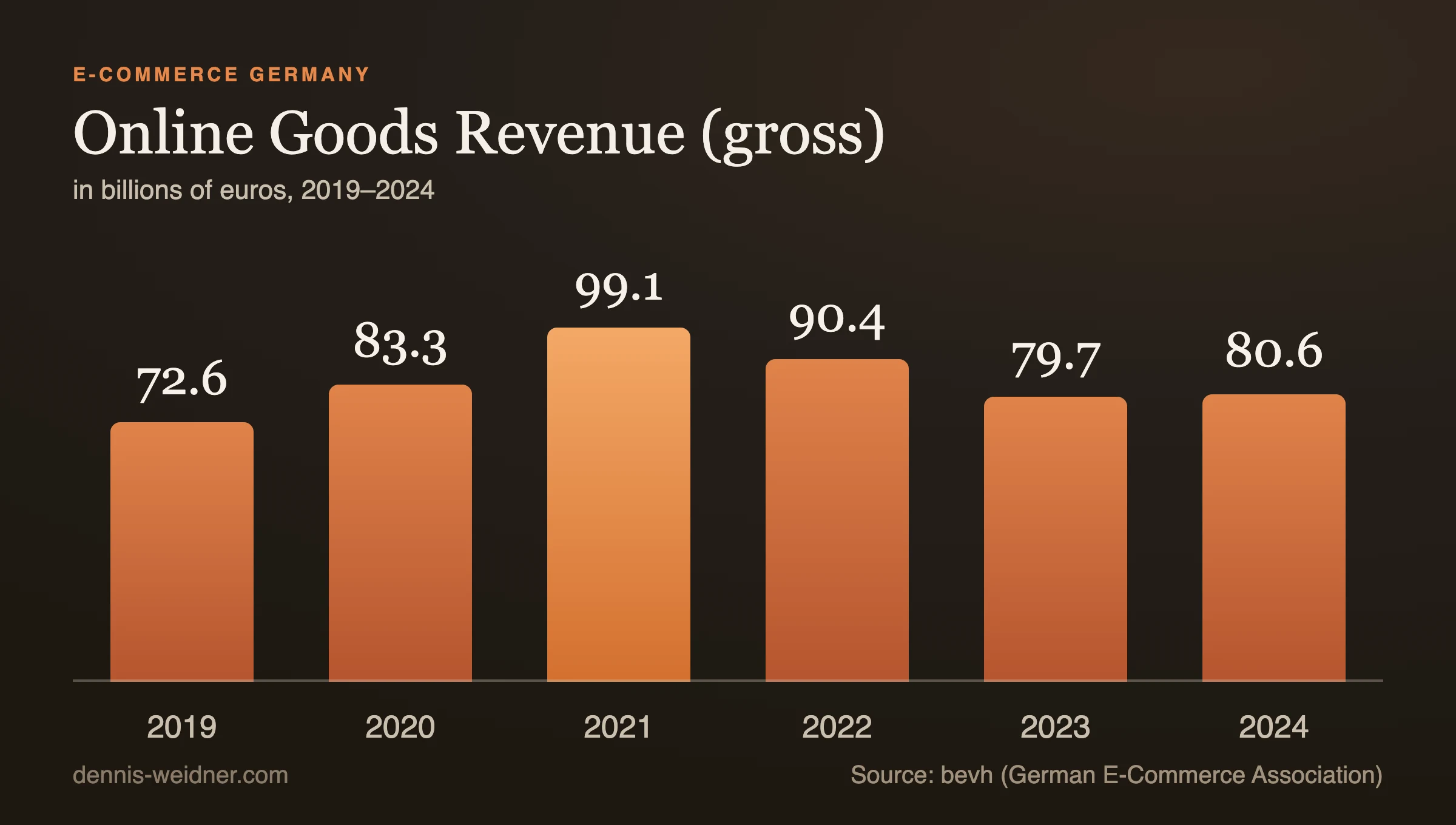
The revenue picture makes it clear. After the pandemic boom to almost 100 billion euros came a correction, and since then, according to bevh, goods revenue has settled at a high level of around 80 billion euros. That is not a slump, that is maturity.
More on this topic: E-Commerce & Live Commerce, with background, practice and every article in one place.
Classic online retail is therefore growing in the high single-digit percentage range per year, solid, but no longer fireworks. Live commerce, on the other hand, is adding around 27 percent per year according to Grand View Research, three to four times as fast. That gap is the real story: when a sub-market grows so much faster than the market as a whole, market share is shifting there, toward those who get in early. For a founder, that is the most interesting signal there is.
What sits behind the numbers
Maturity does not mean standstill, it means displacement. The HDE Online Monitor puts German online revenue for 2024 at around 88.8 billion euros net, up 3.8 percent, with online accounting for 13.4 percent of total retail. But the striking part is not the total, it is the distribution: for the first time, more than half of all online revenue ran through marketplaces, which together hold a share of roughly 57 percent.
That is the real pincer movement. In a mature market, volume migrates to a handful of large platforms, and the individual retailer becomes an interchangeable tile next to ten identical offers. Anyone competing on price alone almost automatically loses that race to scale and logistics giants. That is exactly why I do not look at the headline total, but at the edges, where genuine differentiation is still possible.
Why the mature market needs live commerce
In saturated online retail, competition is fought over price and logistics, a race the biggest players usually win. Live commerce opens a different door: competition over closeness, experience and trust. A retailer is no longer just a shelf in an infinite marketplace, but a face, a show, a relationship. This is a field where smaller and specialized players can win too.
Then there is the channel. The smartphone has long been the dominant shopping device and, according to HDE, accounts for the majority of online revenue. Live commerce is built for the smartphone: vertical, in real time, with chat and countdown. It is not a catalogue you click through at a desk, but a show you follow from the sofa. The sale happens in the moment of attention, not three clicks later in a cart.
A concrete example
Take trading cards. On a marketplace, a single card is barely distinguishable from a competitor's identical listing, so in the end only the price counts. In a live auction, by contrast, the moment counts: the reveal when a box is opened, the host's reaction, the shared suspense in the chat. A product becomes an experience, and a buyer becomes a regular. Why this asset class is more than a hype, I unpacked in Are Trading Cards an Asset Class?, and why the German live market is tipping right now in Live Commerce in Germany.
Where we come in
This is exactly the gap we are building into with Slabhit. Not the next price-driven marketplace, but a curated stage for live auctions where trust is the foundation. I have broken down the market figures, and why the timing is right, in my piece The Live Commerce Market in Numbers.
German retail is no longer growing everywhere, but it is growing in the right places. And live commerce is one of them.
Frequently Asked Questions
How big is German e-commerce?
Depending on the survey, online goods revenue sits between around 80 billion euros (bevh) and 88.8 billion euros net (HDE, 2024, up 3.8 percent). Online accounts for about 13.4 percent of total retail, a mature market with moderate growth.
So where is retail still growing strongly?
In sub-segments like live commerce, which according to Grand View Research is adding around 27 percent per year, a multiple of the overall market.
Why are marketplaces a problem for retailers?
Because, according to HDE, roughly 57 percent of online revenue now runs through marketplaces. There, your offer competes almost entirely on price, a race the largest players usually win.
Why is this an opportunity for smaller retailers?
Because live commerce runs on closeness, experience and trust, not on price and logistics. On that stage, specialized and smaller players can win too.
Warm regards,
Dennis Weidner
Note: AI tools supported me in writing this article, and some images were edited with AI. I stand behind its content and every statement with my name.