TikTok Shop launched in Germany in March 2025, and barely a week goes by without a small merchant asking me: is this worth my time, or just the next shiny thing? I run a live shopping business myself with Slabhit, so I look at these numbers as an operator, not a spectator. The conversion data is real and remarkable, but the economics shifted noticeably in early 2026.
Where TikTok Shop stands in Germany today
One year in, the results are hard to dismiss. According to market researchers at NIQ, just over 15 percent of German online shoppers have now ordered through TikTok Shop at least once, up from 10.5 percent only six months after launch. In NIQ's revenue ranking of German online retailers, the platform already sits at number 15, passing companies that spent two decades building their position.
More on this topic: E-Commerce & Live Commerce, with background, practice and every article in one place.
The seller side is growing just as fast. By TikTok's own account, more than 25,000 merchants now sell on the platform in Germany, and average daily seller revenues nearly doubled within six months. The independent NIQ data points in the same direction. This is no longer an experiment. It is a real sales channel.
The conversion numbers that change the math
Why does it work so well? Because of the format. A conventional online store typically converts two to three percent of its visitors. Live commerce plays in a different league: McKinsey reports companies achieving conversion rates approaching 30 percent, up to ten times higher than conventional e-commerce. That matches what I see at Slabhit every day. A livestream is not a shelf, it is a sales conversation: a person explaining, demonstrating, answering questions in real time, and a moment that passes if you do not act.
On TikTok Shop, this format is the engine, not a side show. According to the platform, sellers generate 60 percent of their revenue on average through shoppable videos and live shopping rather than the static product catalog. If you treat TikTok Shop like a second Amazon, upload your products and wait, you have missed the point entirely. I have written in more depth about why live formats work so differently from a product page on my e-commerce and live commerce page.
The surprising audience: it is not Gen Z
Here is the number that breaks most assumptions. If TikTok makes you think of dancing teenagers, you are wrong about where the purchasing power sits. NIQ's data shows that 37 percent of TikTok Shop revenue in Germany comes from Generation X, people between 47 and 66 years old. That beats Gen Z at 30 percent and millennials at 28 percent.
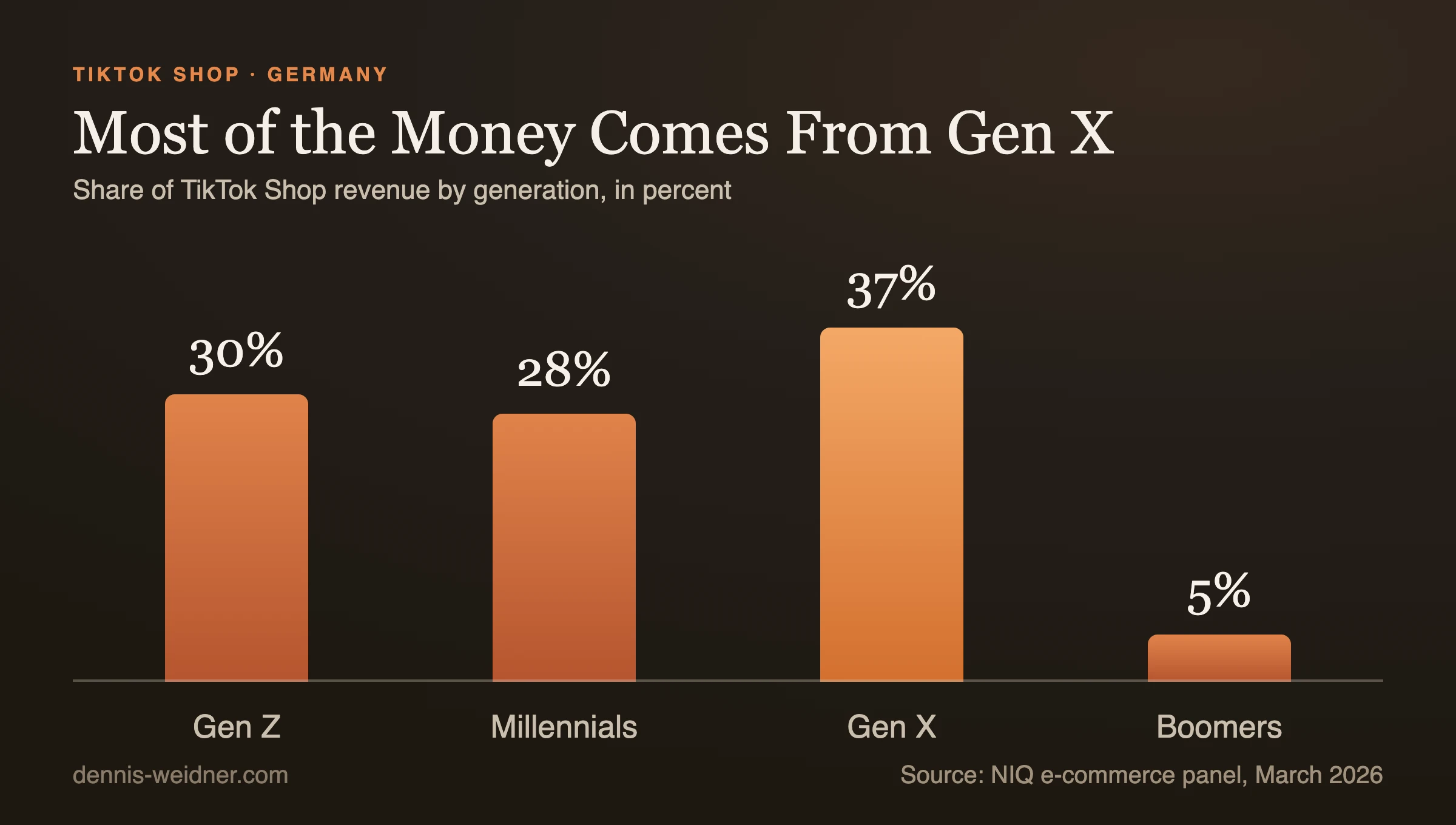
This completely reframes the strategic question. You are not just reaching a young, price-sensitive crowd. You are reaching a generation with real disposable income that is currently discovering how much fun buying in a livestream can be. I underestimated this shift when building Slabhit, then watched it happen live: the strongest buyers are often the people nobody had on their list. The category mix supports a broad play too, with fashion, electronics, and home leading revenue and beauty and health growing fast.
What TikTok Shop costs: commission and margin
Now for the other side of the ledger, and since January 2026 it has teeth. Effective January 8, 2026, TikTok nearly doubled its sales commission in Germany from 5 to 9 percent, with electronics at 7 percent. New sellers pay a reduced 4 percent for their first 60 days, provided they list at least five products within 15 days. The German retail association Händlerbund has documented the details.
Run a simple model for a small merchant. You sell a product for 40 euros, and the 9 percent commission takes 3.60 euros. Then come cost of goods, shipping, returns, and the cost almost everyone forgets: your time for content. A livestream is work, from preparation through two hours on air to fulfillment. If your margin was 30 percent before TikTok, the commission alone eats nearly a third of it.
Against that stands a genuine advantage: you only pay when you sell. No base fee, no media budget evaporating into thin air. If you build organic reach, you acquire customers at marginal costs that Google or Meta advertisers can only dream of. For a small merchant with a good product and a personality that works on camera, that is the real opportunity.
The risks almost nobody talks about
Three things belong in every merchant's risk file. First, dependency: the fee increase from 5 to 9 percent arrived by announcement, not negotiation, and a business built entirely on TikTok Shop is a price taker. Second, price pressure: the platform thrives on deals and impulse buys, so a premium brand with stable pricing must be careful not to devalue itself there. Third, regulation: TikTok remains under constant political scrutiny, has faced the threat of a shutdown in the United States more than once, and European proceedings are ongoing. A total outage is unlikely, but not impossible, and your business should be able to survive it.
My conclusion is one simple principle: TikTok Shop as a channel, never as a foundation. Customer relationships, your email list, and ideally your own store belong to you. Platform reach is borrowed. If you want to understand how the broader live commerce market is developing here and why Germany is years behind Asia, I have analyzed that in my piece on live commerce in Germany.
My verdict: who should get in during 2026
So, is it worth it? For three types of merchants, a clear yes. First, you sell products with margins of roughly 40 percent or more that show well on camera: beauty, fashion, food, collectibles, gadgets. Second, you or someone on your team genuinely enjoys presenting on camera. Third, you want to reach a new audience with real purchasing power without burning a five-figure ad budget. The 60-day discount for new sellers makes testing especially cheap right now.
A clear no applies to merchants with margins below 20 percent, to pure price-comparison assortments, and to anyone who treats content as a chore. Then the commission eats your profit, and without good videos you get no reach. My advice: test it properly, with five products and ten livestreams, before you judge. The numbers say live shopping is here to stay. The only question is whether you show up while the channel is still uncrowded.
Frequently asked questions
What fees does TikTok Shop charge merchants in 2026?
Since January 8, 2026, the sales commission in Germany is 9 percent, with 7 percent for electronics. New sellers pay 4 percent for their first 60 days if they list at least five products within 15 days. There are no monthly fees; you only pay on successful sales.
What conversion rates are realistic in live shopping?
McKinsey reports live commerce conversion rates approaching 30 percent, up to ten times the typical two to three percent of a conventional store. Those are top results, not a guarantee. Product fit, presentation quality, and an engaged community make the difference.
Who actually buys on TikTok Shop in Germany?
A surprisingly mature audience. According to NIQ, Generation X, aged 47 to 66, accounts for 37 percent of revenue, ahead of Gen Z at 30 percent and millennials at 28 percent. TikTok Shop reaches high-purchasing-power buyers across generations.
Is TikTok Shop worth it for small merchants without a big budget?
Yes, if margins and content are up to it. With no base fees and organic reach, the entry barrier is lower than paid advertising. You need products that demonstrate well, margin to absorb the 9 percent commission, and consistent video and livestream output.
Warmly,
Dennis Weidner
Note: AI tools supported me in writing this article, and some images were edited with AI. I stand behind its content and every statement with my name.