Whatnot has just raised 545 million dollars at a 20 billion valuation. The figures are impressive, and some of them say less than they appear to. What that means for the German trading card market, and why I mostly see an opportunity in it.
Whatnot Valuation: 20 Billion Dollars After the Series G
Whatnot, the American live shopping platform, has closed a funding round of 545 million US dollars at a valuation of 20 billion US dollars. The series G was led by Iconiq, Lightspeed and Avra. The company was founded in Los Angeles in 2019 and auctions live: trading cards, sneakers, toys, records, fashion.
The accompanying figures are genuinely impressive. In the first half of 2026, more than 8 billion dollars of merchandise value changed hands on the platform, as much in six months as in all of 2025. Annual revenue is expected to pass the billion mark in 2026. The number of buyers has more than doubled within a year. Whatnot claims roughly 60 percent of a live commerce market it itself puts at around 22 billion dollars.
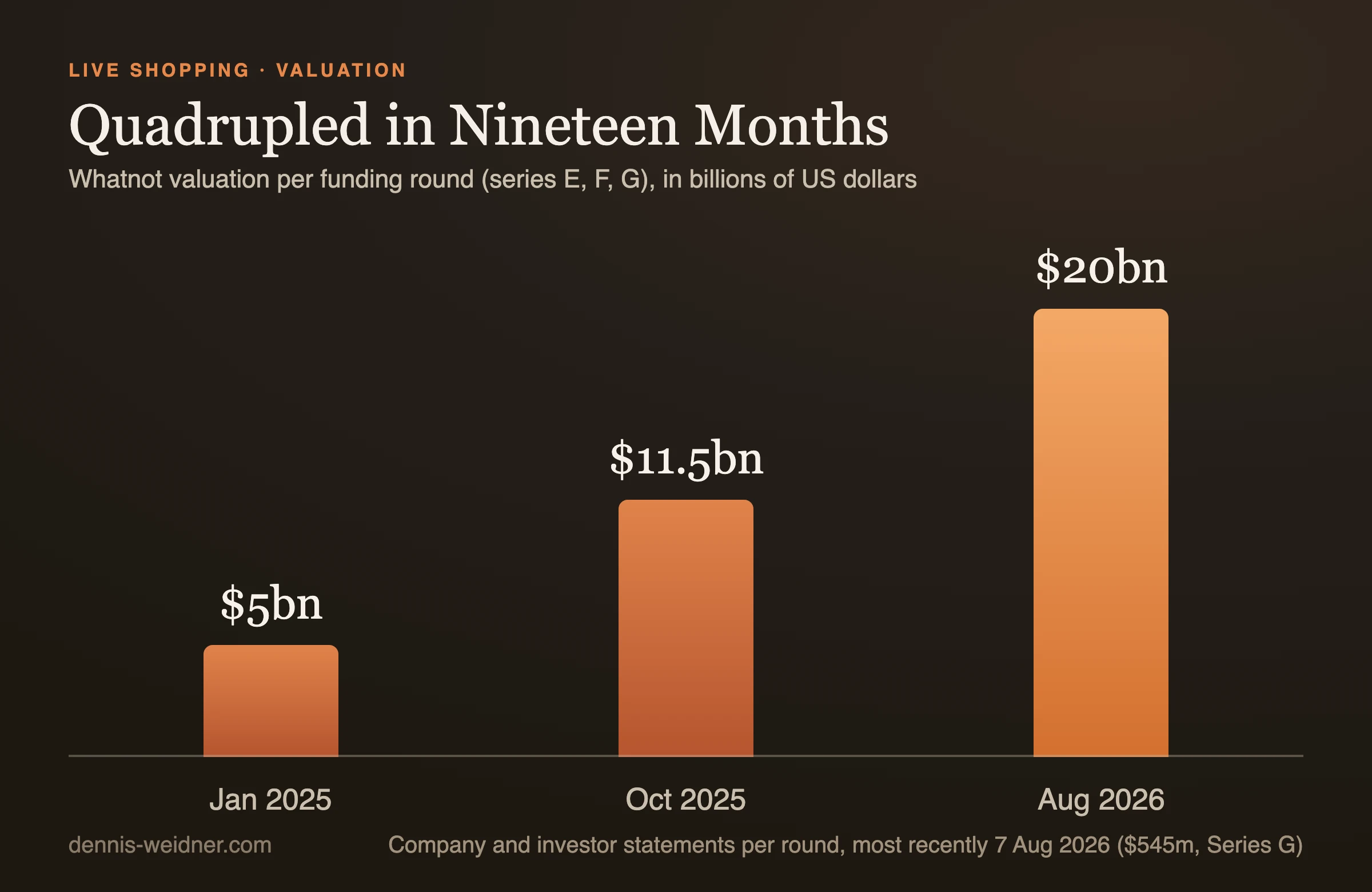
Nineteen months, a fourfold valuation. Anyone who has ever told a growth story knows what such a curve means: it is not a result, it is a promise. And promises have to be kept.
Whatnot Versus Cardmarket: The Scale Compared
To understand what these numbers mean for the European trading card market, a comparison with that market's incumbent helps. Cardmarket, Europe's largest marketplace for trading cards, processed a gross transaction volume of 417 million euros in 2025. Whatnot did more than 8 billion dollars across all categories in the first half of 2026 alone.
Extrapolated to a full year that is roughly a factor of 35. These are different things. Cardmarket is a catalogue marketplace for cards in Europe, Whatnot is a live auction platform across many categories with a US focus. The comparison does not work as competitive analysis, but it answers the question of how much capital is currently looking at this market.
And it shows a second thing: Whatnot's valuation sits at twenty times expected annual revenue. With roughly 16 billion dollars of extrapolated annual merchandise value and about one billion in revenue, the effective take rate is around six percent. That is an important number, because it says how much room there is on the way down.
Whatnot Fees in Germany: Eleven Percent, Not Eight
This is where it gets concrete for sellers. The three platforms that matter for trading cards in Germany take very different shares.
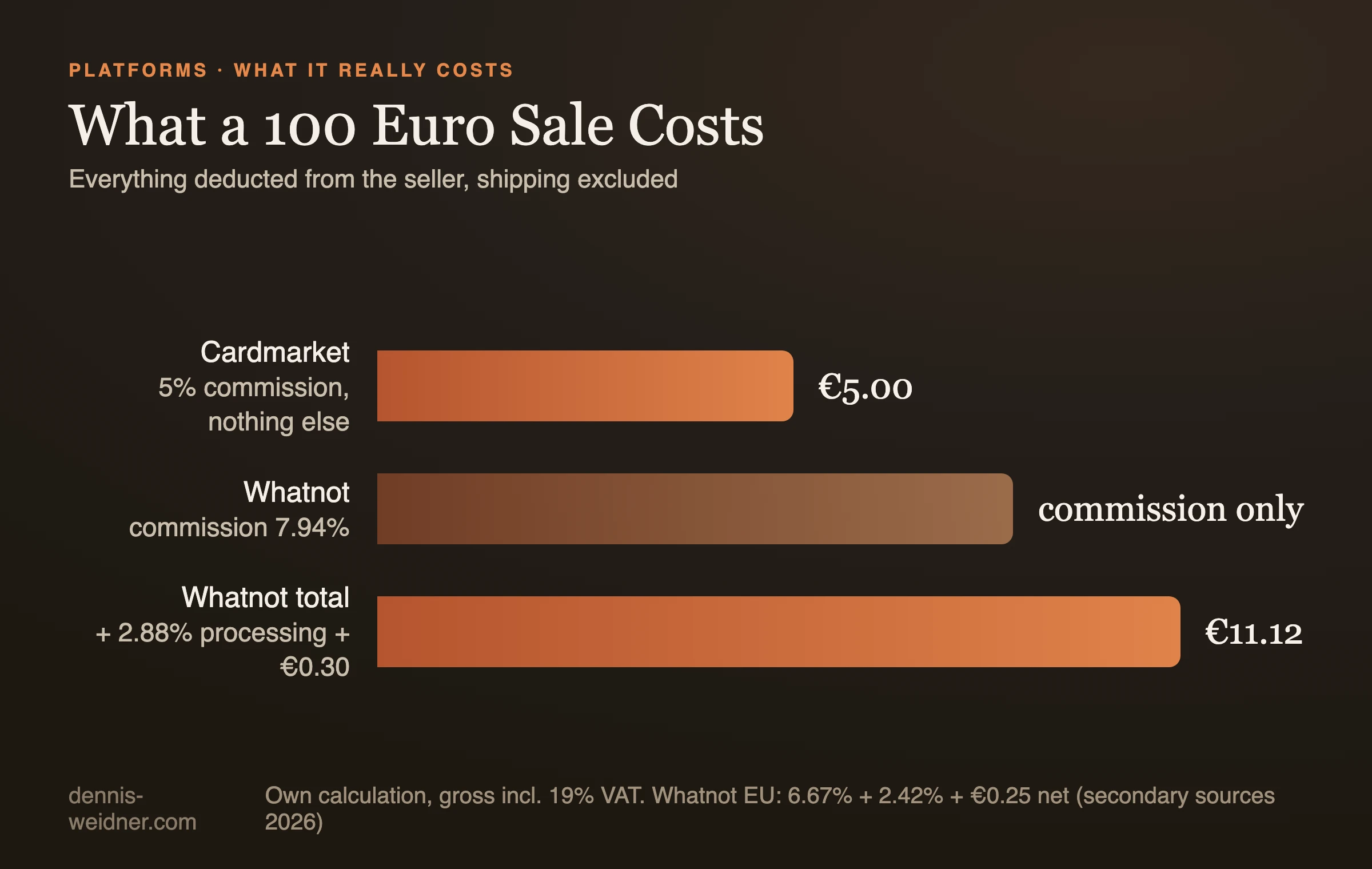
The widely quoted eight percent is only half the calculation. That is the commission, and for European sellers it comes from 6.67 percent net plus VAT, which makes 7.94 percent gross. After that comes payment processing: 2.42 percent net, so 2.88 percent gross, plus a transaction fee of 0.25 euros net. Those 0.30 euros gross are the figure you read everywhere, and they make it sound as if that were all of it.
Together, on a 100 euro sale, that is 11.12 euros, not 8.30. Sellers who told me about it therefore speak of around eleven percent, and that figure is right. With Cardmarket it stays at 5.00 euros: according to its own terms the trustee fee is borne by the buyer, not the seller, so it never appears on the seller's statement at all.
Over a year with 50,000 euros of turnover that is a difference of roughly 3,060 euros. That is not an accusation. Selling live costs more than a listing page because more is delivered: reach, payment handling, streaming, shipping, moderation. Whatnot does not hide the price either, and since January 2026 has introduced relief by dropping commission on the portion above 1,500 euros per order in certain categories.
The breakdown adds up: 6.67 percent times 1.19 gives the widely quoted not-quite-eight percent, and 0.25 euros times 1.19 gives the equally widely quoted 0.30 euros. Two independent statements that reconcile exactly. The binding terms are in your own seller dashboard, because that is where they are stated for your country and category.
The third provider in the German market, Voggt, has belonged to Fanatics Live since 3 October 2024, the live commerce arm of the American sports collectibles group Fanatics. Voggt was founded in France in 2021 and, according to statements at the time of the acquisition, had more than half a million members. Its last publicly known terms of 8.9 percent plus 0.36 euros date from before the takeover.
What the difference explains: a seller who moves known cards at known prices stays with Cardmarket. Live pays off when live can do something a list cannot. And that is where the interesting question begins.
The Numbers Whatnot Leaves Out of Its Own Market Report
Whatnot publishes its own market report on live selling in Europe, and it is a good source because it comes straight from the provider. Reading it, though, a structure stands out that is worth knowing about.
Stated for Germany: more than 1.6 million hours of livestreams watched in 2024. One seller who turned over 70,000 euros in a seven-hour trading card show. Toy sales doubling monthly since launch. Sneakers as a new category with an average 90 percent weekly increase. For Europe: 340,000 streaming hours per week, a seller count up 600 percent year on year, and 59 percent of European live sellers making more than half their revenue there.
Notice anything? Almost every one of those figures is a growth rate or a single record. How many sellers are active in Germany? How much merchandise value changes hands here? What is the average revenue per seller, rather than the best one's? Those numbers are not there. And without a starting point, 600 percent growth is not information: three to twenty-one is also 600 percent.
I am not imputing intent. Every growing company writes its reports this way, and nobody is obliged to disclose country figures. But anyone reading these numbers should know what they are reading: a growth story, not a market measurement. Which is exactly why the Cardmarket comparison above uses an absolute figure you can check, and this section does not.
Whatnot Advertising: What the Ads Say About the Positioning
What strikes me and several people around me: the density of ads is enormous, and their content is shifting. Increasingly the clips show somebody holding a branded product up to the camera saying they got it for four euros, or three. These are real brands, and that is exactly what creates the ambivalence while watching: either it is true, in which case somebody is dumping branded goods. Or it is not, in which case it is a promise the platform has to keep.
Both are a problem for a brand once it becomes the dominant image. Whatnot started as a platform for collectors and enthusiasts, for people looking for a rare card who know the price. A bargain pitch brings in a different audience: people looking for the low price who do not know the goods. They come in cheaper and leave faster.
The fact that this market already argues about formats close to gambling does not make it easier. The German collector scene has debated for years whether formats such as twenty lots at twenty euros each on a product that costs less elsewhere are still trading. That is not a Whatnot-specific problem, it is a live auction problem. But whoever leads the market gets measured by it.
My thesis: a company that quadruples its valuation in nineteen months has to win users faster than a niche brand can grow. The fastest route to users is price. And price is the one positioning advantage you cannot keep.
Live Shopping in Germany: Why Breadth and Depth Contradict Each Other
The second point has nothing to do with advertising and everything to do with physics. Anyone growing across several countries and a dozen categories at once cannot be deep in every country and every category. That is not a criticism of the leadership, it is a consequence of the task.
For the German trading card market that means, concretely: there are rules here you have to know. Commercial sellers need a VAT ID. Margin taxation for second-hand goods is a topic of its own. Buyers expect a condition rating on the scale they know from Cardmarket, and they will argue over one grade step. Shipping runs on formats German collectors have used for twenty years. None of this is unsolvable, but all of it costs attention that is needed elsewhere too.
And that is where the real opportunity lies.
Selling Trading Cards: Where a Small Player Can Win
The usual reaction to news like this is resignation: you cannot take on 20 billion. I think that is wrong, for three reasons.
First, a niche is not a small version of the market. It is a different market. Anyone trading cards seriously wants things a universal platform will never prioritise: reliable condition ratings, authentication, a history for the seller, a connection to the grading companies, a clean handling of European price levels. For a platform that also does sneakers, records and fashion, that is one requirement among many. For a specialised provider it is the product.
Second, the cost of building has shifted. A feature that needed a team and two quarters three years ago now takes days with agentic systems. That does not change who has the bigger distribution, but it changes how many attempts a small provider can make before the money runs out. How I work with that myself is in Rebuilding My Website with AI Agents.
Third, trust is not an economy of scale. A platform ten times the size is not ten times more trustworthy. In a market where the condition of goods is negotiable and counterfeits are a real issue, what decides is whether somebody handles the return and whether the description is accurate. That is an operational question, not a capital question.
It does not follow that you should attack Whatnot head on. It does pay, though, to be distinctly better at one thing rather than somewhat present everywhere.
What I Take From This for Slabhit
With Slabhit we are building live shopping for trading cards, and yes, that is the same stage. Three things stay with me from this news.
The category is proven, which saves a lot of persuading. Two years ago you had to explain why anyone would watch an auction. That question has been answered, and not by us. That is the good news in a 20 billion valuation: the market exists.
Price is taken, diligence is not. Competing on the lowest total price means taking on a war chest. Competing on reliability means taking on a company that currently has to work on many fronts at once. The second contest is the one a small team can fight.
Being German is a feature, not a handicap. The rules here are awkward enough that mastering them is a difference. Anyone using the condition scale German collectors know, and solving the tax questions cleanly from the start, does not have to retrofit it later.
None of this replaces reach. You cannot hide in a niche from the fact that users have to show up first. But you can choose which fight you pick. On retail in general and where it is shifting right now, I write on my topic page on e-commerce and live commerce.
Frequently Asked Questions
How much is Whatnot worth?
On 7 August 2026 Whatnot was valued at 20 billion US dollars in a series G round of 545 million US dollars. In October 2025 the valuation was 11.5 billion, in January 2025 it was 5 billion. The round was led by Iconiq, Lightspeed and Avra.
What revenue does Whatnot generate?
Annual revenue for 2026 is expected to exceed one billion US dollars. Merchandise value traded on the platform in the first half of 2026 was over 8 billion dollars, as much as in all of 2025. That implies an effective take rate of roughly six percent.
What does selling on Whatnot in Germany really cost?
Around eleven percent, not eight. The widely quoted eight percent is only the commission (6.67 percent net, so 7.94 percent gross). On top comes payment processing at 2.42 percent net, so 2.88 percent gross, plus a 0.25 euro net transaction fee. On a 100 euro sale that adds up to 11.12 euros. Since January 2026 no commission applies to the portion above 1,500 euros per order in selected categories.
Is Whatnot more expensive than Cardmarket?
Considerably: 11.12 euros against 5.00 euros on a 100 euro sale. Across 50,000 euros of annual turnover that is roughly a 3,060 euro difference. With Cardmarket the seller only pays the 5 percent commission, because under its terms the trustee fee is borne by the buyer. In return, Whatnot delivers a different service: reach, streaming, payment and shipping handling.
Who owns Voggt?
Fanatics Live, the live commerce arm of the American sports collectibles group Fanatics. The acquisition of Voggt's assets was announced on 3 October 2024. Voggt was founded in France in 2021 and was regarded as Europe's market leader in live selling of sports collectibles and trading cards, with more than half a million members according to statements at the time.
How big is Whatnot compared to Cardmarket?
On an annual basis roughly a factor of 35 in merchandise value: Cardmarket processed around 417 million euros in 2025, Whatnot over 8 billion dollars in the first half of 2026 alone. The comparison has limits, because Cardmarket is a European catalogue marketplace for cards while Whatnot is a live auction platform across many categories with a US focus.
Why do the growth figures say less than they appear to?
Because Whatnot's own European report consists almost entirely of growth rates and individual records, with hardly any absolute baseline figures. A 600 percent increase in seller numbers is not information without a starting value, since three to twenty-one is also 600 percent. How many sellers are active in Germany, and what merchandise value changes hands here, is not stated.
Do small providers stand any chance in this market?
Yes, but not on price. A niche is not a small market, it is a different one: anyone trading cards seriously needs reliable condition ratings, authentication, a connection to the grading companies and knowledge of European price levels. For a universal platform that is one requirement among many; for a specialised provider it is the product. On top of that, trust does not scale: a platform ten times the size is not ten times more trustworthy.
Warm regards,
Dennis Weidner
Note: AI tools supported me in writing this article, and some images were edited with AI. I stand behind its content and every statement with my name.