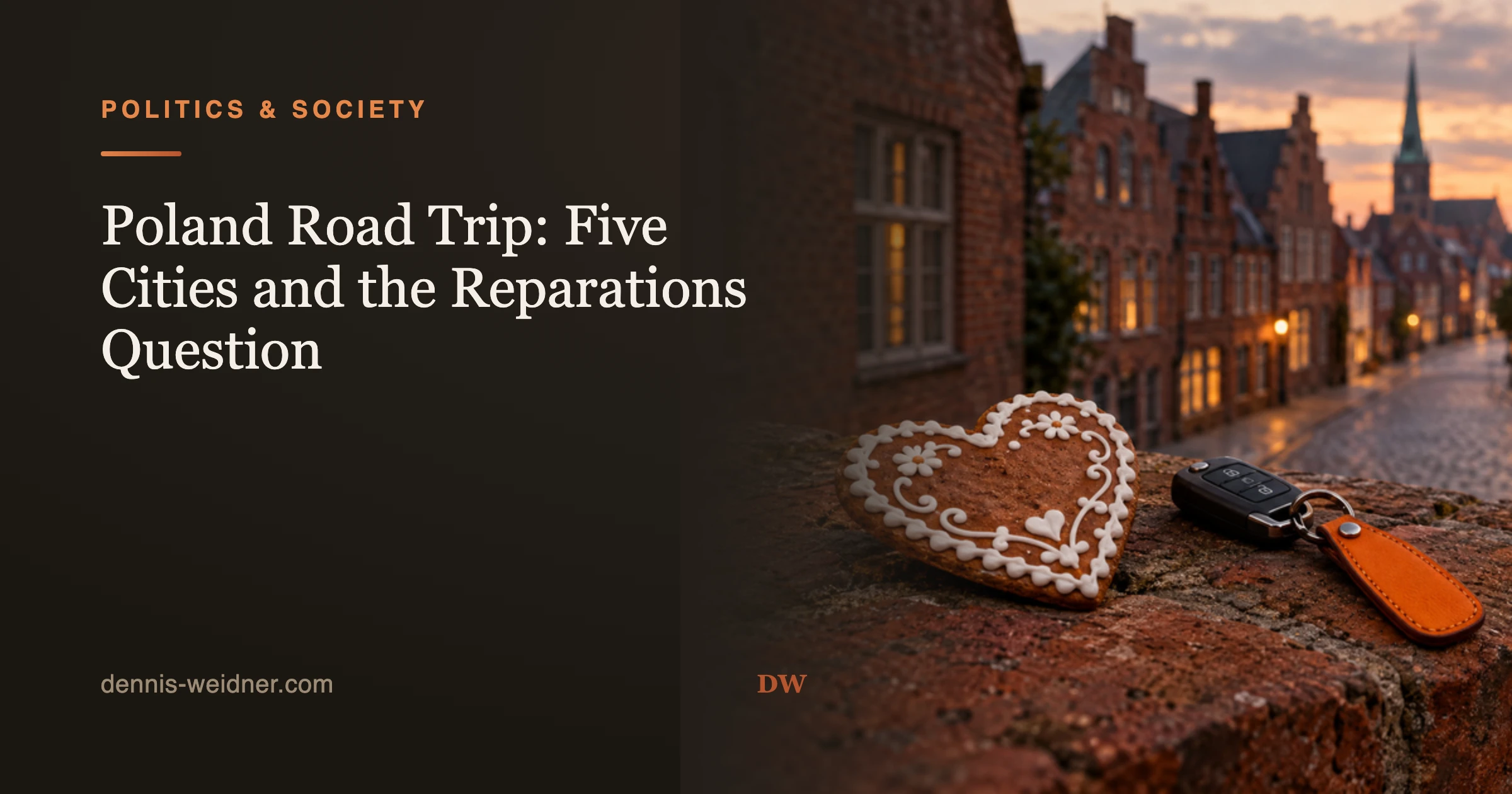
Eleven days, one car, five cities: what began as a birthday trip for my wife to the Polish Baltic coast turned into a road trip from Mielno via Gdańsk, Toruń and Bydgoszcz to Poznań, 569 kilometres between the stops. Poland surprised us with good roads, clean cities, warm service and prices well below German levels, and with how naturally families with a baby are catered for. Along the way, one question kept coming up, the one that keeps resurfacing in the news: why does Poland demand reparations from Germany? The short answer: since 2022, Poland has put the damage caused by the German occupation of 1939 to 1945 at 6.22 trillion złoty, about 1.3 trillion euros at the exchange rate of the time. The German government considers the matter closed, pointing to Poland's waiver of 1953 and the Two Plus Four Treaty of 1990. What remains open is a gesture for the up to 50,000 Polish victims who are still alive: Warsaw considers 10,000 złoty a year per person adequate, and Germany's draft 2027 federal budget sets nothing aside for it so far.
Political information as of 28 October 2026.
More on this topic: Politics & Society, with background, practice and every article in one place.
Poland Road Trip and Reparations: Key Facts at a Glance
- 569 kilometres: Mielno, Gdańsk, Toruń, Bydgoszcz and Poznań, just under seven hours of pure driving time.
- About a quarter: That is how much cheaper restaurants and hotels in Poland are than in Germany, according to Eurostat's price levels for 2025.
- 1473: Nicolaus Copernicus is born in Toruń, whose medieval old town has been a UNESCO World Heritage Site since 1997.
- 23 August 1953: Poland waives reparations from Germany, effective 1 January 1954.
- 12 September 1990: For Berlin, the Two Plus Four Treaty is the final word, but Poland was not a party to it.
- 6.22 trillion złoty: the war damage put forward in Poland's report of 1 September 2022.
- 10,000 złoty a year: what Warsaw considers adequate for each of the up to 50,000 surviving victims, with nothing decided yet.
Poland Road Trip by Car: Our Route Through Five Cities
The plan was just the Baltic coast. For my wife's birthday we drove to Mielno on Monday, 19 October, our first big trip with our baby. We liked it so much that we spontaneously kept going: along the coast to Gdańsk, then inland to Toruń, Bydgoszcz and Poznań, and on 29 October back home to Brandenburg. The longest leg came first: from Mielno to Gdańsk it is 214 kilometres. The shortest was between Toruń and Bydgoszcz, just 47 kilometres. Altogether that adds up to just under seven hours of pure driving time, spread over eleven days. The time in between belonged to the cities and to everything along the road.
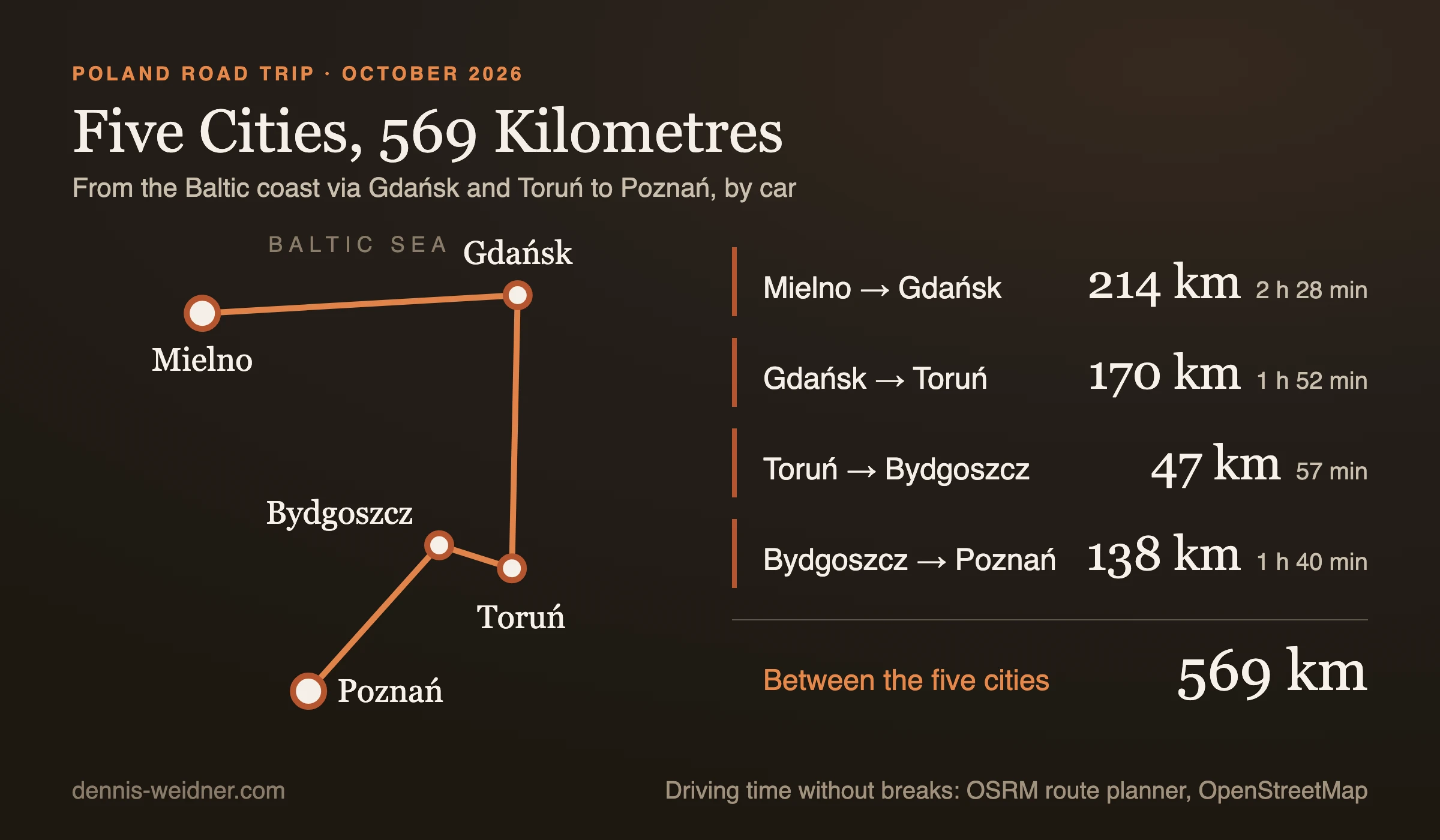
If you want to follow the route, here are the five stops at a glance, including the German names under which many of these places appear in old family histories and history books.
| City | German name | What it stands for | Don't miss |
|---|---|---|---|
| Mielno | Großmöllen | Baltic resort between the sea and Lake Jamno | Beach and sea air |
| Gdańsk | Danzig | Hanseatic city, outbreak of the Second World War, Solidarity | Long Market, Westerplatte, Museum of the Second World War |
| Toruń | Thorn | Hanseatic city, Copernicus, gingerbread, UNESCO World Heritage | Old town, city walls on the Vistula, Gingerbread Museum |
| Bydgoszcz | Bromberg | City on the River Brda, industrial history | Mill Island, Exploseum |
| Poznań | Posen | Old Market Square, Imperial Castle, uprising of 1956 | The goats on the town hall at noon |
Driving Through Poland: Roads, Tolls and Places to Stay
Poland's roads are in excellent condition. On our entire route, motorways and expressways were new or freshly renovated, well signposted and pleasant to drive. In Poland, drivers only pay tolls on three privately operated motorway sections; state-run motorways have been free for cars since July 2023. On our route that meant the A1 between Gdańsk and Toruń, 27.90 or 29.90 złoty depending on the exit at Toruń, according to the operator's toll calculator, and on the way home the A2 from Poznań to the border at Świecko, 59 złoty according to the Autostrada Wielkopolska price list. About 87 to 89 złoty in total, about 20 euros for the whole trip. The S6 and S5 expressways and national road 80 between Toruń and Bydgoszcz, which covered the rest of the route, are free. You can see where the money goes, and I would much rather pay for that than for potholes.
We booked from stop to stop, usually the evening before, on Booking.com or other travel apps, sometimes an apartment, sometimes a three-star hotel. We were never disappointed: clean, comfortable, perfect water, friendly staff. A baby cot was ready every time at no extra charge, and a late check-out was a matter of one minute everywhere. If you travel as spontaneously as we did, you do not need much lead time in Poland outside the high season.
Mielno: A Spa Town on Poland's Baltic Coast
Mielno sits on a narrow strip of land between the Baltic Sea and Lake Jamno, not far from Koszalin, once known as Köslin. The town lives from the sea and from its guests, many of whom spend weeks here for spa and rehabilitation stays. For us, Mielno was the place for the birthday and the start by the water. It was also where we decided not to drive home but to carry on to the big cities. Coming from Berlin or Hamburg, you quickly realise how close the Polish Baltic coast really is.
Gdańsk: Things to Do Between the Old Town, the Harbour and Westerplatte
Gdańsk was the harbour city of our trip, and it is beautiful. The Main Town with the Long Market, the narrow merchants' houses and the granaries along the Motława invites you to walk, and almost every facade tells a story. That much of it was rebuilt after 1945 is hard to tell from the streets today. Above it all stands St Mary's Church, by its own account the largest brick church in Europe.
Gdańsk is also where the Second World War began. Early on the morning of 1 September 1939, the German battleship Schleswig-Holstein opened fire on the Polish military depot on the Westerplatte peninsula. If you want to understand why the question of reparations runs so deep in Poland, the Museum of the Second World War in Gdańsk is a good place to start. Four decades later, the city made history again: in 1980, the Solidarity trade union grew out of the strike at the Gdańsk shipyard, as the European Solidarity Centre tells.
In the evenings it was pierogi. Restaurants that specialise in these filled dumplings are called pierogarnia in Poland, and there are several of them in Gdańsk's old town. Our tip: simply go where the locals are sitting. Gdańsk was the most expensive stop on our trip; as a tourist hotspot, prices in the old town are noticeably higher than in Toruń and Bydgoszcz. Still, it is not expensive by German standards, and every evening there was worth it.
Toruń (Thorn): Why This City in Poland Impressed Us Most
Toruń was our absolute hidden favourite; of all five cities, it impressed us the most. The old town is clean and well kept, the restaurants are good, and there is culture on almost every corner: churches you should not skip and lanes of colourful town houses where you can simply stroll for hours. Down by the Vistula, part of the medieval city wall still stands with its gates and towers. The medieval town has been a UNESCO World Heritage Site since 1997, and the tourism portal Visit Toruń gives a good overview.
This is where Nicolaus Copernicus was born on 19 February 1473, the astronomer who moved the sun to the centre of our picture of the universe. According to tradition, he was baptised in St John's Church, today's cathedral, where the Gothic font still stands. And Toruń is the city of gingerbread: pierniki have been baked here since the Middle Ages, and at the Living Gingerbread Museum (Żywe Muzeum Piernika) you can try your own hand at it. We also had pancakes in Toruń, and nobody gets past the gingerbread there anyway.
What we did not know beforehand: along a path in the old town you find the names of cities that Toruń has been linked with since the Middle Ages, Dortmund and Osnabrück among them. The link is the Hanseatic League. Toruń, founded by the Teutonic Order in 1231 and granted town rights in 1233, was a member of the great league of cities just like Gdańsk, connecting merchants from Bruges and London to Bergen and Novgorod. Coming across Dortmund in the middle of Poland shows how closely this region and Germany have been intertwined for centuries, for better and for worse.
Bydgoszcz and Poznań: Mill Island, Goats and Industrial History
In Bydgoszcz, called Bromberg in German, Mill Island lies in the middle of the city on the River Brda: water, old granaries, green spaces and museums in a small area. On the edge of town, the Exploseum of the Bydgoszcz District Museum tells a darker story. At the DAG Fabrik Bromberg explosives plant, prisoners of war, concentration camp inmates and forced labourers had to work during the Second World War, most of them Poles. This is exactly the generation people mean today when they talk about a humanitarian gesture.
Poznań brings the trip to a close. On the Old Market Square, two mechanical goats butt heads on the town hall tower every day at noon, the city's best-known symbol. A few streets away stands the Imperial Castle, built from 1905 to 1910 for Wilhelm II, when Poznań belonged to Prussia. And in June 1956, workers took to the streets here against the communist leadership; the Poznań uprising is part of the city's identity.
Poland With a Baby: Changing Rooms, Nursing Cabins and Play Corners in Every City
Travelling with a baby, you see a country through different eyes. What struck us most in Poland: parents and children are thought of everywhere. Every shopping centre we visited had large, clean and modern baby changing rooms, often with toys and separate cabins for breastfeeding. On top of that, there were play corners right in the middle of the mall where children can move around while their parents take a breather. This was not the one good exception, it was the same in every city, on the coast just as in Poznań.
In Germany we are more used to searching for the one changing table, and when you find it, it is not always a place where you would happily lay your child down. Germany has some catching up to do here, and I find that a shame. The difference is no accident, by the way: since 2018, Polish building regulations have required a separate room for breastfeeding and changing in new and converted buildings for catering, retail and services with more than 1,000 square metres of floor space. Germany has no comparable general requirement; in Berlin, people have been calling for one for years. Whether a country is family-friendly is decided in everyday life, not in speeches.
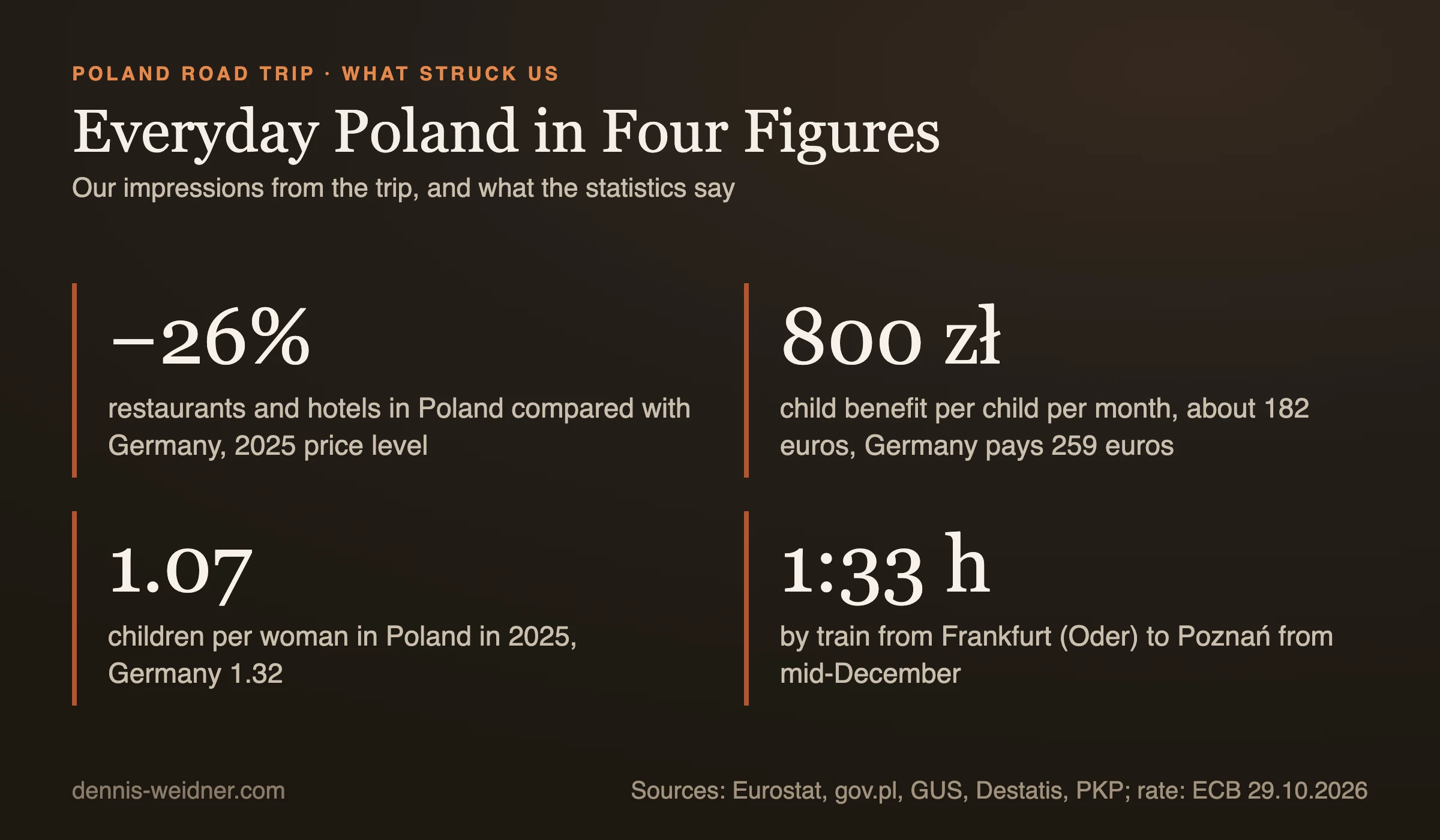
Does that explain why many couples in Germany decide against having a child, or a second one? It is not that simple. Since January 2024, Poland has paid 800 złoty a month for every child up to their 18th birthday, about 182 euros, with no income limit, as the Polish family ministry explains. Even so, women in Poland have only 1.07 children on average, according to the statistics office GUS for 2025, compared with 1.32 in Germany according to Destatis. Changing rooms do not make babies. But they show whether a country takes parents seriously in everyday life, and that is exactly what decides how exhausting the first years are. Once you have experienced how relaxed it is to push a pram through a Polish shopping centre, you understand why parents start to wonder after their first child whether they want to do it all again in Germany.
Eating Out in Poland: Warm Service, Much Lower Prices
We ate well everywhere, and we were served warmly everywhere. Menus are almost always available in English, sometimes in German, and in the old towns promoters stand outside the doors, introduce their restaurant and their food and invite you in. It does not feel pushy, it feels welcoming. In the evenings, too, we felt comfortable and safe in all five cities; the streets were clean and the townscape well kept, with lots of small shops and restaurants.
We found our favourite restaurant in Bydgoszcz on Mill Island: MONKA in the restored Rother Mills. The name is written in capital letters, and at first glance we read Wonka. As big Willy Wonka fans who took in everything Wonka back in Las Vegas, we were curious straight away. The place has nothing to do with chocolate, but a lot to do with a wood-fired oven, its own bakery and Italian-French cooking. The food was excellent, a clear recommendation. MONKA's original restaurant, by the way, is in Toruń.
Our impression after eleven days: in a really good restaurant in Poland you pay 30 to 40 percent less than in Germany. The statistics confirm the direction. According to Eurostat's price level indices for 2025, restaurants and hotels in Poland stand at 80.5, with the EU average at 100, and Germany at 108.4. That is about a quarter less, and across all consumption a good third less (71.1 against 109.1). In the really good places, the gap felt even bigger to us.
If you are thinking about not just holidaying in Poland but moving there, our sister site Gründerfreunde has the figures in German: average salary, housing costs and taxes in Poland and Germany compared, and everything on registration, the PESEL number and setting up a company in the guide Moving to Poland.
Poland Reparations: Why the Demand Keeps Coming Back
Poland demands reparations because it has never considered the damage of the German invasion and occupation of 1939 to 1945 settled. A report presented by a working group of the Polish parliament on 1 September 2022 puts it at 6.22 trillion złoty. On 3 October 2022, Warsaw demanded this sum from Berlin in a diplomatic note, about 1.3 trillion euros at the time, as Verfassungsblog explains. The German government declined to negotiate.
The issue has not gone away since. President Karol Nawrocki, in office since August 2025, raised the demand during his first official visit to Berlin in September 2025 and renewed it at Westerplatte on 1 September 2026. The money should go to the Polish armed forces and the arms industry, he said in his speech on the anniversary of the outbreak of the war. A Federal Foreign Office spokesperson replied the next day at the government press conference that the question was legally closed. I collect more perspectives like this from an entrepreneur's point of view under Politics and Society.
Poland's 1953 Waiver and the Two Plus Four Treaty: the Legal Position
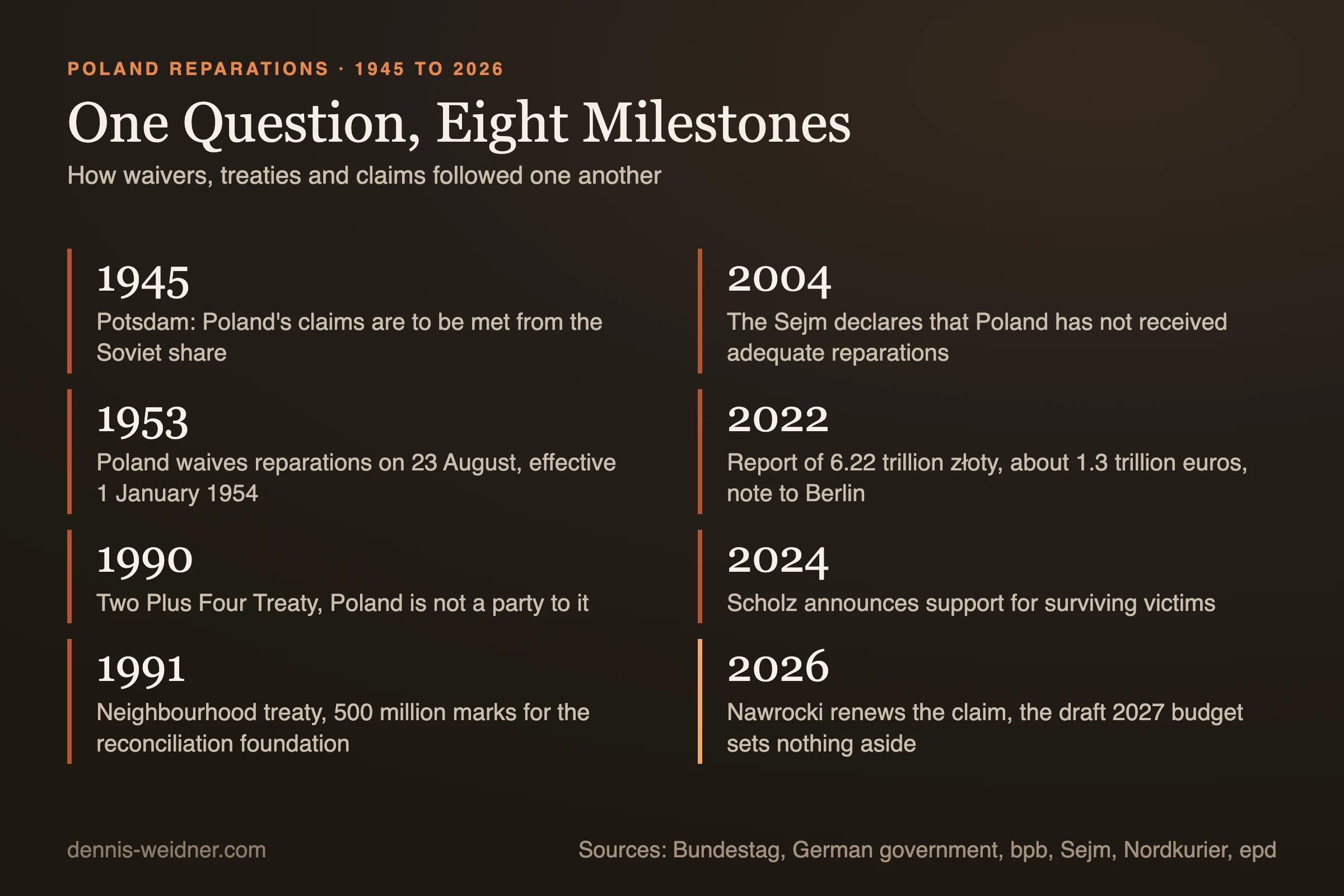
Legally, everything turns on two dates. On 23 August 1953, the Polish government declared that it waived reparations from Germany with effect from 1 January 1954, shortly after the Soviet Union had ended its extractions from East Germany. Under the Potsdam Agreement of 1945, Poland's claims were in any case to be met from the Soviet share. In 1970, Poland's deputy foreign minister confirmed the waiver during the negotiations on the Treaty of Warsaw. This is set out in the 2017 report by the Bundestag's research services.
The second date is 12 September 1990. In the German government's view, the Two Plus Four Treaty between the two German states and the four victorious powers settles all legal questions arising from the war once and for all. An important point: Poland did not waive its claims a second time in 1990. It was not a party to the treaty at all. What was secured that year was the border, in the treaty of 14 November 1990, followed in 1991 by the German-Polish Treaty of Good Neighbourship.
The German government sticks to its line. Its reply to the Bundestag of August 2024 states: "The reparations question is closed." Poland, it says, later confirmed the validity of the waiver several times. The other side counters with two arguments. First, the People's Republic of Poland was not a sovereign state under Soviet influence in 1953, so the waiver was void, as Völkerrechtsblog summarises the Polish position. Second, international law knows no treaty to the detriment of third parties, Article 34 of the Vienna Convention on the Law of Treaties. The victorious powers could waive their own claims in 1990, but not those of Poland, which took no part, Verfassungsblog argues.
My take: no court will rule on the trillions any time soon. Poland had not initiated any formal legal proceedings since the Two Plus Four Treaty, as the Bundestag's research services noted in 2017, and in 2022 Warsaw again chose a diplomatic note. The demand is above all a political signal. The more interesting question is the one that can actually be solved.
What Germany Has Paid Poland, and What Is Missing Today
There were no direct reparations payments from the Federal Republic to the Polish state. Under the Potsdam Agreement, Poland received reparations from the Soviet share until 1953, that is, from the Soviet occupation zone. In a final protocol of 4 July 1957, Poland recognised that the Soviet Union had fulfilled this obligation, as the Bundestag report notes. Today, Warsaw considers that compensation inadequate. On top of this came compensation payments: in 1975, the Federal Republic paid 1.3 billion Deutschmarks to Poland, and after reunification a further 500 million Deutschmarks followed, as the Federal Agency for Civic Education summarises on compensation for forced labour. They were distributed through the Foundation for Polish-German Reconciliation. From 2001, the Remembrance, Responsibility and Future Foundation made one-off payments of between 500 and 7,700 euros to former forced labourers.
| Year | What | Amount | For whom |
|---|---|---|---|
| 1975 | Lump-sum payment to Poland | 1.3 billion Deutschmarks | compensation during the Cold War, forced labour not included |
| 1991 | Foundation for Polish-German Reconciliation | 500 million Deutschmarks | victims of Nazi persecution in Poland, paid out from 1992 to 2005 |
| 2001 to 2007 | Remembrance, Responsibility and Future Foundation | one-off 500 to 7,700 euros per person | former forced labourers, including from Poland |
| ongoing | Federal Compensation Act | personal compensation | people persecuted on grounds of race, faith or belief, including in Poland |
| 2022 | Poland's demand | 6.22 trillion złoty, about 1.3 trillion euros | the Polish state |
| 2024 | Offer for a humanitarian gesture | 200 million euros, rejected by Poland as too little | surviving victims |
| 2026 | Proposal from Warsaw | 10,000 złoty a year per person, about 2,333 euros | up to 50,000 survivors |
The last row is the one that matters right now. At the exchange rate used by Süddeutsche Zeitung, that would be just under 195 euros a month per person; some German media put it at around 170 euros. Nothing is being paid yet: it is a proposal from Warsaw on which Berlin has not decided.
A Humanitarian Gesture for the Survivors: Where Things Stand in Autumn 2026
On 2 July 2024 in Warsaw, Olaf Scholz announced that Germany would support the surviving victims of the occupation, without an amount and without details, as Notes from Poland reported on the government consultations. According to a report by Süddeutsche Zeitung from June 2026, as relayed by the dts news agency, Donald Tusk rejected an offer of 200 million euros as too little. Today, Warsaw considers 10,000 złoty a year for each surviving victim acceptable. The newspaper estimates the cost at around 100 million euros in the first year and about 300 million euros in total.
Time is running out. When Scholz made his promise, around 60,000 victims were still alive according to Tusk, citing the Foundation for Polish-German Reconciliation; by the end of 2025 it was around 50,000. Today the number is likely lower. "Hurry up if you really want to make this gesture," Tusk said on 1 December 2025 after the government consultations in Berlin. Friedrich Merz named no sum there. Germany's draft 2027 federal budget sets no money aside so far, and the Federal Foreign Office points to the lack of a political decision, Nordkurier reported on 2 October 2026. On 27 October 2026, the Federal Association of German-Polish Societies called on Merz, Klingbeil and Wadephul in an open letter to provide the funds during the rest of the budget process.

My view as a neighbour and entrepreneur: there will be no agreement on trillions, but there can be one on a gesture for up to 50,000 very old people. The German government sees itself as obliged to seek support for the surviving victims, as its 2024 reply to the Bundestag states. Every month without a decision is a decision, because according to estimates around a thousand of those affected die every month. Anyone who takes history seriously should not spend longer doing the maths than necessary.
Working on the Poland Road Trip: Agents, a Laptop and Pokémon Cards
The laptop came along, and it did not get in the way. While we were driving through Poland, our AI agents kept working: looking after projects, checking websites, preparing texts. I made decisions, gave approvals and adjusted course on the side, and the rest of the day belonged to us and the cities. I even recorded the notes for this article on the road.
For me, that is the real freedom agents bring: not necessarily less work, but work that is not tied to a desk. The precondition is that the processes are set up properly beforehand and every agent knows what it is responsible for. I have described in detail how I go about building multiple companies at once, and the tools that help are in my AI stack. How this journey began is told in From a Budget PC to AI Agents.
There was one appointment on the list all the same, and a nice one: for SLABHIT, our marketplace for live auctions of trading cards, we were looking for Pokémon stock. Among other places, we struck lucky at Smyk, by its own account Poland's largest chain for children's products and toys, with more than 260 stores, where Pokémon cards were also available in English. Along the way we also found some really good card shops and talked to their owners. That turned into a small network through which we want to source stock from Poland in future. How SLABHIT came about is described in the post on the launch of SLABHIT with live shows.
Our Next Trip to Poland: by Train to Poznań and Warsaw
The next trip is already planned. Around Christmas we are going back to Poland, this time without the car, by train from Frankfurt (Oder). From there, eight direct trains run to Poznań on weekdays, taking one hour and 41 minutes, and from the timetable change in mid-December just one hour and 33 minutes. To Warsaw there are seven direct Berlin-Warsaw Express connections on weekdays and a good four hours on the train, four hours and twelve minutes from December according to the PKP timetable. Deutsche Bahn sells trips to Poland with the Super Sparpreis Europa from 18.99 euros, with Berlin to Poznań from 19.99 euros. There is hardly a more comfortable way to start a city break.
After that, we are drawn to the triangle of Warsaw, Łódź and Kraków, three cities we do not know yet. And at some point we will head south to the Czech border, into the mountains. In the Giant Mountains, the Polish side has Szklarska Poręba with its ski arena on Szrenica and Karpacz at the foot of Śnieżka, two winter sports resorts right on the border. Poland in the snow is what we are still missing.
Our Verdict on the Poland Road Trip: a Neighbouring Country Worth the Drive
Five cities that could hardly be more different: Mielno as a quiet place by the sea, Gdańsk as a proud harbour city full of history, Toruń as a medieval gem, Bydgoszcz with its Mill Island and Poznań with its Old Market Square. Add plenty of Polish culture along the road and good food, from pierogi to gingerbread. And a country that won us over in everyday life: good roads, clean cities, warm service, fair prices and a natural place for families with children.
Just take a car, visit a few cities, book on the spot and learn about your neighbour's history along the way: I can recommend it to anyone. If you know what happened at Westerplatte and who had to work in the factory in Bydgoszcz, you read the news about reparations with different eyes. And if you then come across the name Dortmund in Toruń, you understand how close we really are.
Frequently Asked Questions
Has Germany paid reparations to Poland?
Not directly from the Federal Republic to the Polish state. Under the Potsdam Agreement, Poland received reparations from the Soviet share until 1953 and recognised their fulfilment in 1957; in 1953 it waived further claims. There was compensation, however: 1.3 billion Deutschmarks in 1975, 500 million Deutschmarks after reunification through the Foundation for Polish-German Reconciliation, payments to former forced labourers from 2001 to 2007, and benefits under the Federal Compensation Act.
Why does Poland demand reparations from Germany?
Poland considers the damage of the German invasion and occupation of 1939 to 1945 never to have been settled. A report of 1 September 2022 puts it at 6.22 trillion złoty, about 1.3 trillion euros. President Karol Nawrocki most recently renewed the demand at Westerplatte on 1 September 2026.
Did Poland waive reparations in 1953?
Yes. The Polish government declared the waiver on 23 August 1953 with effect from 1 January 1954 and confirmed it in 1970. The German government considers it binding and regards the matter as finally settled by the Two Plus Four Treaty of 1990. Critics in Poland argue the waiver was made under Soviet pressure, and Poland was not a party to the 1990 treaty.
Do Polish victims of the Nazis receive money from Germany today?
Anyone persecuted on grounds of race, faith or belief receives benefits under the Federal Compensation Act, including in Poland. For most other Polish victims there is no ongoing benefit. An additional humanitarian gesture for the up to 50,000 surviving victims has been under discussion since 2024, with Poland considering 10,000 złoty a year per person adequate. It has not been agreed, and Germany's draft 2027 federal budget sets nothing aside for it so far.
How much time do you need for a road trip through Poland?
Our route via Mielno, Gdańsk, Toruń, Bydgoszcz and Poznań covers 569 kilometres and just under seven hours of pure driving time between the cities. With time to arrive and explore, ten days to two weeks is a good measure; we were on the road for eleven days. Tolls apply only on certain motorway sections, the expressways are free.
Is Poland family-friendly when travelling with a baby?
In our experience, very. Every shopping centre we visited had large, clean baby changing rooms, often with nursing cabins and play corners. Baby cots were available in all our accommodation at no extra charge, and a late check-out was possible everywhere. There is a rule behind it, too: since 2018, Polish building regulations have required a separate room for breastfeeding and changing in new and converted larger restaurants, shops and service buildings. On top of that, Poland pays 800 złoty child benefit a month for every child up to 18.
How much cheaper is eating out in Poland than in Germany?
According to Eurostat, restaurants and hotels in Poland were about a quarter below the German price level in 2025, and consumption overall a good third. In good restaurants, we paid 30 to 40 percent less than in Germany by our impression. In tourist centres such as Gdańsk's old town, prices are noticeably higher than in Toruń and Bydgoszcz.
Note: The political information reflects the situation on 28 October 2026. If the Bundestag decides on the humanitarian gesture in the 2027 budget, I will add it here.
Best,
Dennis Weidner
Note: AI tools supported me in writing this article, and some images were edited with AI. I stand behind its content and every statement with my name.